
New Releases: The March Of Folly by Barbara W. Tuchman

New Releases

Blackstone AudiobooksThe other day I was at the library, looking for trade paperback comics, and I spotted A Thousand Ships, the complete first volume in Age Of Bronze series.

EXCITEMENT AT THE LIBRARY!

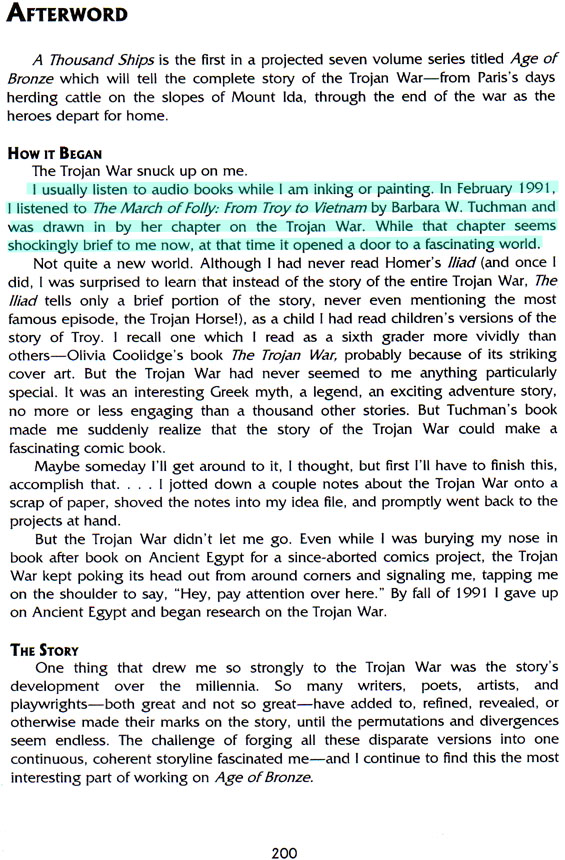
I knew I’d enjoy the TPB of A Thousand Ships because I had purchased the first issue of the comic earlier this summer, and had quite liked what I had seen. Then, in reading the subsequent 8 issues edition, I spotted this, the first page of Eric Shanower‘s fascinating 7 page afterword:

A Thousand Ships - Afterword

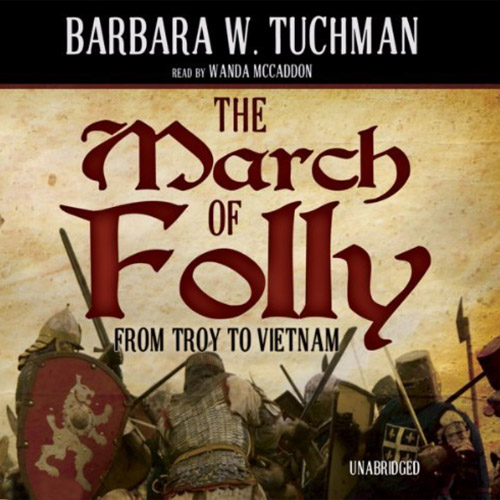
Cool hey? I looked into it and while it seems the edition Shanower was referring to is out of print (likely the Books On Tape edition as read by Grover Gardner in 1984) it seems that a year ago this week Blackstone Audio released their edition of The March Of Folly: From Troy To Vietnam

BLACKSTONE AUDIO - The March Of Folly: From Troy To Vietnam by Barbara W. TuchmanThe March Of Folly: From Troy To Vietnam
By Barbara W. Tuchman; Read by Wanda McCaddon
15 CDs or 2 MP3-CDs – Approx. 17.9 Hours [UNABRIDGED]
Publisher: Blackstone Audio
Published: September 2009
ISBN: 9781433295072 (cd), 9781433295102 (mp3-cd)
In The March Of Folly, two-time Pulitzer Prize winning historian Barbara Tuchman tackles the pervasive presence of folly in governments through the ages. Defining folly as the pursuit by governments of policies contrary to their own interests, despite the availability of feasible alternatives, Tuchman details four decisive turning points in history that illustrate the very heights of folly in government: the Trojan War, the breakup of the Holy See provoked by the Renaissance popes, the loss of the American colonies by Britain’s George III, and the United States’ persistent folly in Vietnam. The March of Folly brings the people, places, and events of history magnificently alive for today’s reader.

Posted by Jesse Willis

LibriVox: The Iron Heel by Jack London

SFFaudio Online Audio

LibriVoxThe Iron Heel, one of the books from our 4th Annual SFFaudio Challenge. It is now complete and available free from LibriVox! Narrator Matt Soar sez:

I have just this afternoon finally finished the last chapter of Jack London’s The Iron Heel. Phew! It’s been quite an experience – begun in Montreal, completed in France, six months in the making.

He actually wrote that two months ago. See, Matt decided to make a planned creative commons release release PUBLIC DOMAIN! Woohoo! It’s on LibriVox and it has now been catalogued!

And, over in the “about” section of Matt’s site, TheIronHeel.net Matt wrote:

The entire expe­ri­ence has been intrigu­ing, if not uncanny: The story, about an over­bear­ing, immoral gov­ern­ment char­ac­ter­ized by decep­tion, tor­ture, and war­mon­ger­ing, against a back­ground of civil­ian exploita­tion and reli­gious zealotry, is mainly remark­able for the fact that it was writ­ten a hun­dred years ago — rather than, say, five.

Per­haps the only aspects of The Iron Heel that really age it are its breath­lessly roman­tic hero­ine, occa­sion­ally pro­saic lan­guage, and the author’s fleet­ing use of dubi­ous terms to describe eth­nic minori­ties. These quib­bles aside, I’m really glad I took the time to record it, and hope you enjoy it too.

LIBRIVOX - The Iron Heel by Jack LondonThe Iron Heel
By Jack London; Read by Matt Soar
26 Zipped MP3 Files or Podcast – Approx. 8 Hours 18 Minutes [UNABRIDGED]
Publisher: LibriVox / TheIronHeel.net
Published: July 16, 2010
Generally considered to be the earliest of the modern dystopian novels, The Iron Heel chronicles the rise of an oligarchic tyranny in the United States. It is arguably the novel in which Jack London’s socialist views are most explicitly on display. A forerunner of “soft science fiction” novels and stories of the 1960s and 1970s, the book stresses future changes in society and politics while paying much less attention to technological changes.

Podcast feed: http://librivox.org/rss/4342

iTunes 1-Click |SUBSCRIBE|

[Thanks a ton Matt!]

Posted by Jesse Willis

Review of Armor by John Steakley

SFFaudio Review

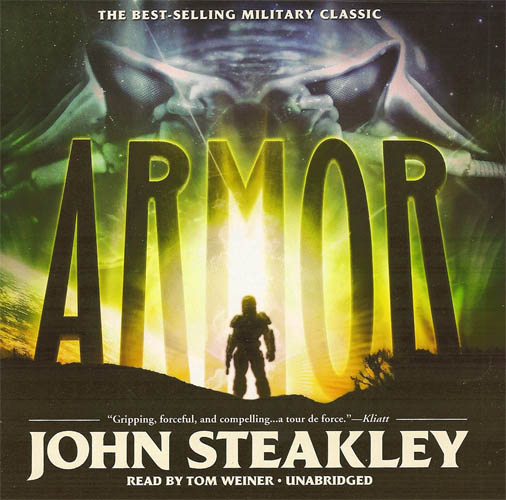
Science Fiction - Armor by John SteakleySFFaudio EssentialArmor
By John Steakley; Read by Tom Weiner
11 CDs – Approx. 13.5 Hours [UNABRIDGED]
Publisher: Blackstone Audio
Published: 2009
ISBN: 1433294834
Themes: / Science Fiction / Military SF / War / Leadership / Drugs / Psychology /

The planet is called Banshee. The air is unbreathable, the water poisonous. It is the home of the most implacable enemies that humanity, in all its interstellar expansion, has ever encountered. Felix is a scout in A-team Two. Highly competent, he is the sole survivor of mission after mission. Yet he is a man consumed by fear and hatred. And he is protected not only by his custom-fitted body armor, the culmination of ten thousand years of the armorers’ craft, but also by an odd being which seems to live with him, a cold killing machine he calls “the Engine.” This best-selling science-fiction classic is a story of the horror, the courage, and the aftermath of combat and also of how strength of spirit can be the greatest armor of all.

Armor is a novel that was clearly inspired by Robert A. Heinlein’s Starship Troopers. It makes use of both powered exoskeletons and insect-like alien enemies. But, instead of being a novel of politics and leadership it is a very different kind of story. At first I thought it was about the psychological effects of violence and the various kinds of heroism that can exist within a person. I was wrong because that isn’t enough. This novel is not one or two things. It isn’t the normal kind of idea driven SF that I so love – instead its ideas flow more through the emotions, eliciting our sympathies. I think this was acomplished by it changing, turning over and over, with it’s many plot surprises.

Early on Felix, our viewpoint character, refers to something he calls an “engine.” I thought he was describing the powered armor of the title. That would make sense, there was a video game called Heavy Gear that, like than Mechwarrior, had men and women doing battle in humanoid shaped tanks. I think it refereed to its “mechs” as “engines.” Felix seems pretty much like any of the other soldiers he’s been dropped with on planet Banshee. Maybe he’s a bit more of a hick – he doesn’t know the names of the winners at the Powered Olympics. Felix makes no waves, volunteers for nothing. He just wants to survive the battle to come. But when the waves of enemy aliens pour out of their holes only Felix survives – and keeps on surviving.

Armor has taut battle scenes, flowing exposition, and realistic dialogue. Had John Steakley written more, and his other novel Vampire$ |READ OUR REVIEW|, I think he’d be a very well known author.

The first third (or so) of the novel follows Felix, a low ranking scout in the invasion of the planet Banshee. Here the action somewhat resembles that of Starship Troopers. Then there is an abrupt switch – the novel seems to lurch into an an entirely different scene and setting. Set a few years later and following in first person perspective this time we meet a man named Jack Crow. Crow is a notorious galactic scoundrel. A well known thief, pirate, and adventurer – his legend is long and precedes him even to an obscure research station on a planet called Sanction. Crow is there to infiltrate, but eventually finds himself involved in an experiment – one that drains him of his half-hearted bravado and changes his life. If were talking about where this novel fits in the SF library I’ll say this: Armor synthesizes the action of Heinlein’s Troopers with the emotional impact of Haldeman’s The Forever War – but still comes off as a completely unique story.

Tom Weiner, who seems to be narrating almost every Blackstone Audio audiobook that I’m listening to these days, delivers his usual letter perfect narration. Weiner animates Felix with a weary melancholy of a veteran scout, brightens audibly with the cocksure Crow, pulls a vocal Tom Bombadil with Louis, feminizes for Lya, and geeks it all up for Holly (a star-struck scientist). That’s pretty impressive. Check this audiobook out!

Posted by Jesse Willis

Aural Noir Review of Gentlemen Of The Road by Michael Chabon

Aural Noir: Review

RANDOM HOUSE AUDIO - Gentleman Of The Road by Michael ChabonGentlemen Of The Road: A Tale Of Adventure
By Michael Chabon; Read by Andre Braugher
Audible Download – Approx. 4 Hours 13 Minutes [UNABRIDGED]
Publisher: Random House Audio
Published: October 2007
Provider: Audible.com
Themes: / Adventure / Crime / Jewishness / War / Politics / Mercenaries / Con-men / Khazaria /

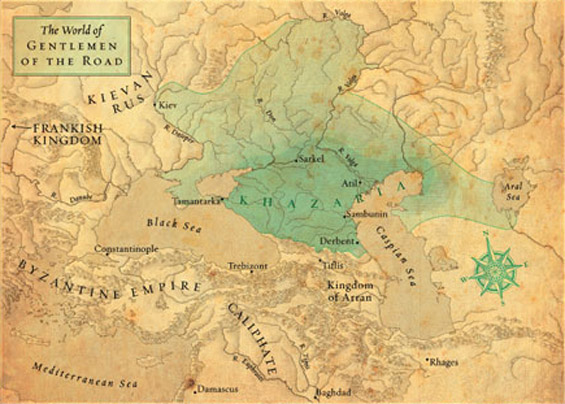
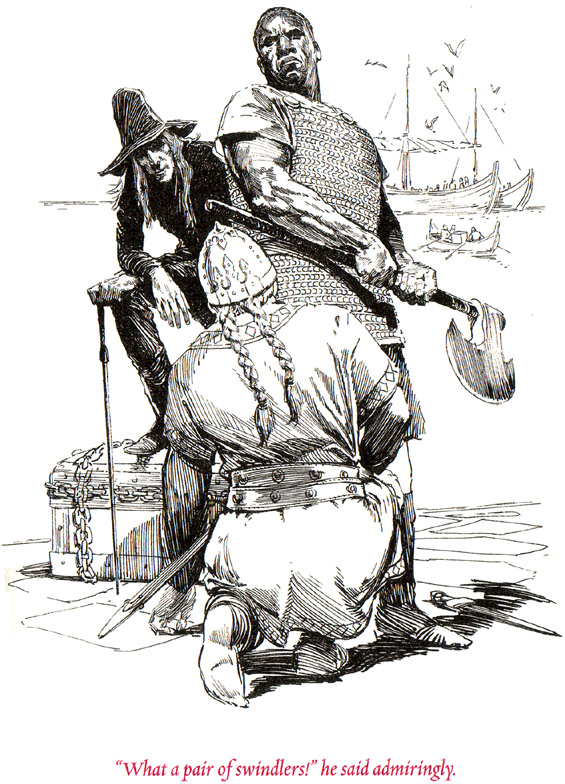
Gentlemen Of The Road was first published as a serial in The New York Times Magazine. Despite it’s sword and sorcery feel, it is not actually a Fantasy novel, but is instead a “swashbuckling adventure” set in an obscure, but real, historical setting. Its heroes, Amram and Zelikman, are an odd, but vaguely familiar, pair. Familiar in their companionable rivalry and clearly inspired by Fritz Leiber’s famed pair of characters: Fafhrd and Grey Mouser. But, instead of one being a short, urban thief and the other a hulking Northern barbarian, the two are instead the titular gentlemen of the road, wandering Jews, or as Chabon himself states in the audiobook’s afterword “Jews With Swords.” And that’s what was really important in this story; though each of these two Jews looks entirely unalike from the other, they are tied together by far flung tradition, common heritage and similar tales of woe. The larger of the pair is Amram, a swarthy Abyssinian with a penchant for shatranj and quite literally an axe to grind. The slighter and paler of the pair is Zelikman, a fair haired Frank, who far from being a member of the thieves guild is actually a doctor (he wields an “over-sized bloodletting lance as a rapier”). Together they are a neat pair of dark age sell-swords/con-men, working the taverns and inns of southern Eurasia. It is, all in all, one of the neatest set-ups for a book I’ve ever heard. And you couldn’t find a funner fictional premise for illustrating the Jewish diaspora in an adventure novel.

One evening (circa AD 950), a chance encounter at a roadside inn in the kingdom of Aran leads to a body-guard job. The job involves a journey to the neighboring khaganate of Khazaria. Along the way they meet many a fellow road traveler and have some less than polite encounters. Eventually, Amram and Zelikman (A & Z) find themselves fully entangled in a rebellion and plot aimed at restoring a displaced Khazar prince to the throne.

Narrator Andre Braugher is a television actor that I’ve admired since his portrayal of the unwaveringly professional detective Frank Pembelton on Homicide: Life on The Street. Braugher has a powerful voice that he uses to deliver Chabon’s ornately constructed descriptive scenes and dialogue. You can tell, with every sentence of Braugher’s delivery, that Chabon loves language. I thoroughly enjoyed the book after I got into it. But it wasn’t easy, I really had to shift gears. This is embellished storytelling, it feels both old-fashioned and unrepentantly ostentatious. It has very little of the usual fantasy stylings, it dumps any ordinary flat or prosaic description in favour of the deliberately lavish. Once I did get into it, I loved it. There’s a lot of detail to enjoy here. Chabon’s hulking Abyssinan, for instance, has a battle-axe. He gained it after combat with the Varangian Guard in Byzantium. A runic inscription on it roughly translates into “defiler of your mother.” Another writer would have done it another way – another writer wouldn’t have done it at all. This is what makes Chabon, his books and this novella in particular so special.

Sadly, the audiobook lacks the map and the 15 terrific black and white illustrations (by Gary Gianni ) found in the paperbook. Here is a peek at both:

Gentlemen Of The Road - MAP

Gentlemen Of The Road - PAGE 161

Posted by Jesse Willis

The SFFaudio Podcast #059

Podcast

The SFFaudio PodcastThe SFFaudio Podcast #059 – Jesse and Scott talk with Science Fiction author David J. Williams about his recently completed Autumn Rain trilogy.

Talked about on today’s show:
Mirrored Heavens (book 1 in the Autumn Rain trilogy), The Burning Skies (book 2 in the Autumn Rain trilogy), The Machinery Of Light (book 3 in the Autumn Rain trilogy), writing in the present tense, memory, espionage, using past tense is “privileging the narrative”, cold war, cyberspace, cyberpunk, space as the ultimate high ground, militarizing space, satellites, “rods from god“, the straylight run scene from William Gibson’s Neuromancer, war, Future Of War by David J. Williams |PDF|, WarGames (1983), The Moon Is A Harsh Mistress by Robert A. Heinlein, lagrange points, space elevators, skyhooks, space stations, The Fountains Of Paradise by Arthur C. Clarke, terrorism, Philip K. Dick, the Vietnam War vs. the Korean War, Kahlil Gibran, China, 2008 South Ossetia War, Clarion Workshops, Richard K. Morgan, all good series should end.

Posted by Jesse Willis

LibriVox: The Variable Man by Philip K. Dick

SFFaudio Online Audio

LibriVoxThere’s a new FREE audiobook version of Philip K. Dick’s 1953 novella The Variable Man available from LibriVox and superstar narrator Gregg Margarite!

Here’s the teaser:

“He fixed things—clocks, refrigerators, vidsenders and destinies. But he had no business in the future, where the calculators could not handle him. He was Earth’s only hope—and its sure failure!”

Here are four different covers from various paperbook incarnations of this time travel tale…

The Variable Man by Philip K. Dick - Covers

And here’s the audiobook…

LIBRIVOX - The Variable Man by Philip K. DickThe Variable Man
By Philip K. Dick; Read by Gregg Margarite
3 Zipped MP3 Files or Podcast – Approx. 2 Hours 49 Minutes [UNABRIDGED]
Publisher: LibriVox.org
Published: May 3, 2010
Predictability has come a long way. The computers of the future can tell you if you’re going to win a war before you fire a shot. Unfortunately they’re predicting perpetual standoff between the Terran and Centaurian Empires. What they need is something unpredictable, what they get is Thomas Cole, a man from the past accidentally dragged forward in time. Will he fit their calculations, or is he the random variable that can break the stalemate? From Space Science Fiction September 1953.

Part 1 |MP3| Part 2 |MP3| Part 3 |MP3|

Podcast feed:
http://librivox.org/rss/4275

iTunes 1-Click |SUBSCRIBE|

[Thanks also to Betty M. and Diana Majlinger]

Posted by Jesse Willis