
Review of By Heresies Distressed by David Weber

SFFaudio Review

Science Fiction Audiobooks - By Heresies Distressed by David WeberBy Heresies Distressed
By David Weber; Read by Jason Culp
Approx. 25 Hours [UNABRIDGED]
Publisher: Macmillan Audio
Published: 2009
ISBN: 9781427206794 (CD)
Themes: / Science Fiction / Empires / Religion / War /

The Empire of Charis has been founded out of the marriage between King Cayleb of Charis and Queen Sharleyan of Chisholm, and further expanded by the annexation of Charis’ enemy Emerald. Now Cayleb and Merlin go on the offensive. Sharleyan stays behind to construct the new government out of the former Kingdoms, while Cayleb leads their Navy and tens of thousands of Charisian Marines against the League of Corisande and Prince Hektor. Hektor was the willing puppet of the Church of God Awaiting when he led an armada from several of Safehold’s nations against Charis. That armada was defeated with the aid of the technologies introduced by Merlin, but not before Cayleb’s father, King Haarahld, was killed.

Retribution is also dealt against the Kingdom of Delferahk, greatly offending the Church in the process when the priests responsible for the massacre are called to account. Merlin’s SNARCs, autonomous flying, invisible spy cameras, continue to provide a massive tactical advantage and help to solidify Cayleb’s reputation as a master tactician especially as the battle moves onto land. Some of the advances hinted at in the previous books are seen in action and their effects, amounting to almost two centuries of advancement in our history, are somewhat predictable. Unfortunately, the SNARCs can’t be everywhere, and Merlin and his A.I., Owl, can’t review everything that they record. The Church loyalists manage to slip past Merlin’s security, and target Empress Sharleyan in an attempt to break the new Empire.

Being the third book in the series, Weber brings the anticipated final conflict with Mother Church several steps closer. There is less focus on the new technologies being introduced in this book than in those that proceed it. The tactics and politics assume much more the focus. The land battles are clearly drawn, and the narrator, Jason Culp, keeps the back and forth between the combatants clear.

There are a noticeable number of lengthy monologues, in some cases in the middle of what was a normal conversation. They could have been more concise, however Jason delivers them well. He brings all of the many characters to life with ease, from the lowest soldier in the middle of a battle to the nobility and the priesthood.

Merlin is a magical character to the inhabitants of Safehold, but of Arthur C. Clarke’s variety: sufficiently advanced technology. Although that technology plays an important part in the events, it doesn’t really intrude. Merlin’s visions are provided by his SNARCs and the explanation of, what amounts to a mobile phone, in one scene is as intrusive as it gets. Weber’s Safehold series should appeal to fans of alternate history as well as fantasy and Science Fiction.

Posted by Paul [W] Campbell

Maria Lectrix: Tanks by Murray Leinster

SFFaudio Online Audio

Over at the Maria Lectrix blog and podcast Maureen’s posted all three parts of her reading of Murray Leinster’s Tanks. This is a Military Science Fiction story from the January 1930 issue of Astounding Stories of Super-Science (the very first issue). Sez Maureen:

“I liked this story. It has the Leinster sense that ordinary people with their ordinary habits and ordinary weaknesses, are still strong and capable of doing big things, and what is important often goes unnoticed by the eye. This is more or less the opposite of the nastier side of sf/f’s tendency to tell stories of wish fulfillment, where one Supuh Speshul Geenyus saves all those declasse morons who laughed at him in school. Spinrad’s The Iron Dream is not particularly kindly, but he’s right that if you take elitist Speshulness too far, it’s where totalitarianism comes from.

Astounding Stories Of Super Science January 1930Tanks
By Murray Leinster; Read by Maureen O’Brien
3 MP3 Files – Approx. 77 Minutes [UNABRIDGED]
Podcaster: Maria Lectrix
Podcast: August 2009
In an eerie future that never was, but might have been, two ordinary soldiers hold the fate of a war in their nicotine-stained hands.
Part 1 |MP3| Part 2 |MP3| Part 3 |MP3|

[Tanks so much Maureen!]

Posted by Jesse Willis

Review of On Basilisk Station by David Weber

SFFaudio Review

Ed. – Welcome to Paul [W] Campbell, prestidigitator with Cossmass Productions. This is his first review for SFFaudio.

Science Fiction Audiobook - On Basilisk Station by David WeberOn Basilisk Station (Book One in the Honor Harrington Series)
By David Weber; Read by Allyson Johnson
15 Hours, 15 Minutes – [UNABRIDGED]
Publisher: Brilliance Audio
Published: 2009
ISBN: 9781423393382 (CD)
Themes: / Science Fiction / Military SF / War / Space Opera / Politics /

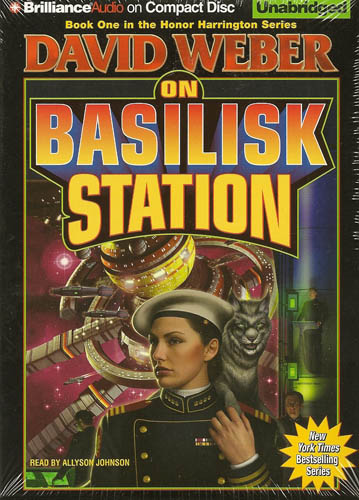
On Basilisk Station is the first of Weber’s Honor Harrington series. A great space opera that quickly builds up to a full out war between the Star Kingdom of Manticoran and her allies against the aggressive and expansionist Republic of Haven. So far there are eleven main novels in the series in print, plus over a half-dozen anthologies and spin-offs.

Mankind has spread out into the stars using a form of Hyperspace which offers the ability of sail along dangerous gravity waves at hundreds, even thousands, of times the speed of light. Some star systems are linked by wormhole termini that offer instantaneous travel between their end points. The benefit to interstellar trade and to fleet maneuvers that this offers is significant. Thus, Basilisk Station is the Royal Manticoran Navy’s picket at one such wormhole. In fact it is a collection of several wormholes that turn the star system of Basilisk into a major hub for commerce. Unfortunately the Republic of Haven’s economy is straining and they are looking at the worlds on the
far side of Basilisk as candidates to bolster their economy. Of course, having Basilisk Station under their control would make their annexation efforts and resultant ‘trade’ much simpler.

Commander Honor Harrington finds her aged and understrength ship being responsible for the entire picket On Basilisk Station. Her crew blame her for their posting to this punishment detail. Honor has been set up to fail. The Havenites are plotting to invade, the aboriginals on the planet below are taking homicide inducing drugs and her Executive Officer hates her.

As an opening volume in a series of this size, On Basilisk Station sets the initial pieces on the board for the following books and the war that develops. However, it doesn’t feel like that is what it is doing. The story is self contained and complete, as are all of the books in the series. Later books do benefit from reading the preceding ones, but it isn’t required. But, I’m not reviewing the series here. It can be a little heavy on the info-dumps at times, such as the history of the Founding of the Manticoran Nobility, Gravity Sails and a few others. Allyson Johnson gets through them well enough, but in audio they do interrupt the flow of the story. Otherwise she brings all the characters to life very well and covers quite a range, from Honor’s soprano all the way down to some gruff old sailors indeed.

Actually hearing Honor’s dialog in a soprano was quite jarring at first as I had read the books before and hadn’t properly assimilated that aspect of her character. Allyson stays truer to the characters and their voices than I had when reading myself. A good performance overall.

There was some slight confusion at times during the climactic battle as the point of view jumped from ship to ship. In print there would be a clear break in the text, but here the scenes flow together perhaps a little too quickly. They do resolves with a few seconds that there has been a scene change, but it still threw me a couple of times.

If you like your space opera with a well thought out political backdrop and with space battles that take into account the danger aboard ship and the scale of space, then On Basilisk Station should keep you happy.

Posted by Paul [W] Campbell

Review of Anne Manx and the Empress Blair Project

SFFaudio Review

Science Fiction Audio Drama - Anne Manx and the Empress Blair Project - RRCAAnne Manx and the Empress Blair Project
Starring Claudia Christian, Ellen Muth, and Robin Atkin Downes
2 CDs – 2 Hours [AUDIO DRAMA]
Publisher: RRCA (Radio Repertory Company of America)
Published: 2009
ISBN: 0977134210
Themes: / Science Fiction / Humor / Private Eye / Government / War /

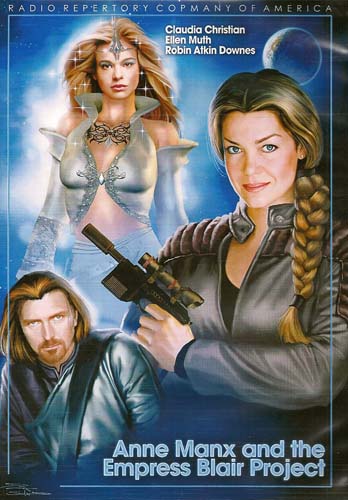
Before she meets the Empress Blair, Anne Manx (Claudia Christian) wants nothing more than to spend her quiet vacation getting a tan. Empress Blair (Ellen Muth), though, has a compelling problem. Her father has been killed, and she fears she’s next. If Anne Manx can keep the Empress alive for a mere two months, she’ll reach her eighteenth birthday and take over for her father. Complicating things is Mr. Logan (Robin Atkin Downes), who shows up just in time – but whose side is he on? Nothing is ever easy for Anne Manx, and she’s rapidly running out of lives.
|MP3 SAMPLE|

This is the fifth installment of the Anne Manx audio drama series from Angelo Panetta and the good folks over at The Radio Repertory Company of America. Anne Manx is a superhero of sorts in this series, which can best be described as a comic book for audio. What’s special about Anne Manx? She doesn’t stay dead, but the number of her lives are limited. She’s got a job that requires those lives, too – she’s a planet-hopping private eye, and each episode presents new problems. In Anne Manx and the Empress Blair Project we find her on vacation at the Caraboo Islands, but the Empress Blair (of the planet Eranix), who’s sure she is a target for murder, interrupts Anne’s holiday. It takes a little convincing, but Manx agrees to help, and we’re caught up in another entertaining episode.

There are several things that set these RRCA productions apart from others. The quality of the actors is the most obvious. In this episode: Claudia Christian (Babylon 5), Ellen Muth (Dead Like Me), and Robin Atkin Downes, who is is a superior and popular voice actor that we’ve also seen on a B5 episode or two. I’ve enjoyed Claudia Christian as Anne Manx since the first episode (Anne Manx in Lives of the Cat). She’s tough, sexy, and I can’t imagine another actress in this role. Her co-stars in this one make the production an all-around joy to hear.

Another thing that I’ve mentioned in previous reviews is the script. This is a smart script that, though it doesn’t miss too many chances for sexual innuendo, is really funny at just the right places. Kudos to Larry Weiner for another job well done.

And lastly, the quality of the sound. Effects, music, and words combine in a way that I never wonder what the setting is, never wonder who is speaking, and I never lose the story. It’s easy to become completely immersed as a listener. My mind fills in the pictures, and I thoroughly enjoy listening.

So much so that I may just go find the first one and start over… back soon.

Posted by Scott D. Danielson

LibriVox: Short Science Fiction Collection Vol. 013

SFFaudio Online Audio

LibriVox Here’s another recent collection from the good people at LibriVox.org. I’ve made a few notes on just a few of these tales. Feel free to add your own as comments (we all should do more of that).



So here are those notes: My listening of Faithfully Yours was slightly distracted, but from what I heard it was a pretty good tale. I’m going to have to listen to it one more time to come to any final judgments about it. Unfortunately many mispronunciations mar Blair Buckland’s reading of The Invaders – but, the story still works – it would make a great tale to re-record. The Next Logical Step, by Ben Bova, is a very solid cold war piece that feels rather more modern than its 1962 vintage would normally suggest. It has an almost cyberpunk feel with its VR computer equipment – and the ending is absolutely rock solid. It has a great title too!

LibriVox - Short Science Fiction Collection Vol. 013Short Science Fiction Collection Vol. 013
By various; Read by various
10 Zipped MP3 Files or Podcast – Approx. 4 Hours 31 Minutes [UNABRIDGED]
Publisher: LibriVox.org
Published: April 24, 2009
Science fiction (abbreviated SF or sci-fi with varying punctuation and case) is a broad genre of fiction that often involves sociological and technical speculations based on current or future science or technology. This is a reader-selected collection of short stories, first published between 1951 – 1962, that entered the US public domain when their copyright was not renewed.

Podcast feed: http://librivox.org/bookfeeds/short-science-fiction-collection-vol-013.xml

iTunes 1-Click |SUBSCRIBE|

LibriVox - Faithfully Yours by Lou TabakowFaithfully Yours
By Lou Tabakow; Read Gregg Margarite
1 |MP3| – Approx. 40 Minutes [UNABRIDGED]
Publisher: LibriVox.org
Published: April 24, 2009
If it’s too impossibly difficult to track down and recapture an escaped criminal … there’s a worse thing one might do…
From “Astounding Science Fiction” December 1955.

LibriVox - The Golden Judge by Nathaniel GordonThe Golden Judge
By Nathaniel Gordon; Read by Hollis Hanover
1 |MP3| – Approx. 44 Minutes [UNABRIDGED]
Publisher: LibriVox.org
Published: April 24, 2009
A suggestion and a highly intriguing one–on how to settle the problems that involve face-saving among nations! From Astounding Science Fiction December 1955.

LibriVox - The Invaders by Benjamin FerrisThe Invaders
By Benjamin Ferris; Read by Blair Buckland
1 |MP3| – Approx. 34 Minutes [UNABRIDGED]
Publisher: LibriVox.org
Published: April 24, 2009
Magic—there’s no such thing. But the crops were beginning to grow backwards… From Weird Tales March 1951.


LibriVox - Moment Of Truth by Basil WellsMoment Of Truth
By Basil Wells; Read by Betsie Bush
1 |MP3| – Approx. 10 Minutes [UNABRIDGED]
Publisher: LibriVox.org
Published: April 24, 2009
“Basil Wells, who lives in Pennsylvania, has been doing research concerning life in the area during the period prior to and following the War of 1812. Here he turns to a different problem—the adjustment demanded of a pioneer woman, not in those days but Tomorrow—on Mars.” From Fantastic Universe December 1957.

LibriVox - The Next Logical Step by Ben BovaThe Next Logical Step
By Ben Bova; Read by Bill Ruhsam
1 |MP3| – Approx. 14 Minutes [UNABRIDGED]
Publisher: LibriVox.org
Published: April 24, 2009
Ordinarily the military least wants to have the others know the final details of their war plans. But, logically, there would be times— From Analog Science Fact & Fiction May 1962.

LibriVox - Pandemic by J.F. BonePandemic
By J.F. Bone; Read by Hollis Hanover
1 |MP3| – Approx. 45 Minutes [UNABRIDGED]
Publisher: LibriVox.org
Published: April 24, 2009
Generally, human beings don’t do totally useless things consistently and widely. So—maybe there is something to it—
From Analog Science Fact and Science Fiction February 1962.

LibriVox - The Perfectionists by Arnold CastleThe Perfectionists
By Arnold Castle; Read by Betsie Bush
1 |MP3| – Approx. 32 Minutes [UNABRIDGED]
Publisher: LibriVox.org
Published: April 24, 2009
Is there something wrong with you? Do you fail to fit in with your group? Nervous, anxious, ill-at-ease? Happy about it? Lucky you! From Amazing Science Fiction Stories January 1960.

LibriVox - Reluctant Genius by Henry SlesarReluctant Genius
By Henry Slesar; Read by Gregg Margarite
1 |MP3| – Approx. 6 Minutes [UNABRIDGED]
Publisher: LibriVox.org
Published: April 24, 2009
It is said that Life crawled up from the slime of the sea-bottoms and became Man because of inherent greatness bred into him before the dawn of time. But perhaps this urge was not as formless as we think. From Amazing Stories January 1957.

LibriVox - Tight Squeeze by Dean IngTight Squeeze
By Dean Ing; Read by Gregg Margarite
1 |MP3| – Approx. 35 Minutes [UNABRIDGED]
Publisher: LibriVox.org
Published: April 24, 2009
He knew the theory of repairing the gizmo all right. He had that nicely taped. But there was the little matter of threading a wire through a too-small hole while under zero-g, and working in a spacesuit! From Astounding Science Fiction February 1955.

LibriVox - We Didn't Do Anything Wrong, Hardly by Roger KuykendallWe Didn’t Do Anything Wrong, Hardly
By Roger Kuykendall; Read by Betsie Bush
1 |MP3| – Approx. 11 Minutes [UNABRIDGED]
Publisher: LibriVox.org
Published: April 24, 2009
After all—they only borrowed it a little while, just to fix it— From Astounding Science Fiction May 1959.


Posted by Jesse Willis

Review of Slaughterhouse-Five by Kurt Vonnegut

SFFaudio Review

Slaughterhouse Five by Kurt VonnegutSFFaudio EssentialSlaughterhouse-Five
By Kurt Vonnegut; Read by Ethan Hawke
5 CDs – 6 hours – [UNABRIDGED]
Publisher: Blackstone Audio
Published: 2009
ISBN: 9781433269691
Themes: / Science Fiction (or maybe not) / World War II / Time Travel / War / Aliens / Mind /

And Lot’s wife, of course, was told not to look back where all those people and their homes had been. But she did look back, and I love her for that, because it was so human.

So she was turned to a pillar of salt. So it goes.

—Kurt Vonnegut, Slaughterhouse Five

During World War II, author Kurt Vonnegut was taken prisoner by the Germans and held captive in the city of Dresden, which was later reduced to flaming rubble during a harrowing fire-bombing by American forces. According to Vonnegut, the city was a gorgeous center of art, architecture, and fine civilian life; its value as a military target was negligible. “What I’ve said about the firebombing of Dresden is that not one person got out of a concentration camp a microsecond earlier, not one German deserted his defensive position a microsecond earlier,” Vonnegut said.

Somewhere between 25,000 and 120,000 civilians (the upper figure is an early estimate, which has since been revised downward to 25,000-40,000) were killed in the inferno of incendiary and high explosive bombs. As such, Dresden remains a controversial, dark chapter of America’s involvement in the war.

Slaughterhouse-Five is Vonnegut’s look back on this dreadful event. It’s not a traditional biography, but a modified account of his own experiences as seen through the eyes of Billy Pilgrim, a tall, awkward, disconnected dreamer who is drafted into the army and thrust into combat. Pilgrim is a pathetic soul with the appearance of a “filthy flamingo,” involved in tragic events beyond his control.

Captured during the Battle of the Bulge, Pilgrim and 100 other soldiers are shipped to Dresden to serve as prison-labor. At night they sleep in a storage-cave beneath a slaughterhouse amidst the butchered carcasses of animals, and it’s this arrangement that allows them to survive the attack. After the firebombing, they emerge the next morning to find the once-beautiful Dresden so utterly destroyed that it resembles the surface of the moon.

A part of me feels guilty for reviewing Kurt Vonnegut’s Slaughterhouse-Five on a science fiction/fantasy Web site. The connections of this classic anti-war novel to the science fiction genre are tenuous, but it attains this designation (in some circles) due to the presence of the Tralfamadorians, a race of aliens that capture Pilgrim and bring him back to their planet for examination. During his months on Tralfamadore, Pilgrim is placed in a sort of zoo, his body and mind laid bare to the curious aliens.

The Tralfamadorians may be simply the imagination of an unwell, traumatized mind. Pilgrim is emotionally unbalanced, suffers a head injury after the war, and reads voraciously of the novels of science fiction writer Kilgore Trout, one of whose novels concerns an alien abduction that sounds suspiciously like Pilgrim’s own experiences on Trafalmadore. But the Tralfamadorians—real or not—allow Vonnegut to explore the concept of time and our place in it, which is the larger theme of the novel. The Tralfamadorians can see in four dimensions and have no concept of time; life just is, and human existence is a series of events and happenings with no beginnings and ends. Events simply occur; wars are fought, we are powerless to stop them and it’s ridiculous to think we can. Free will is a farce.

Pilgrim’s time among the Tralfamadorians allows him to experience his life in this fourth dimension, moving his mind back and forth to the past and future, seemingly at will. He is able to see his own death, and relive events from his childhood, his marriage, and his career as an optometrist. But Pilgrim’s wandering, time-traveling mind returns again and again to the terrible events of Dresden, an experience so powerful that his mind is unable to make sense of it. It just is, and all he can do with the rest of life is to try and look upon the good times in his life, the moments of joy, and not linger too long over the blackened, shrunken bodies, or a fellow American and friend executed for salvaging a teapot from the ruins.

Actor Ethan Hawke (of Dead Poets Society and Hamlet fame) serves as the narrator and does a nice job reading with an understated, dispassionate voice that perfectly fits the tone of the novel. This Blackstone Audio production also includes an unexpected and enlightening 10-minute interview with Vonnegut on the final disc. Here Vonnegut reveals that Pilgrim’s character was based on a real person, Edward Crone, an American who died in Dresden. “He just didn’t understand the war at all, what was going on, and of course there was nothing to understand—he was right,” Vonnegut says.

Posted by Brian Murphy