News, Reviews, and Commentary on all forms of science fiction, fantasy, and horror audio. Audiobooks, audio drama, podcasts; we discuss all of it here. Mystery, crime, and noir audio are also fair game.
This 4,712 word story may not be among Philip K. Dick’s best, but it is certainly worth looking at, and hearing!
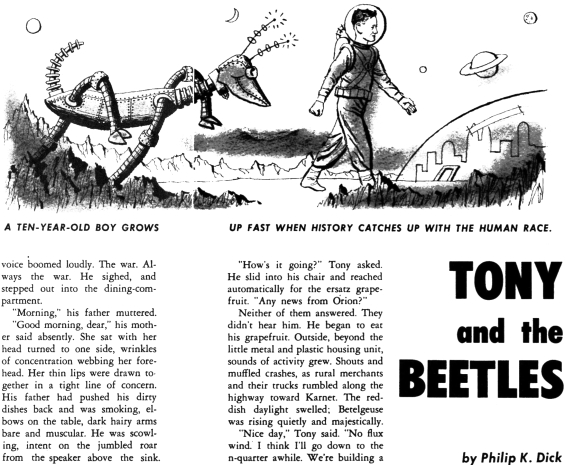
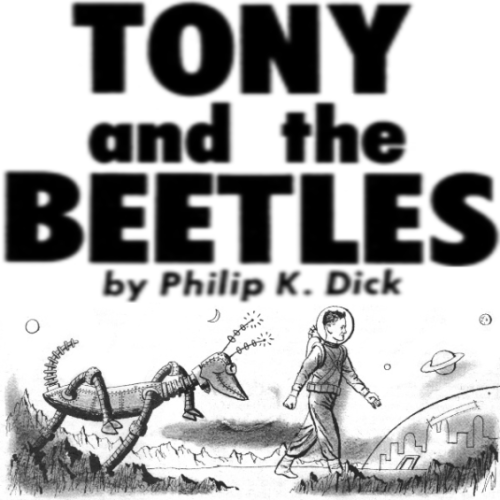
Tony And The Beetles is a bit unusual too, having an almost juvenile or YA feel to it. Maybe that’s because it’s not nearly as horrific as many of Dick’s fantasy tales – there are some frightening elements, but the general tone is that of an ungroundedness. I see Tony And The Beetles as a kind of historical allegory and I’m not the only one. Phil Chevernet, the narrator who recorded it for LibriVox, wrote “I think [Dick] was commenting on imperialism in the 40s and 50s.” I think he’s right, but I think the comment is somewhat ambiguous, rather depressing, and almost wholly unhopeful. Dick grew up during World War II and little PKD was a very sensitive fellow, kind of like Tony.
Here’s the setup:
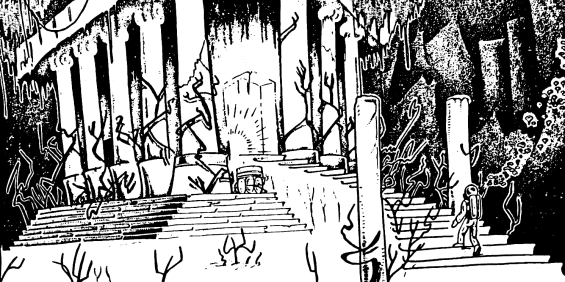
Young Tony Rossi has grown up on an alien world. As a child he’s known little else than bubble helmets, pressure suits, and robot pets. His playmates and schoolmates have all been the non-human children of the planet, but around him swirl the forces of history and when news of the ongoing war breaks Tony’s parents don’t seem to hold the same opinions of what it all means.
Tony And The Beetles
By Philip K. Dick; Read by Phil Chevernet
1 |MP3| – Approx. 34 Minutes [UNABRIDGED]
Publisher: LibriVox.org
Published: October 16, 2012 A ten-year-old boy grows up fast when history catches up with the human race. First published in Orbit, volume 1 number 2, 1953.
And here’s a |PDF| made from it’s original publication in Orbit.
The Zombie Survival Guide: Complete Protection From The Living Dead
By Max Brooks; Read by Marc Cashman
Approx. 8 Hours 38 Minutes [UNABRIDGED]
Publisher: Random House Audio
Published: September 12, 2006
ISBN: 9780739342725
Themes: / Zombies / Humor / Horror / Apocalypse /
The next time a Class 2 zombie outbreak occurs in my neighborhood, I’ll be well-prepared to deal with the shambling corpses of hungry undead now that I’ve read Max Brooks’ The Zombie Survival Guide: Complete Protection From The Living Dead.
The Zombie Survival Guide dispels exaggerated myths and legends of the undead and instead presents the reader with unvarnished “truths” about zombies. You’ll find information on zombies’ physical strength, sight, hearing, and rate of decay, and the pros and cons of various weaponry for battling the undead (everything from medieval maces and claymores, to M-16s and flamethrowers). It describes various scenarios for identifying early signs of localized (Class 1) outbreaks, to full-blown widespread undead infestation (Class 3). You’ll find best practices for battling zombies in urban settings, in harsh desert and swamp environments, even under the sea. The Zombie Survival Guide tells you how to defend your home by stocking up with key food and supplies and moving to your second floor and destroying all staircases (recommend for Class 2), or how to survive on the run as you move to the most remote and therefore safest parts of the planet in a world-wide zombie apocalypse in which mankind is overrun (Class 4). The best vehicle should an outbreak occur? You might not guess it, but it’s a bicycle. On a bike you can easily outrun the slow, slouching pace of zombies, it will never run out of gas, you can carry a bicycle over rough terrain, and you can maneuver a bike through the inevitable traffic jams that accompany a full-on panic. Motorcycles are very good too, though their noise attracts the undead. Boats are also a secure means of travel, says Brooks, but watch your anchor line—zombies walking on the ocean floor can use it to climb up to your boat. “Hundreds” of hapless victims have died this way, Brooks tells us.
The Zombie Survival Guide serves as a perfect gateway to Brooks’ highly recommended World War Z |READ OUR REVIEW|. If for nothing else, and you find Brooks’ post-apocalyptic strategems and survival tactics tedious, I’d recommend this book simply for the highly entertaining “Recorded Outbreaks” section. Here Brooks describes various zombie outbreaks throughout history, from ancient tales recorded in chilling primitive artwork, all the way up through living eyewitness accounts from the early 21st century. These are written in the economical journalism style that Brooks’ employs so effectively in World War Z, lending these “outbreaks” a documentary-style feel, which makes them seem more realistic and terrifying. According to Brooks there have been many zombie outbreaks throughout history—perhaps even in my neighborhood, hence my need to be ready—but these have been largely laughed off by skeptical media, ascribed to outbreaks of disease, localized madness, or industrial pollution, or covered up by governments or the CDC, fearful that public knowledge would result in full-scale panic.
For all its earnestness you have to take The Zombie Survival Guide with a heavy dose of salt. While it’s written in a deadpan style and never descends into farce, and purports to be a “real” guide for complete protection against the walking dead, when you read passages like “If you want to know the true danger of an airborne (parachute) attack against zombies, try dropping a square centimeter of meat on a swarming anthill. Chances are, that meat will never touch the ground. In short, air support is just that—support. People who believe it to be a war-winner have no business planning, orchestrating, or participating in any conflict with the living dead,” you can’t help but laugh (I did laugh out loud, several times). While not as well-written or as compelling as World War Z, for zombie aficionados The Zombie Survival Guide is nevertheless a must-read.
Marc Cashman narrates with a dry, clipped voice that perfectly suits the how-to nature of The Zombie Survival Guide. There’s a touch of William Shatner in his delivery, with dramatic pauses in odd places, but that only adds to the fun.
It took me two attempts to get into this Fritz Leiber audiobook. Part of the issue was that the first person protagonist is female and the audiobook’s narrator is male. Phil Chenevert, the narrator, is a talented voice actor but he still sounded male. This bothered me all the way up to chapter four when I had my growning indignity balloon deflated by this choice paragraph:
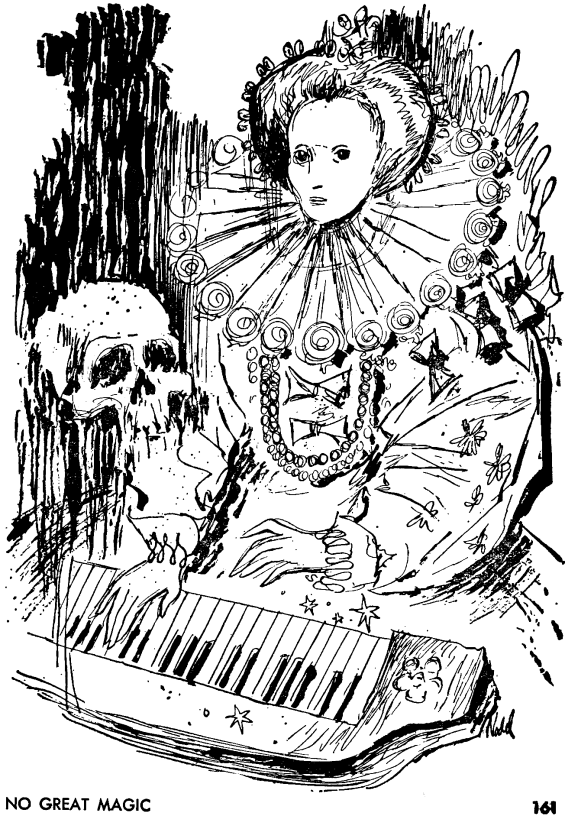
I swung back to the play just at the moment Lady Mack soliloquizes, “Come to my woman’s breasts. And take my milk for gall, you murdering ministers.” Although I knew it was just folded towel Martin was touching with his fingertips as he lifted them to the top half of his green bodice, I got carried away, he made it so real. I decided boys can play girls better than people think. Maybe they should do it a little more often, and girls play boys too.
Despite my loss of that criticism, I am still not fully satisfied with the story. Like The Big Time |READ OUR REVIEW| before it, No Great Magic is well written fluff – with not even the shape of a plot beginning until the very end.
It may just be that No Great Magic, and perhaps a good deal of other time travel related SF, are of a kind of “cozy” Science Fiction story that I just don’t fully embrace.
Still, the first person narration by the amnesiac heroine and Chenevert’s narrative skill make No Great Magic worth checking out – and perhaps your tastes and my tastes will differ.
“I hope you have been involved in the theater somewhere in your past or present because this story smells heavily of greasepaint.”
No Great Magic
By Fritz Leiber; Read by Phil Chenevert 8 Zipped MP3 Files or Podcast – Approx. 1 Hour 53 Minutes [UNABRIDGED]
Publisher: LibriVox.org
Published: May 27, 2012
|ETEXT| They were a traveling group of Shakespearean players; perfectly harmless, right? wrong. For one thing, why did they have spacemen costumes in their wardrobes,right next to caveman ones? Why was the girl in charge of backstage suffering from amnesia and agoraphobia? No Great Magic is needed to perform the plays they put on, but sometimes great science. No matter where, or when. First published in Galaxy Science Fiction, December 1963.
Here’s a recording of The Temple by H.P. Lovecraft. It was the his first professional sale. And, it’ll be the subject of an upcoming podcast.
It’s read for us by Mirko Stauch, a massive fan of Lovecraft, and a cool German dude with an authentic German accent – something highly appropriate for this story. He is a first time audiobook narrator, and yet, I think he’s done a fine job with it. Check it out for yourself!
The Temple
By H.P. Lovecraft; Read by Mirko Stauch
1 |MP3| – 37 Minutes [UNABRIDGED]
Provider: Mirko Stauch
Provided: August 2012 The skipper of an Imperial German Navy U-boat, in World War I, documents the disaster and ruin of his ship and crew after they torpedo an enemy ship at sink it’s lifeboats. First published in Weird Tales, September 1925.
The Empire Of The Ants
By H.G. Wells; Read by Sean Puckett
1 |MP3| – Approx. 36 Minutes [UNABRIDGED]
Publisher: Voices In The Dark
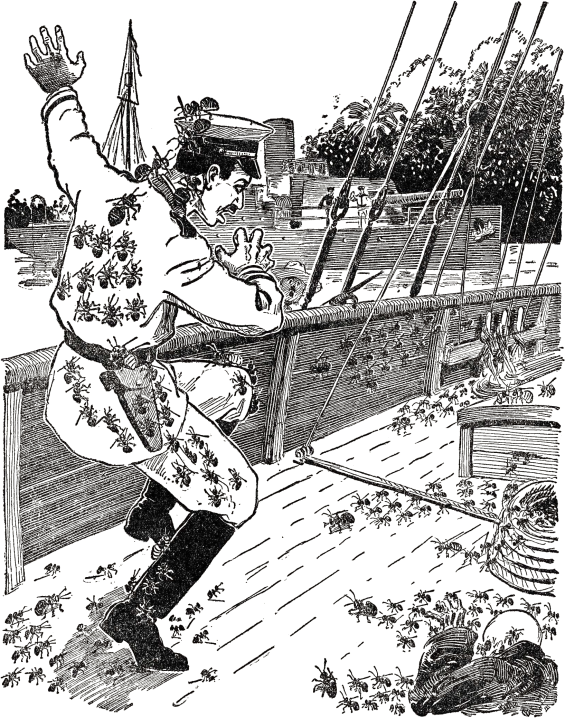
Published: 2005 A Brazilian navy gunboat, sent up the Amazon river to investigate reports of problems inland, discovers that large ants have begun taking over parts of the jungle. Showing signs of intelligence, the insects prove extremely hard to deal with. First published in the Strand Magazine, December 1905.
And here’s a |PDF| made from the publication in Amazing Stories, August 1926.
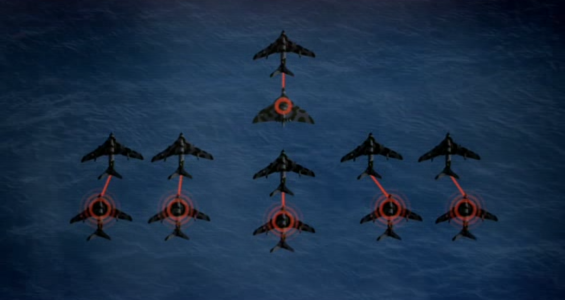
I first heard about Operation Black Buck after watching a Channel 4 broadcast in anticipation of the 30th anniversary (April, May, and June of 1982) of the Falkland War. Falklands’ Most Daring Raid was the “humorous, heroic story of how a Cold War-era Vulcan flew the then-longest-range bombing mission in history with a Second World War bomb that changed the outcome of the Falklands War.” It’s a great watch (and is available via torrent HERE).
And now, thanks to BBC Radio 4 (and RadioArchive.cc) there is as a companion to that doc. And it is a very satisfactory BBC Radio 4 dramatization too!
Like the Dam Busters and Doolittle raids, the story of Operation Black Buck strikes me as an inspirational engineering problem. A kind of wartime terrestrial Apollo mission, but done with 1950s technology.
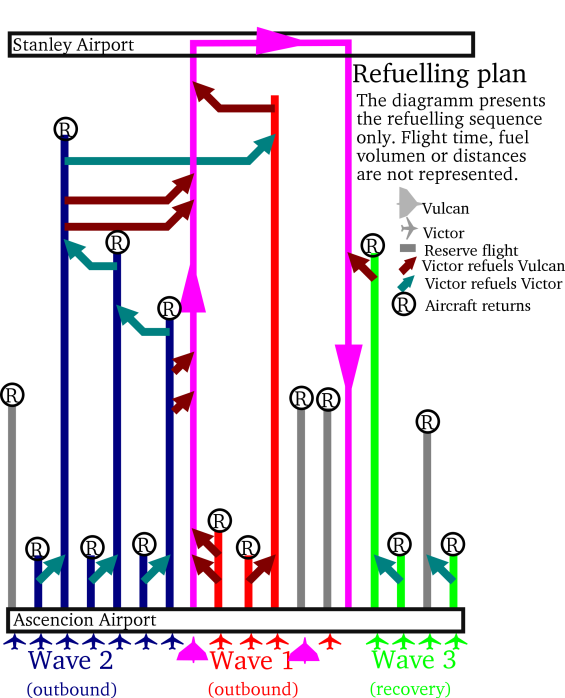
Operation Black Buck was conducted from Ascension Island in the mid-Atlantic to the Falkland Islands as a part of the initial British response to the invasion of the Falkland Islands by Argentina. That 7,500 km distance required an stunning amount of mid-air refueling check out this diagram:
Afternoon Drama: Operation Black Buck
By Robin Glendinning; Performed by a full cast
1 MP3 – Approx. 44 Minutes [RADIO DRAMA]
Broadcaster: BBC R4
Broadcast: June 5, 2012 During the Falklands War 30 years ago, the RAF staged the world’s longest bombing run, in an attempt to damage the runway at Port Stanley. Using ageing Vulcan bombers, crews flew a round trip of 8000 miles from Ascension Island to the South Atlantic. Such a journey required not just in-flight refuelling, but re-fuelling of the refuelling planes – a hazardous undertaking that had never before been attempted on such a scale.
In this drama, Robin Glendinning recreates the nail-biting adventure. Not only were the raids themselves difficult to pull off, but even getting the aircraft ready for the flights was a major task. Aviation museums across the world were raided for spares, and key parts retrieved from junkyards.
But there are those who question whether or not the operation was militarily useful – or whether or not the same job could have been done more effectively using planes attached to the naval task force. Was this really about war, or was it about the RAF trying to carve out a role for itself in a conflict that threatened to be entirely dominated by the Army and Royal Navy? And how successful were the raids anyway?


 Tony And The Beetles

 No Great Magic