
BBC R4 + RA.cc: Markheim by Robert Louis Stevenson [RADIO DRAMA]


I’ve posted about Robert Louis Stevenson’s murderous classic, Markheim, before (the audiobook and another radio drama). But, I’ve just discovered a very good new adaptation (from 2006) available at RadioArchive.cc. The sound design is excellent, and its lengthy enough to bring out most of the nuance in the text.

Markheim
Adapted from the story by Robert Louis Stevenson; Adapted by John Taylor; Performed by a full cast
MP3 via TORRENT – Approx. 45 Minutes [RADIO DRAMA]
Broadcaster: BBC Radio 4
Broadcast: February 1, 2006
On Christmas Day 1886 with London shrouded in fog, a man shadows a girl across Blackfriars Bridge towards the back streets of Holborn. His name is Markheim and his intentions are unremittingly dark.
Directed by John Taylor
Cast:
Tommy – Mark Straker
Markheim – Jack Klaff
Girl – Abigail Hollick
Visitor – Anton Rodgers
Crispin – Anthony Jackson
And for German listeners there’s THIS sexy sounding version produced as a part of a cool series called Gruselkabinett (which translates to “Chamber of Horrors”).
As a bonus I offer this newly created |PDF| and a vintage anlaysisby C. Alphonso Smith from Short Stories Old And New (1916):
Setting:
There is no finer model for the study of setting than this story affords. It is three o’clock in the afternoon of a foggy Christmas Day in London. If Markheim’s manner and the dimly lighted interior of the antique shop suggest murder, the garrulous clocks, the nodding shadows, and the reflecting mirrors seem almost to compel confession and surrender. “And still as he continued to fill his pockets, his mind accused him, with a sickening iteration, of the thousand faults of his design. He should have chosen a more quiet hour.” So he should for the murder; but for the self-confession; which is Stevenson’s ultimate design, no time or place could have been better.Plot:
There is little action in the plot. A man commits a dastardly murder and then, being alone and undetected, begins to think, think, think. It is the turning point in his life and he knows it. Instead of seizing the treasure and escaping, he submits his past career to a rigid scrutiny and review. This brooding over his past life and present outlook becomes so absorbing that what bade fair to be a soliloquy becomes a dialogue, a dialogue between the old self that committed the murder and the new self that begins to revolt at it. The old self bids him follow the line of least resistance and go on as he has begun; the newly awakened self bids him stop at once, check the momentum of other days, take this last chance, and be a man. His better nature wins. Markheim finds that though his deeds have been uniformly evil, he can still “conceive great deeds, renunciations, martyrdoms.” Though the active love of good seems too weak to be reckoned as an asset, he still has a “hatred of evil”; and on this twin foundation, ability to think great thoughts and to hate evil deeds, he builds at last his culminating resolve.The story is powerfully and yet subtly told. It sweeps the whole gamut of the moral law. Many stories develop the same theme but none just like this. Stevenson himself is drawn again to the same problem a little later in “Dr. Jekyll and Mr. Hyde.” Hawthorne tried it in “Howe’s Masquerade,” in which the cloaked figure is the phantom or reduplication of Howe himself. In Poe’s “William Wilson,” to which Stevenson is plainly indebted, the evil nature triumphs over the good. But “Markheim,” by touching more chords and by sounding lower depths, makes the triumph at the end seem like a permanent victory for universal human nature.
Characters
If the story is the study of a given situation, Markheim, who is another type of the developing character, is the central factor in the situation. We see and interpret the situation only through the personality of Markheim himself. Another murderer might have acted differently, even with those clamorous clocks and accusing mirrors around him, but not this murderer. There is nothing abnormal about him, however, as a criminal. He is thirty-six years old and through sheer weakness has gone steadily downward, but he has never before done a deed approaching this in horror or in the power of sudden self revelation. He sees himself now as he never saw himself before and begins to take stock of his moral assets. They are pitifully meager, though his opportunities for character building have been good. He has even had emotional revivals, which did not, however, issue in good deeds. But with it all, Markheim illustrates the nobility of human nature rather than its essential depravity. I do not doubt his complete and permanent conversion. When the terrible last question is put to him – or when he puts it to himself – whether he is better now in anyone particular than he was, and when he is forced to say, “No, in none! I have gone down in all,” the moral resources of human nature itself seem to be exhausted. But they are not. “I see clearly what remains for me,” said Markheim, “by way of duty.” This word, not used before, sounds a new challenge and marks the crisis of the story. Duty can fight without calling in reserves from the past and without the vision of victory in the future. I don’t wonder that the features of the visitant “softened with a tender triumph.” The visitant was neither “the devil” as Markheim first thought him nor “the Saviour of men” as a recent editor pronounces him. He is only Markheim’s old self, the self that entered the antique shop, that with fear and trembling committed the deed, and that now, half-conscious all the time of inherent falseness, urges the old arguments and tries to energize the old purposes. It is this visitant that every man meets and overthrows when he comes to himself, when he breaks sharply with the old life and enters resolutely upon the new.
Posted by Jesse Willis
BBC + RA.cc: Gaiman, Aldiss, Baczkiewicz, Byrnes

Here are links to four recent BBC programs. Myself, I’ve heard most of Neverwhere, and it’s terrific so far, but the others look pretty promising too.
Which have you heard? And what do you think?
Neil Gaiman’s Neverwhere adapted by Dirk Maggs [AUDIO DRAMA]
Hothouse by Brian Aldiss; read by Gareth Thomas
Pilgrim by Sebastian Baczkiewicz – Series 4 [AUDIO DRAMA] (Comments contain links to Series 1 to 3)
White Snow by Frances Byrnes [AUDIO DRAMA]
[Thanks Bob!]
Posted by Jesse Willis
BBCR4 + RA.cc: The Viking Way


First broadcast on BBC Radio 4, in November 2005, The Viking Way is David Aaronovitch‘s three part presentation exploring the world of the Vikings. The documentary is now available via RadioArchive.cc, the great public radio torrent site, HERE.
Part 1 – Ruling The Waves
This programme looks at who the Vikings were, where they came from, their social strata, their home life and why they were called Vikings.
It also examines their carpentry and boat-building skills: Norse craftsmen had a very sophisticated understanding of how to get the best out of wood, and used this knowledge in constructing their houses and ships.
In all nautical matters, Vikings were vastly superior to their contemporaries. Their navigational abilities alone are still being debated by historians and archaeologists: for how did they manage to navigate when out of sight of land?
Had they developed some kind of compass – and if not, what other methods did they use when travelling back and forth between places as far away as Iceland, Norway, and Greenland?
What were their fabled longships really like, and what was the effect of their appearance upon those the Vikings attacked?
…and did Viking warriors really wear those horned helmets?
Part 2 – A Danelaw Day
This programme explores what happened when the Vikings started attacking Anglo-Saxon communities in Britain .
Anglo-Saxon Britain was not a unified state – but it was a wealthy land, and much of that wealth was gathered in the monasteries. It had been gained largely by peaceful trade, but when the Vikings – or “north men” as they tended to be called – turned to raiding rather than trading, the various rival Anglo-Saxon kings found they had a common enemy.
Or did they? Our knowledge of the period is mostly due to the Anglo-Saxon Chronicles, written by the very people who were on the receiving end of that Viking approach to “free enterprise”. In addition, there are several different manuscript versions of the Anglo-Saxon Chronicles, written at different times and in different monasteries – and they don’t all tell the same story.
And what was life like under Norse domination? For those Anglo-Saxons who found themselves living in Danelaw – the area to the east of Britain ruled by the Danes – in what ways did their existence change? Would those at the bottom of the social scale have been better or worse off? Would they indeed have noticed much difference?
Part 3 – Inform, Educate And Entertain
After a hard day’s pillaging and plunder, what did a Viking do to relax?
Not surprisingly, alcohol featured a lot in their social activities – and picking a fight with a rival whilst emptying the goblets, was a commonplace occurrence. However, these were not just drunken brawls – for Norse society had a great love of poetry, and Viking warriors were practised at Insult-Poems: challenging eachother to aggressive poetic contests, each stanza followed by yet another drink…
The competitive element also emerged in a love of board-games, which have been described in such detail in Norse Sagas, that historians have a clear idea of the rules and stratagems used to play them.
However, Norse society’s chief creative contribution to the world, is the Saga. These secular narratives were filled with drama, action and adventure – and were as gripping for their audience as soaps are today. Not only did they provide massive entertainment, but they also demonstrated the Viking moral code: of bravery and loyalty, honour and vengeance, and the importance of kith and kin…
Posted by Jesse Willis
RA.cc + BBC R4: 15 Minute Drama: Modesty Blaise: A Taste For Death


There’s a terrific radio drama series available via torrent over on RadioArchive.cc.
Broadcast late last year on BBC Radio 4, December 17 – 21, 2012, Modesty Blaise: A Taste For Death is truly lovely listening!

I listened to the entire five part serial two or three times. That’s something I rarely do. Yet even after multiple listens this program has left me wanting more.
Blaise, as voiced by Daphne Alexander, is a confident, mysterious, and thoughtful secret agent. The supporting cast is top shelf, as is the sound design, editing, and music. This show is unmissably great.
In tone it’s probably not what you expect, being more of a cozy version of The Sandbaggers than a feminized James Bond. Not campy, exactly, as it is far too reverent for that.
Indeed, this particular adventure features far more than just 007 style espionage, romance, and action – it features friendship, teamwork, kindness, thoughtfulness, and a light-handed touch.
Best of all the producers aren’t at all above teasing the audience – the very first sounds from episode one are a total tease!
I love it.
Also cool, Modesty Blaise: A Taste For Death seems to be set in the period the novel of the same name was written (1969). Blaise, a child escapee from a WWII era displaced person camp, drives a “Jensen” (in my mind it’s a Jensen Interceptor).
Here’s the description from RA.cc:
She’s glamorous, intelligent, rich and very, very cool. Modesty Blaise has been called the female James Bond but she’s much more interesting than that. With her expertise in martial arts and unusual weapons, the ability to speak several languages and her liking for fast cars, twenty-something Modesty became a female icon long before the likes of Emma Peel, Lara Croft, or Buffy.In Stef Penney’s brand new radio adaptation of Peter O’Donnell’s novel, Sir Gerald Tarrant, Head of a secret British agency, tempts Modesty out of retirement and into a job involving a young woman with extra sensory powers, an exotic desert location, and a larger than life public school villain, intent on murdering his way to a vast fortune. With its perfect cocktail of glamorous settings, hidden treasure, a twisting turning plot, and characters to root for, A Taste for Death is an action packed treat – and a guilty pleasure.
With an original score by Goldfrapp’s Will Gregory, arranged by Ian Gardiner, and performed by the BBC National Orchestra of Wales, conducted by Ben Foster.
Cast:
Modesty Blaise ….. Daphne Alexander
Willie Garvin ….. Carl Prekopp
Sir Gerald Tarrant ….. Alun Armstrong
Simon Delicata ….. Sam Dale
Steve Collier ….. Geoffrey Streatfeild
Dinah Pilgrim ….. Samantha Dakin
McWhirter ….. Alex Fearns
Skeet Lowry ….. Jeff Mash
Sir Howard Presteign ….. Nigel Anthony

Produced and Directed by Kate McAll
Modesty Blaise’s comics origin:
And here’s the movie trailer, yikes!
Posted by Jesse Willis
Ray Bradbury’s The Flying Machine and The Fruit At The Bottom Of The Bowl

I’m not sure exactly how I came across this broadcast recording. But I’m very glad I did. It’s as part of a collection called The Golden Apples Of The Sun – a five part half hour of radio drama series adapting Ray Bradbury stories. This episode, episode 2, includes a pair of stories.
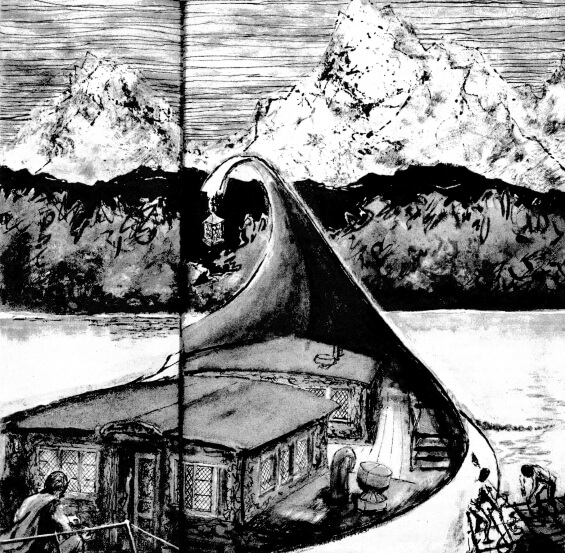
The first, The Flying Machine, is a short “fantasy” set in a mythical China. The story was familiar somehow so I looked it up and realized it was in an issue of Playboy that I have. I have appended the beautiful accompanying illustration (by Franz Altschuler).
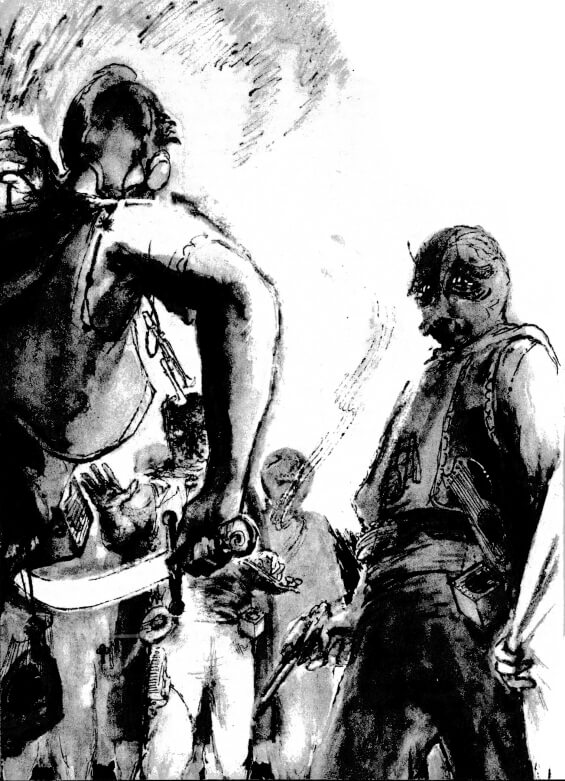
In the same broadcast was an iconic tale of an obsessive compulsive murderer. Called, The Fruit At The Bottom Of The Bowl, it was first published as Touch And Go! in a mag called Detective Book (November 1948). Unfortunately, I don’t have a beautiful scan of the first publication of that. Instead, I have a terrible scan (see below).
But, my new friend John Feaster, who I found through LibriVox, mentioned an adaptation of it in the EC Comics comic called Crime SuspenStories (#17). And that I do have a nice picture of.
The Golden Apples Of The Sun – The Flying Machine
Adapted from the story by Ray Bradbury; Adapted by Lawrence Gilbert; Performed by a full cast
1 |MP3| – Approx. 30 Minutes [RADIO DRAMA]
Broadcaster: BBC Radio 5
Broadcast: January 30, 1991
Source: Archive.org
Producer Peter Hutchings.
Cast:
Paul Maxwell
Don Fellows
Ed Bishop
Paul Downing


And The Fruit At The Bottom Of The Bowl was adapted to TV for The Ray Bradbury Theater. And it stars Michael Ironside and Robert Vaughn!
Posted by Jesse Willis
BBCR4X: A Canticle For Leibowitz: Fiat Homo by Walter M. Miller Jr.

A new five part abridged reading, with added sound effects, of the first part of A Canticle For Leibowitz, “Fiat Homo”, begins here:
A Canticle For Leibowitz
By Walter M. Miller, Jr.; Read by Nigel Lindsay
STREAMING AUDIO – [ABRIDGED]
Broadcaster: BBC Radio 4 Extra
Broadcast: November 26, 2012
Set in a Catholic monastery in the desert of the southwestern United States after a devastating nuclear war, the story spans thousands of years as civilization rebuilds itself. The monks of the fictional Albertian Order of Leibowitz take up the mission of preserving the surviving remnants of man’s scientific knowledge until the day the outside world is again ready for it.
First published in 1959.

[thanks Roy!]
Posted by Jesse Willis