 The SFFaudio Podcast #654 – Star Ship by Poul Anderson; read by Paul Harvey (for LibriVox). This is an unabridged reading of the story (1 hour 32 minutes) followed by a discussion of it. Participants in the discussion include Jesse, Paul Weimer, and Scott Danielson.
Talked about on today’s show:
Planet Stories, Fall 1950, the description therein, The strangest space castaways of all!, weirdly medieval, the life-boat cracked up, an AI that rebelled against them, this episode of Star Trek Voyager, all simulation, Paul unleashed, “The Paradise Syndrome”, not good depictions of Native Americans, C.J. Cherryh’s the Foreigner series, 12 novels vs. 90 minutes, padded vs. lean and mean, the backstory is all in here, a two part Voyager episode, Star Trek The Next Generation, an episode of The Orville, time works differently down there, Interstellar (2014), “Blink Of An Eye”, Dragon’s Egg by Robert L. Forward, “Mad Idolatry”, Sandkings by George R.R. Martin, Ted Sturgeon’s Microcosmic God, accelerated rate vs. accelerated time, all they needed was a remote control, Aliens (1986), the orbiting Sulaco, their away mission included the entire crew, Apollo 11, you gotta leave Michael Collins up there, subspace vortex, your people with your equipment, one in a billion chance, one ion storm, wrong timeline?, what Heinlein did, Poul Anderson’s complete psychotechnic league, the third story, Flandry, egalitarian, looser, Sandra Miesel, Startling Stories, Winter 1955, back in the early 1940s Robert A. Heinlein let it be known, The Snows Of Ganymede, a bare outline, fantasy and prophecy, the first 250 years, 2875, The Star Ways, some of them are as yet unwritten, Cold Victory wasn’t published until the 1980s, Oswald Spengler, The Decline of the West, Arnold J. Toynbee, anthropoid robot invented, anti-robot riots, a historical view, a me discovering this, psychodynamics was created, the early death of Dwight D. Eisenhower. U.S. Socialism in the 1950s, like Asimov’s psychohistory, influence government policy and popular attitudes, his own Foundation, uncomfortable questions, realism vs. idealism, Anderson’s political beliefs, he reversed his strong support for the United Nations, more cynical, cycles of history, libertarian?, internationalist, individualist, any other stories, a reversal of The High Crusade, capes, cannons, siege engines, medieval futuristic, Jack Vance, only three generations, a mix of elements, The Dragon Masters, worldbuilding happened outside of the plot, like reading Heinlein, he has a plan, Friday is set in the same universe as Farmer In The Sky, part of a greater universe, reading his openings more than once, nobody with amnesia,
With sunset, there was rain. When Dougald Anson brought his boat in to Krakenau harbor, there was only a vast wet darkness around him.
the aliens when we get to them, fur with clothes, he swished his tail, my gosh look at that alien!,
The Khazaki was humanoid, to be sure—shorter than the Terrestrial average, but slim and lithe. Soft golden fur covered his sinewy body, and a slender tail switched restlessly against his legs. His head was the least human part of him, with its sloping forehead, narrow chin, and blunt-muzzled face. The long whiskers around his mouth and above the amber cat-eyes twitched continuously, sensitive to minute shifts in air currents and temperature. Along the top of his skull, the fur grew up in a cockatoo plume that swept back down his neck, a secondary sexual characteristic that females lacked.
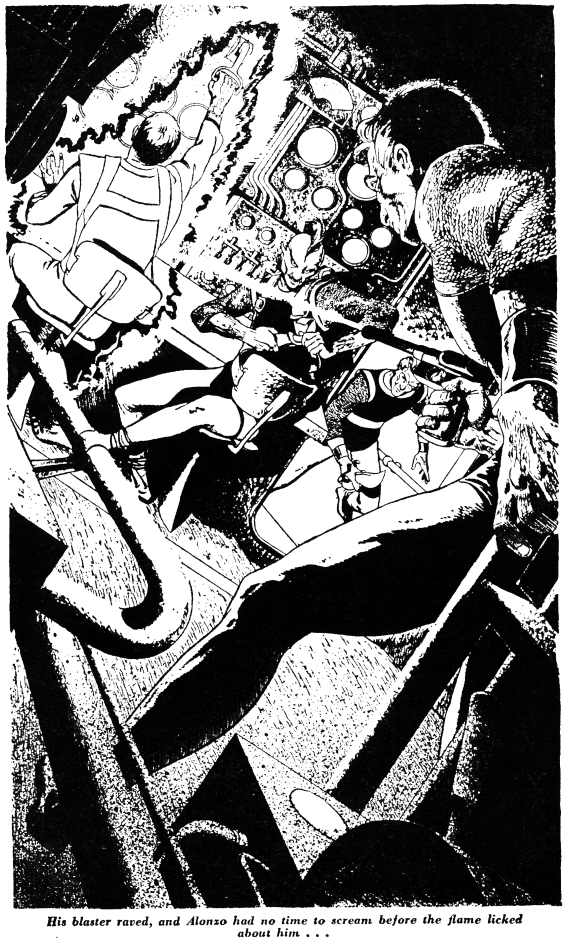
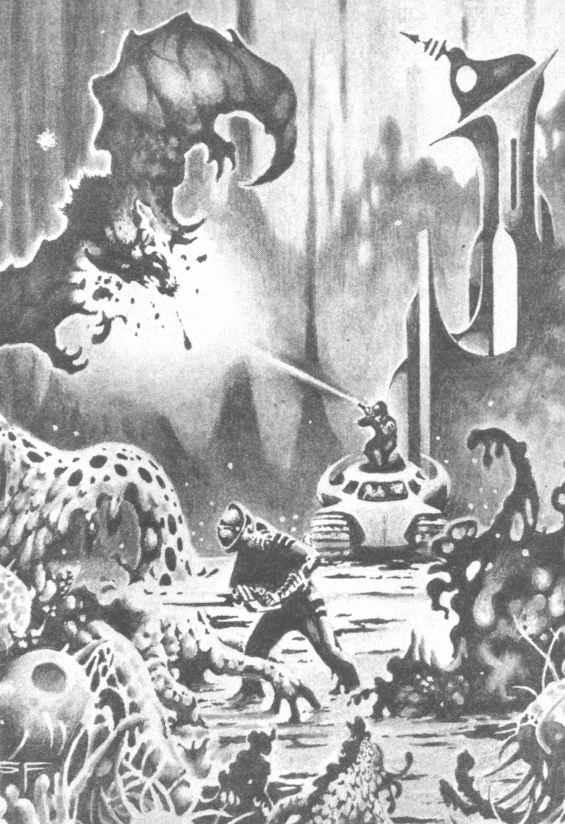
the original art, it just looks like a mohawk, this picture is from right near the end of the story, funny things going on in the background, a little post-medieval, the Khazaki – Kozakis – Cossacks, in the analogue that is Poul Anderson’s brain, Japanese, Scandanavian guy, lucky, plot magic, a lot of females, Ching Chun Chen aka Ensign Kim, taught astrogation from her grandfather, our Conan figure, prematurely old looking, a forehead scar, had many women attracted to him (including the native women), L. Sprague de Camp, rishathra, cultural vs. wenching,
He looked away, his face hot in the gloom, realizing suddenly why Masefield Carson hated him. Briefly, he wished he hadn’t had such consistent luck with women. But the accident that there was a preponderance of females in the second and third generations of Khazaki humans had made it more or less inevitable, and he—well, he was only human. There’d been Earthling girls; and not a few Khazaki women had been intrigued by the big Terrestrial. Yes, I was lucky, he thought bitterly. Lucky in all except the one that mattered. Right after, Anse felt a small hand laid on his arm. He looked down into the dark eyes of DuFrere Marie. She was a pretty girl, a little younger than he, and until he’d really noticed Ellen he’d been paying her some attention.
“I don’t care about equality,” she whispered. “A woman shouldn’t try to be a man. I’d want only to cook and keep house for my man, and bear his children.”
It was, Anse realized, a typical Khazaki attitude. But—he remembered with a sudden pity that Carson had been courting Marie. “This is pretty tough on you,” he muttered. “I’ll try to see that Carse is saved…. If we win,” he added wryly.
“Him? I don’t care about that Masefield. Let them hang him. But Anse—be careful—”
a very Conan guy, escape to the moon, I was promised a STAR SHIP, not a science fiction story in its main action, that’s what Planet Stories is about, the whole purpose is to get to another place, fun, planetary romance, a novelty, Planet Stories is way ahead, picking up on Science Fiction in the 1950s, maybe there’s something to this stuff, as opposed to romance or railroad or baseball fiction magazines, extrapolative science fiction, some real thing behind it, some scientific idea, the reason we like Dragon’s Egg, if we had a neutron-star, put in a ton of brain work, the speed of their metabolism, how do I tell it as a story, all that brainwork lends some sort of truth to the story, a mediocre story, still good, he has some stuff going on in his mind, the struggle we’ll see between the Soviets and the United States, the Moon is a tangible object in the sky, plot the mountains of the Moon, Mission Of Gravity by Hal Clement, the Mesklinites, we’re gonna be friends, a very masculine story, give me your sword,
He added, after a moment: “A man has to stand by his comrades.”
Janazik nodded, very slowly. “Give me your sword,” he said.
“Eh?” Anse looked at him. The blue eyes were unseeing, blind with pain, but he handed over the red weapon. Janazik slipped his own glaive into the human’s fingers.
Then he laid a hand on Anse’s shoulder and smiled at him, and then looked away.
We Khazaki don’t know love. There is comradeship, deeper than any Earthling knows. When it happens between male and female, they are mates. When it is between male and male, they are blood-brothers. And a man must stand by his comrades.
they don’t have any gays on this planet, a dozen words for betrayal but not a single word for love, teach me this earth thing you call kissing, humans have to teach sex to the aliens, in the Doctor Who universe, unusual on Earth, you have sex all the time?, what’s wrong with you?, build a rocket, there is this past, the first space-boat, a vivid past, Jerry Pournelle’s King David’s Spaceship, bootstrap a spaceship, you can’t colonize us, quasi-medieval, ran in the same circles, so many ideas, starships won’t even be necessary, Peter F. Hamilton, wormhole on Mars, Pandora’s Star, rockets that grow like trees, Beowulf Schaeffer, engineered by the Pak?, interesting tidbit, fishbowl helmet, any way to get to space, living and working in space, to go to another place, international space station, The Integral Trees and The Smoke Ring, space is the absence of a place, what if…, raiding across the galaxy, I could make this go another way, fun stuff, similar situation, somehow the humans are the dominant ones, take out our macbooks and upload a virus, Independence Day 2 (2016), hey that H.G. Wells and the War Of The Worlds thing?, I’m doing that, a computer virus, a fun movie, waiting for the Americans doing something, Independence Day: UK, when talking to Julie Davis, the Russians won WWII in Europe, Operation Market Garden, Western front vs. Eastern front, we gotta get the Chinese market, throw in a Chinese character, Dwayne Johnson, a scene set in Seoul, Skyscraper (2018), it lands badly, if you’re building the rocket ship, spoilers and scoops and pinstripes on a rocket, it doesn’t overstay its welcome, only 90 minutes, a very small story, a little planetary romance, detailed backstory that the author knows and we can surmise, a good outline, a couple of Heinlein stories, the rise of the prophet, the crazy years, with a science fiction setting, a standard Green Odyssey sort of story, Conan/action, blood brothers, pirates, a barbarian by comparison, ringmail, a blonde mane, a sword, a higher gravity planet, how it got to be as fine as it is for a very pulpy story, really obsessed with Iceland?, he makes it work, obsessed with the norther lands, an Icelandic saga, The Man Who Came Early, Poul Anderson’s answer to Lest Darkness Fall by L. Sprague de Camp, detail and place, I’m only going to tell stories set in the Black Forest, scandinavian history, Star Ways, he’s not top tier, consistently never terrible, Andre Norton, how did he manage to make a good story?, leaning on Conan, leaning on the same things, one of the reasons we know Howard writes so well, leaning heavily on history, almost never has magic as a major function, an evil wizard whose casting a spell, this tower is made of magic, fighting a literal god, leaning on the science, that is beauty, that’s poetic, NESFA, serviceable, very watered down mead, Njáls Saga, Netflix watch party, the Skiffy and Fanty people, Ragnarok, the final verdict, oh shit we gotta write a whole series, Netflix is planetary, Norsemen, funny silly stuff, leaning heavily on the facts of Norwegian life, its legit, the gutter of pulp, weak ass stories, a Conan pastiche, Tarzan, Hour 25, Sherlock Holmes, novels and collections, Delenda Est, the time patrol stories, more coming our all the time, the good news, finally hitting gutenberg, Three Hearts And Three Lions, Jeffro Johnson, The Broken Sword, Appendix N, a book of reviews, what they contributed to Dungeons & Dragons, Dave Arneson and Gary Gygax, Jack Vance’s magic system, if you’re a dungeon master, lift from these guys, Jerome Bixby, The Man From Earth (2007), Star Trek actors sitting in a room for 90 minutes, an ideas guy, Planet Stories, all Star Trek things, four episodes of the original Star Trek, ideas are incredibly important for science fiction, nice prose vs. characters, a crappily written story that’s interesting, a first contact protocol, teleportation aka transporters, Star Trek basics, Star Trek ideas in non-Star Trek stories, “By Any Other Name”, “Mirror, Mirror”, goateed Spock, “Day Of The Dove”, “Requiem For Methuselah”, “Galileo Seven”, a shuttle, “Metamorphosis”, mate with the giant guys who throw rocks, The Twilight Zone, “It’s A Good Life”, a good ideas story, his two tricks, somehow you can get a career, Lord Dunsany, Clark Ashton Smith, a staple of Jesse’s diet, a Poul Anderson, a Ray Bradbury Podcast: Bradbury 100, Science Fiction 101, more general, the Silverberg anthology (Worlds Of Wonder), an introduction to Science Fiction, old stuff, current stuff, future stuff, looking back over your life, you tripped and fell into an open grave, at night, on a Thursday, this is a good podcast, distilled it down, a novelette, Paul’s having a brain freeze because of Covid-19 and the vaccine for same, will Scott ban himself from the Baen forums, it doesn’t seem to be that big a deal, Trump should make a militia, Harold Lamb, historical fiction guy, Marching Sands, Omar Khayyam: A Life, Genghis Khan: King Of All Men, need more Rubáiyát in my life, the LibriVox version is preferable, Cirsova, Julian Hawthorne’s The Cosmic Courtship, astral projection, a professional narrator, leverage more stuff, our narrator today, like Jesse reading, the majority are pretty good, share the wealth, if pizza was still under trademark, Pizza authorized restaurant, no cheerios pizza!, let our pizzas free, champagne, parmesan, Cheddar, let people make their own pizzas, we’ve had a pizza flourishing, the ketchup on hot-dogs, its allowed, the right condiments for hotdogs, don’t lock down my hot dog, The Ship Of Ishtar by A. Merritt, Planet Stories series, Sword Of Rhiannon by Leigh Brackets, Robots Have No Tails by Leigh Brackett, Stefan Rudnicki, Johnny Heller, Nightfall And Other Stories, 40 or 50 titles, more officially public domain, 1923 was a cutoff until 2 years ago, the late 1920s pretty soon, The Great Gatsby by F. Scott Fitzgerald, Leonardo Dicaprio (the short guy from Titanic), push books to sell to the high schools, oh shit the copyright’s expiring, the Philip K. Dick estate, the Folio Society collection of The Complete Short Stories of Philip K. Dick, Bryan Alexander, a monstrosity, $750 for four books, Jesse’s complaints are legion, Americans tend to do that, the artistic objects, collecting old things, a half million dollar revenue project, does not include Dick’s juvenile, a handful or two handfuls not in there, lazy as fuck, the colours are fluorescent, commissioning new art, too highbrow and too generic, The Infinites, Colony, a pointless argument, people like art, these are objections for collection, like buying a sculpture, a phenomenon in art, this is a way of storing value, artificial scarcity, art as one object, not for the billionaires, above the funko pop level, The Book Of The New Sun, a new Tor version, zener card symbols are public domain, this is bad cover art, is art objective or subjective, a minimalist room, Scott doesn’t complain about art, The Doomsday Book by Connie Willis, Kivrin, $750!, Subterranean Editions, The Best Of David Brin, The Best Of Elizabeth Bear, Nancy Kress.

Posted by Jesse WillisBecome a Patron!



 Dangerous Women: Stories