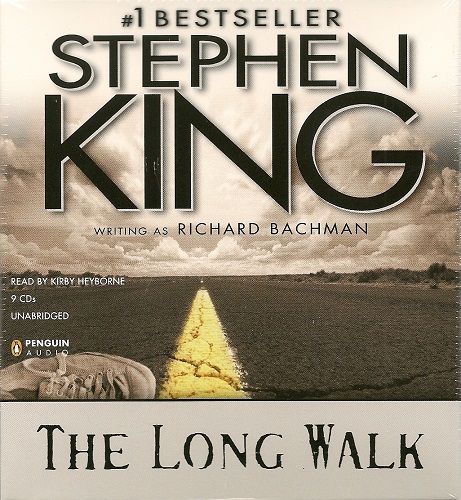
 The Long Walk
By Stephen King; Read by Kirby Heyborne
9 CDs – Approx. 11 Hours [UNABRIDGED]
Publisher: Penguin Audio
Published: 2010
ISBN: 9780142427835
Themes: / Horror / Walking / Alternate History / Maine /
Every year, on the first day of May, one hundred teenage boys meet for an event known throughout the country as the “Long Walk.” Among this year’s chosen crop is sixteen-year-old Ray Garraty. He knows the rules: Warning are issued if you fall under speed, stumble, sit down. After three warnings, you get your ticket. And what happens then serves as a chilling reminder that there can be only one winner in the Walk: the one who survives.
One of the things that generally makes me not connect with fiction is what’s missing. That is to say, if the story isn’t talking about some idea (the human condition, society, or how the world works) I probably won’t connect with it. I therefore always assume that a novel has some message. A lesson it is trying to impart to me. Perhaps this is a mistake as The Long Walk, by Stephen King, lives on the surface of what it is. It’s 100 boys walking across the United States in a kind of slow motion deathrace. Unlike the the traditional death march, these walkers are all volunteers, and are supplied with food and water. “That’s the premise.” I told myself. But what message had King planted underneath it? What idea was he trying to convey in novel form?
At first I was wondering if King was addressing the Vietnam War. But that didn’t pan out, not exactly. The way the book is structured, the premise is never flatly stated, we only learn how the boys ended up where they are (walking across Maine) when they discuss it amongst themselves. So, we’re learning the premise as we go. I figured that if there was a message in The Long Walk it needed to be decoded. My first suspect for the key to the message was the soldiers who passively enforce the Long Walk’s rules. Their faces were strangely blank, providing no bounce or reaction to their work or the insults the walkers hurl at them. I thought their blankness might be a hint, a symbol, or something. But if so, it didn’t work out for me. In fact, by the end, never having learned the names of any of the nearly faceless soldiers, it was quite the opposite. The only idea I could come up with to explain this was that they were designed to represent the unfeeling laws of nature. Kind of an embodiment physics, unfeeling and inalterable. That got me thinking that perhaps the whole of the The Long Walk was kind of a metaphor for mortality – you know, the idea that no matter your station, no matter your talent, none of us can escape our coming demise. But, the more I read, the less that seemed likely. In fact, no matter which intellectual straw I grasped at I kept coming away with a figurative handful of nothing.
Another angle of attack I took was to look at the world. What kind of a world would allow this horror race? What was the meaning of “the prize” for the winner? The world, what little we get to hear of it, was pretty interesting. We learn that there are 51 states in the Union, that before then end WWII some kind of air raid from Nazi Germany hit the American East Coast, and that the government may be entirely in the hands of a military dictatorship. Nice! These and other small details slip out in the many varied conversations between the boys in the Walk, amongst trash talk, sex talk and the discussion of literature. With nothing much left to go on I tried to think about the literary references, tried to see if there was some key there, to unlocking the meaning of this novel. At one point one of the walkers says that ‘the Walk is like living in a Shirley Jackson story.’ He was right! And later on, when ruminating on the effect of being watched by the public, another of the boys says he’s ‘reminded of a Ray Bradbury story.’ And he was right! In fact, there are maybe a half dozen literary references alluded to in this novel. But none of them, not any one of them, was the key to decoding the meaning for me. So, in the end, I didn’t come away with was any sense of what this novel was about, other than what it would be like to be force marched across the United States.
Apparently The Long Walk was originally written in 1966 and 1967 while King was in his first two semesters of university. I’m assuming it was somewhat updated or re-written before it’s 1979 debut in paperback under King’s Richard Bachman pseudonym. I first heard Kirby Heyborne’s narrative abilities with Little Brother |READ OUR REVIEW|. That novel was told in the first person, and Heyborne’s youthful voice was up for the job there. Here, voicing more than a dozen young men and boys, all in the third person, he renders an acceptable, if not stellar, performance. He adds the occasional regional American accent to each kid and it always sounds appropriate for what we know about his background. Also of note: There is an interesting introductory essay on Disc 1 entitled The Importance Of Being Bachman. It does not, however, provide any particular details about The Long Walk.
Posted by Jesse Willis


 Bruce Sterling reads from Distraction