LibriVox: Herbert West – Reanimator by H.P. Lovecraft

SFFaudio Online Audio

Herbert West - Reanimator

H.P. Lovecraft’s not well known for his sense of humor, but he had one,as evidenced by this six-part 1922 serial (available in two parts below). It’s a novelette, featuring the titular character and his attempts to reverse the effects of death. The results of which are inevitably, and hilariously, recurrent.

LibriVoxHerbert West – Reanimator
By H.P. Lovecraft; Read by: Matt Bohnhoff
2 MP3s – Approx. 80 Minutes [UNABRIDGED]
Publisher: LibriVox.org
Published: October 17, 2008
Convinced that death is merely mechanical failure, and that they can find a chemical mechanism to reboot the machine, West and our nameless narrator, are on the hunt for bodies–the fresher, the better. Through graveyards and laboratories, they want to find death, chase it, trap it, prod it, and defeat it. But when you chase something to within arm’s reach, it can reach back… First published, serially, in six issues of Home Brew, February-July 1922.

Part 1 |MP3| Part 2 |MP3|

Posted by Jesse Willis

Review of The Gunslinger by Stephen King

SFFaudio Review

*Introducing one of our new reviewers – Rob Z. While he waits for his first audiobooks to review for SFF Audio, we thought we’d tide you over with one of his favorite audiobook reviews.*
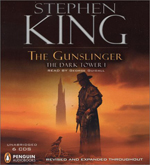
The Gunslinger by Stephen KingThe Gunslinger (The Dark Tower #1) – revised and expanded ed.
By Stephen King; Read by George Guidall
Publisher: Penguin Audio, now available on Audible
Publication Date: 6 October 2003
7 hours, 24 minutes [UNABRIDGED]

Themes: / fantasy / parallel worlds /

Publisher summary:

Eerie, dreamlike, set in a world that is weirdly related to our own, The Gunslinger introduces Roland Deschain of Gilead, of In-World that was, as he pursues his enigmatic antagonist to the mountains that separate the desert from the Western Sea in the first volume of The Dark Tower series. Roland, the last gunslinger, is a solitary figure, perhaps accursed, who with a strange single-mindedness traverses an exhausted, almost timeless landscape of good and evil. The people he encounters are left behind, or worse, left dead. At a way station, however, he meets Jake, a boy from a particular time (1977) and a particular place (New York City), and soon the two are joined, khef, ka, and ka-tet. The mountains lie before them. So does the man in black and, somewhere far beyond…the Dark Tower.

The start of an epic journey. Or is it? The start I mean.

“The man in black fled across the desert, and the gunslinger followed.”

Why? To what purpose? How long has he been chasing him? Ah my friends, these are but a few of many questions.

The journey is the key, and here we throw our lot in with the Gunslinger as he speeds towards his goal. Will we ever reach it? One must continue the journey with Roland to find out. And so I have. Again.

I’ve lost track of how many times I’ve read this book. It’s probably my least favorite in the series, and yet it contains some of my favorite moments.

The glimpses into Roland’s childhood that are a large part of what makes Wizard and Glass one of my absolute favorite books are present in this book with much smaller doses. The story of Roland’s coming of age in particular is one I could listen to again and again (and so I have, say thankee-sai).

Another particular favorite of mine is Tull. It gives us a glimpse, and it just a glimpse of who the Gunslinger really is.  It is here that Mr. King makes a revision in a scene I’m not sure I agree with.  It’s not a “Han Shot First” re-write for me, but one I felt un-necessary that tries to offer some forgiveness for Roland’s actions.

That said. I love this book. The original book is actually a collection of  5 stories that were published in a magazine over the span of about 3 years. Mr. King revised the book in 2003.

For the most part, the revisions help to fill out the story and clear up some continuity issues that Mr. King hadn’t worked out when he first wrote them. You could maybe call it ret-con, but I really consider it more of clarification of detail that was lacking.

I’ve always wondered why so many people don’t like this book. My friend listened to it with his brother. He almost quit the series right there. His brother did. I’ve seen many people recommend skipping this book outright and coming back to it at the end. I suppose that would work, but the need for it is beyond my comprehension.

I thought maybe this re-read many years since my last around the time of the final 3 books release in the mid 2000s would shed some light on it. It did not.

Maybe it’s a sense of nostalgia. Maybe because I first read this book before many of the long sprawling epics I’ve tackled since. But their are certainly other books I enjoyed as a younger man that I no longer enjoy as an adult.

This book isn’t one of those. To me it offers you a glimpse and a promise of all that is to come. For that I must again say Thankee-sai to Mr. King.

I listened to the audible version of the revised edition of this book. The reader is George Guidall.

He was enjoyable enough, and his voice seems suited to the tale. I opted to do an audio-book re-‘read’ of the series as my friend has been experiencing it for the first time and I find my memory of it lacking.

One of the things lost by doing the audio however is the artwork. I have 1-4 in trade paperback by Plume (with both the original text and updated version that this audiobook contains) and the original hard cover releases of 5-7. The Plume editions contain some, but not all of the artwork contained in the original hard cover releases.

Some may not welcome the art, as they prefer to let their own imaginations paint the pictures, but I’ve always been lacking in visual imagination so I welcome the inspiration to help my brain fill in the rest. I plan to make it a point to re-visit the art at some point as my re-read continues.

Review by Rob Zak.
Commentary: Annotating Ward Shelley’s A History Of Science Fiction

SFFaudio Commentary

I love looking at Ward Shelley’s The History Of Science Fiction. It really inspires me.

I’ve, for my own amusement, done a little annotating, adding little thumbtacks noting every podcast READALONG we’ve done. But I’ve only put on the ones that are explicitly named on the chart. So, for example, even though we’ve talked about Tarzan Of The Apes I haven’t noted it because the chart only lists “Tarzan.” Similarly, we’ve done a podcast about A Princess Of Mars but as the chart only reads “John Carter” I haven’t made a notation.

But still and all, I find it fun to look at. And looking at it, it makes me want to add more!

You can click through to see more detail.

SFFaudio Podcast Episodes Noted

Posted by Jesse Willis

BBCR4 + RA.cc: The Viking Way

SFFaudio Online Audio

BBC Radio 4RadioArchives.ccFirst broadcast on BBC Radio 4, in November 2005, The Viking Way is David Aaronovitch‘s three part presentation exploring the world of the Vikings. The documentary is now available via RadioArchive.cc, the great public radio torrent site, HERE.

Part 1 – Ruling The Waves
This programme looks at who the Vikings were, where they came from, their social strata, their home life and why they were called Vikings.

It also examines their carpentry and boat-building skills: Norse craftsmen had a very sophisticated understanding of how to get the best out of wood, and used this knowledge in constructing their houses and ships.

In all nautical matters, Vikings were vastly superior to their contemporaries. Their navigational abilities alone are still being debated by historians and archaeologists: for how did they manage to navigate when out of sight of land?

Had they developed some kind of compass – and if not, what other methods did they use when travelling back and forth between places as far away as Iceland, Norway, and Greenland?

What were their fabled longships really like, and what was the effect of their appearance upon those the Vikings attacked?

…and did Viking warriors really wear those horned helmets?

Part 2 – A Danelaw Day
This programme explores what happened when the Vikings started attacking Anglo-Saxon communities in Britain .

Anglo-Saxon Britain was not a unified state – but it was a wealthy land, and much of that wealth was gathered in the monasteries. It had been gained largely by peaceful trade, but when the Vikings – or “north men” as they tended to be called – turned to raiding rather than trading, the various rival Anglo-Saxon kings found they had a common enemy.

Or did they? Our knowledge of the period is mostly due to the Anglo-Saxon Chronicles, written by the very people who were on the receiving end of that Viking approach to “free enterprise”. In addition, there are several different manuscript versions of the Anglo-Saxon Chronicles, written at different times and in different monasteries – and they don’t all tell the same story.
And what was life like under Norse domination? For those Anglo-Saxons who found themselves living in Danelaw – the area to the east of Britain ruled by the Danes – in what ways did their existence change? Would those at the bottom of the social scale have been better or worse off? Would they indeed have noticed much difference?

Part 3 – Inform, Educate And Entertain

After a hard day’s pillaging and plunder, what did a Viking do to relax?

Not surprisingly, alcohol featured a lot in their social activities – and picking a fight with a rival whilst emptying the goblets, was a commonplace occurrence. However, these were not just drunken brawls – for Norse society had a great love of poetry, and Viking warriors were practised at Insult-Poems: challenging eachother to aggressive poetic contests, each stanza followed by yet another drink…

The competitive element also emerged in a love of board-games, which have been described in such detail in Norse Sagas, that historians have a clear idea of the rules and stratagems used to play them.

However, Norse society’s chief creative contribution to the world, is the Saga. These secular narratives were filled with drama, action and adventure – and were as gripping for their audience as soaps are today. Not only did they provide massive entertainment, but they also demonstrated the Viking moral code: of bravery and loyalty, honour and vengeance, and the importance of kith and kin…

Posted by Jesse Willis