
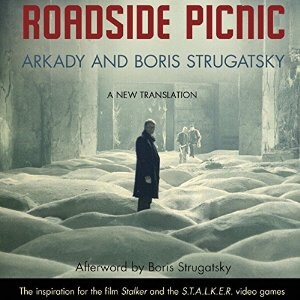
 Roadside Picnic
By Arkady and Boris Strugatsky; Translated by Olena Bormashenko; Read by Robert Forster
7 hours 8 Minutes [UNABRIDGED]
Publisher: Random House Audio
Release Date: October 2, 2012
Eastern European Science Fiction has not been on my RADAR for decades. Of course, it would be easy to blame the Anglo-American dominance in the genre for this, but another reason might have been the ill-timing of my first touchpoints with SF from what was then still (even though barely) the Soviet Union. As a kid, I got a box of books from the German Democratic Republic with Soviet and other Eastern Bloc Science Fiction stories (Utopian Novels they were called to avoid the Anglicism). I read one of them and browsed a few others. Suffice to say, that I was not impressed. Blame my immature literary taste buds, but to me, they seemed overly intellectual, a bit cumbersome, boring. After that I hardly touched any book that came from beyond the Iron Curtain, with few exceptions. What an idiot I had been! A recent trip to Moscow sparked my interest in Russian culture, so I thought, what the heck. Gimme some of those Strugatsky brothers that everyone is going on about. Luckily, there has been a fairly recent re-release of the brothers’ Arkady and Boris Strugatsky most famous work Roadside Picnic. Published in 2012, it not only has been newly translated but it is also based on a restored version of the text prepared by Boris Strugatsky (Arkady having passed away in 1991) to repair the damage that was done to the book by Soviet censorship, including all of the filthy language. It is a testament to the brilliance of the novel that even in its crippled version it was nominated for a John W. Campbell Award in 1978 and came second, a rare occurrence for a foreign-language book.
What’s it about then? It’s a First Contact story, with a clever twist. It’s about alien contact alright, but without the aliens. At some point in time, Earth was visited by alien beings, who settled at six different locations around the globe. The result was disastrous with weird phenomena wreaking havoc among the human settlements that were affected. However, this was no attack, no attempt at invading Earth. In fact, no one ever got to see the aliens. There was no attempt at communication and no intention to stay by the visitors. After a while they just left, leaving behind so-called “zones”, in which marvelous artefacts could be found; some completely baffling, others very useful and thus quickly becoming coveted contraband. The problem is that getting these artefacts is highly dangerous. The laws of physics as we know them do not seem to apply in the zones and there is a plethora of hidden traps for unwary explorers. Because of the dangers and study the valuable artefacts (which stubbornly defy any attempt to fully comprehend them), an international research institute has been created which cordons off the zones and occasionally sends in expeditions to collect specimens for examination. Apart from the sanctioned officials there are illegal treasure hunters, called Stalkers, who risk their lives for the high profits the items from the zone yield on the black market.
The story is based around one of the visitation zones, near a small town in Canada and is mainly told from the point of view of Redrick “Red” Schuhart. Red is a stalker, who at the beginning of the novel is employed by the Institute where is experience in the zone is needed when he accompanies a researcher into the zone. The expedition ends badly, Kirill, the Russian scientist has an accident and dies shortly after his return from the zone. This doesn’t stop Red from being a Stalker, and the further the novel progresses it becomes clear that although he doesn’t mind the money it is not his only reason to risk his live. The zone has become an obsession for Schuhard and nothing can keep him out. The novel follows Schuhart for eight years, in episodic chapters with a few changes in points of view but always coming back to him. He has good times and not-so-good, going in and out of jail, sometimes living the good life from the profits and sometimes worrying what will happen to his wife and kid when he’s in prison. In the meantime, life around the zone is changing, security is getting tighter, the government wants to re-settle all of the remaining population. No wonder considering that the dead are returning from their graves and reclaim their lives among their families and the children of frequent visitors to the zone are showing strange mutations. Life is getting harder for Stalkers, as not only does it get more and more difficult to get into the zone, but the amount of artefacts dwindles until only one big prize seems to be left. A golden orb that can grant its owner any wish – unless it really does come from the heart. This is what Redrick Schuhart is going for in the final chapter of the novel. But – what to wish for?
Schuhart reminds one of the tough, foul-mouthed, hard-drinking and chain-smoking protagonists of a Hard Boiled detective novel and to no small degree is it exactly that language and approach to the narrative that makes it so accessible. Yes, this book touches on some pretty philosophical topics – this is Literature with a capital L – but in the best tradition of the Science Fiction genre, it does so in wrapped in a damn good story. What can human being ultimately know? Could we really ever hope to communicate with an alien species or are we just like some frightened small animals coming out of hiding only after the picnic party has left and all that remains to do is to fight for the scraps they left behind? The narrator, Robert Forster, does a fine job indeed, breathing life to Redrick Schuhart, both when he’s being a cynical bastard and when he’s ridden by doubt and despair. One could not have wished for a better narrator for the audio book.
The recording concludes with a very interesting afterword by Boris Strugatsky about the long and complicated history of getting the book through the Kafkaesque maze of censorship and bureaucracy that was the Soviet publishing industry. The foreword by Ursula K. LeGuin that is included in print version is missing from the audio but that’s about the only desideratum of an otherwise brilliant production. Highly recommended!
Posted by Carsten Schmitt