The Conqueror Worm by Edgar Allan Poe

SFFaudio Online Audio

The Conqueror Worm by Edgar Allan Poe

Here’s the LibriVox version |MP3| as ably read by Bob Gonzalez (from the Vintage Verse Rhapsody A Poetry Collection).

The Conqueror Worm
by Edgar Allan Poe

Lo! ’tis a gala night
Within the lonesome latter years!
An angel throng, bewinged, bedight
In veils, and drowned in tears,
Sit in a theatre, to see
A play of hopes and fears,
While the orchestra breathes fitfully
The music of the spheres.
Mimes, in the form of God on high,
Mutter and mumble low,
And hither and thither fly-
Mere puppets they, who come and go
At bidding of vast formless things
That shift the scenery to and fro,
Flapping from out their Condor wings
Invisible Woe!

That motley drama- oh, be sure
It shall not be forgot!
With its Phantom chased for evermore,
By a crowd that seize it not,
Through a circle that ever returneth in
To the self-same spot,
And much of Madness, and more of Sin,
And Horror the soul of the plot.

But see, amid the mimic rout
A crawling shape intrude!
A blood-red thing that writhes from out
The scenic solitude!
It writhes!- it writhes!- with mortal pangs
The mimes become its food,
And seraphs sob at vermin fangs
In human gore imbued.

Out- out are the lights- out all!
And, over each quivering form,
The curtain, a funeral pall,
Comes down with the rush of a storm,
While the angels, all pallid and wan,
Uprising, unveiling, affirm
That the play is the tragedy, “Man,”
And its hero the Conqueror Worm.

Posted by Jesse Willis

BBCR4 + RA.cc: Gulliver’s Travels – a magnificent new RADIO DRAMA adaptation

SFFaudio Online Audio

BBC Radio 4RadioArchives.ccSFFaudio EssentialI’ve just finished listening to the new BBC Radio 4 Classic Serial adaptation of Gulliver’s Travels. And now I must tell you that this version, written by Matthew Broughton and directed by Sam Hoyle for BBC Cymru/Wales, is one the finest radio drama adaptations of any book that I’ve ever heard!

It’s stupendous! Of course the acting is wonderful, it’s BBC, and the sound design is unimpeachable, it’s BBC, but it’s the writing, the choices made in what to keep and how to play it, the particular attention to the audio medium that makes this version of Gulliver’s Tavels so magnificent. The three hour production allows for a much richer experience. I found myself curious, surprised, and delighted in each of the three episodes.

Here’s a snippet of Laura Pledger’s review from the Radio Times:

“this is a rollicking adventure awash with humour, taking potshots at everything from the Brits abroad to politics — shots that hit their targets as accurately as Lilliputian arrows skewer a man-mountain.”

I think she’s totally underselling it. I was fully submerged into the world of the play, variously laughing and frightened. The interweaving of the audio and the visuals they conjured up in me made this the best audio experience of my year so far.

Part of my amazement comes from my recent close familiarity with the the novel. Over the years I’d read plenty of the adaptations, seen the parodies, collected the comics, watched the movies, even heard radio dramas. They were alright, but I really didn’t know what I was missing until I compared them with the original text. Which I did just over a year ago when we talked about the book itself, in The SFFaudio Podcast #094.

The problem with all the adaptations, abridgements, and movies is actually addressed in this production in a terrific framing story.

To fully appreciate the magnificence of this adaptation I recommend you too first experience the unexpurgated original text.

And if you do I am confident that you will be then very well placed to see just how marvelous an adaptation this three part, 170 minute, production is.

The entire three part serial is available via |TORRENT| at RadioArchive.cc.

Episode 1 – Broadcast February 5, 2012
Gulliver is shipwrecked on the Island of Lilliput where the natives are tiny people living in a miniature society. With his unique overview of this realm, Gulliver discovers a world of petty politics and small minds. Coerced into a war between two nations who disagree on the best way to eat boiled eggs, Gulliver finds himself betrayed by friends and battered by enemies – escape is his only option if he wants to survive! Gulliver’s adventures in Lilliput are hilarious, disturbing and profound. This is a story of dishonest politicians, mindless ceremony and wars based on unconvincing arguments. A satire as potent now as it ever was! Gulliver’s Travels quickly became a classic. The book has become not only the defining work of its author but also of its genre – a landmark in English Literature to which all satirists today can trace a heritage.

Episode 2 – Broadcast February 12, 2012
Gulliver’s adventures continue when he finds himself in Brobdingnag – a land where the inhabitants are enormous! Here, as a miniature man, Gulliver must fight for survival against rats the size of dogs, a dwarf who is 40 foot high, and the ridicule and humiliation of a scornful court. With his uniquely close-up view, Gulliver sees the people (even the great beauties) as if under a microscope – and they are dirty, stinking and disgusting. He becomes increasingly horrified by humankind, stranded in a frightening land where his only ally is an innocent child. Once again, escape is imperative – if he doesn’t, he won’t survive… As an exploration of of man’s vanity and complacency, Gulliver’s second voyage is an acute satire – as relevant today as ever. Beyond that, it is also a rattling good adventure story – a man lost, swashbuckling his way through manifold giant-sized dangers, desperate to find a way back home.

Episode 3 – Broadcast February 19, 2012
The last voyages of Jonathan Swift’s story are the lesser told. Gulliver finds himself on the floating Island of Laputa, where he encounters mad scientists and the terrifying ghosts of the great and the good. He flees from these intellectual and spiritual horrors, only to finally find a kind of Eden with the Houyhnhnms, a race of intelligent and gentle horses. However, in this land, humans – or as they are called, the ‘Yahoos’ – are considered vermin. The dark and traumatizing experiences Gulliver has in this land change his life (and his wife and family’s lives) forever. With the satire here focused on crazy scientific experimentation, superstition, and finally spiritual desolation – Gulliver’s Travels is as modern and potent now as it has ever been.

Cast:
Arthur Darvill as Gulliver
Matthew Gravelle
Sam Dale
Bethan Walker
Judith Faultless
Richard Nicol
Chris Pavlo
Claire Cage
Lynne Seymour
Gareth Pierce
Ewan Bailey
Phoebe Waller-Bridge

Posted by Jesse Willis

2011 Nebula Nominees Audio

SFFaudio Online Audio

nebula iconThe 2011 Nebula Nominees have been announced.  Sfsignal has a good collection of links to free online text of the shorter works.  I’ll list all the available audio versions.  I think it’s just from Clarkesworld and Lightspeed (I found a few others).  Clarkesworld should make it easier to go from their online text versions to their online audio versions.  Jenny says listen to E. Lily Yu first.

Best Novella:

Catherynne M. Valente – Silently and Very Fast (Clarkesworld) – Part 1 Part 2 Part 3

Best Novellette:

Jake Kerr – The Old Equations (Lightspeed) – |MP3|

Best Short Story:

Adam-Troy Castro – Her Husband’s Hands  (Lightspeed) – |MP3|

Tom Crosshill – Mama, We are Zhenya, Your Son  (Lightspeed) – |MP3|

E. Lily Yu – The Cartographer Wasps and the Anarchist Bees (Clarkesworld) – |MP3|

Ken Liu – The Paper Menagerie (Podcastle) – |MP3|

Nancy Fulda – Movement  (Escape Pod) – |MP3|

Posted by Tamahome

CBS Radio Mystery Theater: Wuthering Heights adapted from the novel by Emily Brontë

SFFaudio Online Audio

We’ve got the audiobook version, and here’s cool radio drama adaptation from the 1970s. I’ll be listening to this tonight as I drift off into dreamland.

CBS Radio Mystery TheaterCBS Radio Mystery Theater – #0643 – Wuthering Heights
Based on the novel by Emily Brontë; Adapted by Elizabeth Pennell; Performed by a full cast
1 |MP3| – Approx. 45 Minutes [UNABRIDGED]
Broadcaster: CBS
Broadcast: April 29, 1977
Provider: CBSRMT.com
Heathcliff, an adpoted son, returns home to the family that mistreated him as a youth.

Cast:
Lloyd Battista
Paul Hecht
Russell Horton
Roberta Maxwell
Bryna Raeburn

Bonus: The Semaphore Version of Wuthering Heights (courtesy of Month Python):

Posted by Jesse Willis

Cathy And Heathcliff by Emily Brontë – from The Crackerjack Book For Girls

SFFaudio Online Audio

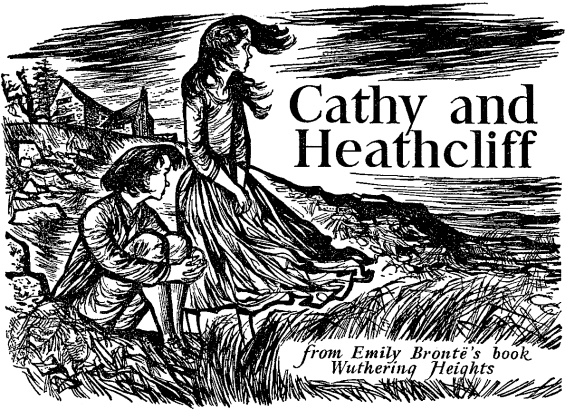
Cathy And Heathcliffe by Emily Brontë - illustration by William Stobbs

I’ve been looking for an excuse to begin reading Emily Brontë‘s Wuthering Heights!

Now I’ve got one.

This excerpt from the novel works well on it’s own, and makes up the bulk of chapters IV, V, and VI.

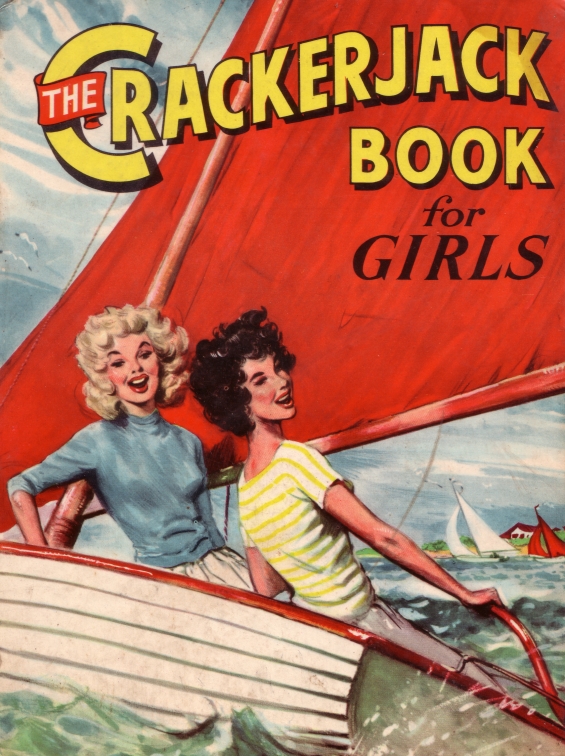
I found it in a great uncopyrighted (and undated) kid’s book from the mid 20th century called The Crackerjack Book For Girls!

The Crackerjack Book For Girls

I love these old collections, they combine terrific illustrations with a level of intelligence that’s hard to find in modern kid’s books.

What I’ve actually done here is taken the story’s text and images |PDF| and matched them up with the terrific solo narrated audiobook as performed by the talented Ruth Golding for LibriVox. Or to put it another way I abridged the public domain audiobook of Wuthering Heights to match the text as it appears in The Crackerjack Book For Girls. Here’s the |MP3|.

I should also point out that the complete audiobook of the novel is HERE).

Before you listen, read, or watch the video check out the introduction to Cathy And Heathcliff as it appeared in The Crackerjack Book For Girls:

Emily Brontë was one of three sisters – all if them writers – who lived in the first half of the nineteenth century. Their father was a clergyman and their home was Haworth Parsonage, a bleak, rather forbidding house with the gravestones if the churchyard on one side and the wild, desolate Yorkshire moors on the other.

Their lives were spent in this lonely little village if the West Riding, and the Yorkshire character and landscape colour all their writings. Emily, particularly, loved the windswept, moorland country which surrounded their home, and Wuthering Heights, her only novel, owes its sombre, fascinating atmosphere to the background if her life.

Of the three sisters, Charlotte, Emily and Anne, only the work of Charlotte gained recognition in the author’s lifetime; but now, a century later, we recognise the true genius if Emily. The beauty of her poetry, and the power and dramatic quality if her novel far excel anything written by her sisters (even Charlotte’s masterpiece, Jane Eyre).

Wuthering Heights relates the histories of two neighbouring Yorkshire families, the Lintons and the Earnshaws, through three generations; and the changes if fortune brought upon both of them by the chance action if Mr. Earnshaw, which is described in the excerpt from the book which follows. The strange little foundling boy grows up to be the principal actor in the drama. This is Heathcliff, a character drawn with a power and assurance which at once mark Emily Brontë as a great English writer.
(The story is told in the first person, and is taken up in turn by minor characters in the book. Here Nellie Dean, an old family servant, is telling the story.)

And here’s the afterword:

This incident marked the close of a chapter in Heathcliff’s life. The Cathy who came back to Wuthering Heights had changed beyond his recognition; her stay with the Lintons had turned her into an elegant young lady with fine clothes and manners. In bitter disappointment and despair, Heathcliff fled. Years later he returned, a grown man. Hatred and a desire for revenge had taken complete possession of him, and his one reason for living had become vengeance upon Hindley.

Posted by Jesse Willis

Philip K. Dick Philosophical Podcast

SFFaudio Online Audio

I’ve yearned for a podcast like this! For years, endless years. And now it is real! As real as their owl.

Do you like their owl?
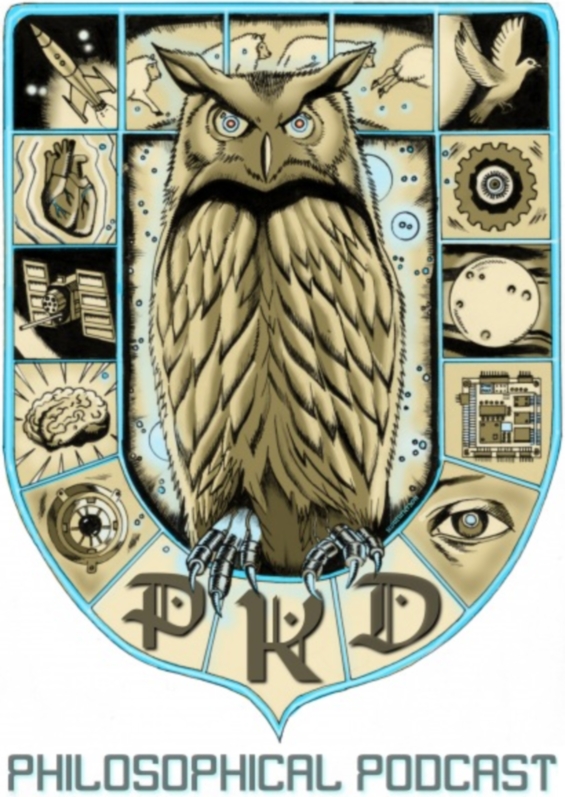
PKD Philosophical Podcast

Here’s the official description:

“Exploring the paranoid, hallucinatory future worlds of author Philip K. Dick. At the PKD Philosophical Podcast, we attempt to answer the important philosophical questions, like ‘how tasty are martian go-birds?’, and ‘why can’t androids dream of regular sheep like the rest of us?’ Each episode covers one short story, or part of a novel, starting with Philip K. Dick’s early short stories from 1952.”

I want to say that Adam Hulbert and Phil Young have done a pretty good job with the show so far. But my expectations are just too high. The show is just not fantastic, nor in any sense as definitive as I’d like it to be, at least not yet.

I will admit the logo is absolutely fantastic, as you can see above.

The audio itself is way, way overproduced, with added echoes and trippy (useless) sound effects.

Also, the website is buried, buried, on get this…. Facebook … YUCK!
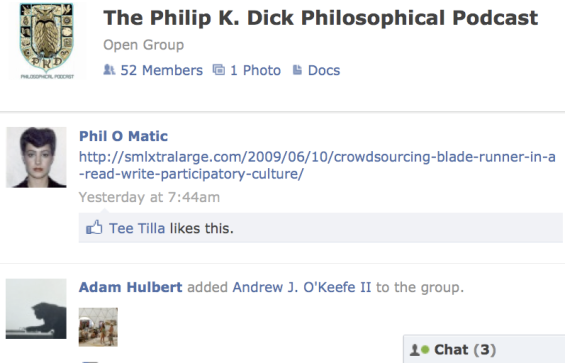
PKD Philosophy Podcast Facebook page

But the ambition, the ambition! The potential for a podcast like this is terrific!

Now my main problem with the show, other than the extensive, unnecessary and frankly annoying sound design work, is the lack of homework done by the hosts.

For instance, in the first episode Adam and Phil lay down references to Ulysses 31, which was an early 1980s anime series based on The Odyssey that they apparently both saw. It’s a reference they both get and chuckle about and that’s it. I had to look it up. And maybe the connection is strong if you’ve seen the show. But I just don’t see it at all. Myself I’d have gone with the original, The Odyssey itself (particularity Book X which features a minor goddess turning men turn into pacifistic pigs). I’d relate a brief outline of the story and let that fuel the discussion. They don’t do that.

Adam and Phil ask a question about this line that comes near the end of the story:

“A very foolish thing,” it said. “I am sorry that you want to do it. There was a parable that your Saviour related—”

The guys are wonder which parable the wub was going to relate asking: “Could it be the story of Judas? Could it be the story of Lazarus?” Could it be the story of Cain and Able?” And I will admit that this is a ponderer. It definitely isn’t the story of Cain and Abel, that’s old testament guys – get it straight – they just let it all lie there as an unanswered question. They don’t even try to answer it. Terrible! Terrible! DO YOUR HOMEWORK GUYS!

Myself, when I read that line, I always think of Matthew 26:26 where Jesus suggest his disciples eat some bread as if it were his body (While they were eating, Jesus took bread, gave thanks and broke it, and gave it to his disciples, saying, “Take and eat; this is my body.”).

But that isn’t really a parable as much as it is a straight up metaphor. It’s closer to the parable form in John 6:35 in which Jesus says:

“I am the bread of life. He who comes to me will never go hungry”

That fits the story, but again it isn’t exactly a parable as much as it is a metaphorical statement. I like the “comes to me” part though.

Perhaps Luke 14:7-11, an actual parable, would be better:

When he noticed how the guests picked the places of honor at the table, he told them this parable: “When someone invites you to a wedding feast, do not take the place of honor, for a person more distinguished than you may have been invited. If so, the host who invited both of you will come and say to you, ‘Give this person your seat.’ Then, humiliated, you will have to take the least important place. But when you are invited, take the lowest place, so that when your host comes, he will say to you, ‘Friend, move up to a better place.’ Then you will be honored in the presence of all the other guests. For all those who exalt themselves will be humbled, and those who humble themselves will be exalted.”

The other idea I had was Matthew 8:28-33:

“When he arrived at the other side in the region of the Gadarenes, two demon-possessed men coming from the tombs met him. They were so violent that no one could pass that way. “What do you want with us, Son of God?” they shouted. “Have you come here to torture us before the appointed time?” Some distance from them a large herd of pigs was feeding. The demons begged Jesus, “If you drive us out, send us into the herd of pigs.” He said to them, “Go!” So they came out and went into the pigs, and the whole herd rushed down the steep bank into the lake and died in the water. Those tending the pigs ran off, went into the town and reported all this, including what had happened to the demon-possessed men.

I admit that I don’t know which of these parables, if any, Dick was actually referring to, but I at least did my homework. DO YOUR HOMEWORK GUYS! DO YOUR HOMEWORK!

Adam Hulbert and Phil Young also take a stab at the title’s meaning. This is a problem that vexes me too. Dick loved to use literary allusions, and he loved the word “beyond”. I’m betting Beyond Lies The Wub is a variation of some poem with a line reading “beyond lies the _______”. But I haven’t found that yet.

And then Adam and Phil talk about the name “wub” itself.

I’d say, wub = love. As in “I wub you vewy much.”

But where is the talk about Circe and her animals? That’s something Dick comes back to in Strange Eden. Where is the discussion of the visual pun of Peterson the captain and all the crew sitting at the table and eating? Get it? Peter-son? As in the disciple Peter at The Last Supper. Where is the discussion of the immortality of the soul? What the hell is an optus and why don’t you care? And more importantly, for a podcast about philosophy in PKD stories, where is the discussion of the metaphysics, ethics, aesthetics, and epistemology at work in this story?

Here are the first four episodes:

Ep1. Beyond Lies The Wub |MP3| –We discuss Philip K. Dick’s first published short story. Adam muses on the relative delectability of Martian go-birds, and Phil tries not to use the sweepings of his semantic warehouse to discuss space truckers. Readings by Stephanie Carrick. Music by A

Ep2. The Gun |MP3| –We discuss Philip K. Dick’s second published short story. Adam cautions on the dangers of basing romantic decision on fairybread come-downs, and Phil plays with hand-held nukes. Readings by Stephanie Carrick. Music by Adam Hulbert. Intro by Luke ‘voiceo

Ep3. The Skull |MP3| –We sidestep the vast reaches of space and delve into the exotic landscape of midwest America for some slem-gun-toting timetraveller-stand-offs at high noon. Watch yer don’t get yer truck shot full of holes… Readings by Luke ‘Voiceover’ Mynott.

Ep4. The Little Movement |MP3| –When good toys go bad! This episode we discuss Philip K. Dick’s story about a wind-up toy soldier revolution on 1950’s earth. And feature some of Luke ‘ Voiceover’ Mynott’s finest work to date…

Podcast feed:

http://www.weirdfictionrecords.com/pkdpodcast/pkd-pp-feed.xml

Posted by Jesse Willis