News, Reviews, and Commentary on all forms of science fiction, fantasy, and horror audio. Audiobooks, audio drama, podcasts; we discuss all of it here. Mystery, crime, and noir audio are also fair game.
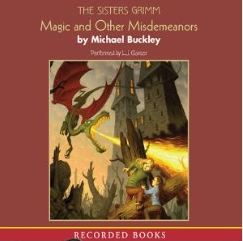
The Sisters Grimm: Magic and Other Misdemeanors (Book 5)
By Michael Buckley; Read by L. J. Ganser
6.5 Hours – [UNABRIDGED]
Publisher: Recorded Books
Published: 2008
Themes: / Fantasy / Magic / Mystery / YA /
This is the fifth book in the series, but my first foray into the world of the Sisters Grimm.
At first I found it interesting. Two young girls, Sabrina and Daphne, are the last in a long line of descendants or Wilhelm Grimm. They live with their Granny Relda, Uncle Jake, Mr. Canis and Puck, a mischievous fairy with a penchant for trouble. Their parents are asleep, victims of some sort of sleeping spell.
The girls are being trained to be detectives and help the Ever Afters, immortal folk from the fairy tales, who are trapped in Ferryport Landing.
I like the premise. I like the characters and the story. But as I got into the story I found myself pulling out my iPod every chance I could get to listen. I even found myself lying in bed, listening to the story when I should have been sleeping.
This time, the group must pay the evil Mayor Heart and Sheriff Nottingham exorbitant back taxes or risk losing their home. At the same time, three of their Ever After friends have lost valuable magical items and need the Grimm’s help in recovering them.
The ending is not what I expected. Well, not exactly. Nor were several of the twists thrown in to distract the family and keep them from solving the case. But they all fit very nicely and the ending was satisfactory – sort of. The story ended with a “To be continued” as the overarching story continues. I’ve already purchased book six to begin as soon as I finish this review.
On a scale of one to ten, I give this book an enthusiastic nine. Read it. Give it to your daughters, nieces, nephews and anyone who loves fantasy and fairy tales. It’s a delightful book.
Arguably: Essays
By Christopher Hitchens; Read by Simon Prebble
24 CDs – Approx. 28.5 Hours [UNABRIDGED]
Publisher: Hachette Audio
Published: September 1, 2011
ISBN: 9781611139068
Themes: / Non-fiction / History / War / Biography / Science Fiction / Fantasy / Iran / Afghanistan / Germany / North Korea / France / Dystopia / Utopia / Religion / Tunisia / Piracy / Terrorism / Feminism / Pakistan /
The first new collection of essays by Christopher Hitchens since 2004, Arguably offers an indispensable key to understanding the passionate and skeptical spirit of one of our most dazzling writers, widely admired for the clarity of his style, a result of his disciplined and candid thinking. Topics range from ruminations on why Charles Dickens was among the best of writers and the worst of men to the haunting science fiction of J.G. Ballard; from the enduring legacies of Thomas Jefferson and George Orwell to the persistent agonies of anti-Semitism and jihad. Hitchens even looks at the recent financial crisis and argues for arthe enduring relevance of Karl Marx. The audio book forms a bridge between the two parallel enterprises of culture and politics. It reveals how politics justifies itself by culture, and how the latter prompts the former. In this fashion, Arguably burnishes Christopher Hitchens’ credentials as-to quote Christopher Buckley-our “greatest living essayist in the English language.”
Here’s a question I was thinking about while listening to Arguably.
What is fiction for?
One answer, the bad one, is that it’s for entertainment. That’s certainly where many readers are willing go, and the fiction writers who write it too. Maybe that’s precisely why so much fiction is just so very shitty.
To me, if you aren’t exploring ideas in your fiction, then you really aren’t serving a greater purpose. Idea fiction, fiction with ideas rather than just action and plot, is to my mind a kind of supplement to the wisdom found in writings on history, biography and science.
Of the many lessons learned I in listening to the 107 essays in Arguably I was particularly struck by the wisdom Christopher Hitchens gleaned from his reading of fiction. Hitchens reviews many books in this collection, nearly half of the essays are book reviews. Books like 1984, Animal Farm, Flashman, The Complete Stories Of J.G. Ballard, Our Man In Havana, and even, surprisingly, Harry Potter And The Deathly Hallows all get fascinating, critical, and reverent reviews.
Yet Hitchens also takes the lessons with him into his writing about his travels. Hitchens writes about visits to such places as North Korea, Cyprus, Afghanistan, and Kurdish Iraq. When talking about his visit to Beirut we see what comes when Hitchens, a man of ideas, acts upon them. The essay, The Swastika and the Cedar sees the convictions of the commited anti-fascist Hitchens beaten and nearly kidnapped for an act of vandalism on a prominently displayed swastika. Writes Hitchens:
“Well, call me old-fashioned if you will, but I have always taken the view that swastika symbols exist for one purpose only—to be defaced.”
In a review of two books, Lolita and The Annotated Lolita, Hitchens applies the controversial subject in a real life look at the modern, and very non-fictional oppression and objectification of women. Indeed, the ideas he appreciated in fiction helped Hitchens to come to grips with the real world.
I think the worst essay in this collection is the one on the serving of wine and restaurants, Wine Drinkers Of The World, Unite. It was simply a waste of the talent, too light, too easy a target. And yet, even that essay, the worst essay in all 107 has a memorable anecdote: “Why,” asks Hitchens’ five year old son, “are they called waiters? It’s we who are doing all the waiting.”
As to the narration of the audiobook. I’m ashamed to admit that I was initially dismayed when I saw that Christopher Hitchens had not narrated this audiobook himself. I was wrong to worry. Incredibly, Simon Prebble seems to have have become Hitchens for this narration. Prebble perfectly captures the erudite words, so eloquently performs them, and with an accent so like that of Hitchens’ own so as to make me think that it was Hitchens who had actually read it.
I think the worst essay in this collection is the one on the serving of wine and restaurants, Wine Drinkers Of The World, Unite. It was simply a waste of the talent, too light, too easy a target. And yet, even that essay, the worst essay in all 107 has a memorable anecdote: “Why,” asks Hitchens’ five year old son, “are they called waiters? It’s we who are doing all the waiting.”
Here’s a list of the book’s contents, with links to the original etexts when available, along with my own notes on each:
The Private Jefferson – a review of Jefferson’s Secrets: Death And Desire At Monticello by Andrew Burstein
Jefferson Vs. The Muslim Pirates – a review of Power, Faith, And Fantasy: America In The Middle East: 1776 To The Present by Michael B. Oren
Benjamin Franklin: Free And Easy – a review of Benjamin Franklin Unmasked: On the Unity of His Moral, Religious, And Political Thought by Jerry Weinberger
John Brown: The Man Who Ended Slavery – a review of John Brown, Abolitionist: The Man Who Killed Slavery, Sparked The Civil War, And Seeded Civil Rights by David S. Reynolds
Abraham Lincoln: Misery’s Child (aka Lincoln’s Emancipation) – a review of Abraham Lincoln: A Life by Michael Burlingame
JFK: In Sickness And By Stealth – a review of An Unfinished Life: John F. Kennedy, 1917–1963 by Robert Dallek
Saul Bellow: The Great Assimilator – review of six novels by Saul Bellow (The Dangling Man, The Victim, The Adventures Of Augie March, Seize The Day, Henderson The Rain King, and Herzog)
Vladimir Nabokov: Hurricane Lolita – reviews of Lolita by Vladimir Nabokov and The Annotated Lolita edited and annotated by Alfred Appel, Jr.
John Updike: No Way – a review of The Terrorist by John Updike (with reference to The Coup too) John Updike: Mr. Geniality – a critical review of the affable Due Considerations: Essays And Considerations by John Updike
Vidal Loco – Gore Vidal went crazier, more elitist and perhaps more racist as he got older (with attention and quips for Quentin Crisp and Oscar Wilde and Joyce Carol Oates)
America The Banana Republic – Hitchens on the “socialistic” bank bailout of 2008 (“socialism for the rich and free enterprise for the rest”)
An Anglosphere Future – a review of The History Of The English Speaking Peoples by Andrew Roberts (with reference to both Sherlock Holmes and The White Company by Sir Arthur Conan Doyle as well as to Cecil Rhodes and Rudyard Kipling)
Political Animals – a review of Dominion: The Power Of Man, The Suffering Of Animals, And The Call To Mercy by Matthew Scully
Old Enough To Die – on capital punishment as applied to children In Defense Of Foxhole Atheists – a visit to the United States Air Force Academy and the tax funded proselytizing
ECLECTIC AFFINITIES Isaac Newton: Flaws Of Gravity – a stroll through the medieval streets of Cambridge with the scientists, mathematicians, and philosophers who worked there
Gustave Flaubert: I’m With Stupide – a review of Bouvard et Pécuchet by Gustave Flaubert translated by Mark Polizzotti The Dark Side Of Dickens – a review of Charles Dickens by Michael Slater a biography (Hitchens was a not uncritical admirer of the subject)
Marx’s Journalism: The Grub Street Years – a glowing review of Dispatches for the New York Tribune: Selected Journalism Of Karl Marx edited by James Ledbetter, foreword by Francis Wheen (Marx admired the United States, and other fascinating facts about the father of communism)
Rebecca West: Things Worth Fighting For – an introduction to Black Lamb and Grey Falcon: A Journey Through Yugoslavia by Rebecca West
Ezra Pound: A Revolutionary Simpleton – a review of Ezra Pound, Poet: A Portrait Of The Man And His Work: Volume I: The Young Genius, 1885-1920 by A. David Moody (a biography of the fascist poet)
John Buchan: Spy Thriller’s Father – a review of John Buchan The Presbyterian Cavalier by David R. Godine (with discussion of The 39 Steps and a fantasy novelette The Grove Of Ashtaroth)
Fraser’s Flashman: Scoundrel Time – a look at the George MacDonald Fraser series of Flashman books and the connection with The Adventure Of The Empty House
AMUSEMENTS, ANNOYANCES, AND DISAPPOINTMENTS Why Women Aren’t Funny – a controversial essay on why more comedians are male and why women laugh at them the way they do
As American As Apple Pie – a literary and chronological history of the blowjob, with reference to Valdamir Nobokov’s Lolita
So Many Men’s Rooms, So Little Time – a fascinatingly insightful argument on what’s was going on with the Larry Craig bathroom airport scandal and related phenomena
A War Worth Fighting – a persuasively systematic review of Churchill, Hitler And The Unnecessary War: How Britain Lost Its Empire And The West Lost The World by Pat Buchanan
Just Give Peace A Chance? – a critical review of Human Smoke by Nicholson Baker
Don’t Mince Words – the disenfranchisement of south Asians in Britain isn’t the cause of bombings, hatred of women is.
History And Mystery – al-Qaeda in Iraq, jihadists, or “insurgents”? Do words matter? Of course they bloody well do.
Words Matter – political slogans make of “every adult in the country” an “illiterate jerk who would rather feel than think”
This Was Not Looting – how can a government “loot” it’s own weapons manufacturing facility? The government of Iraq managed it according to The New York Times.
The “Other” L-Word – a lighthearted piece on the prominence of the word “like” and it’s use
The You Decade – what’s wrong with you (marketing to the selfish)
Suck It Up – the Virginia Tech shootings prompted the wrong response from the world (namely that it prompted one)
A Very, Very Dirty Word – the English empire, in centuries to come, may only be remembered for soccer and the phrase “fuck off”
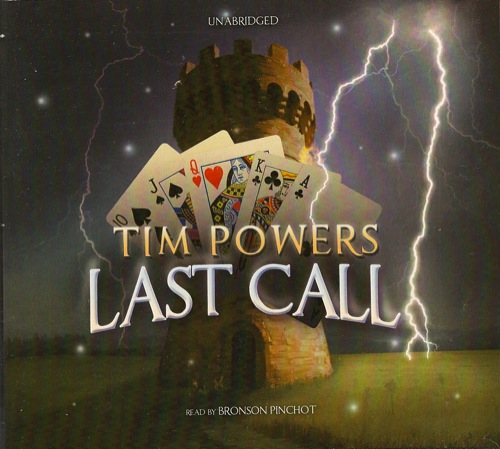
Last Call
By Tim Powers; Read by Bronson Pinchot
16 CDs – Approx. 19.1 Hours [UNABRIDGED]
Publisher: Blackstone Audio
Published: December 2010
ISBN: 9781441757364
Themes: / Fantasy / Gambling / Immortality / Las Vegas / Poetry / Arthurian Legend / Greek Mythology / Egyptian Mythology
Scott Crane abandoned his career as a professional poker player twenty years ago and hasn’t returned to Las Vegas, or held a hand of cards, in ten years. But troubling nightmares about a strange poker game he once attended on a houseboat on Lake Mead are drawing him back to the magical city. For the mythic game he believed he won did not end that night in 1969—and the price of his winnings was his soul. Now, a pot far more strange and perilous than he ever could imagine depends on the turning of a card. Enchantingly dark and compellingly real, this World Fantasy Award–winning novel is a masterpiece of magic realism set in the gritty, dazzling underworld known as Las Vegas.
Tim Powers’ Last Call (1992 William Morrow and Co.; 2010 Blackstone Audio, Inc.) is studded with references to old myths, snatches of T.S. Eliot’s “The Wasteland,” the art of poker playing, and the unique culture and atmosphere of old and new Las Vegas. It contains numerous major and minor characters, overarching themes and subplots, and digressions into probability theory. In other words, it demands close reading and attention to detail. Listening to it in half-hour chunks as I did while driving to work was probably not the best idea, and may have affected my review of the book, but what follows is an honest appraisal.
There’s a lot to like in Last Call, and I lot I liked. At its heart it’s really about the vast, mysterious forces driving the universe and the ways in which they manifest in our lives. Why does tragedy pass over a criminal and take a good person instead? Why does a disease like cancer randomly strike a family man with a wife and children to support? Although life appears chaotic and meaningless, perhaps there are active, purposeful forces of fate at work as well, old gods that exist outside our typical suburban lives but can be sought out and appealed to, and even manipulated. In Last Call Powers breathes new life into ancient myths like the Arthurian Fisher King, the Greek god Dionysus, and the Egyptian goddess Isis, incorporating themes of resurrection and physical health tied to spiritual health. These ancient demigods reappear in the forms of unlikely modern-day characters, including broken-down ex-gambler Scott Crane and his estranged foster-sister Diana. Last Call also includes a cast of memorable bad guys, including a bloated fat hit man Trumbull who is convinced that eternal life can be had through the consumption of raw flesh, and the chief baddie Georges Leon, a mystic who achieves immortality through stealing and possessing the bodies of the living. Crane is the central figure in the story, a man who in 1969 played a portentous game of Assumption with a powerful set of tarot cards. Twenty years later Crane returns for a second game against Leon with nothing less than his soul on the line.
Last Call is ultimately a hopeful book, as it implies that there may be a purpose to our lives and a way to control one’s destiny, if you can read the cards and master the archetypes of the Tarot. In Powers’ hands playing cards are a metaphor for the mysteries of life and the skill and luck required to navigate its uncertain waters.
Neil Gaiman’s American Gods employs a similar conceit of old gods reincarnated in the modern world but I must say I enjoyed Gaiman’s take better. Powers is a talented writer and I enjoyed his descriptions of the seedy soul of Las Vegas, as well as some memorable set-pieces he creates, including an encounter with the ghost of the infamous gangster Bugsy Siegel beneath the waters of Lake Mead. But the slow pace of the narrative, the meandering plotline, the too-numerous characters and plotlines that drop in and out of the story without sufficient explanation and resolution (Crane’s wife Susan, for example), and tedious descriptions of card game after card game make Last Call a difficult listen and at times an outright chore, despite the fine narration by Bronson Pinchot.
Perhaps my lukewarm reaction to Last Call has something to do with the fact that I I’m not a fan of card playing; Vegas is a cool place to visit and I’ve tried my hand at a few slot machines, but sitting down at a table in the company of hardcore gamblers has zero appeal for me. If you read Last Call watch closely for the signs, the subtle flush of cheek or restless eyes that the best card players know how to detect and interpret. As for casual readers: Beware.
Nine Princes in Amber
By Roger Zelazny; Read by Alessandro Juliani
5.5 Hours – [UNABRIDGED]
Publisher: Audible Frontiers
Published: 2012
Themes: / Fantasy / Siblings / Royalty / Swordplay / Magic /
Before Joss Whedon, there was Roger Zelazny. I thought this at some point during this time through Nine Princes in Amber, a book I revisit now and then. Zelazny’s dialogue is snarky and the story quick and interesting. Figure out how to depict the road to Amber, and the Amber novels would make an excellent television series. If Joss wrote this, though, the women in the story would have stronger roles.
My reason for re-reading this was the publication of a new unabridged audio version from Audible Frontiers. Alessandro Juliani narrates, and makes the story even better. Before this, the only unabridged recording that existed was read by Zelazny himself. I’ll definitely keep those audiobooks – Zelazny has a very distinctive voice – but Juliani’s reading fleshes out the character of Corwin so well that it makes the book more entertaining.
The novel is told in first person from Corwin’s point of view. At the opening, Corwin wakes up in a hospital bed with memory loss. As he figures things out, so do we. He learns that he’s a quick healer, that he’s got some skills, and that he has a sister. Further along he realizes more – he’s part of a royal family of Amber, the only true world. There’s magic and intrigue, there’s trumps and travels to Amber, there are creatures and mean princes. It’s wonderful. And it’s a short listen, coming in at only 5 1/2 hours.
If you like this one, listen to the other four in the series, all available on Audible. They are all great fun. After that, there are another five books. It’s excellent to see that Audible Frontiers is alert enough to change the narrator for those. Alessandro Juliani narrates the first five books, then Wil Wheaton takes over for the next five because those books are from another character’s point of view. Well done, Audible!
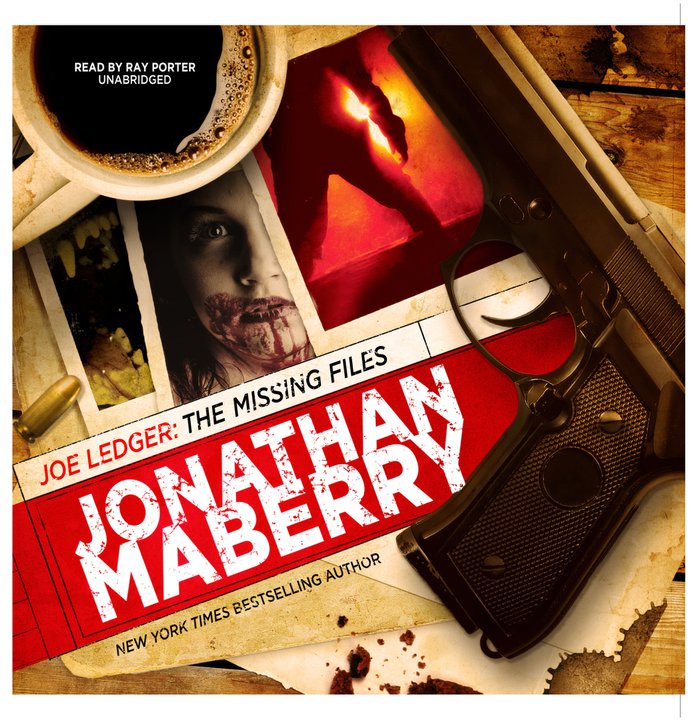
Joe Ledger: The Missing Files
By Jonathan Maberry; Read by Ray Porter
4 Hours – [UNABRIDGED]
Publisher: Blackstone Audio
Published: 2012
Themes: / Short Stories / Supernatural / Horror / Bio-engineering /
The description for this brief collection of short stories says “… author Jonathan Maberry fills in the blanks in his action-thriller ‘Joe Ledger’ novels.”
This isn’t something I’d have picked up myself and, frankly, wouldn’t have bothered if it weren’t sent as a review book. I am usually disinterested in add-on short stories that sew up “loose ends” of novels or serve to tell us what a character’s been doing between one book and the next. In my experience, those are toss-offs and these days, what with 99-cent stories on Amazon, they just serve as money grabbers.
However, we all know I’m a sucker for Joe Ledger and I absolutely love the narrator’s way with these stories so if I wasted a few hours on mental cotton candy so be it. Also I was mildly interested in what seem to be two stories that aren’t connected to any novels, “Deep, Dark” and “Material Witness.”
Countdown: The prequel to Patient Zero and it told me nothing I didn’t learn in the beginning of the book. Honestly, it seemed as if it were a story prospectus given to a publisher to gain interest.
Zero Tolerance: The second story added a little to Patient Zero‘s ending since it could have been called “What Happened to Amirah.” (Pardon my spelling as I’ve only heard the audio for the novel.) Worth paying for? Not to me.
Deep, Dark: With the third story we get to something interesting. As is the case in Joe Ledger novels, it teeters on the knife’s edge between probability and supernatural/horror fiction. The Army has a little problem in one of their underground complexes. A little bio-engineered problem. It’s just a “bug hunt,” as it goes in one of my favorite lines from Aliens, but one that has righteousness on its side.
Material Witness: This story was more interesting than anything preceding it (or following, as it turned out … yes, foreshadowing!). However, that was mostly because Maberry was filling us in on another series of his: the creepiness that is Pine Deep, Pennsylvania. Imagine the house from The Shining, but … it’s a whole town! Maberry’s melding of the two worlds was rather intriguing but not enough to make me want to get whatever book it was he wrote about Pine Deep. For one thing, spoilers abound. I wonder if I already knew all about that “world” if the story would have kept my attention as it did.
Dog Days: The final story and the one which was the test of whether Maberry had improved at short story writing or whether the previous two just created interest because of the unfamiliar material. Yep. Choose door number two. It wasn’t a terrible story, just extremely easy to figure out as Joe Ledger goes to settle a personal grudge against the world’s deadliest assassin. The most interesting thing about it to me was the introduction of Ghost, the wonder dog. One feels (at least I do) that this should have been a prequel or flashback in The King of Plagues. I especially feel this since I spent much of the beginning of that book wondering what the heck happened to Ledger’s cat and why only one or two sentences gave us the dog’s history. This almost reads as discovery writing or something that was edited from a book. Ghost is ok, but he is definitely “made” to be Ledger’s dog, as he is a Wonder Dog with super-canine reflexes and understanding.
Summing up – these files could’ve stayed missing. It’s only four hours long but that is four hours you could use on something uniformly good.
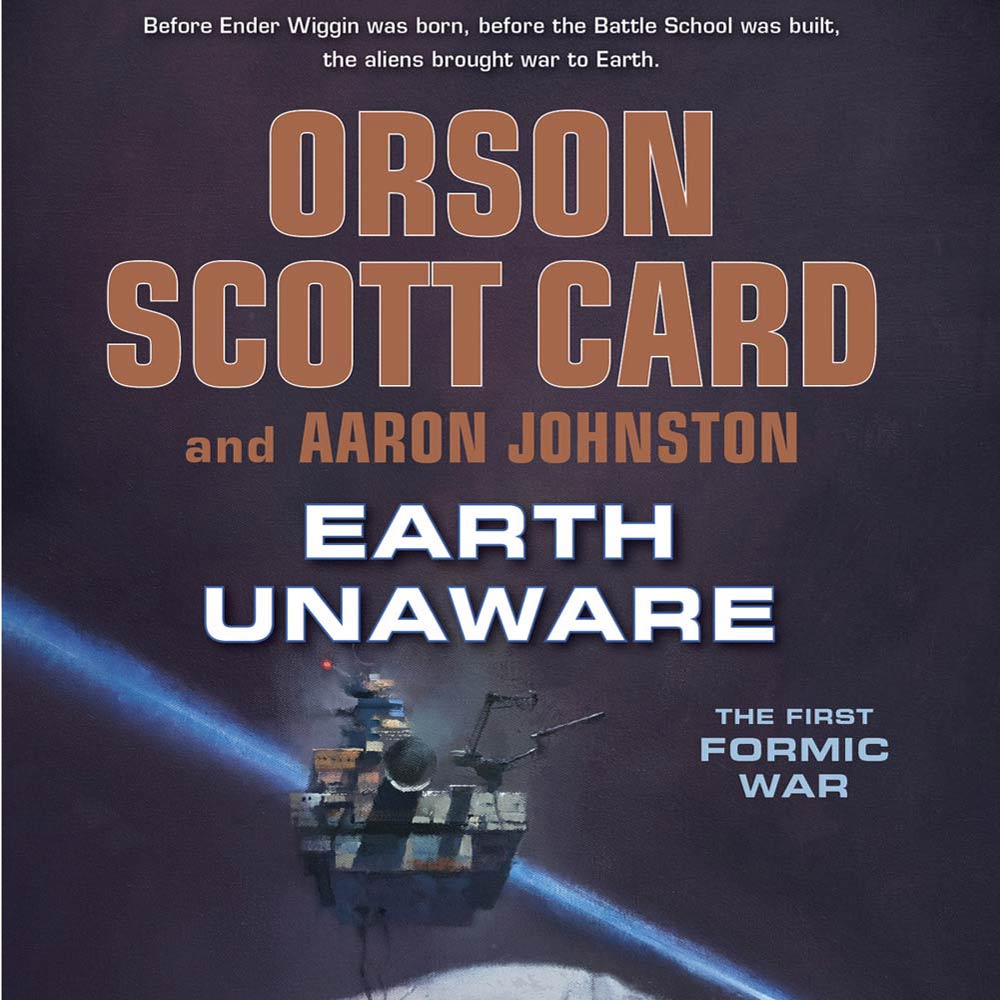
Earth Unaware
By Orson Scott Card and Aaron Johnston
Read by Stefan Rudnicki, Stephen Hoye, Arthur Morey, Vikas Adam, Emily Janice Card, Gabrielle de Cuir, and Roxanne Hernandez
14 Hours – [UNABRIDGED]
Publisher: Macmillan Audio
Published: 2012
Themes: / Science Fiction / Solar System / Asteroids / Mining / Gravity / Aliens / Alien invasion /
One of the pleasures of listening to science fiction audiobooks over the years has been hearing Orson Scott Card’s Ender series. Besides being expertly narrated by an ensemble led by Stefan Rudnicki, these audiobooks are entertaining because Card isn’t delivering the same book over and over. In Earth Unaware, Orson Scott Card and Aaron Johnston take the series in yet another direction.
I know, I know. It’s been proven time after time. When a book series gets to the point where [Original Author] picks up [Insert new author here (often a relative)], the results are just… not good. I’m happy to report that Earth Unaware is an excellent novel. I thoroughly enjoyed it.
Aaron Johnston and Orson Scott Card created and are telling the story of the First Formic War in the comic format. I haven’t read those, so I can’t say how similar this novel is, but Aaron Johnston says in the Afterword that Earth Unaware draws from the characters and events in those comics.
The subtitle (First Formic War) implies that we’re in for a military SF novel, but that’s not what this is. This novel is a tense near-space adventure set in the not too distant future and peopled with characters I cared about. The opening reveals the thoughts and feelings of teenager on the El Calvador, a mining ship in the Kuiper Belt. Close by, on a different ship, is a man who has invested much time and effort into the invention of a gravity laser. He needs to prove his worth to his corporate employer. And back on Earth, an elite military unit is being formed. These lives, some entwined, move forward as normal until all interests are altered in the face of the arrival of an alien ship in the solar system.
Even though the cover doesn’t say it, this is Book 1 of at least a few. I look forward to the continued development of the concept of difference. On Valentine Wiggin’s Hierarchy of Foreignness is Varelse. True aliens, aliens so alien that we can’t even communicate with them or even hope to understand them. How could war with such a race be avoided? Difference also extends to human beings, who seem so content to drop their conflicts in the face of greater danger. Why is that what it takes?
The audiobook is performed by multiple narrators in the style that fits Orson Scott Card’s stories so incredibly well. The narrators (all excellent) change with the POV of the story. Reading the story were: Stefan Rudnicki, Stephen Hoye, Arthur Morey, Vikas Adam, Emily Janice Card, Gabrielle de Cuir, and Roxanne Hernandez. Top notch!

 The Sisters Grimm: Magic and Other Misdemeanors (Book 5)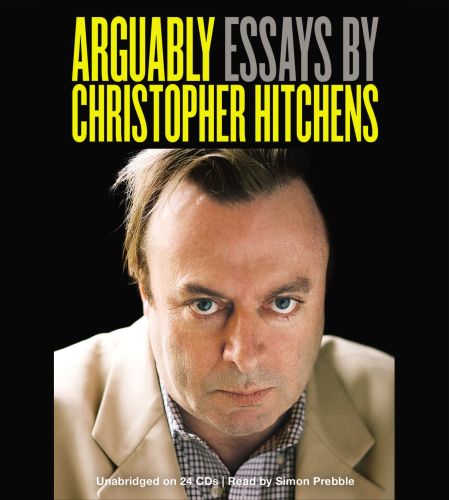
 Arguably: Essays