Review of Dark Adventure Radio Theatre: H.P. Lovecraft’s The Shadow Out Of Time

SFFaudio Review

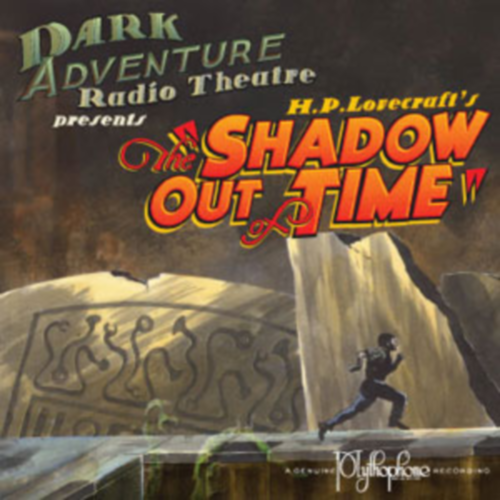
HPLHS - Dark Adventure Radio Theatre - H.P. Lovecraft's The Shadow Out Of Time SFFaudio EssentialDark Adventure Radio Theatre: H.P. Lovecraft’s The Shadow Out Of Time
Adapted from the novella by H.P. Lovecraft; Performed by a full cast
1 CD – Approx. 77 Minutes [AUDIO DRAMA]
Publisher: HPLHS
Published: October 27, 2009
Themes: / Horror / Science Fiction / Aliens / Consciousness Swapping /

It their line of faux Old Time Radio shows the H.P. Lovecraft Historical Society has also adapted the old master’s The Shadow out of Time. After the slightly disappointing At the Mountains of Madness and the great Dunwich Horror we now look the The Shadow Out Of Time – not quite what I would have expected for an audio drama treatment.

As usual you can get the audio both as a download and in the physical CD form, the latter is enhanced with certain goodies. The HPLHS started off as a supplier of props for Lovecraftian role-playing games (both pen-and-paper, and live action). This CD is no exception and so you can find a cutout from the fictitious Arkham Advertiser printed on real newspaper paper, a sealed Marconigram (a telegram), torn pages from a psychological journal detailing the case of Nathaniel Peaslee, and finally a very well made faux facsimile page from the infamous “Von Unaussprechlichen Kulten“. The latter being in absolutely perfect German. Not that you will actually need any of these things but they are fun to look add and just add to the impression that this is a quality product.
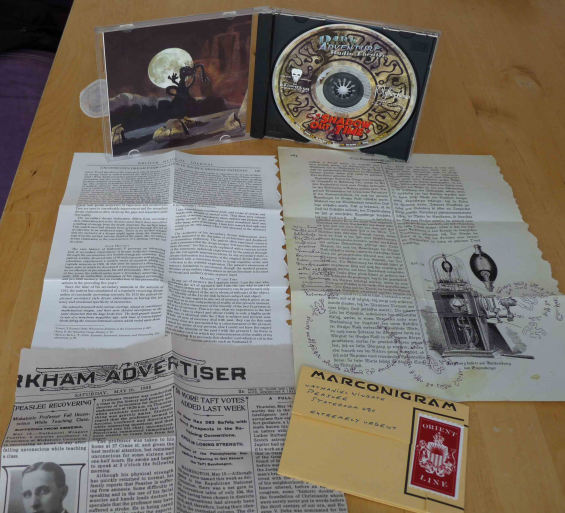
HPLHS - The Shadow Out Of Time - Ephemera

But what about the audio?

The story tells of Nathaniel Peaslee, Professor of Political Economics whose mind gets exchanged by an alien entity from the Great Rave of Yith who are time travelers from earth’s distant past. The strange behavior of the entity in his body alienates Peaslee from his family and friends, and he becomes a celebrity patient among psychologists.

When the real Peaslee is being sent back into his body with no memories of his experience he is shocked to find his life in shambles and is soon confronted with nightmarish visions of his life as a captive of the Yithians. Eventually he becomes involved in an archeological dig in Australia that is about to uncover the remnants of the ancient pre-human city along with the Yithian arch-enemies that still dwell there.

Lovecraft’s usual topic, of showing the insignificance of human kind in light of some alien being or race who could eradicate it in the blink of an eye, is emphasized by the fact that even these powerful beings can be overcome by some more powerful than they are.

Let’s face it, you don’t read an individual Lovecraft story for the action or suspense. It’s more the joy of unveiling the cosmology that connects most of his literary works. The Shadow Out Of Time is no exception, if anything it is an even more than typical example. I mean it starts with an alien hijacking a professor of *Political Economics* of all things! (Dear students of Economics, this is nothing personal but you must admit that the discipline does not quite come to mind as the starter for a horror story of cosmic dimensions) A sizable part of the story consists one massive infodump detailing the culture and society of the Great Race of Yith. In it Lovecraft even goes so far as to classify the economic and political system (I can see a pattern evolving) of the Yithians, which he dubs some form of “socialist fascism”. All of this is delivered in the form of a letter to Peaslee’s son and the world at large.

Not an easy thing to turn into an audio drama.

However, the HPLHS managed surprisingly well to create a more dynamic form of presentation. First of all, when the story starts on the ship bringing Peaslee home from Australia the audio drama introduces the ship’s doctor as a counterfoil so that Peaslee can actually tell his story to someone. Peaslee’s research into the lost years of his amnesia during which his hijacker traveled the world in search of arcane knowledge is made more vivid through a conversation with a Swedish librarian, and so are the flashbacks into his incarceration in Earth’s distant past together with fellow prisoners from other ages and places. These diversions from the original story all serve to liven up the dramaturgy without changing the essence of Lovecraft’s Shadow Out Of Time.

As usual, the production and voice acting are great, especially considering that this is not an entirely professional production. The HPLHS are hobbyists who, in spite of the love and attention to detail they pour into their products, have not lost their sense of humour. Thus, The Shadow Out Of Time is the first Lovecraft adaptation to my knowledge which features product placement (Fleurs de Lys anyone?). It is not least this tongue-in-cheek humour that helps to turn an slightly stuffy tale of pre-historical kidnapping with cosmic, nay, titanic dimensions into an enjoyable audio drama. Highly recommended.

Posted by Carsten Schmitt
Review of The Summer Isles by Ian R. MacLeod

SFFaudio Review

AUDIBLE FRONTIERS - The Summer Isles by Ian R. MacLeodThe Summer Isles
By Ian R. MacLeod; Read by Steve Hodson
Audible Download – Approx. 13 Hours [UNABRIDGED]
Publisher: Audible Frontiers
Published: 2012
Themes: / Alternative History / Dystopia / History / Fascism / Homosexuality /

I have always been intrigued by alternative histories. Unfortunately my knowledge of history sometimes limits my enjoyment, being more of an overview of the subject. I often can’t tell if an event has been changed, and if so, whether it is significant or not. In some of the better alternate histories you can get away with not knowing too much about the period and still enjoy the story. Thankfully, in this case, I had recently been reading a history of Europe covering the same period from the early 1910’s to 1940.

MacLeod’s The Summer Isles is set primarily in a 1940 where Great Britain lost The Great War in 1918. America doesn’t enter the war and France makes an appeasement with Kaiser Wilhelm II’s Germany. The result is that Britain, not Germany, is left in a state of shock, feeling betrayed by their supposed allies. A young soldier, John Arthur, rises to power in the bleak years that follow, suggesting a parallel to Hitler, who gets only a single reference, never having the opportunities to gain power that losing the war afforded. The great Empire that was Britain is stripped away in the reparations following the war. That sense of betrayal is used to fuel Arthur’s rise to power as he brings in his political movement “Modernism”. John Arthur’s portrait hangs everywhere, even in the men’s public toilets.

Modernism is a very British take on fascism and drove several of the same horrors that Naziism did in our own history. Jews, homosexuals, intellectuals, the Irish and any and all other ‘deviants’ are persecuted and ultimately removed from the new Modernist society. The Jews in particular are sent to be “resettled” on the eponymous Summer Isles.

The story is told by Geoffrey Brook, a secretly homosexual Oxford history Don, who had some prestige for having been a favourite teacher of John Arthur as a child. Brook is in his 60’s in 1940 when he receives the news that he has at terminal lung cancer.

Brook, in trying to reconcile himself with his past, recounts in flashbacks the one true love of his life that he lost in the Great War. More flashbacks fill in the years before and after that war; several of the scenes flowing together with the present day as Brook’s mind drifts in and out of his reminiscences. Particularly when he visits some of the same locations.

MacLeod’s writing is excellent, at times didactic, as the historian narrator recounts past political and social events, yet by turns touching, confused, detailed and frightened as more personal or recent events are recounted. Slow at times, this fits will with the drifting recollections of the narrator as the hidden story is gradually revealed. The final act of the novel moves at a much faster pace, while still holding convincingly onto the character of the narrator. The Summer Isles was nominated for the John C Campbell Memorial Award, the Sidewise Award for Alternate History and the World Fantasy Award.

The audio narration by Steve Hodson fits the character perfectly. The weariness with life, the broken rapture at prized but lost moments of love and of lust are all perfectly portrayed. He even nails virtually all of the Scottish pronunciations; a pet peeve sf mind, being Scottish myself, with several other narrators.

Posted by Paul [W] Campbell

Aural Noir Review of The Hook by Donald E. Westlake

Aural Noir: Review

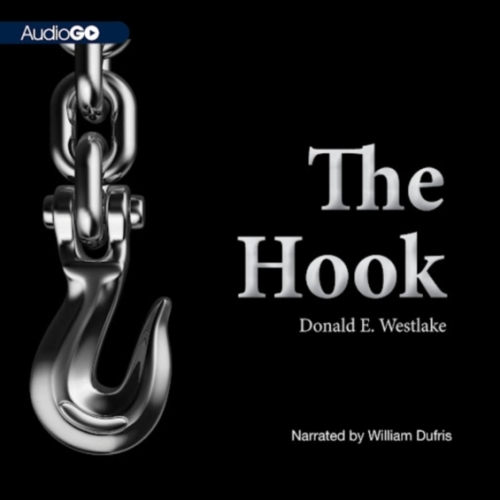
AUDIOGO - The Hook by Donald E. WestlakeThe Hook
By Donald E. Westlake; Read by William Dufris
MP3 Download – Approx. 7 Hours 17 Minutes [UNABRIDGED]
Publisher: AudioGo
Published: 2012
ISBN: 9781609988654
Themes: / Crime / Murder / New York /

Bryce Proctorr has a multimillion-dollar contract for his next novel, a trophy wife raking him over the coals of a protracted divorce, a bad case of writer’s block, and an impending deadline. Wayne Prentice is a fading author in a world that no longer values his work. He’s gone through two pseudonyms, watched his book sales shrivel, and is contemplating leaving the writing life. Proctorr has a proposition: If Prentice will hand over his unsold manuscript to publish under Proctorr’s name, the two will split the book advance fifty-fifty. There’s just one small rider to the deal…

I’m a literal babe in the woods when it comes to mystery/suspense. The Hook by Donald Westlake would be … the first book I’ve ever read in the genre. No, really. So if you’re interested in an evaluation of The Hook’s place among the all-time great works of crime fiction, or of learned comparisons to other like authors and works, you’ve come to the wrong place. But if you’re interested in reading the opinion of a purely neutral observer—a Fantasy/SF fan’s clear-eyed observations of a completely alien genre—read on.

I liked The Hook. It was a lot of fun. It’s obviously the product of a man with a lot of writing experience under his belt. This certainly describes Westlake (1933-2008), a legend in the genre more than a hundred novels and non-fiction books to his credit. The prose is effortless and engaging, the dialogue convincing. It’s mainly suspense, not action, though the violence is unexpected and shocking, and well-portrayed.

Bryce Proctorr is a bestselling mystery/suspense author in the midst of an ugly divorce with a terrible case of writer’s block. With his bills mounting, alimony looming, and a million-plus dollar advance hung up on a book he cannot produce, Bryce asks a former friend, Wayne Prentiss, a struggling mid-list author, to give him his manuscript in exchange for half the advance. The only caveat: Wayne has to kill Bryce’s wife first. Yikes.

The ending is not predictable, save as one possible outcome among many. Westlake keeps you guessing: Have Wayne and Bryce sufficiently covered up their tracks? Will the persistent New York detective Johnson solve the crime? Will Wayne decide that Bryce is too unbalanced and kill him to save his own skin? Will Bryce go off the deep end, cracking under the strain of covering up an awful deed and the mounting pressures in his life? These questions keep you reading on to a chilling end.

In addition to its intrigues The Hook also contains an interesting insider’s look at the publishing business and the squeeze put on midlist writers with the advent of the computer. Wayne’s lament: The bookstores took on 5,000 copies of his last book but only sold 3,100. So for his next work the computer recommends an order of only 3,500 copies. The result is thinner national distribution and lower sales: Wayne’s next book only moves 2,700 copies. So the computer calls for an order of 3,000. And so the downward spiral continues. His advances fall from $75,000 to $20,000. Wayne hits on a workaround: Writing under a pen name, he is able to get a good advance as a “first time” author with a good book. But when his pen name suffers the same fate, he takes up Bryce on his offer to collaborate as a behind-the-scenes ghostwriter. And so the events of The Hook unfold.

It’s hard to go into too much additional detail, lest spoilers ensue. But I will say I can definitely see the appeal of mystery/suspense, which lies in its unpredictability, the tension within and between the characters, and not knowing how or even whether a character’s bad deeds will go unpunished. Will I become a regular mystery reader? Probably not. Would I read something else by Westlake, should the chance arise? Certainly yes. The man can write.

William Dufris does a fine job narrating the tale; my only criticism is his voice portrayal of Bryce Proctorr, which seemed a little too reminiscent of J. Peterman of Seinfeld fame. Overall he has a fine voice for mystery.

Posted by Brian Murphy

Review of The Folded World by Catherynne M. Valente

SFFaudio Review

The Folded World (A Dirge for Prester John, #2)The Folded World (A Dirge for Prester John #2)
By Catherynne M. Valente, Read by Ralph Lister
9 hours 18 minutes [UNABRIDGED]
Publisher: Brilliance Audio
Published: November 2011
ISBN: 1597802034
Themes: / Fantasy / Creatures / Monks / Quest / Immortality / War / Crusades / Parenting

Publisher Summary: When the mysterious daughter of Prester John appears on the doorstep of her father’s palace, she brings with her news of war in the West–the Crusades have begun, and the bodies of the faithful are washing up on the shores of Pentexore. Three narratives intertwine to tell the tale of the beginning of the end of the world: a younger, angrier Hagia, the blemmye-wife of John and Queen of Pentexore, who takes up arms with the rest of her nation to fight a war they barely understand, Vyala, a lion-philosopher entrusted with the care of the deformed and prophetic royal princess, and another John, John Mandeville, who in his many travels discovers the land of Pentexore–on the other side of the diamond wall meant to keep demons and monsters at bay.

These three voices weave a story of death, faith, beauty, and power, dancing in the margins of true history, illuminating a place that never was.

To fully appreciate this book, it is essential to first read The Habitation of the Blessed (A Dirge for Prester John #1), because The Folded World starts off right where the last book left off. The mythology of this trilogy is thick, and the second book builds nicely on what is developed in the first.  Where in The Habitation of the Blessed, the reader is introduced to all the fantastical creatures and the ways of the new lands, The Folded World digs deeper into the stories of some of the characters.  Although Prester John himself has lived with his blemmye wife for some time, he is still experiencing life as an outsider as he tries to put his own religion through the filters of the various beings he encounters.

It doesn’t help that the Crusades are going on, and the armies are getting closer.  Prester John doesn’t exactly fit in with his old life the way he used to.  This conflict is central to the development of the overarching story that I’m sure will continue in book #3.

While The Folded World lacked the breathtaking impact of the first book, probably just because the overall world was familiar to me, the same elements that I loved are present here – beautiful writing, a detailed mythical place with its own history and stories, and the clash between worlds.  There is one more book planned in this series, with the release date tentatively set for November 2012.

Posted by Jenny Colvin

Review of Brad Lansky and the 4D-Verse

SFFaudio Review

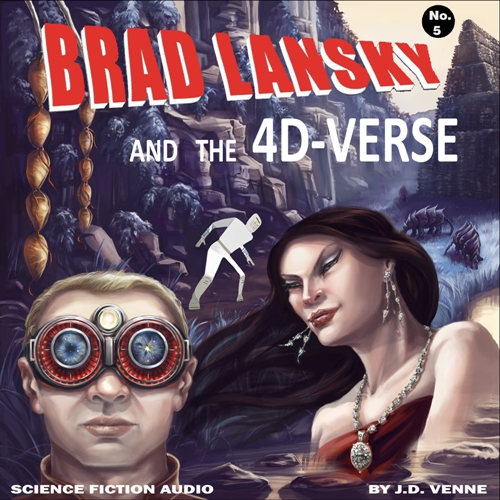
Science Fiction Audio Drama - Brad Lansky and the 4D-VerseBrad Lansky and the 4D-Verse
By J.D. Venne; Performed by a full cast
1.5 Hours – [AUDIO DRAMA]
Publisher: Protophonic.net
Published: 2012
Themes: / Science Fiction / Hard SF / Audio Drama / Dimensional space / Quantum entanglement / Artificial Intelligence /

Taking up where the previous Brad Lansky title ended, this drama has Brad and Alex exploring the 4D-Verse. They get split up while searching for MAMAI (an artificial intelligence), with Alex moving to a higher dimension while Brad figures how to get him back.

In a previous review I compared a Brad Lansky audio to Meatball Fulton’s Ruby series. This one comes from the same mold. It’s a aural feast from start to finish; among the richest audio you’ll hear. Another comparison leapt to mind this time: the film 2001: A Space Odyssey. Not only is the subject matter similar (hard SF involving alien beings), but the tone is similar. Just like Kubrick lingered on shots to allow the viewer time to experience awe, Dieter Zimmerman and crew linger with sound that creates images in the listener’s mind. This is very much a cooperative experience. Break out your best headphones and be prepared to provide imagination.

Lansky: I can’t wait to check out these places!
Alex: What? Are you crazy?
Lansky: No, just an explorer who doesn’t run away when he finds something interesting!

Dieter Zimmerman, one of the creative people behind the Brad Lansky series, was recently interviewed on Fred Greenhalgh’s Radio Drama Revival podcast. Find that episode |HERE|.

All of the Brad Lansky titles can be purchased at Protophonic.net!

Posted by Scott D. Danielson

Review of Moxyland by Lauren Beukes

SFFaudio Review

Image of Moxyland audiobook Moxyland
By Lauren Beukes; Read by Nico Evers-Swindell
8 hours [UNABRIDGED]
Publisher: Angry Robot via Brilliance Audio
Published: 2011

Themes: dystopia / commericalism / police states / apartheid / art / AIDS / cell phones

Publisher summary:

You think you know what’s going on?
You think you know who’s really in power?
You have No. Fucking. Idea.

Moxyland is an ultra-smart thriller about technological progress, and the freedoms it removes. In the near future, four hip young things live in a world where your online identity is at least as important as your physical one. Getting disconnected is a punishment worse than imprisonment, but someone’s got to stand up to government inc., whatever the cost.

This might be one instance where an audiobook has the potential to lead a reader (listener) into confusion more than reading the print might do. Moxyland is read by Nico Evers-Swindell, best known for his portrayal of Prince William in the made-for-tv movie William & Kate.  While he does a good job with the voices and South African accents, the intertwining stories are hard to keep up with, particularly with the way the reader is dumped right into the center of everything already going on.

That’s how living in a totalitarian, nearly-post-Apartheid South Africa can be sometimes. The four main characters in Moxyland don’t seem to have a grasp of the big picture either, and can hardly keep up with navigating the landscape where your cellphone can punish you, viruses can be used as crowd control, and your body can be turned into an irrevocable product advertisement.

This has tastes of William Gibson and Cory Doctorow, and the realism is helped by the ten years Beukes spent as a journalist, where she started thinking “What would happen if…?” The world she has created is scary, but not difficult to imagine.  After all, some of us are already living it.

Posted by Jenny Colvin