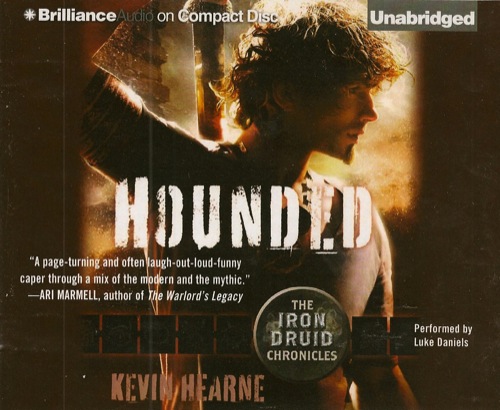
Review of Hounded by Kevin Hearne

SFFaudio Review

YA Fantasy Audiobook - Hounded by Hounded: The Iron Druid Chronicles
By Kevin Hearne; Read by Luke Daniels
8 Hours – [UNABRIDGED]
Publisher: Brilliance Audio
Published: 2011
Themes: / Fantasy / YA / Druids / Occult / Werewolves / Vampires /

This is the first of a hugely popular YA series, highly recommended by a friend and, luckily for me, available as a review book from SFFaudio.

Here’s the brief summary for those who, like me, hadn’t heard of this book:

Atticus O’Sullivan, last of the Druids, lives peacefully in Arizona, running an occult bookshop and shape-shifting in his spare time to hunt with his Irish wolfhound. His neighbors and customers think that this handsome, tattooed Irish dude is about twenty-one years old — when in actuality, he’s twenty-one centuries old. Not to mention: He draws his power from the earth, possesses a sharp wit, and wields an even sharper magical sword known as Fragarach, the Answerer. Unfortunately, a very angry Celtic god wants that sword, and he’s hounded Atticus for centuries. Now the determined deity has tracked him down…

The book begins with verve as Atticus is a charming narrator who introduces us to his friends, who are mainly from the supernatural world. We meet Druid gods, local werewolves, a Viking vampire, the local coven of witches, and Atticus’s Irish wolfhound, Oberon, with whom Atticus can carry on mental conversations. There are few genuine humans in Atticus’s life and none are developed beyond a paltry few amusing characteristics, such as the Irish widow who likes to get drunk before going to Mass and forgives murder on her lawn if she is told the victims were British. The most likable character in the group is the dog Oberon who is charmingly focused on doggish things and has just enough understanding of Atticus’s world to offer his own solutions from time to time.

My initial attraction to the story soon ground to a halt. The problem with this book, and it is a large problem, is that Atticus is a perpetual Peter Pan character. His emotional development seems to be frozen at several years younger than his outward 21 years since a heaving bosom is all it takes to permanently distract him from whatever he’s doing. Pity. One would have hoped that 2,100 years of living would result in a certain amount of experience leading to wisdom. Instead, Atticus spends more time in a practical joke on an ambulance attendant than in thinking through how much he should have healed himself from a bullet wound to make it seem convincing to local law enforcement. That’s ok though because Atticus has friends and allies who unfailingly show up to give an easy solution without readers ever feeling that Atticus himself is too worries about the outcome. This leads to a permanent lack of dramatic tension.

It’s a pity there isn’t a “Wendy” to accompany Atticus’s “Peter Pan.” That would give Hounded the necessary depth and contrast. Now we can see how wise J.M. Barrie was in the construction of his tale. Without a truly human element who lacks control of the situation, all the adventures are one boring episode after another with nary a worry about how Atticus will escape.

The one good thing about this book is the narrator, Luke Daniels. I haven’t come across him before but will keep an eye out for him in the future. His talents kept me listening long past the point where I would have given up. His voicing of Oberon has found its way into my head whenever we “speak” for what our dogs in our household.

Sadly, Daniels’ talents aren’t enough to make this shallow story worth your time. There are many wonderful YA stories out there that are worth reading and rereading: The Graveyard Book by Neil Gaiman, the Harry Potter series by J.K. Rowling, Eon: Dragoneye Reborn by Alison Goodman, White Cat by Holly Black, and Assam and Darjeeling by T.M. Camp are just a few.

For that matter, try Peter Pan by J.M. Barrie. You’ll see what Hounded could have been with proper attention given to the storytelling.

Posted by Julie D.

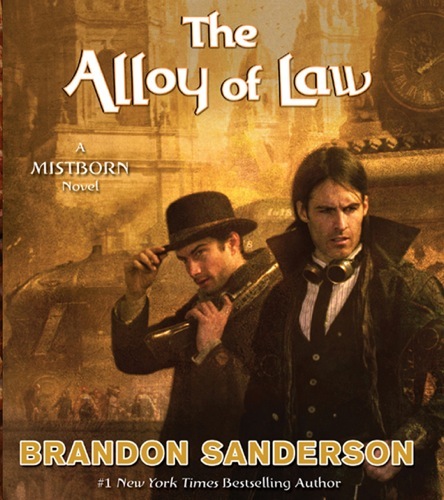
Review of The Alloy of Law by Brandon Sanderson

SFFaudio Review

Fantasy Audiobook - The Alloy of Law by Brandon SandersonThe Alloy of Law: A Mistborn Novel
By Brandon Sanderson; Read by Michael Kramer
11 hours – [UNABRIDGED]
Publisher: Macmillan Audio
Published: 2011
Themes: / Fantasy / Magic / Allomancy / Feruchemy / Series / Mistborn /

Ed. – Welcome to Jeff Miller (aka The Curt Jester) to the pages of SFFaudio! This is his first review for us.

Having just finished reading the Mistborn trilogy I was delighted to see that a new novel in the Mistborn universe is about to be released.  The world-building, plotting, and characters of the original trilogy got me hooked and there is plenty of potential for new books in the same universe.

The original series is epic fantasy with elements of Tolkien eucatastrophe. The Allow of Law is a standalone novel with a different feel to it.  It takes place 300 years after the events of The Hero of Ages. The cultural stasis that had been maintained by the Lord Ruler has fallen apart and Scadrial is approaching a more modern age reminiscent of the turn of the 20th Century. The societal structure has changed to reflect a paid working class along with the influential families tied to the previous society.

A prominent part of the Mistborn series is the use of Allomancy and Feruchemy.  Alllomancy allows those born with the ability to ingest and burn certain metals and alloys for physical and mental powers.  Feruchemy is similar, though the same metals and alloys are worn and used to store attributes that can be released later.  The fallout at the end of the original trilogy sets up the case where the use of one or both of these powers is more common along with the ability to use two new metals.  Those having both abilities are called Twinborn.

The main protagonist is Waxillium Ladrian, a rare Twinborn, who falls into the Bruce Wayne, Tony Stark template.  Born to a prominent family he spent much of his life working in the Roughs using his abilities as a sort of Marshall. Common to this template he is also the emotionally-wounded hero with past events playing a part in his dealing with other people.  Circumstances bring him out of this life to have to lead his family business and as you might expect further circumstances involve him in investigating a series of robberies and kidnappings in the city.

Add in the roguish wisecracking partner along with the intelligent young woman and a nearly indestructible villain and you have all the standard devices similar to the superhero genre.  The difference is that Brandon Sanderson makes it all work seamlessly and you don’t feel the sharp-edges of a put-together template. The use of Allomancy and Feruchemy provide a good framework, but it is really his characters that shine and make his novels so worthwhile.  While I enjoyed the original trilogy more, I still quite enjoyed this novel and his taking the series in a different direction.

At 336 pages this is almost a novella by Brandon Sanderson standards and it certainly appears to be a start of a new series involving these characters. While this novel is considered standalone, it would be much better understood in context if you had read the original trilogy first.

Michael Kramer is once again the reader for the Mistborn series. Kramer is the type of reader who is skillful enough to read a story without making his character voicing forced. He provides enough differences in character speech patterns and accents to help you easily follow the story.

Posted by Jeff Miller

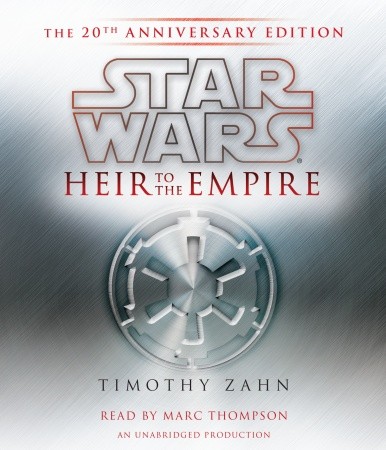
Review of Star Wars: Heir to the Empire by Timothy Zahn

SFFaudio Review

Science Fiction Audiobook - Star Wars: Heir to the Empire by Timothy ZahnStar Wars: Heir to the Empire, 20th Anniversary Edition
By Timothy Zahn; Read by Marc Thompson
13 Hours – [UNABRIDGED]
Publisher: Random House Audio
Published: 2011
Themes: / Science Fiction / Fantasy / Star Wars / Revolution / Space Opera /

Listening to Star Wars: Heir to the Empire on unabridged audio was nostalgic for me. I read the novel in print when it came out almost 20 years ago. I liked it then, and I enjoyed this audiobook, too.

There have been many Star Wars audiobooks. Until a few years ago, the available titles were abridged, anywhere from 3 hours to 9 hours in length. One of the qualities of those short audiobooks that I liked is that they successfully incorporated the Star Wars sounds, and I LOVE the Star Wars soundscape. I expected this unabridged reading to leave those sounds behind, but I’m very happy to report that they are here. This audiobook opens with the John Williams opening score, and there are plenty of light sabers, droids, wookies, and blasters throughout. Awesome.

Listen to an excerpt: |HERE|

It’s a few years after the Battle of Endor (from Return of the Jedi), and the New Republic now has to deal with the fact that they’ve won. Many of the characters we know from the original film trilogy are here: Luke Skywalker, Princess Leia and her husband Han, Chewbacca, R2D2, C3PO, Lando Calrissian, etc. Making things difficult for our heroes is Grand Admiral Thrawn and an unstable Dark Jedi named Joruus C’Boath.

I was impressed with Marc Thompson’s skilled narration. He was able to evoke these well-known characters with his voice, from outright impression to a cadence change or other verbal tic. I always knew which character was speaking.

This novel came out well before the film versions of Episodes 1, 2, and 3, so there are blessedly no midi-chlorians here. If you like the original Star Wars films and have considered reading one of the novels, this audiobook is an excellent place to start. I enjoyed revisiting Lucas’ universe, and it’s an entertaining story.

Posted by Scott D. Danielson

Review of Tunnel in the Sky by Robert A. Heinlein

SFFaudio Review

Tunnel in the Sky from Full Cast Audio Tunnel in the Sky
By Robert A. Heinlein; Read by David Baker and cast
10 hours 15 minutes [UNABRIDGED]
Publisher: Full Cast Audio
Published: 2011
Themes: / Science Fiction / Survival / Space Travel / Society /

Publisher summary: When Rod Walker decides to take the final test for “Deacon” Matson’s interplanetary survival course, he knows he will be facing life-or-death situations on an unsettled planet. What he doesn’t expect is that something will go wrong with the “Tunnel in the Sky” and he and his fellow students will not be able to return to Terra.

Stranded on a hostile planet, Rod and his friends are faced with the challenge of carving a civilization out of the wilderness. They must deal with hunger, deprivation, and strangely savage beasts. But the bigger question is, can they survive each other?

This science fiction classic pits a savage world against the most untameable beast of all: the human animal. Chock full of high adventure, futuristic speculation, witty repartee, and profound philosophy, Tunnel in the Sky represents the greatest SF writer of all time at his peak.

Survival stories are frequent in YA literature, and Tunnel in the Sky was probably one of the first, originally published in 1955. It is referred to as one of “Heinlein’s Juveniles,” and is a great tale of adventure with a life-threatening scenario.   Rather than making a statement, as some of Heinlein’s works attempt to do, this book is just danger and kids using what they have learned to create a new society and survive on an alien planet.  Anyone who enjoyed The Hunger Games or Ender’s Game would probably also enjoy this story, as it has similar themes.  The time period of its original publication is evident in a few moments, but not to the extent I am used to when reading Heinlein.

This was my first experience with Full Cast Audio, and I felt the story was greatly enhanced by being in audio form.  There is sometimes transition background music, but it isn’t distracting, and the voice actors do a good job.  The narrator manages not to blend in with the other adult characters, making it clear when the story is being told.  A few occasions of the word “Huh?” are quite jarring screamed into the listener’s ear, but I think I’ll blame Heinlein for that.  After all, the main character of Rod needs to be a little naive for the story to work, and he is, more than a little.

Posted by Jenny Colvin

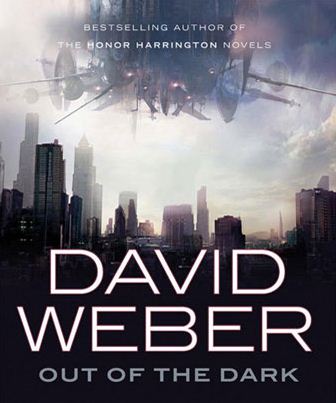
Review of Out of the Dark by David Weber

SFFaudio Review

Science fiction audiobook - Out of the Dark by David WeberOut of the Dark
By David Weber; Read by Charles Keating
17 hours – [UNABRIDGED]
Publisher: Macmillan Audio
Published: 2011
Themes: / Science Fiction / Military / Aliens / Alien invasion / Historical /

No one would have believed in the early years of the 15th Century that human affairs were being watched from the orbiting ships of the Galactic Hegemony’s Survey Force. No-one could have dreamed that we were being scrutinised as the French and English forces advanced towards each other across the field of Agincourt. Few men even considered the possibility of life more vegetarian than ours and yet, from their survey ships, minds immeasurably more craven than ours, regarded this Earth with horrified revulsion. And slowly and surely, they drew their plans against us.

David Weber attempts to take the traditional alien invasion and add an unusual twist. The twist, unfortunately, isn’t brought to fruition until very nearly the end of the book, where it clangs into place more like a late addition, a Deus Ex Machina.

Out of the Dark starts as a typical alien invasion: ships arrive in-system, observe us for a while to find where the big cities and military bases are, then strike them from orbit. Wipeout the majority of the population and then attempt to sweep in to rule over the cowering survivors. Shock and Awe. Unsurprisingly the aliens discover how tenacious we humans are. They struggle to comprehend why we are unhappy about having half the population of Earth wiped out in an afternoon. Is there something wrong with us? Are we not civilised?

In the Galactic Hegemony vegetarianism is the norm for intelligent star-faring races. Omnivores and carnivores being too aggressive to develop the required technological base required to reach the stars without wiping themselves out. There is one exception to this rule, the Shongairi, and they make the other races in the Hegemony nervous just by existing. So, in an attempt to weaken the Shongairi, the Hegemony grant them the right to colonise three other worlds, including one discovered some 500 years before. A world that also has the pacifistic Hegemony worried.

According to the Colonisation rules of the Hegemony, any race that has not advanced enough technologically are fair game to be colonised. Naturally their assumption is that Earth, being populated by a crazy race that commits such bloodthirsty battles as that observed at Agincourt five centuries earlier, will still be very low on their technology scale. The Shongairi are then somewhat surprised to find that we have developed so far as we have, indeed possessing some technologies that rival their own. We may still be trapped upon our home planet, but we have advanced computer technology and encryption techniques that make them think we should really be classed at a level where we would be granted a protected status. Considering the expense of the time and resources involved in the launch this offensive, the Shongairi Commander decides to sweep that data under the carpet and hope that no-one notices. Bombing us back to the stone-age to hide the evidence if necessary. And thus the invasion goes ahead and half the world’s population is lost to a kinetic bombardment.

The novel follows several characters, although most are expended showing how effective our weaponry is against an alien ground force that expected to face nothing more advanced than a bow and arrow. They are expended in that they demonstrate, repeatedly, that the Shongairi react with overwhelming orbital strikes. This pattern repeats several times through out the book and does become a little tedious.

The Shongairi alien nature is basically that of a predatory pack animal, almost canine in nature. Their philosophy is that when faced with an overwhelming opponent you surrender. That humans refuse to acknowledge the Shongairi’s superiority confuses them. This mentality reminded me a lot of the elephant-like aliens from Larry Niven and Jerry Pournelle’s Footfall from the ’80’s.

The characters include Master Sergeant Stephen Buchevsky who finds himself a passenger on a military cargo plane flying over Eastern Europe when the aliens strike and his plane is force to make a crash landing. With only a handfull of other US personnel from the plane he begins gathering locals around him as he becomes their protector. He joins up with a local group who’s charismatic leader seems to be too friendly, helpful and successful at defending against the Shongairi. Buchevsky is a gee-shucks hero doing the best he can.

One of the other main characters is Dave Dvorak. Or, as I think of him, Dave “Mary Sue” Dvorak. Dvorak is one of the most prepared people to hide out in the Carolina hills, in what reads like a palatial cabin with his family and friends. Although he actually does very little plot-wise he becomes a middle-man for lots of other survivors in the area and through these contacts we hear about much of what is happening in the world. When we aren’t watching sacrificial attacks against Shongairi troops. We do get to hear in excruciating detail how, over the previous few years, he and his brother-in-law converted a family cabin in the woods into a home away from home, complete with redundant power generators, hidden food and weapon caches and a huge underground fresh water tank.

We are also shown the invasion from the alien’s perspective. Much of their emotions are expressed in the positioning and twitching of their ears, reinforcing the K-9 impression that their omnivore and pack nature suggests. There is almost no physical description of them, that I remember, beyond this.

The cover blurb talks of the survivors receiving help from an “old enemy”. I’m not going to spoil this aspect of the book, although I guessed it just from reading the blurb and was actually looking forward to it. Other readers have claimed to have been blind-sided by it. I can see why, but only if they simply hadn’t read the book cover. It is not a genre I’m aware Weber has written in before. I was disappointed with the execution of this aspect. The surprise element doesn’t feel integrated into the book as a whole. It really felt like the story had originally been written without it, then realising that he had dug a hole too deep for humanity to get out of, he had to go back and add this in to tip the scales in our favour. The conclusion wraps up very quickly; like a TV series been told they are being cancelled and only have two episodes to wrap everything up. Or he got bored with the story and wanted to finish it and move on to something else.

And yet, this is not the worst aspect of this book for me. I have also been listening to Weber’s Safehold series, but have abandoned it after the third book, in large part due to this flaw. Weber has started writing massive monologues for many of his characters that run on for tens of minutes at a time. They are both internal and external discourses where the characters go into minute detail about what has already happened, their current position, beliefs, expectations and plans. Two or three times per book I could swallow, but this feels like it is becoming Weber’s go-to method of filling out a scene. They feel completely unnatural, especially when it is one character talking at another. In some situations this would be okay, a specific character who was prone to this sort of thing, or that the situation called for the character to speak for such an extended time, without any apparent aide-memoire or time to prepare. Even if it helped to move the plot on quickly, I might be tempted to forgive it, but it seldom does. It is often a repeat of information we already know, explained from the current character’s slightly different perspective. Yet not actually adding anything to the story other than word count. Unfortunately any interruption to my listen during one of these monologues meant that when I returned I had no little or no idea who was talking. I could eventually infer who was talking, after a few minutes, based on the geography and names of characters they mentioned, but seldom from how the character spoke. Neither the writing nor unfortunately the narration had enough colour when it came to most of the character voices.

The narrator, Charles Keating, does well with most of the book, especially the alien lisping Shongairi. Unfortunately he too struggles to bring life into Weber’s indigestible, interminable speeches.

This had the potential to be an interesting hybrid of genres, but really feels like something bolted on at the end. Weber’s editor needs to get tough with him and curtail those endless monologues.

Posted by Paul [W] Campbell

Free Listens Review: The Willows by Algernon Blackwood

Review

The Willows by Algernon Blackwood

Length: 2 hours, 21 minutes
Reader: Michael Thomas Robinson


The book: Considered one of the greatest stories in horror literature, The Willows lives up to its reputation. Two friends canoeing down the Danube stop for the night on an island in the middle of a huge expanse of willow trees. The place seems mystic, almost otherworldly, and in the night the two interlopers find out why.

Blackwood could have set this story in any exotic river in the world, but he chose the Danube. This river, which runs through the heart of Europe, is the wildness that runs through what was then the epitome of civilization. As the atmosphere of this turns from idyllic to terrifying, Blackwood is showing that the unknown horrors of the world can be anywhere, even where we should be the most safe. This, I think, is the most horrifying realization of all.

Rating: 9 / 10

The reader: At first, I was not impressed by Robinson’s voice. He’s somewhat nasal, and starts the book with a bored, straightforward style. As the story went on, though, I realized the initial bored tone was probably intentional, contrasting with the building dread of the story. His pace quickens and slows to build the tension, drawing the listener into the horror of what the narrator is experiencing. Despite my early misgivings, I greatly enjoyed this reading.

Posted by Seth