Review of The Broken Sword by Poul Anderson

SFFaudio Review

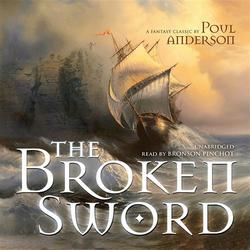
Fantasy Audiobook - The Broken Sword by Poul AndersonThe Broken Sword
By Poul Anderson; Read by Bronson Pinchot
7 CDs – 8 Hours – [UNABRIDGED]
Publisher: Blackstone Audio
Published: 2011
ISBN: 9781441786876
Themes: / Fantasy / Vikings / Myth / Battle /

The Viking Age of England offers fertile ground for storytelling. It was a time of strong men, beautiful fair-haired women, and bloody raids for plunder. Christianity was the new religion on the block, striving to make inroads on the old pagan beliefs—and often at the point of a sword. Gods were said to mingle with men and the world lay poised on the edge of Ragnarok, a final battle and fiery conflagration that would end the world.

Poul Anderson drew on the best of this wild and poetic age, stirred it up with myth and fantasy, and the result was his 1954 novel The Broken Sword. Its like has rarely been matched in the annals of fantasy literature.

I’ve read The Broken Sword previously and knew what a wonderful book it was, but TV and film actor Bronson Pinchot’s narration in this new Blackstone Audio, Inc. production added a new dimension to the novel. I had first heard Pinchot in a reading of Stephen King’s Eyes of the Dragon. While he was wonderful there he ups his game in The Broken Sword, reading with a spite and fury in his voice that perfectly matches the book’s unrelenting grimness and battle fury. Pinchot breathes life into beautiful maidens and proud warriors, deep-throated trolls, and ancient elven warrior-kings whose voices are like winds sighing through treeless leaves.

Oddly enough there is exactly one sound effect in the entire recording—an echo effect used to convey the cold, cruel laughter of Odin—and it’s on the final disc. It was cool but rather jarring, considering it’s on the last disc and there’s no precursor. But on to the tale.

In The Broken Sword the land of Faerie exists alongside the lands of men, invisible save to those with the witch sight. Faerie is a land of bright castles and achingly lovely elves, of the gods of Odin and Tyr, the giants of Jotunheim, black-eyed trolls, and other, fouler monsters.

Pride and ambition touches off the events of The Broken Sword. Orm the Strong is the fifth son of Ketil Asmundsson and thus low in the totem pole of inheritance. Rather than accept a smaller share of wealth Orm seeks his own fortune by going a–viking. On one of his raids he kills a husband and his sons, burning their hall to the ground. The man’s mother, a witch, escapes and swears revenge: She bestows a curse that Orm’s eldest son will be fostered beyond the world of men, while he in turn will foster a wolf that will one day rend him.

The elf-earl Imric travels to the lands of men and sets the witch’s curse in motion. Imric takes Orm’s unbaptized infant son Skafloc and replaces him with Valgard, a changeling, whom Imric himself has fathered by raping a captive troll woman. Valgard’s dark ancestry is evident when he bites his unknowing mother’s breast and grows restless and violent in Orm’s care. Skafloc, raised among the elves, is fair haired and fair of spirit, though equally mighty and otherwise a mirror image of his dark changeling “brother.”

After he discovers his true half troll, half-elf heritage, Valgard embarks on a mission of revenge, killing several members of his foster family. Aided with an army of trolls he then launches a war of annihilation on the elven lands of Alfheim. Skafloc and the elves are beaten back by the initial assaults and all seems lost. Only by going on a quest to reforge a powerful ancient weapon—the eponymous broken sword, a weapon of terrible demonic power that demands blood each time it is drawn and ultimately turns on its wielder—can Skafloc save Alfheim and avenge his family.

Though The Broken Sword seems largely forgotten these days it remains influential. The elf Imric for example reveals the clear stylistic (and thematic) influence The Broken Sword had on subsequent authors like Michael Moorcock. Moorcock (a big fan of the book, who once wrote thatThe Broken Sword “knocked The Lord of the Rings into a cocked hat”) based his Melniboneans heavily on Anderson’s elves. Imric is (largely) Elric of Melnibone, not only in similarity of name, but in appearance and even character. Anderson’s Elves are darker than those in The Lord of the Rings (though I would point out that Tolkien’s elves closely resembled Anderson’s in his source material; see the prideful warrior Feanor from The Silmarillion). They are haughty, prideful, shun the sunlight, and if not malicious are certainly mischievous. These traits have their roots in Norse myth, which both Tolkien and Anderson drew upon.

Everything about the book is wonderfully northern. Characters mingle soaring verse with common speech in conversation. Anderson weaves old northern vocabulary into the tale, evocative words like “Fetch,” “Fey,” and “Weird” (the latter is a fate from which no man escapes), which lend The Broken Sword a hard northern ethos to match its flavor. In this pagan hierarchy the Norns are higher than the towering Jotuns or even the Aesir. Even the gods will die in the fires of Ragnarok at their appointed time. That grimness bleeds through into The Broken Sword as its protagonists are slowly crushed beneath the merciless wheel of fate.

“Throw not your life away for a lost love,” pleaded Mananaan. “You are young yet.”

“All men are born fey,” said Skafloc, and there the matter stood.

This is hard stuff and an unforgiving outlook on life, though not incompatible with that other somewhat famous work that debuted in 1954—Tolkien’s Fellowship of the Ring. No matter what Moorcock—he of the tin ear when it comes to Tolkien analysis—may tell you.

The writing in The Broken Sword is top-notch, really and truly great stuff. A small sample of dialogue uttered by the troll-woman Gora:

“The world is flesh dissolving off a dead skull,” mumbled the troll-woman. She clanked her chain and lay back, shuddering. “Birth is but the breeding of maggots in the crumbling flesh. Already the skull’s teeth leer forth and black crows have left its eye sockets empty. Soon a barren window will blow through its bare white bones.”

One final, important note about the Blackstone recording: The text is Anderson’s original from the 1954 version of the book, which Anderson updated in 1971 for republication in the Ballantine Adult Fantasy line. This is not immediately apparent from the description on the Blackstone website. I’ve only read the 1971 version, so for those who haven’t had the chance to experience The Broken Sword in its earliest and rawest incarnation you now have another chance.

Posted by Brian Murphy

Free Listens review: Fantomas by Marcel Allain and Pierre Souvestre

Review

Fantômas by Marcel Allain and Pierre Souvestre

Source: LibriVox (zipped mp3s or M4B)
Length: 10 hrs, 11 min
Reader: Alan Winterrowd

The book: Literature is full of great detectives; less so with great criminals. The criminal masterminds that take center stage in novels are often either effeminate plotters or crooks-with-a-heart-of-gold types. Fantômas is the rare criminal genius with the brawn and cold-heartedness to carry out gruesome murders, yet the charm to seduce a princess as he robs her. Close on his heels is the detective Juve of the Paris police, a master of disguise with the intelligence to almost, but not quite, catch up with Fantômas.

In France, Fantômas stars in over 40 books by Allain and Souvestre; the authors’ system of working together on the plot, then dividing the writing of the chapters led to this astounding productivity. Fantômas’s criminal exploits and his pursuit by Juve make for an entertaining read, but the characters do not have the brilliance of Sherlock Holmes nor the humor of Arsene Lupin.  Although the characters are not so deep, the plot twists so much that even when I thought I knew the identity of Fantômas, there were still several more surprises. Fantômas belongs in the middle ground between the pulps and the great classics of the crime genre.

Rating: 7 / 10

Reader: Allan Winterrowd has a strong American baritone that does not distract from the story. He varies his tone slightly for the various characters, without going so far as to perform voices. As far as I could tell, he pronounces the French place-names correctly, though I’m no expert in French. Winterrowd speaks in a steady pace that allows the listener to keep up. The recording itself is well-done and clear.

posted by Seth

Review of The Adjustment Bureau by Philip K. Dick

SFFaudio Review

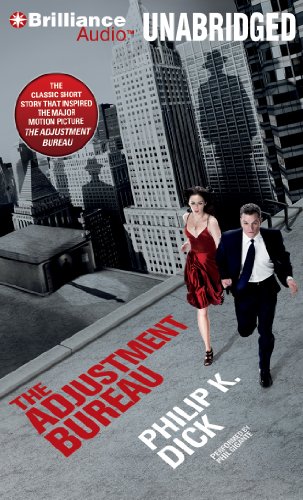
BRILLIANCE AUDIO - The Adjustment Bureau by Philip K. DickThe Adjustment Bureau (aka Adjustment Team)
By Philip K. Dick; Read by Phil Gigante
1 CD – Approx. 1 Hour [UNABRIDGED]
Publisher: Brilliance Audio
Published: March 4, 2011
ISBN: 9781441894694
Sample |MP3|
Themes: / Science Fiction / Horror / Freezing Time / Adventure /

The Adjustment Bureau is a major motion picture based on Philip K. Dick’s classic paranoid story, The Adjustment Team. This is the short story, The Adjustment Team, which asks the question – Do we control our destiny, or do unseen forces manipulate us? Ed Fletcher is a real estate agent with a normal life, until one day he leaves the house for work a few minutes later than he should have. He arrives at a terrifying, grey, ash world. Ed rushes home and tells his wife, Ruth, who goes back to the office with him. When they return, everything is normal. But he soon realizes people and objects have subtly changed. Panic-stricken, he runs to a public phone to warn the police, only to have the phone booth ascend heavenward with Fletcher inside…

The short story Adjustment Team, was written by Philip K. Dick in 1953 and published in 1954. This story makes us re-consider why any chain of events happens. Is it we who construct our destinies or is there an agency that controls us? Dick, as illustrated in the story, suggests that beings of high mentality control the world. Also, there is a group of men who control time and make sure everything is working as they intend. They are called “The Adjustment Team.”

The main character in the story is Ed. He is a business man working for the Douglas and Blake Company. One day, a clerk from “The Adjustment Team,” was supposed to interrupt Ed’s chain of events – to make him arrive at his work before the team starts controlling that area called “Sector T310.” However, the clerk fails and makes a timing mistake. This eventually leads Ed to arrive at his company on time, and he sees “The Adjustment Team.” And, for the first time in his life Ed sees something that people shouldn’t ever see.

Phil Gigante narrated this short story with a strong voice, making the book more interesting than I had expected. His accent is American, with a low tone. At least a couple of short stories, by Dick, contain dogs that talk. A talking dog can be found in this story as well. In fact, Gigante narrated it as as a lazy hound. I highly recommend this audiobook to anyone who loves Dick.

Posted by Jay

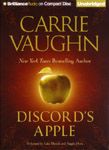
Review of Discord’s Apple by Carrie Vaughn

SFFaudio Review

BRILLIANCE AUDIO - Discord's Apple by Carrie VaughnDiscord’s Apple
By Carrie Vaughn; Read by Angela Dawe and Luke Daniels
8 CDs – Approx. 9 Hours 12 Minutes [UNABRIDGED]
Publisher: Brilliance Audio
Published: July 6, 2010
ISBN: 9781441876003
Sample |MP3|
Themes: / Fantasy / Magic / Gods / Family / Romance / Greek Mythology / Colorado / Terrorism / Arthurian Legend / Russia / Los Angeles / Immortality /

When Evie Walker goes home to spend time with her dying father, she discovers that his creaky old house in Hope’s Fort, Colorado, is not the only legacy she will inherit. Hidden behind the basement door is a secret and magical storeroom, a place where wondrous treasures from myth and legend are kept safe until they are needed again. Of course, this legacy is not without its costs: There are those who will give anything to find a way in. With the help of her father, a mysterious stranger named Alex, and some unexpected heroes, Evie must guard the storeroom against ancient and malicious forces, and protect both the past and the future even as the present unravels. Old heroes and notorious villains alike rise to fight on her side or to do their best to bring about her defeat. At stake is the fate of the world and the prevention of nothing less than the apocalypse.

Novels with alternating storylines, like Discord’s Apple, are probably easier to write than regular single plot novels. I’ve never come across one that defeated the main problem of such novels. It’s the problem of comparison. The present (alternate present) storyline in Discord’s Apple is far less compelling than those parts which are set during, and in the immediate years following, the Trojan War. By disc three it had become abundantly clear that the two storylines would meet up – and that the more interesting part of the book would be subsumed by the lesser. But, as the novel progressed MORE storylines were added and none of them were very promising. First there was The Eagle Eye Commandos story, the story of a set of G.I. Joe knock-offs that are, we are told, ‘the most popular comic book series in the USA.’ That storyline is told in a third person ominscient POV, as if were’ reading over Evie’s shoulder while she writes it on her laptop. That’s a big problem. I’ve seen scripts for comic books. They look nothing like what Evie writes for her artist collaborator – she’s writing standard prose, not a comics script, the artist would have to adapt what Evie wrote and dumping most of it. Then, just to confuse things just a little more, we get an out of nowhere historical Walker family storyline. It goes nowhere. Then, another short lived storyline will pop up for a chapter, then disappear, never to be heard from again. By disc five, these trends, along with many other warning signs, had cast a dread pall over my hopes for the novel’s conclusion.

It is never good when an author shows contempt for her story or for her readers. Carrie Vaughn is guilty of both of these authorial sins. As was pointed out in detail on Charlie Stross’ blog even the opening scene of Discord’s Apple is a mess. It is, of course, described (not shown) and features the destruction of “The Kremlin” by an Cessna full of kerosene:

He made a noise like a deflating balloon. “The Kremlin’s been bombed. Obliterated. A Cessna filled with drums of kerosene rammed it. They’re thinking it’s Mongolian rebels.”

She took a moment to register that he was talking about current events and not a plot point in their comic book. “Then our May storyline is out the window.”

The Eagle Eye Commandos couldn’t raid the building complex if it wasn’t there. She should have seen this one coming.

“Yeah. Unless we can put some kind of ‘how things might have been’ spin on it.”

Uh …. no. How could she have seen this coming? That whole passage should stop you in your tracks. Let me lay it out for you:

1. The biggest Cessna ever built carries no more than a dozen passengers and crew, the Cessna brand, moreover, is widely known to be a small aircraft manufacturer, with pretty much every single model ever built measuring far less than the 16 meters of their very largest passenger jet.

2. The Kremlin, meanwhile, is a massive fortress without one central structure. It measures a vast 68 acres and yet this plane full of drums of kerosene “obliterated” it. I would be very much surprised to learn that even the worlds biggest aircraft could completely destroy the Kremlin with any number of drums of Kerosene stuffed into it. Consider this, even with a maximum capacity of 27,276 liters the largest water bomber in the world, the Martin Mars, world only be able to drench four acres in a single pass. At that rate it would require no less than sixteen passes to completely cover the Kremlin with Kerosene – and that would assume that every pass had no overlaps.

3. Worse, why would “Mongolian rebels”, of all rebels, attack the Kremlin? That makes absolutely no sense at all. Russia and Mongolia have essentially been staunch allies for the last five hundred years. Russia never annexed Mongloia, doesn’t claim any part of it as a part of Russia, and didn’t even incorporate it into the Soviet Union. This is an absolutely monumental gaff – as backward as expecting the Palacio Nacional in Mexico City to be attacked by Quebec separatists.

And she should have ‘seen it coming’?

Other signs of contempt for the reader litter the novel. At one point the main character, a comic book writer, notes that the events that have just happened to her seemed unbelievably “overwrought” – after which she makes a point of filing them away for future use as a plot twist in her comic book series. She wants to add an unbelievable and overworked event to her own writing … what is a reader supposed to takeaway from that other than Vaughn is pissing on our shoes? Is she thumbing her nose at comics?

More stumbling blocks – as the “terrorism” in Russia continues we’re told that trainyards and shipyards are the targets. Yeah …. no …. that doesn’t sound like terrorism – it sounds like war. Terrorism is violence intended to foster terror. Blowing up a shipyard, attacking a citadel, derailing a train – that all is far more targeted than than strategic bombing of Europe in WWII. Carrie Vaughn seems blissfully ignorant of the meaning and import of the word “terrorism.”

But it doesn’t stop there! Vaughn has her central character, a rough analogue for herself, say that the Trojan Horse was the “car bomb” of its day. After hearing that I was figuratively shaking my head for about an hour.

That character, Evie Walker, then does some stunt driving while being chased by a herd of coyotes. In so doing she executes something she calls a “Hollywood turn.” … What I assume that Vaughn was actually referring to is, in fact, called either a Rockford or Moonshiner’s or J-Turn (and never a “Hollywood turn”).

Evie Walker also casually mentions that a drive through Los Angeles requires multiple stops and searches – adding hours to a commute. But it doesn’t end there, even the small town in Colorado, as depicted in Discord’s Apple, exist under a draconian police state. A drive through the city center means a warrant-less search of your vehicle and a questioning by police. There’s also food rationing. It isn’t explained, none of it. That’s shocking and interesting stuff and yet it has absolutely no follow up in the book whatsoever. Evie Walker doesn’t seem alarmed by it, finds it mildly annoying (and maybe even comforting), but she doesn’t mention it as being particularly shocking or even attempt to explain why it isn’t. What the fuck?

At first I thought maybe that my problems with Discord’s Apple were the same kinds of problems I had with Catherine Asaro’s Sunrise Alley |READ OUR REVIEW|. I thought that maybe Carrie Vaughn’s focus and interest just wasn’t on the stuff I care about: ideas, attention to detail, and the surprising (but logical) consequences to those ideas and details. But upon further consideration I don’t think that’s true. Vaughn’s writing technique for Discord’s Apple consisted of remixing her Sinon fan-fiction with events in her own life, filtered through a magical grab bag of other mythology and politics that she is only very dimly interested in. A few aspects of this novel could have worked had they been more focused and perhaps less slap-dashed together. Was she writing on a tight deadline? Couldn’t she do some revision? I don’t know.

The return of King Arthur (and Merlin) – ok why not? Sadly, this epic pair seem to be merely active mannequins in Discord’s Apple – their presence may have initially been to offer a possible rival love interest for the protagonist, but that doesn’t even come close to ripening. What about that artist penciler/inker partner on the comic book Evie Walker is writing? Oh him? Apparently he’s there solely to give Walker someone to talk to, setup the novel’s unpaid off premise. He just dries up and blows away.

What about that mysterious new dog, Queen Mab, that Evie’s father has? You know, the one with more emotion, knowledge and expression than all the rest of the characters in the novel? Oh that? It’s just what Vaughn would call her “Wash” techniques – something designed to manipulate the audience’s expectations. Consider me manipulated.

It is terrible.

The best part of the novel, the part that is actually alright – good even – the part that Vaughn wrote with passion and attention: That’s Sinon’s story. The rest, set in Evie’s time (or whenever else Vaughn went with the roving POV) is full of characters that are only minimally purposeful. Their goals are only strong enough to push them onto the stage, not strong enough to explain what they’re doing there or explain why they skulk-offstage when someone else is talking.

Or to put it another way – if this novel was a piece of clothing it would be a sweater. But unfortunately it’d be the kind of sweater that started out as a smart-looking and comfortable scarf and has now has been inexplicably knit-into an unwieldy sweater/dress/hat garment with a dozen fist sized holes in it. This sweater may be somewhat fashionable in some parts of the book store sweater store. Maybe it’ll be popular with the talented readers who don’t have time to think about what they’re reading. But for a Science Fiction reader, like me, who tries on a book sweater thinking it will be a garment with a particular purpose in mind, well he may find that every string of that sweater’s yarn wants to unravel. Or to put it in Carrie Vaughn style terms:

It’d be like the arrival of the president of the radical monarchist league (driving an Austin-Healey Bug Eyed Sprite with 17 liters of re-fried beans in the glove compartment) to an Outer Limits cast reunion party in Ruritania. Yep. It’s going to mess-up President Al Franken’s America in many magically unproductive ways! I should have seen it coming.

The shame of it is that Vaughn’s probably could write a lot better than Discord’s Apple. What works in the novel works well. Over on John Scalzi’s blog Vaughn wrote:

I have more ideas than I will ever be able to write in my lifetime. One of my solutions to this dilemma is to put as many ideas in a book as I can manage. The more disparate the better, because finding connections between seemingly unrelated ideas can make for great stories.

In a grad school Latin course, I translated bits of the Aeneid and fell in love with Sinon. He’s the Greek spy left behind to talk the Trojans into bringing the horse into the city. He’s brash, clever, and really awesome. So I committed a very long piece of fanfic telling what happened to Sinon after the war — he was kidnapped by a very pissed-off Apollo, made a slave, granted immortality so he’d be a slave forever, and. . .well. You’ll just have to read about it, because his story is the second part of Discord’s Apple, in which we learn that the Trojan War never really ended. (It all fits together, honest.)

At first, I didn’t know quite what to do with this very long piece of fanfic. I got to thinking about the nature of epic literature in general, and I decided that Sinon’s story needed to be part of Evie’s story. You see, “Evie returns home to discover an amazing heritage” is just an idea. But Evie and Sinon meeting each other, the chaotic events surrounding that meeting, and the fact that the goddess Hera still wants to get her hands on that apple – that’s a story.

Throw in King Arthur and my deep and irrational fondness for 1980′s GI Joe comics and what I ended up with was a novel about family, storytelling, history, and war and how they get tangled together.

This right here is the whole problem. Ideas are what stories should be about. But what Vaughn doesn’t realize is that not all ideas are gold. Not all ideas should include everything you think to include, not all of them fit together. A book about a comic book writer living in a Alternate Present USA police state? That sounds really cool. A book about King Arthur returning? That could be cool. A book about a woman who returns home to take care of her dying father only to discover that every magical artifact from history is in the basement? COOL! All together it is a mess.

Vaughn’s not short of ideas, not even short of good ideas. She’s short of a filter, an editor. Vaughn needs to have someone really critiquing the shit out of her ideas, really making the novel focused. Vaughn is a huge Sinon of Ithaca fan, and with the parts of this book set during and after the Trojan War she has made me one too. The market may not be clamoring for fiction rooted wholly in Greek Mythology, or for a book about a comic book writer living in an alternate USA, but I am. What I’m not clamoring for is a novel about all of those things in one.

The audio production itself is faultless. Discord’s Apple is a two narrator production with the vast majority of the reading is by Angela Dawe. Dawe performs everything except for the Bronze Age storyline which is delivered by Luke Daniels. Both Dawe’s and Daniels pronunciation and delivery are flawless.

Posted by Jesse Willis

Free Listens review: A Shadow over Innsmouth by H.P. Lovecraft

Review

A Shadow over Innsmouth by H.P. Lovecraft

Source: Voices in the Dark (Part 1 | 2 | 3 | 4 | 5 )Voices in the Dark logo
Length: 2.6 hours
Reader: Sean Puckett

The book: While on a architectural tour of New England, a man visits the isolated port of Innsmouth. Locals from neighboring towns view the place with suspicion and treat the odd-looking Innsmouth natives with disgust. While there, he hears rumors of strange goings-on and investigates further. His investigations turn up more than he expects.

This is a dark and frightening tale that also causes some unease when it comes to digging beneath the surface as a modern-day reader. Lovecraft is obviously drawing upon pre-War racist attitudes and fears of miscegenation in his portrayal of the Innsmouth people. He shows mistrust of non-Western people and their “demonic” religions. Though thematically distasteful, this novella is probably my favorite H.P. Lovecraft story, though I can’t say I’ve read Lovecraft’s entire oeuvre.

Rating: 8/10

The reader: Puckett narrates this story in a melancholy tone that fits well with the mood. For characters like Zadoc, he drops into a believable-enough dialect. He has a few repeats of phrases and there is some background noise, but otherwise this is a good recording.

Posted by Seth

Review of Confessor by Terry Goodkind

SFFaudio Review

Fantasy Audiobook - Confessor by Terry GoodkindConfessor
By Terry Goodkind; Read by Sam Tsoutsouvas
20 CDs – 24 Hours [UNABRIDGED]
Publisher: Brilliance Audio
Published: 2007
ISBN: 9781423316589 
Themes: / Fantasy / Series / Magic / War

The final novel in Terry Goodkind’s Sword of Truth series begins in near-hopeless darkness. The hero of the series, Richard Rahl is not only a slave to the black hole of evil known as the Emperor Jagang, but he’s also been stripped of his magical powers, forced to play a murderous game rigged against him, and wakes to find an unhealthily devoted fan of another team trying to stab him to death. How can he possibly get free, save his wife, his friends, and his kingdom from millions of life-hating fanatics of the Imperial Order come to burn his followers from the earth?

The answer takes some doing to get to. Between you and the final resolution lie some brilliant set pieces; epic sequences of pulse-pounding battle action (and sports action in a game best described as naked football to the death with rocks); and some of the most glaciated, pace-killing, engine-gumming dialogue ever laid out on the slab of an otherwise well-paced story. Some of the characters are interesting and likable, but lord, don’t get them talking! They blather on about the principles of a well-lived life, the course of prophesy, and the evils of mindless devotion to religion so long, you wish you could conjure a little Wizard’s Fire to shorten the book.

Completing the tale also takes a healthy dose of credulity to accept a non-magical mensch getting up after two nights without sleep to play a brutal blood-sport for hours on end and then slice his way through a million-man army before hiking to the top of a mountain to fight his way through a packed room of elite warriors. But even more so, it takes a strong stomach for clinically detailed, lavishly prolonged violence against women. Apparently, it isn’t sufficient for Jagang to be bad; he has to be over-the-top, heinously Dark-Lord evil. What should be a quick, stark characterization draws on so long, it begins to feel like a creepy fetish.

This is the only novel of the entire series I have read, and I’m certainly glad of it. It was entertaining, overall, but I can’t imagine wading through ten-thousand pages of Goodkind’s uneven prose only to get to the slightly anticlimactic climax that Confessor brings. In sum, it wasn’t bad, but it isn’t good enough to be great, and certainly not good enough to cap a dozen books in a way I would have found satisfying.

Posted by Kurt Dietz