Review of The Red Panda Adventures – Season 4

SFFaudio Review

Superhero Audio Drama - The Red Panda Adventures - Season FourThe Red Panda Adventures – Season 4
By Gregg Taylor; Performed by a full cast
12 MP3 Files via podcast – Approx. 6 Hours [AUDIO DRAMA]
Podcaster: Decoder Ring Theatre
Podcast: September 2008 – May 2009
Themes: / Fantasy / Superheroes / Mystery / Crime / Adventure / Marriage / Toronto / Magic / South America / Dinosaurs /

“I’m not implying mystic threats, foreign powers and shadowy organizations aren’t important. But sometimes they do disconnect us from the street.”

After four years and 48 episodes Gregg Taylor’s writing is still amazingly fresh. It’s super-quotable too. As I listen I find myself writing down, here and there on scraps of paper, lines of dialogue. That’s terrific writing folks. Is it kind of sick that I even enjoy the commercials?

“I like all of those words.”

Speaking of words, in the opening lines of the new season Kit Baxter is no longer just the red panda’s “driver” now she’s his “fiance”! Another change is the introduction of a new sponsor (fast and easy weight loss dot com). Still around are the charming birthday wishes and other greetings from family members around the world who spend their dollars on keeping the Red Panda show going.

I’ve got a detailed episode by episode review below (minus any serious spoilers)…

Episode 1 – “The Third Wave
The season 3 finale of The Red Panda Adventures set up a Nazi scientist called Professor Von Schlitz to be the major villian for Season 4. So it wasn’t too shocking to have him take the first scene of episode one The Third Wave, of Season 4. As the show begins Schlitz and his new pilot are headed toward a secret lair in the jungles of South America. All is proceeding normally. Then SLAM! A twist I didn’t see coming. This opening shocked me! First there was the introduction of a new superhero, a man named “Captain Tom Sunlight” (played by Christopher Mott) – apparently an ally of The Red Panda’s. Second, I realized just how much Von Schlitz is a pastiche of two Raiders Of The Lost Ark villains (Belloq and Toht). An auspicious beginning. With this episode The Red Panda has now done something previously “unthinkable.” The rest of the episode deals with a frightening 1930s phenomena – with the title of the band of villains taken from a 1967 high school history class experiment.

Episode 2 – “The Mask of Death
This episode feels like the Red Panda Version of The Taking Of Pelham 123 but with zombies! A train station full of passengers is held for ransom. The arch-villain involved is another tenured teacher, Professor Zombie! playing junior panda member Harry is rather obviously female (and not male) – this is a problem I can’t see around. Finding child actors of talent are difficult, adults playing children ditto.

Episode 3 – “Murder In The Castle
The scenic Casa Loma is the setting for this season’s locked room mystery. A locked castle mystery actually as an unexpected murder that interrupts Kit’s romantic evening with her groom-to-be. This episode feels like a Nero Wolfe plot (minus the many confusing characters). Does old RP have a rooftop orchid garden?

Episode 4 – “The Gathering Storm
A full-scale dimensional breach imperils 1930s Toronto and only Red Panda and his trusty side-kick are up to the task of patching it back up. This episode clearly demonstrates the way magic is handled in the Red Panda universe. Scientists, especially ones named Chronopolis, can wrap their heads around the mystical arts and mystical objects – sometimes they just can’t control them.

Episode 5 – “Trial By Terror
Barton Meyer, an orderly at the Queen Street Lunatic Sanitarium, meets an old resident who claims to have been “born here.” The Electric Eel (performed by Scott Moyle) is home at last! With his incredible powers, and made up entirely of energy, he’ll team up with a few imprisoned residents/patients at the mad house (The Genie and The Jackrabbit). But this dastardly team-up doesn’t want to kill the Red Panda, they want to put him on trial in order to determine his sanity. The results? An electrifying episode.

Episode 6 – “The Boy In Blue
Constable Andy Parker, voiced by Brian Vaughan, best known from previous episodes of RPA for his crush on Flying Squirrel (like pretty much everyone else who listens to the show) takes center stage in this tale of police corruption. Is Parker working for The Syndicate or is there a more innocent explanation for him palling around with dirty cops? Which reminds me, all this Parker/Syndicate has got to be a nice little shout out to Richard Stark. I tell you that Greg Taylor packs a whole lot of goodness into each episode. Another thing to take note of in this episode is the new “Pappy” moniker Kit Baxter is floating for her husband-to-be.

Episode 7 – “The Golden Idol
A new superhero is prowling the streets of Toronto. He’s got super-strength, can fly and seems more than capable of replacing the Red Panda – the only question is: Why? Christopher Mott playing the ever excitable Mad Monkey makes an appearance – meaning he steals the show – in this case almost literally. Fun stuff!

Episode 8 – “I Dream Of Genies” Modern technology allows banks to secure their vaults better than ever. 17 stories into the sky they’re safe aren’t they? But can they stop a heat ray wielding villain on a flying carpet? Probably not. There’s a very cool audio montage in this ep. That’s something I don’t ever remember ever hearing before! Actor Brian Vaughan returns, reprising his super-villain role as The Genie from Seasons 2 and 3 (and 4).

Episode 9 – “Jungle Of Terror
Paying back a favour to their superhero buddy, Captain Tom Sunlight, Red Panda and Flying Squirrel fly into a South American jungle. There they discover a strange gateway, an old enemy, and some very large and very hungry fauna. This episode feels inspired by Sir Arthur Conan Doyle’s The Lost World. This is a cool away adventure. I hope RP and FS can do more of these next season.

Episode 10 – “The Crimson Death
Returning from South America with her fiance, the Flying Squirrel is all aflutter about her upcoming nuptials to her partner in crime-fighting. Luckily, there’s been a series of mysterious murders in Toronto while they’ve been away; solving them will be the perfect distraction from her wedding jitters. Her first stop: A visit to the Queen’s Street Lunatic Asylum. Whoever is responsible has some mean-ventriloquism chops, is invisible and wields fire. What an odd combination! This is the shortest (and probably weakest) episode of the fourth season – but that doesn’t mean it’s bad. There’s plenty of wonderful character development in between all that invisible, fire-throwing, voice-chucking menace.

Episode 11 – “Endgame
Tied up and hanging above a vat of acid Commander Varkin has the Red Panda and Flying Squirrel just where he wants them – now for the speechifyin’. Varkin (voiced by Gregory Z. Cooke) is a Blowfeld type villain – he fills us in on the season spanning conspiracy – and unleashes a lot more than hot air. But that isn’t the dynamic couple’s only problem, it seems that a vat of acid and a world domination speech aren’t enough for Varkin as a dangerous virus and secret partner will keep Squirrel and Panda busy. The perfect penultimate play? Possibly!

Episode 12 – “Operation Cold Feet
Kit Baxter’s even more antsy with her impending wedding just days away. But what’s up with all the false Red Panda sightings? They don’t seem to bother the real Red Panda. But when a fake Flying Squirrel makes a newspaper appearance Big Red nearly chokes on his toast! In this episode we finally learn the true identity of the Red Panda! For the previous 47 episodes Gregg Taylor has managed to side-step revealing our hero’s real name. Even characters who should have known the name of the man “who wears the mask of the Red Panda” have carefully not spoken it up to this point. He’s been called “Pappy” and “Puddin” by Kit Baxter, “my dear boy” by his fellow wealthy peers Toronto, really everything but “hey you.” It’s a name that’ll be remembered with the likes of Lamont Cranston and Bruce Wayne.

Happy Canada Day everybody, go celebrate with some RED PANDA!

Here’s the podcast feed:

http://decoderring.libsyn.com/rss

Posted by Jesse Willis
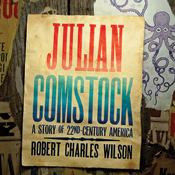
Review of Julian Comstock by Robert Charles Wilson

SFFaudio Review

Science Fiction Audiobook: Julian Comstock by Robert Charles WilsonJulian Comstock: A Story of the 22nd Century
By Robert Charles Wilson; Read by Scott Brick
21 Hours – [UNABRIDGED]
Publisher: Macmillan Audio
Published: 2009
Themes: / Science Fiction / Government / Aristocracy / History / Politics / Global Warming / Civilization / Theocracy /

The United States of America has changed. Global warming fears have come to pass, Christian groups have become a stronger part of the government (practically its own branch, called The Dominion), aristocracy has ascended because fewer and fewer have access to so much. The average citizen in this 22nd century view of the future have taken a step backward. The scientific past has retreated into myth, and superstition rules the day.

In short, Robert Charles Wilson has taken a particular view of what the United States is and has taken it to extremes in “if this should continue” science fiction tradition. The characters do not feel futuristic – instead they feel historical. Like Firefly in a way, the characters are straight from the 19th century. This creates a very interesting juxtaposition of time: A possible future that’s really a look at the present, but with characters that feel historical. Sci-Fi Wire quotes Wilson on this:

The past regarding the present from the future—that’s a literary effect only science fiction can achieve, and that’s what I was aiming for, a kind of simultaneous triple perspective. We think of the past as quaint and the present as mundane and the future as, well, futuristic—but so did our great-grandparents, and so will our great-grandchildren. ‘All times have been modern,’ as the French composer Nadia Boulanger said.

The novel is told by Adam Hazzard, a friend of Julian Comstock, who is aristocrat (the Comstock family has held the Presidency for years and years). Hazzard tells us right up front that he’s writing this biography of Comstock because Comstock has become a great man.

The first scenes have the two as young men looking through a pile of discarded books. They take what they can carry, but Comstock gives a specific book to Hazzard; a history of manned exploration of the Moon. Hazzard doesn’t believe such things actually happened, but accepts the book anyway, and wonders.

From there, Hazzard uses events like this one to show readers the life of Comstock, but everything is colored through Hazzard’s point of view. In a way, the book is like a Sherlock Holmes novel, but Wilson has created a much more interesting character in Hazzard than Doyle ever did with Watson.

Scott Brick takes full advantage of the Hazzard character, and does well with the 19th century sensibility of all the characters. This book has a whole lot of detail and a whole lot of lengthy conversation between the main characters about various subjects. Brick keeps it interesting, like he always does. We even get to hear him speak French when the characters spend time in Montreal.

This novel is rich and draws on a rich tradition. A Canticle for Leibowitz, The Postman, and Earth Abides all leap to mind, but this isn’t a homage or a retelling of those books. This is a story that looks at the present in a way that only science fiction can.

Posted by Scott D. Danielson

Aural Noir review of Columbine by Dave Cullen

Aural Noir: Review

I didn’t expect to be reviewing this audiobook. Prior to its arrival in the SFFaudio mailbox I didn’t even know this audiobook existed. It is neither Science Fiction, nor Fantasy. Its Horror is of the very detached and remote kind because of the way it is told. I scoured the packaging looking for a sign as to why we were sent this audiobook. The only thing that stood out was that it was directed by Emily Janice Card (that’s Orson Scott Card‘s audiobook producing daughter). That’s a very tenuous connection to what is normally our kind of audiobook. But, after listening to the book in its entirety I found I had some things to say about it. And… we do have this handy “Aural Noir” tag that I use to talk about the Mystery, Thriller, and Noir audiobooks that I so love. Why not review it under its aegis?

Done!

Blackstone Audiobooks - Columbine by Dave CullenColumbine
By Dave Cullen; Read by Don Leslie
11 CDs – Approx. 13 Hours [UNABRIDGED]
Publisher: Blackstone Audiobooks
Published: March 2009
ISBN: 9781433290435
Themes: / Crime / History / Colorado / Murder / Suicide / Psychopathy /

“If you want to understand ‘the killers,’ quit asking what drove them. Eric Harris and Dylan Klebold were radically different. Klebold is easier to comprehend, a more familiar type. He was hotheaded, but depressive and suicidal. He blamed himself for his problems. Harris is the challenge. He was sweet-faced and well-spoken. Adults, and even some other kids, described him as ‘nice.’ But Harris was cold, calculating, and homicidal. ‘Klebold was hurting inside while Harris wanted to hurt people.'”

Journalist Dave Cullen has assembled what must be, for the foreseeable future, the definitive book about the 1999 Columbine High School massacre. Myself, I was only vaguely familiar with the incident at the time. In 2002 I watched Michael Moore’s disturbing film Bowling For Columbine. It was a kind of editorial-documentary on the event itself, the connections with other shootings and firearms in general. Since then, the Columbine High School massacre had been completely off my radar. Dave Cullen’s non-fiction book Columbine supports my conviction that if you really want to know what exactly happened, you’ll have to wait for the facts to be ferreted out by a historian. Cullen is just such a historian. The history Cullen paints is rich in factual details. His sources are: the writings and videos of Eric Harris and Dylan Klebold themselves, county records, friends of the murderers, their fellow students, eyewitness interviews, police records, victims, victim’s families and probably most crucially a senior FBI agent. That agent, Dwayne Fuselier, had a son attending Columbine High School on the day – so his arrival on the scene was both personal and professional – his later investigations reveal insights into the vast reams of documents and video produced by the killers themselves. With Fuselier’s assistance Cullen debunks virtually all of the many myths and falsehoods that swirled around the media’s coverage of the massacre.

Other than the two murderers, and the gun suppliers, the only other major villain in Cullen’s account of the massacre and its aftermath is the Jefferson County Sheriff’s Office. “Jeffco” was in charge of the investigation. It was also responsible for a lot of the incompetence that lead to it being necessary. In the aftermath Jeffco had a limelight loving sheriff who was concocting conspiracy theories that he had no investigative evidence for. But that bunk seems to have supressed some very interesting facts. For instance. Were you told the police had, prior to the attack, documented murder threats by Harris/Klebold prior to the attack? Did you know that the police had even made out a search warrant based on these threats? Did you know that, if the warrant had been taken to a judge, it would have allowed the police to discover the weapons cache the teens were preparing? Did you know that Eric Harris and Dylan Klebold been arrested together, for another crime, prior to the attack?

Other myths Cullen debunks are those generated by the media and church groups. Had you heard about the girl who said ‘yes’ when asked if she ‘believed in God’? Ya, I had too. Did you know that she actually didn’t say it? That another teen had, and that she wasn’t shot? That instead this survivor, the one who had actually proclaimed her belief, was branded a liar by the evangelical community? I hadn’t known that.

With Columbine Cullen, has assembled a first rate piece of non-fiction history. It illustrates exactly why a public reaction to the daily news so often leads to dangerously false beliefs. If there was just one takeaway from this audiobook let it be that American society needs to be more focused on the problem of detecting psychopathy. Not all psychopaths are murderous, in fact most are law abiding. What unites them all is that other people don’t matter to them, except as a means to their ends.

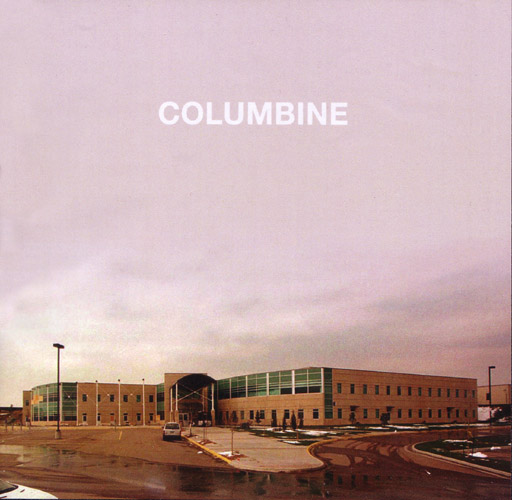
Blackstone has issued the same stark cover for the audiobook as is on the paperbook. Chapters jump back and forth in time, showing the consequences of and the preparations for the murderous assault. This is a wise structural move as the day’s events themselves are not the primary focus of this book. In fact a good deal of the narrative follows others who were there that day: Frank DeAngelo, the Columbine High School principal, some of surviving victims and their families or the workings of the media itself. Don Leslie, the narrator, is given the grim task of reading the words of Klebold and Harris. It isn’t an enviable job, but he is up to the task. There is a disclaimer at the beginning of the audiobook that explains that all the words in quotes are sourced from interviews, transcripts and articles. This is naturally less clear in the audiobook version than the paperbook edition but Leslie does his best to make each quote as clear as he can.

Posted by Jesse Willis

Review of The Strain by Guillermo del Toro and Chuck Hogan

SFFaudio Review

The Strain by Guillermo del Toro and Chuck HoganThe Strain
By Guillermo del Toro and Chuck Hogan; Read by Ron Perlman
Audible Download – 13 hours 36 mins [UNABRIDGED]
Publisher: Harper Audio
Published: 2009
Themes: / vampires / scientific thriller / horror / New York / mythology / medical mystery

Yes, it’s another book about vampires. But wait, don’t shrug it off just yet. Several things set The Strain apart from the glut of vampire novels flooding the market of late. First, it’s co-written by movie director Guillermo del Toro, whose past film successes include the vampire flick Blade II, the comic-book adaptation of Hellboy, and the mythological Pan’s Labyrinth. He’s also heading up the forthcoming film adaptation of J.R.R. Tolkien’s The Hobbit. Furthermore, The Strain takes a more sobering view of the undead, divorced from the romanticism weighing down the vampire genre.

The Strain begins when a plane lands at JFK airport with almost all its passengers struck dead. The Center for Disease Control calls in its chief investigator Ephraim Goodwether, newly divorced and newly sober, to look into the matter. Mysteries abound when the passengers’ bodies go missing from the morgue, the few survivors begin acting strangely, and a coffin-like trunk inexplicably vanishes from the plane’s cargo hold. Ephraim and his partner Nora, with whom he’s had some past romantic involvement, find unlikely aid in the guise of pawn shop owner Abraham Setrakian, an aged Holocaust survivor who carries an odd staff with a silver wolf’s-head handle. The old man explains that a centuries-old conflict between vampire tribes is about to burst forth onto the streets of New York.

And indeed it does. The narrative frequently shifts away from the main storyline to tell the stories of men and women infected with a strange virus, whose vector is a disgustingly pulsating capillary worm. Initial side effects resemble a mild flu and include sore throat and slight disorientation. But this is only the beginning. The sore throat, it turns out, heralds the growth of a new sinister organ, a long tendril-like apparatus under the tongue tipped with a deadly stinger, which in turn infects other humans. Other vampiric characteristics soon manifest, including the whitening of gums, an aversion to sunlight, and immunity to most forms of attack.

The premise is intriguing, especially since it presents a more scientific approach to the undead than most other vampire novels, except perhaps Richard Mathesen’s superior I Am Legend. Unfortunately, the actual story unfolds too slowly and spasmodically, and lacks evidence of any real structural forethought on the part of the authors. Del Toro originally pitched the idea as a TV show, and evidence of his screenwriting background can be found in the scene headings affixed to each section and in the many entertaining but ultimately superfluous vignettes of violence. The suspense sequences are spine-tingling and the action scenes hair-raising, but most of them do little to further the story.

The book’s shining gem is the character of Abraham Setrakian, whose harrowing escape from Nazis and forces even more sinister we learn throughout the book in flashback sequences. Del Toro’s interest in mythology and folklore take center stage, and provide the most compelling moments of the book.

It’s difficult to know how the division of labor fell between Guillermo del Toro and Chuck Hogan in writing The Strain, but my impression is that del Toro provided the concept and perhaps wrote some of the pivotal scenes, while Hogan did the heavy lifting of filling in the gaps and pulling the whole thing together. This should have been a good thing, since Chuck Hogan is an acclaimed best-selling author. However, writing good speculative fiction requires a certain sensitivity and perspective that I believe Hogan lacks, although this is only a guess on my part since I’ve read none of his other work. Del Toro has keener vision as a storyteller, at least as seen in his films, though these skills don’t necessarily translate to the written word. Since the cover bears both their names, both del Toro and Hogan must bear some blame for crafting a less-than-stellar novel.

The Strain is narrated by actor Ron Perlman, who incidentally also played a role in del Toro’s Blade II. Particularly in works of suspense and horror, a good voice actor can make the difference between scenes that leave you gripping the arms of your chair and scenes that make you laugh out loud by virtue of their inadvertent cheesiness. I’m pleased to report that Perlman’s voice work in The Strain had the former impact on me. His intonations are pitch-perfect, and he snarls out the vampiric growls and moans with enough force and feeling to chill the blood.

The Strain is the first in a trilogy of the same name, as can be seen in the novel’s grim and hurried ending. As Dante Hicks says of The Empire Strikes Back in Clerks, “it ends on such a downer.” That said, the ending brought significant changes to the lives of several pivotal characters who, despite the spotty storytelling, I’ve grown to care about, and I’ll probably read the sequel when it hits the audio airwaves next year.

Posted by Seth Wilson

Aural Noir Review of FALCO: Venus In Copper – a RADIO DRAMA

Aural Noir: Review

BBC Audio - Venus In Copper - based on the novel by Lindsey DavisSFFaudio EssentialFalco: Venus In Copper
Based on the novel by Lindsey Davis; Performed by a full cast
3 CDs or Audible Download – Approx. 3 Hours [RADIO DRAMA]
Publisher: BBC Audio / Audible.com
Published: July 2006
ISBN: 1846071399
Themes: / Crime / Ancient Rome / Detective / Murder / Noir /
Sample: MP3

“Greetings! Marcus Didius Falco at your service, private informer, investigator to you. If you need references ask the emperor. I’ve just done a big job for him. It went very well, so well his chief spy got jealous and threw me in prison, accused me of stealing some imperial lead. Those ingots are going to haunt me forever. I’d have given them the money if anyone had bothered to ask. Still it wasn’t all bad rotting in jail. I had company, a very friendly rat. But before I had time to get to know him better my mother bailed me out.”


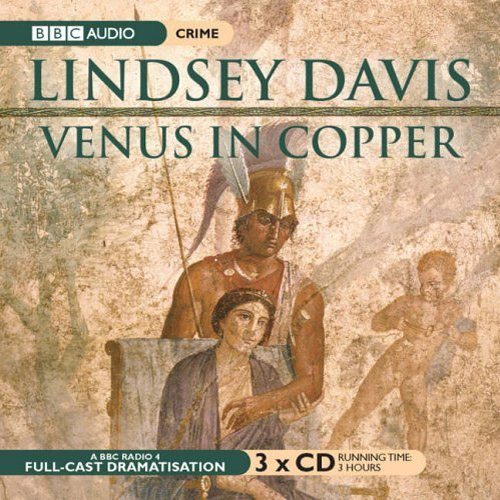
Marcus Didius Falco is the central character and narrator of Venus In Copper (the third in a series of novels by Lindsey Davis). Falco’s narration and dialogue is sprinkled with half-nods and sly-winks to the private detective stories of the 20th century. At least one or two lines out of Falco’s mouth each episode echoes something from Chandler, Chinatown or another quip you’ll half recognize. Falco lives in 70’s AD Rome under the rule of Emperor Vespasian. He works as a ‘private informer’ solving mysteries for the citiy’s elites or the nouveau riche freed slaves. That latter is the case with this mystery, concerning the investigation of a black widow set to marry into a rich family made up of freed slaves. The serpentine plot takes the fore of the drama with Davis and dramatist Mary Cutler (a friend of Davis’s) beeing careful to detail Falco’s personal life just enough to make us care about them all. I mentioned that the program seems to delight in referencing the 20th century private detective story. But it also seems highly interested in showing us actual historical 1st century AD detail. The feel for Rome itself, the interplay between fact actually informs the plot – how wonderful and refreshing for a historical mystery! Te program is both comforting in its familiarity and simultaneously fascinating in its new setting. The characters are likewise familiar and new. Venus In Copper is wonderful.

Anton Lesser, playing Falco, is absolutely extraordinary, carrying the program to the heights of radio drama excellence. Anna Madeley, playing Falco’s aristocratic girlfriend, is also amazing. In fact the entire cast does excellent work. Falco’s world is depicted with a rich soundscape with atmospheric effects and well themed music. The only flaw in the entire production was an artificial sounding talking parrot – but then again I don’t think I’ve ever heard a convincing talking parrot imitation. The program is available in stereo on CD or (occasionally via BBC iplayer) or in monaural via Audible.com. Highly recommended.

Posted by Jesse Willis

Aural Noir Review of The Cutie by Donald E. Westlake

Aural Noir: Review

BBC Audiobooks America - The Cutie by Donald E. WestlakeHard Case CrimeSFFaudio EssentialThe Cutie
By Donald E. Westlake; Read by Stephen R. Thorne
Audible Download – Approx. 5 Hours 27 Minutes [UNABRIDGED]
Publisher: BBC Audiobooks America / Audible.com
Published: March 2009
Themes: / Mystery / Crime / Noir / Murder / New York /

“Mavis St. Paul had been a rich man’s mistress. Now she was a corpse. And every cop in New York City was hunting for the two-bit punk accused of putting a knife in her. But the punk was innocent. He’d been set up to take the fall by some cutie who was too clever by half. My job? Find that cutie – before the cutie found me.”

That’s Clay, the strong right arm of Ed Ganolese, talking above. Ed’s a NYC syndicate boss. The mob may have old roots but the syndicate, the crop of gangsters in this novel, only goes as far back as WWII. See during the show in Italy a bunch of D-Day Dodging G.I.s found themselves allied with some old-world black marketeers. And now, twenty or so years later, in the 1960s those bonds lead Clay down strange alleys. He’s forced to turn amateur detectivewhich is something new for a mob enforcer. But his boss Ed, but you call him Mr. Ganolese, is under the squeeze from the “parent company” in Italy. And when Ed asks, Clay does. So, Clay takes the case. He needs to solve the frame-up murder put over on a low level pusher named Billy Billy. Billy Billy is innocent – everyone knows he wouldn’t harm a fly – but the cops like him for the murder. And it looks bad for Billy Billy because he woke-up from his heroin induced stupor in the middle of the murder scene. Everyone knows he’s innocent, Ed knows, Clay knows but the cops, well they just don’t care. Since Billy is someone’s patsy and just a hair’s-breadth ahead of the law that means Clay has really got his work cut-out for him.

I had previously read the paperbook of this novel, but not with the Hard Case Crime title of The Cutie. When I read it originally the novel was called The Mercenaries. The strange thing is that the title seems to have influenced my opinion as to the character of the book, maybe its a combination of things. The title and the way it was read. When I first read the novel about five or six years ago I would have classified it as a rather dark, but with this new title, new cover art (by Ken Laager), and the brightly lit voice acting by Stephen R. Thorne it comes off as surprisingly light. Almost a caper in fact. Part of of it must also be because The Cutie is told in first-person from Clay’s point of view. Narrator Thorne brings a youthful confidence to the part (something my inner voice apparently didn’t). But, it’s still strange how Clay is really a cold blooded and murderous thug – Westlake gives him an excellent backstory. But then again perhaps I’m still hearing Thorne’s reading of Somebody Owes Me Money |READ OUR REVIEW|. The Cutie is fully utterly engaging, I found myself trying to solve the central mystery again, all the while marveling at Westlake’s masterful storytelling. The Cutie is a gritty, fast paced, and well plotted murder mystery with a highly unusual criminal/detective lead. If you haven’t tried a Westlake novel before this, now and with The Cutie is your perfect place to start – this was Donald Westlake’s first novel under his real name.

Posted by Jesse Willis