News, Reviews, and Commentary on all forms of science fiction, fantasy, and horror audio. Audiobooks, audio drama, podcasts; we discuss all of it here. Mystery, crime, and noir audio are also fair game.
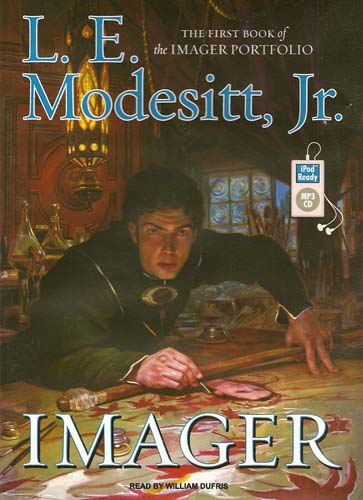
Imager (The First Book of the Imager Portfolio)
By L.E. Modesitt, Jr.; Read by William Dufris
2 MP3-CDs – 18 hours – [UNABRIDGED]
Publisher: Tantor Media
Published: 2009
ISBN: 9781400161805
Themes: / Fantasy / Magic / Politics / Coming of Age / Economics /
| MP3 Audio Sample |
L.E. Modesitt, Jr. has published over 50 novels, both science fiction and fantasy. Imager, his latest novel, is the first time his work has appeared on audio.
Imager is the start of a new fantasy series called “The Imager Portfolio”. It’s the story of Rhenn, who at the beginning is an apprentice portrait painter. In a life-changing event, he realizes two things: First, he can no longer continue in his profession, and second, he is an “imager” – a person who can make things real by visualizing them in his mind. Imagers are not common, but common enough to be feared and respected in Modesitt’s world.
After this, the novel takes it’s time in following Rhenn grow into his new-found ability. He climbs the ladder as an imager taking various and interesting training that use his ability in unique ways. My first thought was not that an imager would make a good bodyguard, but imaging something into a person’s body makes for quick defense – or a potent offense.
William Dufris is wonderful as always. The novel is not quick paced, as if Modesitt is using this volume to firmly create the world for future volumes. Dufris is as engaged a narrator while relating the details as he is during the exciting bits. A pleasure to hear!
Tantor will be publishing the next two volumes of this trilogy, and I will be listening!
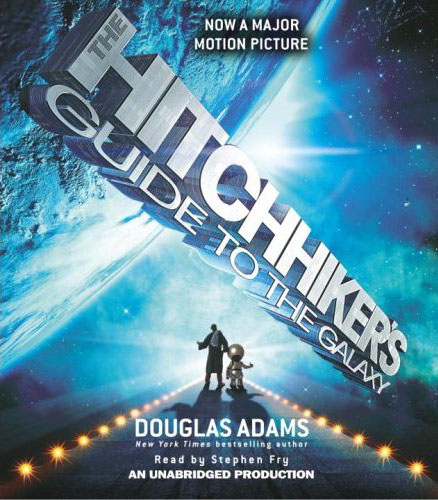
The Hitchhiker’s Guide to the Galaxy
By Douglas Adams; Read by Stephen Fry
6 hours – [UNABRIDGED]
Publisher: Random House Audio
Published: 2005
ISBN: 9780739322208
Themes: / Science Fiction / Comedy / Planetary Destruction / Depressed Robots / Books /
Humor is arguably the most difficult genre of writing to pull off. Hampered by the limitations of the print medium, humor writers must ply their craft without the benefit of a number of tools commonly used in live comedy and in film—visual gags, voice inflections, and so on. This inherent difficultly is why good comedy writers like Dave Barry are a scarce commodity, and worth reading when you can find them.
The Hitchhiker’s Guide to the Galaxy is one of those rare examples of written comedy that actually works. When I last read this book back in middle school (it seemed like every dorky, D&D and Atari-playing kid like me was toting it around at the time), I enjoyed it very much. But I was in for an even more pleasant surprise when I recently returned to this book via the audio format. This was actually the first comedy I’ve listened to on CD, and I now believe that this genre might benefit the most from audio treatment. The Hitchhiker’s Guide to the Galaxy is a first-rate example of what a talented narrator/actor can do with funny, well-written material. English actor/comedian Stephen Fry takes The Hitchhiker’s Guide to new comedic heights, and on a few occasions I found myself laughing out loud during my commute to work. Fry literally turns the text into a running Monty Python skit.
The plot of the book is as follows: Arthur Dent, a nondescript Englishman, is about to lose his house to a construction crew in the name of progress (an overpass is scheduled to run through Dent’s property). Simultaneously, an alien race called the Vogons has scheduled the vaporization of earth to clear the way for a hyperspatial express route. Dent is saved from destruction at the last second by his friend Ford Prefect, a roving alien researcher on the earth to complete an entry for a galactic encyclopedia called The Hitchhiker’s Guide to the Galaxy. Prefect and Dent later hook up with Zaphod Beeblebrox, Galactic President and rogue ship-thief, and his two crewmates (an annoying robot stricken with depression and ennui named Marvin, and Trillian, a female and earth’s only other survivor). Beeblebrox has stolen a cutting-edge spaceship called the Heart of Gold and is on a mission to find the lost planet of Magrathea, rumored to hold riches beyond imagining, as well as the answers to the mystery of life, the universe, and everything.
To appreciate The Hitchhiker’s Guide to the Galaxy you must like Monty Python (author Douglas Adams has writing credits in an episode of Monty Python’s Flying Circus, and appeared in two others, and his British comedy influences are plain). Here’s an example of the type of humor you’ll find:
Vogon poetry is of course the third worst in the Universe. The second worst is that of the Azgoths of Kria. During a recitation by their Poet Master Grunthos the Flatulent of his poem “Ode to a Small Lump of Green Putty I Found in My Armpit One Midsummer Morning” four of his audience died of internal hemorrhaging, and the President of the Mid-Galactic Arts Nobbling Council survived by gnawing one of his own legs off. Grunthos is reported to have been “disappointed” by the poem’s reception, and was about to embark on a reading of his twelve-book epic entitled My Favorite Bathtime Gurgles when his own major intestine, in a desperate attempt to save life and civilization, leaped straight up through his neck and throttled his brain.
The very worst poetry of all perished along with its creator, Paula Nancy Millstone Jennings of Greenbridge, Essex, England, in the destruction of the planet Earth.
Although The Hitchhiker’s Guide to the Galaxy is ostensibly mere over-the-top comedy, part of the reason (I believe) for its enduring appeal are its pithy insights about the nature of humanity and the universe and mankind’s raison d’etre. Overall it’s well worth reading and/or listening to.
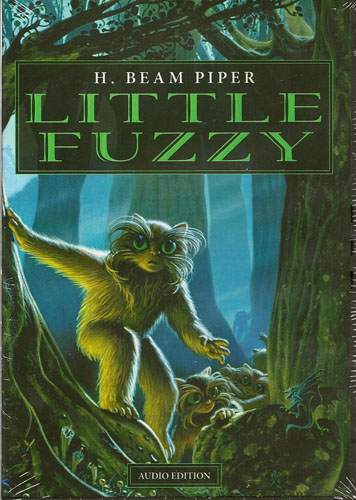
Little Fuzzy
By H. Beam Piper; Read by Brian Holsopple
5 CDs – 5 Hours 53 Minutes [UNABRIDGED]
Publisher: Audio Realms
Published: November 2006
ISBN: 9781897304617
Themes: / Science Fiction / Planetary Colonization / Sapience / Law / Mining /
The chartered Zarathustra Company had it all their way. Their charter was for a Class III uninhabited planet, which Zarathustra was, and it meant they owned the planet lock stock and barrel. They exploited it, developed it, and reaped the huge profits from it without interference from the Colonial Government. Then Jack Holloway, a sunstone prospector, appeared on the scene with his family of Fuzzies and the passionate conviction that they were not cute animals but little people…
Little Fuzzy is a novel cherished by a smallish but passionate group of admirers. They seem to love it for its portrayal of the fuzzies themselves. It may be a “furry fandom” book too (but I’m a little afraid to do the research on that). I myself hadn’t heard of the novel, or much of the author, H. Beam Piper, until Little Fuzzy and pretty much everything else written by H. Beam Piper began being posted to Project Gutenberg.
My initial sense of the book was that Little Fuzzy would act as a lens through which historical colonizations could be examined – something like what was done in Ursula K. Le Guin’s The Word For World Is Forest. But it didn’t work out that way. Piper was not trying to explore historical events as much as what we mean by the word “sapience.” The verdict on the Fuzzies is obvious from the begining, but curiously enough the Fuzzies are still somewhat treated like children even by their human champions. Perhaps this was the only way Piper could easily characterize the right minded human’s benevolence? I wish he were alive so I could ask him about this. For the infantilization of the Fuzzies parallels some attitudes towards the aboriginal peoples facing colonization here on Earth. But like I said, the general focus is on a philosophical examination of the concept of sapience – not colonization.
After some initial trepidation I found myself hanging on the every word of this WONDERFUL audiobook. H. Beam Piper is an amazing storyteller. His homespun folksiness allows him to make grammatically wrong choices, but none that ever misconstrues his intended meaning. For example:
“He dropped into a chair and lit a cigarette. It tasted badly, and after a few puffs he crushed it out.”
I think Grammar Girl would have a problem with this noting that ‘cigarettes don’t have tongues so they can’t taste well or badly’ – despite this, I think Piper’s Little Fuzzy is some of the most transparent and plainspoken prose that I’ve ever read. Narrator Brian Holsopple doesn’t have a vast range with which to pitch his voice, but he subtly manages to give accent and attitude to every character. His voicing of the entire fuzzy vocabulary (just the one word: “yeek”) is nearly as broad – giving curiosity, understanding, determination and suggestion to every yeek in the book. There was a small editing gaffe on disc 3, a repeated line, and another similar one on disc 5 but otherwise the production was perfect.
Proven Guilty
By Jim Butcher; Read by James Marsters Audible Download – approx. 16 hours [UNABRIDGED]
Publisher: Penguin Audio
Published: 2009
Themes: / Fantasy / Urban Fantasy / Magic / Chicago / Wizard / Faeries / Vampires / Black Magic
By the time most fantasy series reach their eighth novel, they’re usually showing their age. For proof, one need look no further than Robert Jordan’s Wheel of Time, in which the eighth book, Path of Daggers, is seen as the beginning of the cycle’s decline, although some would place this event significantly earlier. In any case, Jim Butcher’s Dresden Files series certainly doesn’t follow this trend. In fact, Proven Guilty suggests that the series just keeps getting better.
The novel initially follows the series formula: Chicago wizard-for-hire Harry Dresden faces a series of seemingly-disconnected incidents which, as the plot progresses, reveal themselves to be connected in a sinister way. The White Council is on the lookout for black magic; monsters from the big screen are wreaking havoc at a horror fan convention; and Molly Carpenter, daughter of Harry’s good friend Michael, is in some kind of mysterious trouble. Harry must juggle all these fly balls and, as usual, keep himself from getting killed. He’s aided by the usual cast of supporting characters like officer Karin Murphy and the elemental Bob the Skull., and White Court vampire Thomas.
Harry soon discovers that the faerie courts of Summer and Winter have taken an interest in recent events. Perhaps this is why I enjoyed Proven Guilty so much, since it evoked themes from the other faerie-centric novel in the series so far, Summer Knight, which is also one of my favorites. Butcher writes about the fae as if they are both inscrutably beautiful and incalculably terrifying. In general, the Summer Court tends to side with the “powers of good”, while the Winter Court allies itself with “evil”, but faerie politics aren’t quite that simple. Summer can be incredibly crafty and deceptive, while denizens of Winter are prone to occasional acts of kindness and sacrifice.
This moral ambiguity cuts to the heart of the success of Proven Guilty. Themes of morality, self-control, parenthood, and responsibility abound. Butcher’s early novels felt like little more than exciting detective thrillers with a supernatural twist–entertaining, witty, humorous, but lacking any real depth. In later Dresden Files novels, Butcher has cultivated a heightened emotional sensitivity. in Proven Guilty, this manifests most prominently in Harry’s complex relationship with the Carpenter family. Without giving too much away, suffice to say that the execution of a young boy at the hands of the White Council for misuse of magic holds more than a hint of foreshadowing.
James Marsters, of Buffy the Vampire Slayer fame, narrates the novel flawlessly. His hard-boiled narrative style perfectly fits the book’s genre as a detective story, and his dust-dry rendition of Harry Dresden’s dialogue captures the wizard’s lonely character perfectly. Marsters also handles the female characters deftly, avoiding the pitfall of overacting that some other male vice actors fall prey to.
Readers might get away with reading Proven Guilty as a stand-alone novel, since it does a passable job of weaving backstory into the plot in an unobtrusive manner, but it’s worth reading the Dresden Files series from the beginning. Unfortunately, books six and seven (Blood Rites and Dead Beat) haven’t yet received the audio treatment, though they’re schedules for release sometime in the coming months. It’s well worth plodding through those two volumes in print.
Also take a look at SFFaudio’s favorable review of Small Favor, book ten in the series, which I’m immensely looking forward to once I’ve read the intervening White Night.
Dark Adventure Radio Theatre: The Dunwich Horror
Adapted by Sean Branney and Andrew Leman; from the story by H.P. Lovecraft;
Original music by Troy Sterling Nies; Performed by a full cast
1 CD or MP3 download – 75 Minutes [AUDIO DRAMA]
Publisher: HPLHS
Published: 2007
Themes: / Horror / Fantasy / Weird Tales / New England / Cthulhu Mythos / Yog-Sothoth / Degenerated Backwater Communities /
After their first venture into Lovecraftian audio theatre with At the Mountains of Madness in 2006, the H.P. Lovecraft Historical Society have recently increased their efforts to bring Lovecraft back, if not to the airwaves than at least to our CD players and iPods.
The Dunwich Horror is one of the best known Lovecraft stories set in the Miskatonic Valley with its degenerate backwater folks and cultists, Lovecrafts fictional literary playground, and was first published in 1929 in Weird Tales. There is a classic 1940s radio drama version around – an episode of the famous Suspense show, now in the public domain and freely available on the internet.
The first Dark Adventure Radio Theatre production, At the Mountains of Madness, showed some dramatic weaknesses, however, The Dunwich Horror provides a thoroughly enjoyable audio drama experience. Whilst most Lovecraft fans would want it to be as close to the original as possible (which it is) it does take into account that an audio drama has to follow different dramatic conventions to keep its listeners entertained for more than an hour. Don’t expect an action packed audioFX orgy, though. It’s a Lovecraft story after all, so there will be lots of monologues and narrated bits, all adding to the charme of the original and the faux old time radio show format that this audio drama is presented in. Incidentally, Dark Adventure Radio Theatre has refreshingly politically incorrect fake advertizing (for cigarettes!) The cast does a great job of bringing to life the varied range of characters – from backwater farmers, to New England academics. Production values are overall good and fortunately they did not go wild with freely available sound effects as some other dramas of the semi-professional kind sometimes do. A commercial publisher with bigger budget might have been able to do better, but the guys from Dark Adventure Radio Theatre did a great job with a lovingly rendered version of the Dunwich Horror that shows an eye for detail.
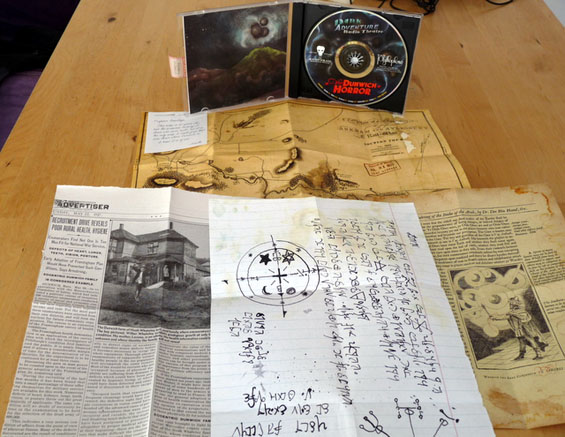
As the HPLHS started off by producing Lovecraft collectibles and high-quality “authentic” props, for the Call of Cthulhu pen & paper and live roleplaying games, it is not surprising that the CD contains a lot of goodies. Namely, a map of the Dunwich area complete with a note stapled onto it, a page from the dreaded Necronomicon and one from Whateley’s diary plus a clipping from the Arkham Advertiser showing Wilbur Whateley himself – all of which are of superb quality. Whilst no one really needs any them, these props make nice gimmicks nevertheless.
For anyone who does not need a physical audio storage medium or shies the shipping and duty costs involved with a mailorder from the USA, an MP3 download is available for about half the price. The file is properly tagged but it does not contain the cover art – this is a minor flaw in all of the HPLHS’ audio dramas downloads.
Another nice extra is the freely available script which helps learners of English to follow the show (download available from the HPLHS website as a PDF)
Dune
By Frank Herbert, Performed by Simon Vance
18 CDs – 22 hours – [UNABRIDGED]
Publisher: Macmillan Audio
Published: 2007
ISBN: 9781427201430
Themes: / Science Fiction / Politics / Space travel / Culture / Ecology /
Dune. Arrakis. Desert Planet.
I first read Dune when I was in college (late 1980’s), after a few false starts. I desperately wanted to read it, so I made it the only thing I took with me on a 30 hour bus ride from Tucson, Arizona to Idaho Falls, Idaho. It was a long trip. I smelled like cigarettes. But I got that book read, and loved it.
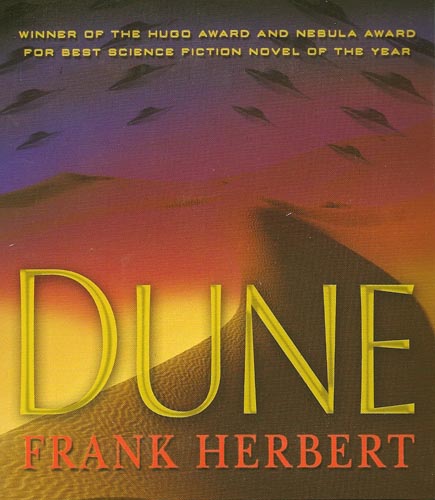
Now, years after that, I’ve heard yet another unabridged version of Dune, this time a multi-voice presentation from Macmillan Audio. And again, I loved it. Frank Herbert’s novel remains one of the finest examples of world-building the genre has to offer. The political intrigue is delicious, the implied history deep and satisfying, and the characters smart.
Simon Vance is the main narrator. Each character’s dialogue is performed by actors, and skilled actors at that. I can’t find a list of the entire cast, but it includes Scott Brick, Katherine Kellgren, Orlagh Cassidy, and Euan Morton. I enjoyed it thoroughly. The actors were allowed to perform, and most of the time the attributives were dropped. Vance’s narration bridges the conversations, and the book is immersive and engaging.
I’m not certain why, but there are long passages that Simon Vance narrates himself. Vance is right up there with Guidall, so it’s an excellent reading. I’m just not certain why the audiobook wasn’t done with a full cast all they way through. I point this out as a curiosity rather than a flaw.
A few short years ago, if a person had asked me if I prefer a single narrator to a full cast recording, there wouldn’t have been any hesitation. Single narrator, definitely. But now, I’d have a difficult time choosing between a full cast narration and a single narrator, assuming the single narrator is good, the actors in the full cast narration are good, and – this is very important – the attributives in the full cast narration are dropped so I don’t have to hear the maddening “he said angrily” after an actor has made it quite clear that a character is angry. The problem is that most full cast narrations lean too far toward audio drama, adding too much sound and music. I love audio drama, but audio drama and audiobooks are very different experiences. Most productions that aim somewhere between the two fail in my opinion. Because of this leaning, there aren’t many full cast narrations I’ve enjoyed, but this production from Macmillan Audio and anything from Full Cast Audio are top-notch.
Despite my enjoyment of Dune, I have never read past it. I can’t explain why. I’ve owned a copies of Dune Messiah and Children of Dune for years, but have never read them. Brian Herbert and Kevin J. Anderson published a book called The Road to Dune (SFFaudio Review), which presented the history of the creation of the Dune books. In there it said that Frank Herbert intended Dune, Dune Messiah, and Children of Dune to be one story. It’s long past time I try more of these novels. Lucky for me, all six of Frank Herbert’s original books have been completed and released by Macmillan Audio, all as full cast productions.

 Imager (The First Book of the Imager Portfolio)
 Little Fuzzy
 Proven Guilty