Review of Thinner by Stephen King

SFFaudio Review

Thinner by Stephen KingThinner
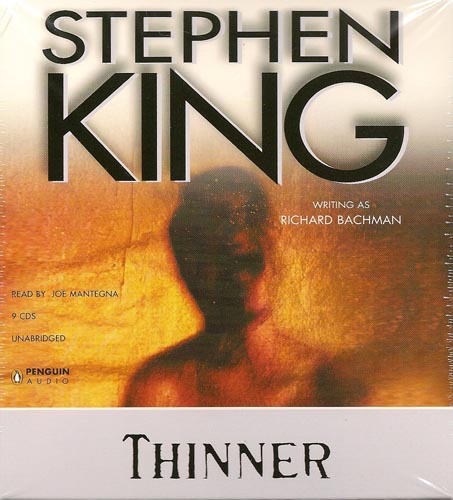
By Stephen King; Read by Joe Mantegna
9 CDs – 10 Hours [UNABRIDGED]
Publisher: Penguin Audio
Published: 2009 (reissue from 1984)
ISBN: 9780143143901
Themes: / Fantasy / Horror / Gypsies / Curses / Magic /

I put off reading Stephen King’s Thinner for the better part of two decades. The dust jacket description—lawyer runs down gypsy and is cursed to become, well, thinner—seemed like a decent short story stretched out into a novel. The premise just didn’t grab me.

As it turns out, my fears proved ill-founded. Thinner is an entertaining little novel that is, at its heart, about big concepts, including guilt, the dangers of not accepting responsibility for one’s actions, and the ruinous, generation-spanning cycle of destruction wrought by revenge. Thinner is positively short by King standards (about 300 pages), moves quickly, and contains a couple nasty little shocks that keep you on your toes and leave you feeling unsettled.

I’ve stated before that Stephen King was, in his early career, batting very nearly 1.000 as a writer. If you take a look at his work from 1973’s Carrie through 1987’s Misery and The Eyes of the Dragon, King was consistently great. I submit that The Tommyknockers (1988), written at the height of his drug and alcohol problems, was the first true misstep in King’s career. Now that I’ve finally read Thinner (released in 1984), I find that my rule holds true. It’s a fine book from King’s classic period.

Thinner tells the story of Billy Halleck, an overweight lawyer who gets distracted while driving home (his wife is giving him a handjob) and accidentally runs down an old gypsy woman crossing the street. Halleck avoids what should have a manslaughter conviction because the judge is an old golfing buddy and lets him off the hook. But Halleck can’t escape the scales of justice. The ancient father of Halleck’s victim curses Halleck by laying a scaly finger upon him and uttering the single word, “thinner.”

In the coming weeks, Halleck’s weight begins to drop alarmingly. When the doctors rule out cancer, Halleck realizes that the gypsy’s curse has taken root. The rest of the novel features Halleck chasing down the gypsies to get the curse lifted as his weight plunges from a high of 252 pounds to half that.

King has the problem of trying to convince the reader that a steadily weakening lawyer from a wealthy Connecticut suburb is capable of exerting enough pressure on a stubborn gypsy clan to lift the curse. He neatly sidesteps this problem by introducing the character of Richie “The Hammer” Ginelli, a minor mafia boss and a former client of Halleck’s. Ginelli assists Halleck by lending his unique and persuasive “services” learned in the hard-knock school of organized crime.

There’s a lot to recommend in Thinner. Taduz Lemke, the old gypsy with the power to curse, is a wonderful character, an ancient soul (over 100 years old) from the old world, the last of the Magyar chiefs. Although he’s initially unlikeable, King renders Lemke and the rest of his gypsy clan sympathetic. Though they are dirty and uneducated, and routinely skirt (and cross) the boundaries of the law, the gypsies are treated with open hostility from the hypocritical communities that they visit. Men like Halleck view the gypsies as an unwelcome disease in their safe and pure suburban communities, which are actually corrupt at the core with their unequal systems of justice, “old boy” networks, and inherent prejudices. When Halleck claims that Lemke’s daughter is equally at fault for the accident, since she didn’t look before crossing the street, he shows his unwillingness to accept responsibility for his own actions. Worse, Halleck took advantage of an unfair system of justice and never had to pay for his (and his wife’s) carelessness. Lemke’s curse is a painful lesson in admitting one’s guilt: “There is no push, white man from town,” Lemke says, again and again throughout the story. “No push.”

If you’re a Generation X-er you’ll appreciate the 1980’s time machine that is Thinner. In it you’ll find references to Apples and TRS-80s, Thunderbirds and Novas. Halleck’s family physician casually blows cocaine during a checkup and it doesn’t seem out of place here, given the period. Halleck’s daughter is mentioned as playing a year long game of Dungeons and Dragons.

Thinner contains very little horror until the end and is more accurately classified as a thriller, which may be why King adopted his (unsuccessful) pseudonym Richard Bachman during the book’s initial release. In Thinner, King was attempting something a bit outside his reputation as a horror author.

Veteran actor Joe Mantegna provides the narration for Thinner and he is magnificent, particularly in his portrayal of Ginelli (no surprise here, given that Mantegna has appeared in various gangster films). I’ve previously railed against the inclusion of music in audio books, but this version by Penguin makes excellent use of it, in particular its use of a chilling, off-putting theme whenever the gypsies—or Halleck’s alarmingly plunging weight—are mentioned.

Posted by Brian Murphy
Review of Steve, The First by Matt Watts

SFFaudio Review

Steve, The First, CBCSFFaudio EssentialSteve, The First
By Matt Watts; Performed by a Full Cast
2 CDs – 2 hours – [AUDIO DRAMA]
Publisher: CBC Radio
Published: 2007
Themes: / Science Fiction / Comedy / Post Apocalypse /

It was a thousand years ago. The Earth: in ruins, a nuclear wasteland. Humanity had written its final chapter. It took only a matter of minutes to destroy what took centuries to build. Greed, materialism… an overall sense of things being off… they would all spell society’s downfall. What few survivors remained were in a state of complete mental chaos. But all was not lost. One man, one hero, one legend, would bring civilization to the uncivilized.

This man… was Steve.

Steve, the First begins with the miraculous birth of Steve, the savior of all mankind, from a pile of rocks. Steve is not impressed with the post-apocalyptic world he sees, nor is he happy with the exploding dogs. The first people he meets are two kids who spend their time collecting dead people, and the hilarious conversation they have sets the tone for the rest of this dark comic radio drama, which was originally broadcast on CBC Radio One in 2005.

Matt Watts, who is Canadian, not that there’s anything wrong with that, wrote the series and also stars as the uninspired Steve. I’ve written about Matt Watts before, but this drama and the one that follows (aptly titled Steve, the Second) were written and broadcast before Canadia: 2056 seasons 1 and 2. That series and this one share some of the same actors, which is a great thing because this crew is wonderful.

The Colleen (Holly Lewis) is perfectly neurotic. My first clue? Her parents. Tim the Melty (Don McKellar) is positively unforgettable – a post apocalyptic Yes Man. And then there’s Steve’s nemesis, Phil Green (Mark McKinney) who still, despite the lack of a good number of people, yearns for political power.

I urge you to give this a listen – you’ll nestle it in your mind somewhere between Red Dwarf and Galaxy Quest in your pantheon of science fiction comedy. Funny, FUNNY, stuff!

Posted by Scott D. Danielson

Review of Starman Jones by Robert A. Heinlein

SFFaudio Review

Blackstone Audio - Starman Jones by Robert A. HeinleinStarman Jones
By Robert A. Heinlein; Read by Paul Michael Garcia
7 CDs – 8.5 Hours [UNABRIDGED]
Publisher: Blackstone Audio
Published: 2008
ISBN: 9781433230387
Themes: / Science Fiction / Space Travel / Aliens / Dystopia /

It was a desperate time, when one’s next meal and the comforts of home couldn’t be taken for granted. Max Jones, a practical, hard-working young man, found his escape in his beloved astronomy books. When reality comes crashing in and his troubled home life forces him out on the road, Max finds himself adrift in a downtrodden land. Until an unexpected, ultimate adventure carries him away as a stowaway aboard an intergalactic spaceship—but to where? And when? And how could he ever get back? With the ship’s pilot dead and his charts and tables all destroyed, Max must call upon all of his untested knowledge and skills in order to survive.

There’s nothing like going back to that old-time Science Fiction. Heinlein’s novels are steeped in the inspissate brew of American idealism. Puritanical hard work, honesty and humility are mixed with the libertarian and the liberal, the conservative and the anarchistic. These aren’t just the bywords of Heinleinian characters, they’re the fundamentals of their character – all that, and tempered too with happy portions of both skepticism and hucksterism. A Heinlein character is just as likely to be a gruff middle aged con-man (honest in his own fashion) as a naive wundderkind. The naive wundderkind is often found with a variously doting, tolerant, and even brighter sweetheart. We find all three, the canny conman, the boy genius and his devoted young woman, along with a whole lot more in Starman Jones.

There are three main sections of Starman Jones. Most of the folks who talk about the novel talk about the middle section – where Max works his way up the chain of command in a luxury spaceliner. Indeed, this is what gives the novel its title. The third section, set on board a primitive alien planet has some nicely interesting aliens (a whole novel could have been done there). Personally I liked the first third, set on a vaguely dystopic planet Earth. This is a land of no-opportunity, in order to get a decent job you have to inherit it. Vested interests, taking the form of professional guilds, seem to have staked out every possible avenue for advancement. Sure, there are people there willing to bend the rules to kind-hearted kids like Jones, but the general rule is a complacency towards pervasive corruption. At one point during this first third a kindly truck driver, hopped up on amphetamines, gets Max to help him break the rules of the road (that you have to pull over and sleep once in a while). That scene and another, gives an odd kind of atmosphere of low-level-corruption that Heinlein seems fairly comfortable with. Later still, with the only ticket off the sewed-up planet Earth is via false documents and bribery – Max goes for it, to the detriment of his conscience only after the fact.

In other juvenile novels, like Citizen Of The Galaxy, a Heinleinian protagonist will stay “dirtside” where he’ll grift and finagle his way through life – justifying each action step by step – here and frankly in every single Heinlein story that I’ve ever read, the bad guys are never bad because of the greed or corruption per se, but rather because they are dumb, ignorant and vain.This is a Heinlein failing I think. His cardboard cut-out villians are too dim, too dull-humored and too officious to be any real threat. There are at least two of these lame-brains in this novel. That got me to thinking. If one were to rewrite a Heinlein novel from the strawman’s point of view – it’d be extremely obvious who Heinlein had meant the hero to be [namely Heinlein’s own ideas and values – however ambivalent they are]. But, don’t let this criticism let you think I don’t like Starman Jones because, warts and all, I really did enjoy it.

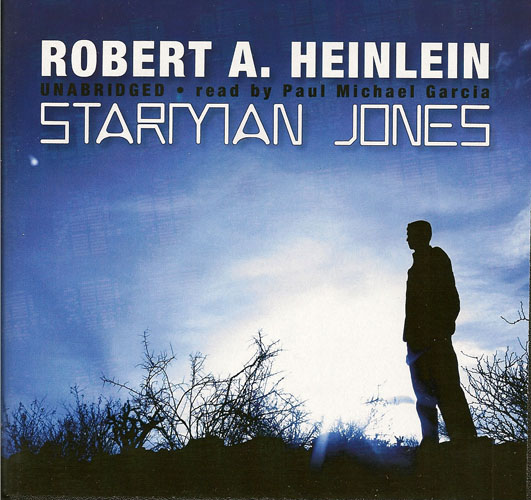
Paul Michael Garcia is ably suited to reading Heinlein’s well chosen words – giving the dialogue-heavy prose a banter-like give and take. Garcia’s range too is very impressive, voicing Max Jones as youthful and energetic, his older pal Sam as languid and confident, the girl, the mom, the step-dad, the alien spacepet, and everyone else – all in unique voice. It really is the ideal reading. I’ve been a fan of Garcia’s narration since Blackstone picked him for Kirinyaga. Despite a lot of technical jargon, especially while talking astrogation, I only heard one tiny mispronunciation in the whole novel. Concomitant meaning “occurring or existing concurrently.” Garcia read it as “konk-mittant.” The original art that Blackstone has given Starman Jones looks good, if a bit generic, but a closer inspection – past the silhouetted landscape and into the roiling clouds will admit a bit more detail in the night’s overcast sky.

Posted by Jesse Willis

Review of January Dancer by Michael Flynn

SFFaudio Review

The January Dancer by Michael FlynnThe January Dancer
By Michael Flynn; Read by Stefan Rudnicki
1 MP3-CD or 9 CDs – Approx. 10.5 Hours [UNABRIDGED]
Publisher: Blackstone Audio
Published: 2008
ISBN: 9781433250996 (MP3-CD), 9781433250972 (CD)
Themes: / Science Fiction / Space Opera / Aliens / Space Flight /

Captain Amos January, and crew, are forced to look for ship repair materials on an unknown planet. There they discover an alien ship filled with fascinating artifacts, among them a shape-changing sculpture that becomes known as “The Dancer.” We learn of some of The Dancer’s attributes as known in ancient legends and confirmation is received as we watch the story unfold. It is sought by cabals, pirates, governments, and other powers who unleash different characters to acquire The Dancer. Not unexpectedly these characters are scoundrels, idealists, and romantics whose tracks intersect and form their own sort of dance as they maneuver to best one another. This tale is told to us as a story within a story as a Harper hears the tale, a bit at a time, from the Scarred Man. This is an interesting device as not only are we told the story but Flynn uses the framing story to give us his ideas about storytelling as an art.

It is a trend these days, or so it seems to me, for modern science fiction authors to attempt to write “space opera.” As an aficionado of that subgenre who has recently been browsing among the past masters of the art (in large part thanks to Librivox), my view is that the modern take tends to be drawn-out, unfocused, and sprawling by comparison. Sadly, although I also am an aficionado of Michael Flynn’s work, I believe he has fallen prey to the desire to expand the story past the demands of the genre. The original writers wrote snappy, bold, romantic adventures that did not worry overmuch about expostulation and got to the point. Flynn, on the other hand, gives a bewildering combination of too much philosophical conversation and not enough details about the characters’ lives. There is a plethora of characters as well, almost too many to track, and this often leaves the listener bewildered as to just who has suddenly popped up unexpectedly in a scene. As well, in the last couple of chapters the tone shifts unexpectedly, as if Flynn suddenly was told he had to finish up, and thus the novel swung into abrupt action and snapped out a strangely sparse finale. The revelations were not illogical or even unsatisfying. However, after dragging on and on in the middle of the book it was quite disconcerting to suddenly be flung headlong into the finish in the style of “a shot rang out and everyone fell dead.”

Stefan Rudnicki narrates with his usual expertise, adroitly affecting slight voice changes that communicate character when voicing dialogue. One wishes that the editors had added a slight aural indicator when there were scene changes. In a book of many characters who are flung from one exotic location to another at a second’s notice, it is very difficult to tell when there is a scene change immediately with nothing other than a slight pause between sections. I must also note, that my above complains about Flynn’s book overall may have been due to the fact that a complex book is necessarily more difficult to grasp when listening rather than reading as it was written. In this instance, the editors would have done well to help the listener all they could.

If you are a Michael Flynn fan, this book will not be a complete waste. I did enjoy it initially, but I simply wished it had been truly the space opera that it purported to be.

Note: should readers think that there are no modern writers capable of space opera that is worthy of comparison with those of older times, I refer you to the “Agent of Change” series by Sharon Lee and Steve Miller (Agent of Change, Conflict of Honors, Carpe Diem, Plan B, and I Dare) and Space Vulture by Gary K. Wolf and John J. Myers. None of these are in audiobook format that I know of but are well worth seeking out.

Posted by Julie D.

Review of Elric of Menibone by Michael Moorcock

SFFaudio Review

Science Fiction Audiobooks - Elric of Melnibone by Michael MoorcockElric of Melniboné
By Michael Moorcock, Read By Jeffrey West and Michael Moorcock
5 CD’s – 5.5 Hour [UNABRIDGED]
Publisher: Audio Realms
Published: 2003
ISBN: 097315960X
Themes: / Fantasy / Epic Fantasy / Magic / War / Gods /

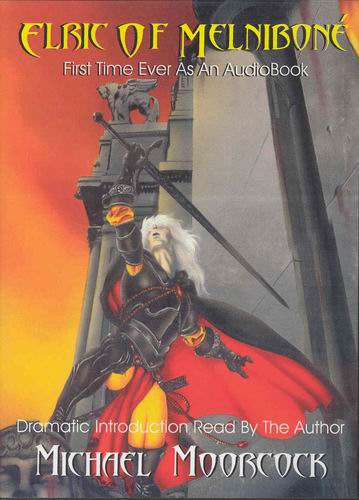
It’s a testament to the imaginative might of author Michael Moorcock that his most famous creation, Elric of Melnibone, has become a permanent and prominent thread in the fabric of fantasy. Though he may not be quite the same household name as Conan, what fantasy fan hasn’t heard of the albino warrior/sorcerer, he of the tortured soul and wielder of the black demon sword Stormbringer.

The character of Elric first appeared in print in 1961 in a short story entitled “The Dreaming City.” Author Michael Moorcock later expanded the work into a short novel, Elric of Melnibone (1973). Though not perfect, I consider this latter a must-read for fans of fantasy fiction. It’s a marvelous work of imagination whose beautiful trappings include Imrryr, a city of alien architecture and strange, often abhorrent customs; demon-summoning sorcerers; and appearances by elementals and the gods of chaos. It combines the fast-pace and adventurous swagger of pulp fiction with a main character prone to brooding meditation and
self-doubt.

The Elric stories are deliberately iconoclastic, taking an ironic stance in opposition to traditional/Tolkienian high fantasy and their often conservative worldviews. Elric is the reluctant emperor of Melnibone, a decadent, fading, yet still powerful kingdom that has dominated the Young Kingdoms of the earth for 10,000 years (think of Rome had it never lost its military might, ruled by emperors like Caligula for millennia). Drunk on the blood of conquest, immoral to the core, and frequently under the influence of dream-inducing drugs, the Melniboneans live by the philosophy, “seek pleasure, however you would.” Slaves perform all the menial work, and some have been surgically altered/bred to perform single functions like singing a single, perfect note, or rowing a war-galley.

The army is unwaveringly loyal to the lineage of the Ruby Throne, as are its emperors—until Elric inherits the throne. He begins to question the old traditions, including the Melnibonean’s right to rule the Young Kingdoms with an iron fist. At heart Elric wants to abdicate the throne and run away with his love, Cymoril. But he’s afraid that the next in line to the throne—his cousin, the wicked Yrkoon, a throwback to the cruelest lords of Melnibone—will institute a reign of terror in his stead.

Yrkoon and his followers despise Elric, whom they perceive as weak and a threat to Melnibone’s place of power. They devise a plot to kill him during a barbarian invasion from the sea. Elric leads a successful attack that routs the barbarians, but at his lowest ebb (Elric’s weak constitution requires him to take a potent concoction of daily drugs to maintain his energy), Yrkoon shoves him into the sea. Weak and weighed down by his armor he begins to drown.

Thinking Elric slain, Yrkoon sails home and assumes the throne. Elric, however, is saved by a whispered spell to an elemental god of the sea and returns to Melnibone to punish and exile his cousin. Aided by a handful of followers, Yrkoon takes Cymoril hostage and escapes the Dragon Isle to start an uprising in one of the barbarian kingdoms. The remainder of the book includes Elric’s quest to get Cymoril back, which culminates with Elric’s recovery of the powerful but cursed Stormbringer.

Elric of Menibone starts off exceedingly strong with some memorable description and characters. Moorcock succeeds in making Melnibone feel like an alien place, as torture, incest, and dining on human flesh are routine occurrences (a scene with the sinister court torturer/chief interrogator Dr. Jest—a thin, sinuous man wielding a merciless, razor-thin scalpel—is forever seared into my memory). Moorcock’s portrayal of magic is exactly the way I like it—powerful and capricious, accessed through great grimoires capable of summoning great powers of darkness, but also prone to turn on the caster in unpredictable ways.

For all its strengths, however, Elric of Melnibone—and in particular its sequels—are not perfect. Moorcock is blessed with a tremendous imagination, but at times I find that he fails to deliver on his promise. For example, we’re told that the Melnibonean sorcerer-kings engage in drugged dream-sleep that allows them to wander other worlds and universes, “consort with angels, demons, and violent, desperate men,” and learn the accumulated lore and magic of the Melnibonean race, all from their dream couches. As a result of these dream-quests, their minds are millennia old. It’s a great concept. And yet how does this activity result in a character like the impetuous Yrkoon, who acts like a spoiled 25-year-old prince instead of a thoughtful sage suffused with the wisdom of ages? I also found the Elric series slips into repetition in later books as Elric battles one demon after another. His world-weary attitude in itself grows tiring after several books as well.

Finally, I must state that I found this Audio Realms AudioBooksPlus presentation a mixed bag. The reader, Jeffery West, was talented and altered his voice enough to create recognizable characters. This version also featured a brief overview/introduction read by Moorcock himself, a very nice, unexpected bonus. But the production was marred by the head-scratching decision to play music in the background throughout the entire reading. This included a loud heartbeat sound played during dramatic scenes. After a while I ceased hearing the music, but at times it was jarring and took me out of the flow of the story.

Note to Audio Realms and other audio book producers: The thought is appreciated, but please drop the soundtracks and stick to the text.

Posted by Brian Murphy

Hardware review of iPod Nano: 4th Generation 16 gb (purple)

SFFaudio Review

iPod Nano 4th Generation (purple)iPod Nano 4th Generation (Purple)
Capacity: 16GB (flash)
Manufactuer: Apple Inc.
Software version: 1.0.3
Themes: / Audiobook / Podcast / iTunes /

This is my third Nano and my fourth iPod. So far I’d rank it as the 2nd best audiobook and podcast player I’ve ever used. This Nano is just a smidge smaller than my previous iPod Nano, an 8gb 3rd generation model. The 3rd generation had a couple of features that make me prefer it over this latest model.

First, though the 4th generation’s screen is exactly the same dimensions as the 3rd’s it doesn’t function as well for audiobooks and podcasts. This is because the 3rd gen’s horizontal layout was friendlier for reading. The 4th generation, when turned sideways, will NOT display text from the Audiobook or Podcast folders, you have to keep the iPod vertical, this makes the amount of time you have to wait to see what’s in a directory a second or so longer. Second, unlike ALL previous iPod models the 4th gen will not charge with my bedside charger/speaker system. In order to keep the iPod charged I have to plug it into the computer itself. I am currently looking into an adapter – the seem to be about $50.00.

The Nano model series has been the best audiobook/podcast player up to the 3rd generation. Up to that point each model and software update the iPod Nano had been improving. Adding a bigger screen and more memory. On the day my first generation Nano was stolen I went straight to the store and immediately bought the 3rd generation – not only was the memory bigger, it’s screen was too. If my new 4th generation was stolen today I’d go out and buy another today- but for if they were still making 3rd gens in 16gb models, I’d buy that instead.

There are issues with the iTunes/iPod interface, many people complain about it, I myself have bitched now and again, but compared to the vast field of MP3 and other portable media players out there iPod+iTunes combo still has no serious competitors.

Features that make the iPod Nano a winner include:

1. True audiobook and podcast bookmarking.
2. A one handed (just your thumb actually) highly intuitive interface.
3. Small size (it can fit in a shirt pocket).

The bad:

1. DRM.
Audible.com provides all of the audiobooks available through the iTunes store, all are DRM’d making sharing and sometimes even accessing audiobooks inconvenient. And, the iPod isn’t compatible with Overdrive (the other big DRM audiobook service) – libraries are wasting their money on a service that can’t be used by more than 70% of the market.

2. $$$
The price is a little high, given the competition I’m willing to pay the premium, but the fact is these devices are always more expensive than their similarly featured (though not similarily functional) rivals. My latest iPod cost me $199.99 CDN, admittedly for the highest end 16gb model. But that’s about $20.00 more than the 16gb Microsoft Zune.

3. Reliability
iPods can be fairly good or fairly bad. When they work, they can work great day after day, and week after week for more than a year. But they all seem to have a fairly short lifespan. My last iPod lasted through only a 13 months of daily use. I definitely got my money’s worth, but I’d prefer to get MORE than my money’s worth.

4. Music/Video domination.
Despite the high praise I give for the iPod Nano as an audiobook and podcast player the machine is still primarily designed for music (and increasingly video). This reveals itself further in this the newest model, which has a widescreen interface (making it harder to read text and easier to watch movies). Another new feature, “genius” idea (shake it to mix it) is also utterly useless for audiobooks and podcasts. The only shaking I do with my ipod is when I’ve had too much coffee.

iPod Nano 4th Generation (purple)

Posted by Jesse Willis