Review of The Blumhouse Book of Nightmares: The Haunted City

SFFaudio Review

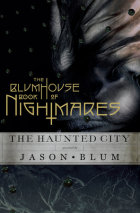
Blumhouse House of NightmaresTHE BLUMHOUSE BOOK OF NIGHTMARES: The Haunted City
Edited by Jason Blum; Read by Various
Publisher: Random House Audio
Publication Date: 7 July 2015
[UNABRIDGED] – 14 hours

Themes: / horror / short stories / ghosts / demonic possession / violence / murder /

Publisher summary:

Emmy Award-winning producer Jason Blum has ushered in a new dawn of horror with franchises like Paranormal Activity, The Purge, Insidious, and Sinister. Now he presents THE BLUMHOUSE BOOK OF NIGHTMARES: THE HAUNTED CITY, a stunning collection of original, terrifying fiction from a unique cast of master storytellers.   

Contents include:

“Geist” by Les Bohem
“Procedure” by James DeMonaco
“Hellhole” by Christopher Denham
“A Clean White Room” by Scott Derrickson and C. Robert Cargill
“Novel Fifteen” by Steve Faber
“Eyes” by George Gallo
“1987” by Ethan Hawke
“Donations” by William Joselyn
“The Old Jail” by Sarah Langan
“The Darkish Man” by Nissar Modi
“Meat Maker” by Mark Neveldine
“Dreamland” by Michael Olson
“Valdivia” by Eli Roth
“Golden Hour” by Jeremy Slater
“The Leap” by Dana Stevens
“The Words” by Scott Stewart
“Gentholme” by Simon Kurt Unsworth

Do you enjoy ghost, demon, and gore-lit? If yes, then you’ll enjoy this collection of stories ranging from psychological horror to down and dirty violent bloodletting. I feel this anthology does a nice job at covering the various bases in this subgenre, and for those of you interested in such reading material, I think you’ll enjoy the reading experience.

I’m not averse to reading stories that are violent or haunted by ghosts, but I need good writing. Some of these tales are fine examples of solid craft and storytelling. “A Clean White Room” by Scott Derrickson and C. Robert Cargill was a delight in the forward lean immediacy of the story. “Gentholme” by Simon Kurt Unsworth is an excellent story rendered in a pleasing unfolding of character exploration, and while the ending is a little flat, it was a pleasure to read.

Regarding recommendations? Yes, if you are a fan of these types of stories. No, if you are only an occasional horror reader. This is not a good collection to start on. It is a great collection if you’re looking to add to your already substantial horror reading catalog.

Several different narrators collaborate on this audiobook. I couldn’t find a list of the readers, but I think all deliver an outstanding reading. I was impressed with the audio quality.

Posted by Casey Hampton.

The SFFaudio Podcast #327 – AUDIOBOOK/READALONG: The Moon-Bog by H.P. Lovecraft

Podcast

The SFFaudio PodcastThe SFFaudio Podcast #327 – The Moon-Bog by H.P. Lovecraft; read by Martin Reyto courtesy of Legamus. This is an unabridged reading of the short story (24 minutes) followed by a discussion of it. Participants in the discussion include Jesse Willis, Seth Wilson, Jim Moon, and Juan Luis Pérez.

Talked about in this episode:
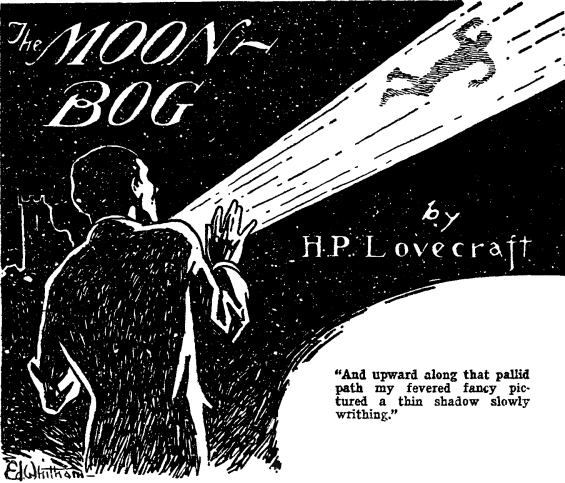
Title has a hyphen; published in Weird Tales in June 1926, but written for a St. Patrick’s Day event; most critics dismiss the story; most characters are nameless; no Cthulhu mythos; Greek ties to Lovecraft’s The Tree; H.P. Lovecraft Literary Podcast; thematic similarities to The Rats in the Walls and Hypnos; conflict between the bog goddess and her servants; frogs; moonbeams; Greek Pan pipes, not Celtic pipes; on the story’s un-Irishness; competing models of colonization; Protestant work ethic; Pied Piper of Hamelin; surviving narrator motif similar to Ishmael in Moby Dick; departure from the traditional Lovecraftian narrator; the poetry of Lovecraft’s prose, alliteration, etc.; Lovecraft’s Supernatural Horror in Literature; spoiler in Weird Tales art; the joys of reading aloud; Lovecraft’s Dunsanian story The Festival; architecture; Tolkien’s Dead Marshes and the gothic symbolism of bogs, etc.; Lovecraft’s descriptionn of cities in The Mountains of Madness and landscapes in The Dunwich HorrorThe Cabinet of Dr. Caligari and similar impressionism in film; The Quest of Iranon; unreliable narrators à la Edgar Allan Poe, especially The Fall of the House of Usher; laughing; bog draining and the curse of the Tiddy Mun; the city of Bath and the intersection of Roman and Celtic cultures; John Buchan’s The Grove of Ashtaroth; this is actually a happy Lovecraft story!; Robin Hood and the defense of the land; humans destroy megafauna; Lovecraft’s The Hound; American horror trope of the Indian burial ground; the lack of Celtic mythology; will-o’-the-wisps; how does one drain a bog? Ask the Dutch; disappointment in scientific explanation for stories; the ruins and the Gothic tradition.

The Moon-Bog by H.P. Lovecraft

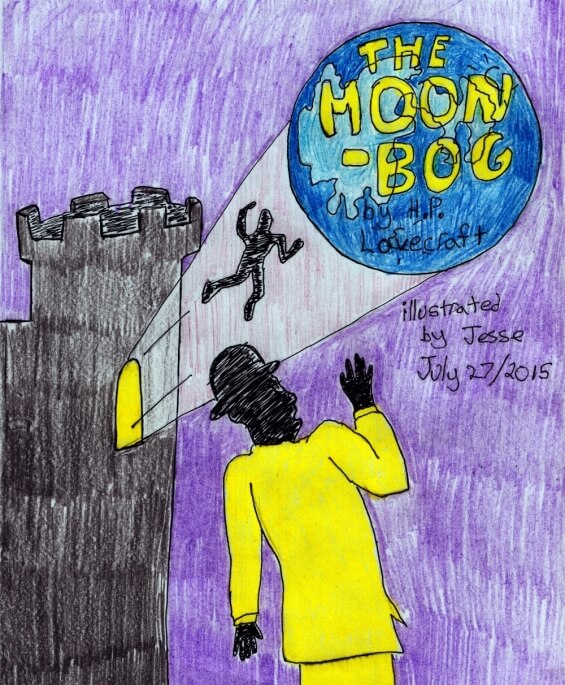
The Moon Bog by H.P. Lovecraft - illustrated by Jesse

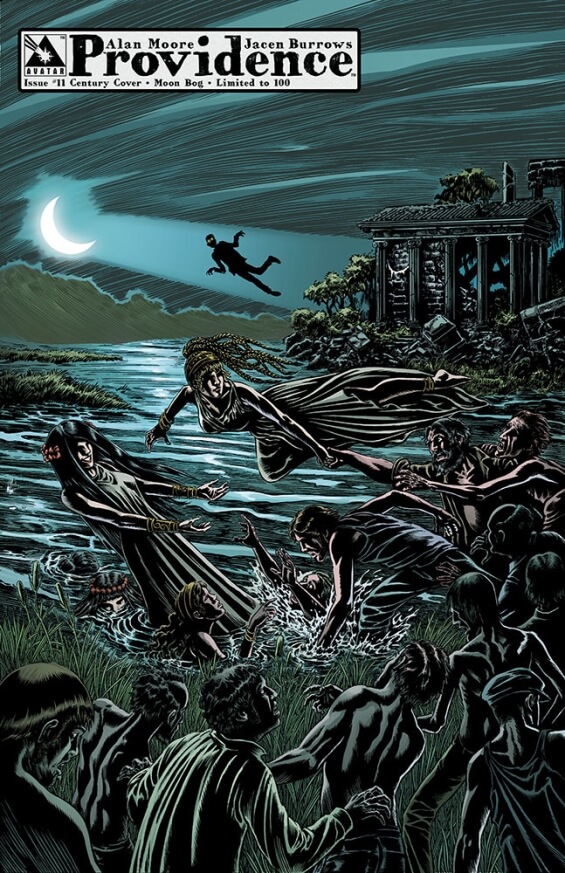
Providence, Issue 10, The Moon-Bog by H.P. Lovecraft - illustrated by Raulo Cáceres

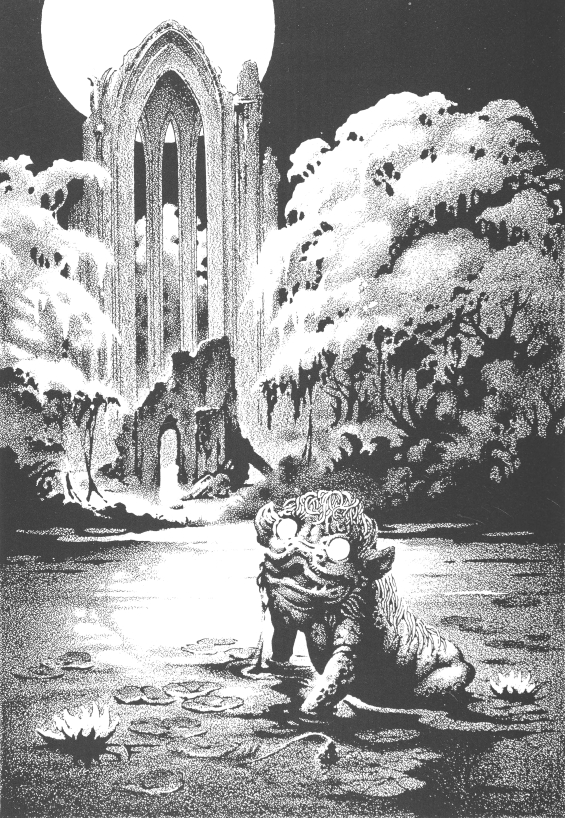
The Moon-Bog by H.P. Lovecraft - art by Stephen Fabian

Posted by Jesse Willis

Review of Worldbinder by David Farland

SFFaudio Review

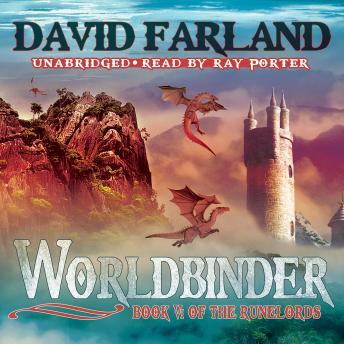
Fantasy - Worldbinder by David FarlandWorldbinder, The Runelords, Book 6
By David Farland; Read by Ray Porter
11.7 hours – [UNABRIDGED]
Publisher: Blackstone Audio
Published: 2012

Themes: / Fantasy / Epic Fantasy / Magic / Supernatural /

After the events of Sons of the Oak, Fallion and Jaz, the sons of the great Earth King Gaborn, are living as fugitives in their own kingdom, newly invaded and secretly controlled by supernatural beings of ultimate evil. The sons are hiding until they can regain their rightful places in the land.

The book opens with Shadowath and Lady Despair setting a trap for Fallion Van Orden by using The One True Tree as bait.

The world that Fallion and his friends, Rhianna, Talon and Jaz return to is one of corruption and darkness. People using any means to usurp power and control others. It’s a world grown dark after the death of the Earth King, Gaborn Val Orden. But Fallion hopes to mend the world by combining it with another.

Sadly, this is exactly what Lady Despair wanted. The two shadow worlds are falling into darkness. The one Fallion knew where humans were turning to greed and corruption, using their Runelord powers to force their will on the people, and the other shadow world where the Warrior Clan fought the evil Wyrmlings who served Lady Despair and wished to destroy all things good, including nature itself.

Fallion, Jaz, Talon and Rhianna must find allies and forge new alliances to combat the Wyrmling threat and save both worlds from Despair.

Like Brotherhood of the Wolf, this is a dark book that leads the main characters into untenable situations. The story goes from bad to worse. And yet, you are left with the hope that all is not lost and that the worlds may yet be saved.

I admit that I had a very hard time with the ending of this book. That’s not necessarily a bad thing. I do not generally like dark stories, but the characters and story are so compelling, so well-written, that I found myself continuing with the story.

It is not all dark. Like all good tales there are ups and downs, victories and losses. This book has more losses than victories, but in the Hero’s Journey, loss is a necessary part of growth and Fallion must grow to become The Light Bringer.

Ray Porter does a wonderful job pulling you into the story and holding your attention. I’ve enjoyed listening to his telling of the tale.

Like all of the Runelords books, I recommend this one. As long as you go in knowing it’s part of a series and that the dark times prophesied in the first series are now here, it’s a great story.

The book can be read as a stand-alone, but I think reading it as a series is much better as you get the entire saga.

I give this book a 4. It sucks you in. I’m reminded of the trip to Moria in Lord of the Rings. It’s dark and gets darker, but I have great hope that all will end well.

Posted by Charlene Harmon

Review of The Diamond of Jeru by Louis L’Amour

SFFaudio Review

Audio Drama - Louis L'Amour's The Diamond of JeruThe Diamond of Jeru
By Louis L’Amour; Performed by a Full Cast
3 hours – [AUDIO DRAMA]
Publisher: Random House Audio
Themes: / Audio Drama / Adventure / Magic / Fantasy / Pulp /

There were times Mike Kardec thought he could feel the magic of this place, a vague sense that just beyond his perception vast but subtle forces were at work… there was power out there, a great organic engine of death and rebirth.

Louis L’Amour (1908 – 1988) is best known for his Western novels, but for a long time I knew him only for a couple of his non-westerns. Last of the Breed (1986) was about a Native American pilot downed in Russia during the Cold War, and The Walking Drum (1984), a historical novel set in the 12th century. Later I read The Lonesome Gods (1983), which, though there were gunfights and horses, I assumed was still one of L’Amour’s atypical works. I enjoyed all of the above, which is why I greeted The Diamond of Jeru with a smile. L’Amour is a fine storyteller.

The Diamond of Jeru is also not a Western. It’s set in Borneo in 1955, where our hero Mike Kardec (played by Joel Bryant) finds himself after the Korean War. He is hired by a Helen and John Lacklan (Traci Dinwiddlie and Time Winters) to guide them deep into the island to find a diamond. There’s a touch of magic in the story, so I’d call it a fantasy adventure.

It’s presented as a “Dramatized Audio”, which I would describe as a rich audio drama with heavy narration. Joe Morton is the narrator, which is terrific because I can’t hear enough of that guy. He was perfect in some of Simon and Schuster’s Star Trek audio titles, and is excellent again here. In fact, all of the actors in this are top notch. This cast is among the highest quality group of actors I’ve ever heard doing audio drama.

On the video page of The Diamond of Jeru Audio Project site, Writer/Director Beau L’Amour and Producer/Editor Paul O’Dell discuss the making of the sound effects. Their methods sound excellent in the final production. I haven’t heard any other titles by this skilled team, but I’d love to hear one in which they rely more on the superb sound than on narration to establish setting and action. The sound had a very deep quality. Nothing out of place here.

The story retained much of the pulp quality of the original story, which was welcome. The website has an audio sample as well as a history of the story, which was written sometime in the late 1940’s or early 1950’s by Louis L’Amour, then revised and expanded to novella length by Beau L’Amour. The original, unedited story can be found |HERE|.

Posted by Scott D. Danielson

Review of Alive by Scott Sigler

SFFaudio Review

Alive by Scott SiglerAlive (Generations Trilogy *1)
By Scott Sigler; Narrated by Emma Galvin
Publisher: Empty Set Entertainment
Publication Date: 14 July 2015
[UNABRIDGED] – 9 hours, 44 minutes

Themes: / young adult / survival / horror /
Publisher summary:

A teenage girl awakens to find herself trapped in a coffin. She has no idea who she is, where she is, or how she got there. Fighting her way free brings little relief – she discovers only a room lined with caskets and a handful of equally mystified survivors. Beyond their room lies a corridor filled with bones and dust but no people and no answers.

She knows only one thing about herself – her name, M. Savage, which was engraved on the foot of her coffin. She finds herself in charge. She is not the biggest among them or the boldest, but for some reason the others trust her. Now, if they’re to have any chance, she must get them to trust one another.

Whatever the truth is, she is determined to find it and confront it. If she has to lead, she will make sure they survive. Maybe there’s a way out, a rational explanation, and a fighting chance against the dangers to come. Or maybe a reality they cannot comprehend lies just beyond the next turn.

“A stabbing pain jolts me awake.” So begins the story of a girl on what is an exciting day in her young life; her twelfth birthday. Maybe the pain was just from a dream, she thinks. But when she realizes she is surrounded by “total darkness” and is unable to move thanks to metal bars, she is forced to make a decision. It will be the first of many choices to be made.

Scott Sigler’s Alive is all about momentum and what I like to call structured discovery. With that in mind, I am going to do my best to keep things as spoiler free as possible. Our main protagonist has virtually a blank slate and nothing to help her as she begins her journey. She is thrust into an unfamiliar situation and doesn’t even know her name. Answers will not come easy for her or anyone else she meets on her quest. The unknown is everywhere. The only way is forward. We (as listeners) are inside her head and learn things as she learns them. For the impatient, this could be frustrating, a tad jarring, and bewildering since the story is told not only in first person but in the present tense as well . If you stick with M. (as she comes to be called), you will be rewarded in time. Be prepared for a slow burn which calls to mind British films as far as the pacing is concerned. This isn’t a bad thing since we are normally conditioned to have everything presented all in a rush with no time to process. It is refreshing to have things unfold naturally. You will feel like you are thrown into the deep end but that is okay because so is M. You are not alone.

This being the audio version of the 368 page novel, the narrator is very important; this can’t be over stated. He or she has to convey all the emotions of not only M. but anyone else, help pull us into Sigler’s world, and adapt to the fluidity of the story. Luckily, Emma Galvin is more than capable of handling the various subtleties. Words change meaning, (the names of certain objects for example), as does the physical and emotional landscape. This is Scott Sigler at his best. The perilous puzzle is well constructed, contains a myriad of vivid descriptions, and keeps you guessing throughout. If this were done as a film, first person point of view would be highly appropriate for the presentation.

If William Golding’s Lord of the Flies comes to mind while you are listening as it did for me, the comparison aptly fits. Questions are explored in depth. What is a leader? What makes a good one verses a bad one? Are we destined to repeat the mistakes of those that who have gone before or can we as a society break the cycle? How and where does a religious/belief system fit into the equation? Do we follow something because of blind faith or because we connect the dots? How do we handle fear? What is the right way to address conflict? Should we hold ourselves accountable because of the choices we have made or should we chalk things up to mere accidental outcomes? When does the life of an individual outweigh the lives of the entire group?

This story doesn’t shy away from harsh realities. Long-time Scott Sigler fans may be asking themselves, “Is there gore?” The answer is a resounding, ‘Yes.” However, this isn’t bloodshed and carnage purely for the sake of it. Everything serves a purpose even if we don’t understand it’s function when we come into contact with it at first. In the same token, things are presented with a deft sensativity to the target YA audience. There are many, many lessons to be learned. There’s a lot for teachers to work with if this book were to be used in a school environment.

As far as the science in this book, I can’t say much without revealing plot points. I will say, however, that technology of all sorts is represented nicely. Scott Sigler’s attention to detail, (another one of his trademarks), is present but skillfully subdued because of the limited knowledge of the main character. Observations are kept simplistic unless finer details are absolutely necessary.

If you are looking for a complex story that has mysteries within mysteries to be solved and a well-rounded cast of characters including a strong (yet vulnerable) female protagonist, this book is definitely for you. While the slow burn approach and the first person, present tense narrative may irk some listeners, the payoffs and the overall journey getting to those rewards make it all worthwhile. This being the first book in a trilogy, there is a true sense of discovery as the scope of things expands and the stakes are raised. Loose ends are tied up to a degree by the novel’s conclusion but the dust is far from settled. It is a claustrophobic roller coaster ride with many jolts, bumps, and twists along the way. Alive by Scott Sigler gets five out of five coffins.

Posted by Allen Sale.