Review of Gameboard of the Gods by Richelle Mead

SFFaudio Review

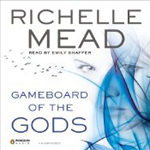
Gameboard of the GodsGameboard of the Gods (Age of X #1)
By Richelle Mead; Read by Emily Shaffer
Publisher: Penguin Audio
Publication Date: June 2013
[UNABRIDGED] – 16 hours

Themes: / urban fantasy / ritualistic murder / military /

Publisher summary:

In a futuristic world nearly destroyed by religious extremists, Justin March lives in exile after failing in his job as an investigator of religious groups and supernatural claims. But Justin is given a second chance when Mae Koskinen comes to bring him back to the Republic of United North America (RUNA). Raised in an aristocratic caste, Mae is now a member of the military’s most elite and terrifying tier, a soldier with enhanced reflexes and skills.

When Justin and Mae are assigned to work together to solve a string of ritualistic murders, they soon realize that their discoveries have exposed them to terrible danger. As their investigation races forward, unknown enemies and powers greater than they can imagine are gathering in the shadows, ready to reclaim the world in which humans are merely game pieces on their board.

I listened to Gameboard of the Gods on audio and to me it feels more like science fiction than urban fantasy. The book is a bit hard to review because it kind of evolves as you go a long and I would not want to spoil it for anyone.

The story takes place in the RUNA (Republic of North America) think a future country that is a unified Canada and USA. Dr. Justin March was a servitor who has been exiled to Panama, his citizenship has been taken from him and emotionally he is barely surviving life. Back in the RUNA there is a serial killer who likes to kill on the full moon. Other servitors have been unsuccessful in solving the crimes. Out of desperation Justin’s old employers have come to Panama with Mae and elite soldier with the RUNA to find and bring Justin back to the RUNA with the hope of getting the murders solved. Justin is dying to come home but he decides to get as much out of the deal as possible and he ends up bringing his friends daughter home with him so she can have the chance at a better education. But things don’t go as planned and Justin and Mae find themselves in an almost hopeless situation.

The story is told from three points of view, Justin, Mae and Tessa. Justin and Tessa make total sense you get a feel for two very different sides of the world and you also find out how similar they actually are to one another. I liked both Justin and Mae. Mae is a beautiful killer yet she is still a sensitive soul despite her upbringing – Justin on the other hand is crazy smart, his mind is continuously working so he uses drugs and alcohol to cope and to relax. I did not care for his comfort in using people to meet his ends especially with women and sex. Tessa on the other hand feels like an afterthought – I did like her character but she did not add much to the plot but perhaps in future books she will do something.

A major challenge with this book is you really do not know what is going on until you are about halfway in. Like it took me forever to figure out what the is a servitor?? It took a bit longer to figure out Horatio and Magnus. SO while it works because it made me curious it was also annoying because I never found answers to some questions like what happened to cause the government to sanction religion?? While I would classify this book as sci-fi the world is clearly challenged with technology – so we have a car that can drive itself and a tablet that does it all but other than that it feels kind of like life here in the old USA which rather sucks for sci-fi. Last but not least I would have liked a bit more mythology – we get a glimpse of them with various cults but I think it could have made for an even better story.

As I mentioned I listened to this book on audio, for me a narrator can make or break a book. Emily Shaffer was not a terrible narrator but I do not think she was the best person for this book. Reading a book with so many POV’s means she should have sounded different but to me she always sounds the same. Justin and Mae are rather hardened people they hide who they are from everyone all the time but Emily made them sound so chipper and curious which for me was the opposite of how they were described. My issues with the narration and the lack of world building information made this a slow going audio book.

The book totally has challenges but in the end I still enjoyed the story and I am looking forward to the next one in the series.

Posted by Dawn V.

The SFFaudio Podcast #244 – NEW RELEASES / RECENT ARRIVALS

Podcast

TheSFFaudioPodcast600The SFFaudio Podcast #244 – Jesse, Jenny, and Seth talk about NEW RELEASES and RECENT ARRIVALS.

Talked about on today’s show: Christmas-edition New Releases podcast; festivus; Seinfeld; Romulus Buckle and the Engines of War; pneumatic zeppelins (related to Led Zeppelin?) vs. non-pneumatic airships; Cherie Priest‘s Clockwork Century steampunk series; Gail Carriger‘s “tea-punk” Parasol Protectorate novels; Wizard of Oz: A Steampunk Adventure; HBO’s completely unrelated Oz television series; Seal Team 13, military vs. supernatural?; Lovecraftian horror vs. traditional horror; Call of Cthulhu role-playing game; World War Z; Overdraft: The Orion Exclusive; Jesse laments that neither Jenny nor Seth has seen Aliens; Sigourney Weaver; Gamadin: Word of Honor; Jesse loves audio drama; Night Vale; Blake’s 7; “audio drama is television or movies without pictures”; Visions of the Future now unabridged; limitations of the Star Wars spinoffs; R.A. Salvatore killed a beloved Star Wars character; Joseph Campbell’s hero’s journey; a Star Wars Oedipus story?; When the World Shook by H. Rider Haggard; Haggard’s She; casual racism in turn-of-the-century fiction; Haggard is the English Edgar Rice Burroughs; Rumpole series (the actor narrates the audiobooks); Inspector Morse; Agatha Christie; Touch Me Eternally; X-Men; Silvered by Tanya Huff; are shape shifters the new vampires?; Charlaine Harris and True Blood; etymology of werewolf; were bat?; every Batman story has been done; Dangerous Women anthology; Lawrence Block; Legends anthologies; George R. R. Martin’s Dunk and Egg stories; Well of Echoes series; geomancy = crystal magic; ABC (the Australian one) book club; CSPAN’s Book TV; Reading Rainbow and the LaVar Burton revival; Herland; Rudyard Kipling’s With the Night Mail and As Easy as ABC; Gungadin and “to carry the water”; Clark Gable; more on racism; White Man’s Burden; DreamScape Audio; The Poison Belt by Arthur Conan Doyle; sequel to The Lost World; similar to The Purple Cloud by M. P. Sheil; Jurassic Park; 1634 by David Weber and Eric Flint; time travel; George Guidall; Jonny Ive (and Seth’s bad Ive impression) read by Simon Vance; Chronicles of Light and Shadow by Liesel Schwartz; Waterlogged Holiday Collection; Kevin J. Anderson’s War of the Worlds: Global Dispatches; Robert A. Heinlein’s The Puppet Masters; Star Trek pancakes attack; Connie Willis especially To Say Nothing of the Dog; Three Men in a Boat by Jerome K. Jerome; Heinlein’s Have Spacesuit Will Travel; The Great Gatsby audio edition including Fitzgerald’s letters; Audible translating George R. R. Martin; Latin translations of Harry Potter; Call Down the Stars; metafiction; the prehistorical sub-genre;  Clan of the Cave Bear; Ian Rutherford; James A. Michener; Harry Harrison; The Wonder Stick (spoiler: it’s a bow!); Jack London; A Quarter to Fear narrated by Mr. Jim Moon at Hypnogoria (Jesse actually bought it!); H.P. Lovecraft Literary Podcast; Audible Editor’s Picks; Audie Awards; Doctor Sleep by Stephen King won Audible Pick of the Year; The Golem and the Jinni by Helene Wecker; American Gods by Neil Gaiman; Grimnoir Chronicles by Larry Correia; The Ocean at the End of the Lane and Coraline by Neil Gaiman; Ender’s Game Alive; The Silo Saga; The Human Division by John Scalzi; The Lost Fleet series by Jack Campbell; Zombie Fallout series by Mark Tufo; Peter Clines 14 and Ex-Heroes series; Roald Dahl’s Matilda narrated by Kate Winslet; tweeting coffee;

Posted by Jesse Willis

The Last Of The Masters by Philip K. Dick is PUBLIC DOMAIN

SFFaudio News

The Last Of The Masters by Philip K. Dick is PUBLIC DOMAIN.

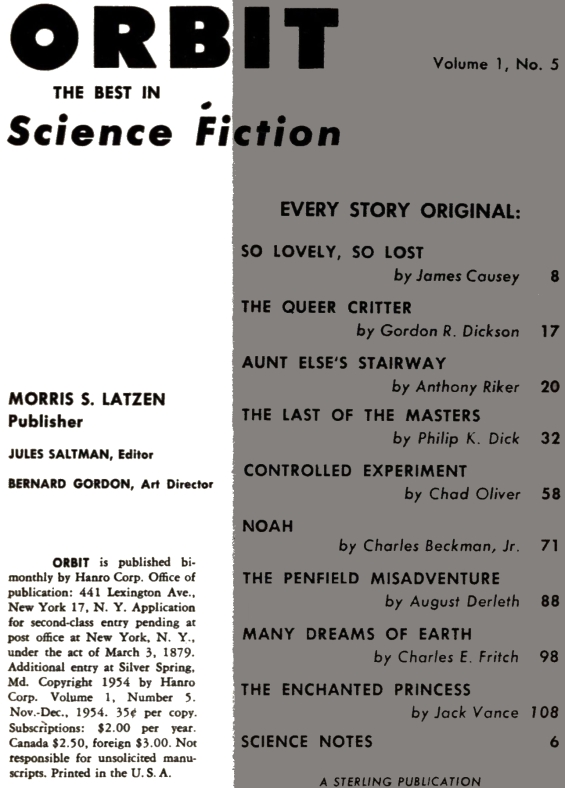
Orbit Science Fiction No. 5 - Includes The Last Of The Masters by Philip K. Dick

Here is the relevant passage from the Wikipedia entry:

After the author’s death, a nonexistent story with the same title was included under the new renewal registration number RE0000190631. This created the appearance that “The Last Of The Masters” was still under copyright protection.

I have a scan of that false renewal. It is HERE.

The Last Of The Masters was not published in Imaginative Tales, November 1955 (see for yourself HERE).

The Last Of The Masters was first published in Orbit Science Fiction No. 5. And that issue of that magazine was published and copyrighted in 1954:

ORBIT Science Fiction No. 5 - Table of contents (includes The Last Of The Masters by Philip K. Dick)

As the copyright for The Last Of The Masters was not properly renewed in its 28th year The Last Of The Masters by Philip K. Dick is PUBLIC DOMAIN.

Here is a |PDF| of The Last Of The Masters.

Posted by Jesse Willis

Review of Boy by Roald Dahl

SFFaudio Review

BoyBoy: Tales of Childhood
By Roald Dahl; Read by Dan Stevens
Penguin Audio
[UNABRIDGED] – 3 hours, 11 minutes

Publisher summary:

Where did Roald Dahl get all of his wonderful ideas for stories?

From his own life, of course! As full of excitement and the unexpected as his world-famous, best-selling books, Roald Dahl’s tales of his own childhood are completely fascinating and fiendishly funny. Did you know that Roald Dahl nearly lost his nose in a car accident? Or that he was once a chocolate candy tester for Cadbury’s? Have you heard about his involvement in the Great Mouse Plot of 1924? If not, you don’t yet know all there is to know about Roald Dahl. Sure to captivate and delight you, the boyhood antics of this master storyteller are not to be missed!

At the start of his book, Roald Dahl says, “An autobiography is a book a person writes about his own life, and it usually filled with all sorts of boring details. This is not an autobiography.”

Rather than a straight autobiography, it’s a short collection of some of his most powerful memories of childhood – the good, the scary, the hilarious and mischievous — all revealed with his amazing ability to paint a scene with the most evocative details and to find humor in even the worst situations.

Roald Dahl knows just the right details to capture your imagination and take you back to that feeling of being a kid, when the world is magical and mysterious and kinda gross, and Dan Stevens does a great job of narrating these tales with an engaging, slightly amused tone. Even readers who don’t know Roald Dahl’s books (they do exist: I know one!) would probably enjoy this book just for the trip back to a child’s perspective.

For fans, though, the collection is even more special, because it’s like taking a tour through Roald Dahl’s mind. Although Dahl rarely mentions it, if you know his work you’ll see the inspirations for his later stories and characters all through these anecdotes.

The most obvious one is in his near-religious awe of the candy shop. It promises so much and is so filled with delights, but the woman who works there is frightening and Roald Dahl in his friends come up with all kinds of conspiracy theories about the seeming-magic of some of the candy: for example, they are convinced the licorice shoelaces are made of rat’s blood, and the ‘tonsil ticklers’ candies are saturated with anesthetic to subdue children.

Then there is Mr. Cadbury, who regularly sent Roald Dahl’s family boxes of unidentified new flavors chocolates to taste-test. It’s not hard to see the seeds for Charlie and the Chocolate Factory when you hear Roald Dahl’s childhood revelation that, somewhere, there are people working away in inventing rooms to come up with new and amazing flavors of chocolate.

Along with all the more colorful and whimsical stuff are the darker stories of his boyhood, like having doctors turn up with their surgical bags and chloroform to operate right there in the living room, and many awful dealings with bullies of all sizes – but even the most horrid character becomes someone to delight in because of Roald Dahl’s cheerful wit and playful descriptive detail. You’re right there with him when the sheer force of the “foul and beastly” matron’s voice causes that “massive bosom of hers to quiver like a blancmange.”

Posted by Marissa van Uden

Review of The Poison Belt by Arthur Conan Doyle

SFFaudio Review

The Poison BeltThe Poison Belt
By Arthur Conan Doyle; Read by Gildart Jackson
Publisher: Dreamscape Audiobooks
[UNABRIDGED] – 3 hours, 24 minutes

Themes: / apocalypse / poison / science fiction /

Publisher summary:

What would you do if you had discovered that the planet was about to be engulfed in a belt of poisonous “ether” from outer space? Professor Challenger invites a hand-picked crew of adventurers and scientists to his home outside London, which has been fortified with several hours’ worth of oxygen. Challenger & Co. assemble in front of a picture window to witness the end of all life on the planet. As birds plummet from the sky, trains crash, and men and women topple over before their horrified gaze, they debate everything from the possibilities of the universe to the “abysses that lie upon either side of our material existence.”

I like Sherlock Holmes but I am much fonder of Arthur Conan Doyle’s other fiction. He was a skilled teller of “weird tales” and I have heard he was proudest of his historical fiction which I really enjoy. The Poison Belt is the second in a series of fantasy and science fiction novels featuring the brilliant and overpowering Professor Challenger.  It functions very well as a stand alone novel.

Having assembled a newsman, big game huntsman, and another scientist to explore South America in their first adventure, The Lost World, it is only logical that Challenger would call upon the same group for this scientific emergency. Professor Challenger puzzles them when he asks each to bring along a cylinder of oxygen. They are well acquainted with Challenger’s eccentricities but little do they suspect that he anticipates an apocalyptic event.

I’d say more but I think reading the whole description would have ruined my astonishment and interest in the story as it unfolded in this superb audiobook. In fact, having grabbed this review book solely based on my enjoyment of The Lost World, I hadn’t read the description at all. I was stunned to find this was such an apocalyptic novel. It is really well written and thought through. I was frequently surprised as various events occurred because I simply hadn’t thought through the consequences of an apocalypse in 1913 England.

Part of the enjoyment of The Poison Belt comes from the adventurers’ interactions. Doyle is very good at inserting humor, often through the two scientists’ bickering over conclusions, and at other times in hunter Lord John’s casual comments as in this instance when Challenger has asked the group to look at an amoeba through a microscope.

Lord John was prepared to take him on trust.

“I’m not troublin’ my head whether he’s alive or dead,” said he. “We don’t so much as know each other by sight, so why should I take it to heart? I don’t suppose he’s worryin’ himself over the state of OUR health.”

I laughed at this, and Challenger looked in my direction with his coldest and most supercilious stare. It was a most petrifying experience.

“The flippancy of the half-educated is more obstructive to science than the obtuseness of the ignorant,” said he. “If Lord John Roxton would condescend—-”

“My dear George, don’t be so peppery,” said his wife, with her hand on the black mane that drooped over the microscope. “What can it matter whether the amoeba is alive or not?”

“It matters a great deal,” said Challenger gruffly.

“Well, let’s hear about it,” said Lord John with a good-humoured smile. “We may as well talk about that as anything else. If you think I’ve been too off-hand with the thing, or hurt its feelin’s in any way, I’ll apologize.”

Part of the humor comes across thanks to the excellent narration by actor Gildart Jackson. As is often the case with actors, his reading is rife with expressive accents, subtle nuances, and changes of pace. This isn’t a very long book and goes along at a rattling pace. I was hooked from the beginning.

I don’t know when I’ve enjoyed an audiobook more and I hope that Dreamscape is considering more of Arthur Conan Doyle’s fiction for the future.

Posted by Julie D.

The Seismograph Adventure by Arthur B. Reeve

Aural Noir: Online Audio

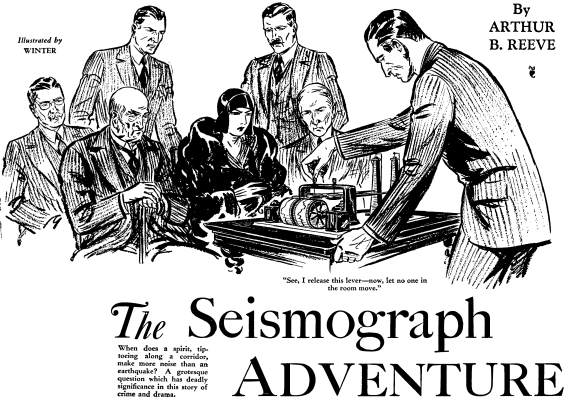
The Seismograph Adventure - illustrated by Winter

Professor Craig Kennedy, a scientific detective similar to Sherlock Holmes, uses his knowledge of chemistry, psychoanalysis, and the scientific method to solve mysteries. In this adventure he foresees “potentialities and possibilities unrecognized by ordinary minds, and with his profound knowledge of applied sciences, is able to approach the enormous tasks confronting him from a new and scientific angle.”

And according to Hugo Gernsback The Seismograph Adventure is “one of the finest, as well as scientific, of Arthur B. Reeve’s stories.”

LibriVoxThe Seismograph Adventure
By Arthur B. Reeve; Read by Elliott Miller
1 |MP3| – Approx. 50 Minutes [UNABRIDGED]
Publisher: LibriVox.org
Published: 2010
“Can ghosts walk? And if they do, can their footsteps be recorded on a machine? And are the spirits of the phantom world subject to the same physical phenomena as our human bodies? These are tantalizing questions which arise during the thrilling and complex mystery into which Craig Kennedy and Jameson are plunged without warning.” First published in Cosmopolitan, April 1911.

And here’s a 10 page |PDF| made from its republication in Scientific Detective Monthly, March 1930.

Posted by Jesse Willis