
 The Highway To Mars podcast recently featured Mr Jim Moon, Odile Thomas, and Stefan Sawynok talking about Robert A. Heinlein’s Starship Troopers (and the 1997 movie adaptation).
|MP3| 1 Hour 48 Minutes
Posted by Jesse Willis
News, Reviews, and Commentary on all forms of science fiction, fantasy, and horror audio. Audiobooks, audio drama, podcasts; we discuss all of it here. Mystery, crime, and noir audio are also fair game.

The Highway To Mars podcast recently featured Mr Jim Moon, Odile Thomas, and Stefan Sawynok talking about Robert A. Heinlein’s Starship Troopers (and the 1997 movie adaptation).
|MP3| 1 Hour 48 Minutes
Posted by Jesse Willis

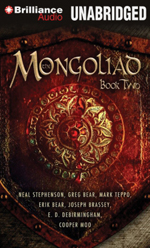 The Mongoliad Book Two
By Greg Bear, Neal Stephenson, Erik Bear, Mark Teppo, Joseph Brassey, Cooper Moo, and Nicole Galland; Narrated by Luke Daniels
Publisher: Brilliance Audio
Length: 12.5 hours
Themes: / mongoliad / martial arts / fantasy / monks / conquests / Mongols /
Publisher summary:
In the aftermath of the Mongolian invasion of 1241, beleaguered Christians struggle with the presence of a violent horde and a world turned upside down. Apocalyptic fever sweeps through Europe, infecting even the most rational individuals, leaving all to wonder if they are seeing the end times — or an hour when new heroes will emerge from the ruins of cataclysmic defeat. An order of warrior monks, the Shield-Brethren, refuses to yield, plotting to overthrow the invaders despite insurmountable odds. Father Rodrigo Bendrito receives a prophecy from God and believes it’s his mission to deliver the message to Rome. Along with the hunter Ferenc, orphan Ocyrhoe, healer Raphael, and alchemist Yasper, Rodrigo sets out to reclaim Europe. But to save Christendom, someone must slay the fierce Khan of Khans. Brimming with intrigue and colorful characters, The Mongoliad: Book Two is a riveting, expertly rendered tale about the will to survive.
Much like The Mongoliad: Book One, The Mongoliad: Book Two tells a myriad of parallel stories, all centered around the Mongol conquests in medieval Europe. There isn’t much that I can say about this book, Book Two, that I didn’t say in my review of Book One.
This book continues most of the plot lines opened in Book One, and adds a couple more. I suppose/suspect that each different author wrote a different parallel story. I’m not sure that a book that is the overall length of the trilogy (the first two books are about 13 hours long each, the third is about 22 hours long) really needs as many parallel stories as the books seem to have–and that’s before I’ve started Book Three, which may add more stories. It’s like reading a story with as many parallel plot lines as The Wheel of Time series or the A Song of Ice and Fire series but with a fraction of the total page count. This makes it confusing to keep track of story progress (overall) and each of the characters. This is also made more confusing by the odd names used. As I wrote in my review of Book One, I suspect that this would be easier to read in print, or at least with a wiki of a cast of characters. I’m amazed that I can’t seem to find one online.
As with Book One, the book didn’t come to any conclusion, it just ended. At least this one didn’t end in the middle of a heated battle. Oddly, Book Two didn’t pick up exactly where Book One left off. This book started with a new plot line, one with a warrior traveling with a severely injured priest to Rome. I spent a good amount of time when I started Book Two listening and re-listening to the first part; I was trying to jog my memory to remember the plot line from Book One. It took me awhile to realize that the story was brand new for Book Two. The story lines so far seem to be:
– The brother knights on their quest to defeat Ogedai (spelling?) Kahn; they have sustained some losses but also have picked up a few extra travelers in their party, including a warrior woman. They also have a brother with them who has visions; he had one in Book One which we saw the outcome of in Book Two. He had another vision in Book Two, which I expect we’ll see the resolution of in Book One.
– The remaining brother knights trying to distract the Kahn’s brother and his traveling circus of fighters; these guys seem to be trying to form a rebellion from within the circus. Andreas is helping to lead this rebellion with the two most prevalent Mongol fighters in the circus.
– Ogedai Kahn’s point of view, where he is now under attack by the Chinese.
– GonSuk, an adviser/guard to Ogedai Kahn (as well as some of his fellow advisers/guards who are with and without him).
– The Levonian (spelling?) knights, who seem to be out to try to re-gain status in the world. They seem to be in conflict with the Rose Knights (the brother knights on the quest). Their role is not exactly clear yet, but it seems that they have ties to the church. This was a new story line for Book Two.
– The cardinals in Rome who are split into two factions for the election of the next Pope. This was a new story line for Book Two and it’s not exactly clear the differences between the factions.
– A wandering warrior and a young warrior girl (one similar to the warrior woman with the Rose Knights, though this young girl is still in training), who have been sent on a quest by one of the cardinals; the cardinal who gave them the quest to pass a message was killed. This was also a new story line for Book Two.
As much of a downer as this review seems, I’m still intrigued. I don’t get it, as this defies most of my typical “rules” for books. This time, I’m going to move right into Book Three, instead of reading a few books in between. Book Three is almost twice as long as Book One or Book Two. I enjoy this world, even though it seems like there are too many story lines and too much going on…with confusing characters. I do think that this world is better-suited to the prequels and the “Side Quest” books. I’ve already read two of the prequels (and have the other one, Seer: A Prequel to the Mongoliad, ready to read), and have three of the Side Quests ready to read once I’m done with the main story. Stay tuned for my review of Book Three, which will include an overall review of the main story line of the “series.”
Posted by terpkristin.

 The SFFaudio Podcast #241 – Jesse and Jenny discuss the 1913 novel Goslings: A World Of Women by J.D. Beresford and the 2013 audiobook from Dreamscape Audiobooks.
PUBLIC DOMAIN |ETEXT|
Talked about on today’s show:
Dreamscape Audiobooks, narrator Matthew Brenher, English dialects (and accents), a casual apocalypse, running out of water, “he’s going to beat his family”, “and we’re very English and we’re moving on”, a world of women,
A global plague has decimated England’s male population and the once-predictable Gosling family is now free to fulfill its long-frustrated desires. When Mr. Gosling leaves his family to peruse his sexual vices, the Gosling daughters, who lack experience and self-independence, find shelter in a matriarchal commune. However their new life is threatened by the community elders’ views on free love.
that’s not what it feels like, what do the women want?, Thrail and his perspective, the Gosling’s perspective, Thrail’s journal, an implicit trust in the British authorities, fathoming an empty world, what is Mother Gosling’s ultimate fate?, a very gentle book, the cruelest moment in this book is the confrontation at the tobacconist’s, “you stupid slut”, a gentle apocalypse, 70% of the population dies, The Stand by Stephen King, exploding heads, Earth Abides, the war of all against all, almost all the men die, the harem, Thrail is asexual, a dalliance with a coquette, Jenny blames Father Gosling, the proximal cause, “we’re wasting the potential of women”, Eileen (aka Lady Eileen), marriage never really protected women, a world of slaves, men can be feminists too, why does it take a man to write a book about a world of women?, J.D. Beresford modeled Thrail on H.G. Wells, Jack London, the 1910s, the Bolshevik revolution, Mastering The Art Of Soviet Cooking, Mastering the Art of Soviet Cooking: A Memoir of Food and Longing by Anya Von Bremzen, an anti-disestablishment bill, the Anglican Church, church and state, the fundamentalist religious people in this book, so many critiques, a very thoughtful book, intellectualism, “you don’t want books, keep your eyes open and think”, Thrail worked on every continent, Thrail is needed for his manly skills (not just his sperm), “the Jewess”, is this casual racism?, this is a weird book because its about fashion, a Science Fiction novel about FASHION!, the clothing, pants, work clothing, Thrail is the Beresford mouthpiece, Thrail’s Dr. Watson, “you’re so mighty!”, women want to attract mates but their worried about what other women think, and men are into fashion too, a vigorous bike ride, “get out of the city”, the suppressed lech, “I saw the god in the father”, a transition back to nature, Sterling, the ending, what’s going on in America, this story would never work now, Goslings is completely of its time, a really well written book, Beresford wrote a book about H.G. Wells, Neil Gaiman, the neat ending undercuts the book, a new way to be, why do we like these downer books, Jenny likes to see what happens when things get torn apart, a farm commune, the thieving, the religious group, class distinctions, fashion and class, Louis Vuitton, a signifier of class, men are not the oppressors, people are oppressing themselves, we weren’t even slaves to intelligence and efficiency, a strong educated woman, a funny utopian book, utopia/dystopia, compared to the end of Earth Abides, the war bride phenomena, think of the children, Virus (1980) aka Day of Resurrection (PUBLIC DOMAIN), an inversion of the situation in Goslings, rape is not okay, how do we rebuild the world with only eight women and eight hundred men?, The Best Of All Possible Worlds by Karen Lord, On The Beach by Nevil Shute, Gooses?, Ganders?, goslings grow up, growing up, Blanche is the elder daughter, Millie becomes a harem girl, beautiful hair, “if you stop I’m gone”, Thrail doesn’t want to suffer the fools, sex in that bush, the women are jealous, “history is a series of stories about the worst fucking people in the world”, bastard after bastard, asshole after asshole, “slut” is the insult word for women, etymology of swear words, bitch, bastard, a term of unworthiness, men worry about bastard children, women are worried about having sluts near their husbands, the terms don’t apply anymore, religious sects that don’t sexually reproduce, the Shakers, the rapture, J.D. Beresford was agnostic and then a theosophist, Paris intellectuals, Madame Blavatsky, the universal over-soul, séances, the cause, the 19th century, “newspapers newspapers newspapers”, disposable income, social negotiations, the girls could push their dad’s buttons, when the hard truth comes…, Jean Claude Van Damme, Jenny plows her own fields, “more beets, less kale”, the prepper phenomenon, a seed bank, all the planting zones are shifting, growing beets and kale in Antarctica, there are only two flowering plants in Antarctica.

Posted by Jesse Willis

Dan Stevens on Narrating the Audible’s new audiobook version of Frankenstein by Mary Shelley
Posted by Jesse Willis
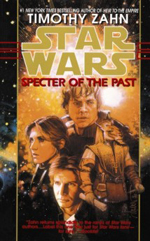 Specter of the Past: Star Wars (The Hand of Thrawn)
By Timothy Zahn; Read by Marc Thompson
Publisher: Random House Audio
ISBN: 9780804128483
Publication Date: 17 September 2013
[UNABRIDGED] – 14 hours, 31 minutes
Excerpt: | MP3
Themes: / Star Wars / New Republic / Thrawn /
Publisher summary:
Hugo Award-winning author Timothy Zahn makes his triumphant return to the Star Wars universe in this first of an epic new two-volume series in which the New Republic must face its most dangerous enemy yet–a dead Imperial warlord.
The Empire stands at the brink of total collapse. But they have saved their most heinous plan for last. First a plot is hatched that could destroy the New Republic in a bloodbath of genocide and civil war. Then comes the shocking news that Grand Admiral Thrawn–the most cunning and ruthless warlord in history–has apparently returned from the dead to lead the Empire to a long-prophesied victory. Facing incredible odds, Han and Leia begin a desperate race against time to prevent the New Republic from unraveling in the face of two inexplicable threats–one from within and one from without. Meanwhile, Luke teams up with Mara Jade, using the Force to track down a mysterious pirate ship with a crew of clones. Yet, perhaps most dangerous of all, are those who lurk in the shadows, orchestrating a dark plan that will turn the New Republic and the Empire into their playthings.
No one does Star Wars quite like Timothy Zahn. He knows how to play the characters just right and make good use of the different factions in the Star Wars universe to make for an interesting story. Zahn has added the most significant and lasting characters to the series after the movies themselves and is the author who really got people excited about Star Wars novels after his trilogy that starts with Heir to the Empire. Specter of the Past is a great book if you like Star Wars or science fiction, although there is some back history from Zahn’s previous trilogy that makes me recommend starting there first. If you’ve already read that trilogy, you will definitely enjoy this.
Specter of the Past is part of a two-book series from Timothy Zahn that takes place just before the books from the New Jedi Order series which takes place about 20 years after the events of Return of the Jedi. The Empire has pretty much been all but defeated by The New Republic and is only left with a considerably smaller portion of the galaxy to call home. Some in Imperial command are considering proposing a truce with the New Republic while others still want to find a way to regain the power they lost. Those other factions use a secret document from the Emperor’s cache on Wayland to polarize parts of the New Republic while promoting a new rallying point for the Empire.
This is back from the more “golden age” of Star Wars before the prequels changed things, so it feels more like it belongs with the original trilogy. Zahn manages to weave an impressive array of factions in this book: The New Republic, The Empire, pirates, smugglers, gamblers, etc. The story keeps up a good pace throughout and keeps things interesting.
My only very minor gripe for this book is actually because it comes from the “golden age” of Star Wars books. There was less coordination between books back then so Zahn is clearly writing with reference to his previous trilogy that happened 10 years before. Characters seemed to just randomly make references in their heads to things from that trilogy or think back to events from those books even though there are something like 10+ books that happen between that trilogy and this novel. I wouldn’t comment on it except that animals and event from Wayland and things that happened with Grand Admiral Thrawn seem to come up a lot.
Audio book: As usual, Marc Thompson did a great job with the impersonations of our favorite characters and kept things lively and energetic throughout the book. He was easy to understand and I look forward to Thompson doing more Star Wars books. The usual music and sound effects commonly found in Star Wars audio books were also in there and were as good as I’ve heard them.
Posted by Tom Schreck
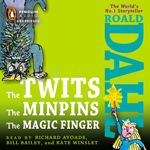 The Twits, The Minpins, & The Magic Finger
By Roald Dahl; Read by Richard Ayoade, Bill Bailey, and Kate WinsletPublisher: Penguin Audio
Publication Date: 26 September 2013
[UNABRIDGED] – 2 hours
Themes: / children’s fantasy / short stories / creatures /
Publisher summary:
THE TWITS
How do you outwit a Twit? Mr. and Mrs. Twit are the smelliest, nastiest, ugliest people in the world. They hate everything—except playing mean jokes on each other, catching innocent birds to put in their Bird Pies, and making their caged monkeys, the Muggle-Wumps, stand on their heads all day. But the Muggle-Wumps have had enough. They don’t just want out, they want revenge.THE MINPINS
Little Billy strays into the forest, where he meets the Minpins?tiny people who live within the trees. The Minpins tell Billy about The Gruncher, who preys on them. So Billy embarks on a mission to rid the Minpins of their foe once and for all, and sets off?on the back of a swan?to confront The Gruncher.THE MAGIC FINGER
What happens when the hunter becomes the hunted? To the Gregg family, hunting is just plain fun. To the girl who lives next door, it’s just plain horrible. She tries to be polite. She tries to talk them out of it, but the Greggs only laugh at her. Then one day the Greggs go too far, and the little girl turns her Magic Finger on them. When she’s very, very angry, the little girl’s Magic Finger takes over. She really can’t control it, and now it’s turned the Greggs into birds! Before they know it, the Greggs are living in a nest, and that’s just the beginning of their problems.
Although I have enjoyed many of the movies made from Roald Dahl’s books (most notably James and the Giant Peach) I cannot recall reading any of his books except Charlie and the Chocolate Factory which was … fine but not world changing for me. That’s kind of odd too, when I think about it, because I was the right age to be the prime audience when a lot of his books were coming out but I was largely oblivious to them. (Yep. Dated myself. Don’t care.)
However, as I have learned in the past, audio often breaks open a book or author who I didn’t find congenial in print. It was that way with Coraline by Neil Gaiman. It was that way with the last half of The Lord of the Rings (yes, I am ashamed but I will not lie). And, now, it is that way with Roald Dahl.
The Twits are the most horrible couple in the world and quite hateful to each other, until they are under attack from a common enemy. Even then they are horrible which makes it quite gratifying to see them get their comeuppance from the Muggle-Wump monkey family and the Roly Poly bird. This story had the most disgusting description of a beard I have ever encountered. Even while I was grimacing, I was also laughing because Dahl had such a clever way with words. Narrator Richard Ayoade had a lovely, calm British narration style that didn’t preclude hilarious, low-class voices for the Twits. First class stuff.
The Minpins has the most perfect monster name I’ve ever heard — The Gruncher, a fire-breathing, boy eating creature in Sin Forest. It sends Billy right up a tree where he meets the Minpins and they form an ingenious alliance to deal with their common foe. Bill Bailey narrated this with a great deal of gusto which didn’t detract in the least from the story.
The Magic Finger was my favorite story, partially because Kate Winslet’s narration won me over from the very beginning. I also just couldn’t resist the little girl who “puts my Magic Finger” on those who displease her. The Greggs are worthy of a magic finger punishment because they are such keen hunters. What the Magic Finger does is typical Dahl ingenuity at its best.
All three of these are little stories but each is a gem which children would love. Heck, I liked them quite a bit myself and, as I have revealed, I am far past the age of tender youth. I am now going to look for more Roald Dahl in audio, possibly even revisiting Charlie and the Chocolate Factory.
Posted by Julie D.