Expediter by Mack Reynolds

SFFaudio Online Audio

Expediter by Mack Reynolds

Mack Reynolds is an SF author who needs more attention. Unfortunately his non-public domain works, the majority of his work, are languishing, orphaned. Escape Pod has paired this less than stellar novelette with an excellent narrator, Corson Bremer, but even so it’s a less than stellar representative example of Reynold’s most thoughtful societal thinking. Expediter merely hints at the kinds of things Mack Reynolds could do. Come to think of it, what we really need is an expediter to make the still copyrighted works of Mack Reynolds available as ebooks (and audiobooks).

Podcast - Escape PodExpediter
By Mack Reynolds; Read by Corson Bremer
1 |MP3| – Approx. 1 Hour 22 Minutes [UNABRIDGED]
Podcaster: Escape Pod
Podcast: October 28, 2013
His assignment was to get things done; he definitely did so, Not quite the things intended, perhaps, but definitely done. First published in Analog, May 1963.

Podcast feed: http://escapepod.org/podcast.xml

Here is the |ETEXT|.

And I’ve assembled a |PDF|.

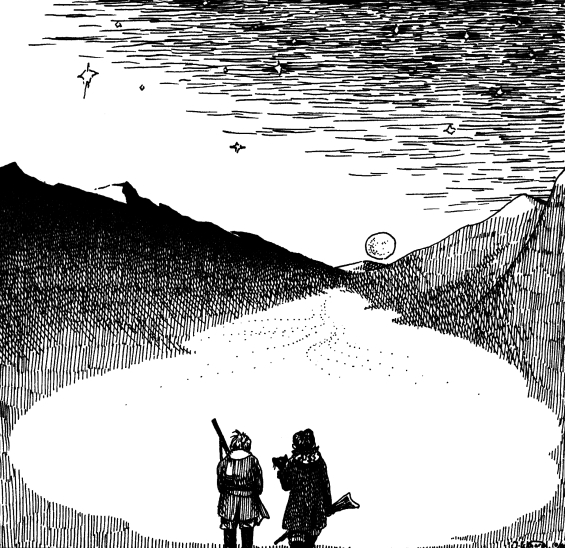
Expediter by Mack ReynoldsIllustrated by George Schelling

Posted by Jesse Willis

The Hedgehog by Saki

SFFaudio Online Audio

One can easily imagine a story like this actually happening at an upper-crust English country seat like the fictional Downton Abbey – Ruth Golding’s fabulous narration is spot on for this cute little “ghost story” by Saki.

LibriVoxThe Hedgehog
By Saki; Read by Ruth Golding
1 |MP3| – Approx. 15 Minutes [UNABRIDGED]
Publisher: LibriVox
Published: 2012
The busybodies at a vicarage garden party invite a one Miss Ada Bleek, from the “Society for Psychical Research”, to have a bit of a snoop at their local ghosts – she finds a very large and rather pale one.

And here’s a five page |PDF| version.

Posted by Jesse Willis

The SFFaudio Podcast #236 – AUDIOBOOK/READALONG: The Hills Of The Dead by Robert E. Howard

Podcast

The SFFaudio PodcastThe SFFaudio Podcast #236 – The Hills Of The Dead by Robert E. Howard, read by Paul Boehmer (courtesy of Tantor Media’s The Savage Tales Of Solomon Kane). This is a complete and unabridged reading of the story (60 minutes) followed by a discussion of it. Participants in the discussion include Jesse, Mr Jim Moon, Matthew Sanborn Smith, and Bryan Alexander

Talked about on today’s show:
Second-to-last Solomon Kane story chronologically, “Red Shadows” and “Wings of the Night” close contenders for Solomon Kane stories, the latter featuring harpies from Jason and the Argonauts, history of Solomon’s staff explained in other stories, fetishes (not THAT kind!), juju stick, magical weapons, Wandering Star edition illustrated by Gary Gianni, comic book adaptations, vampire-slaying, story uncharacteristically well-plotted including foreshadowing, “plains and hills full of lions” oh my!, lion sleeping habits, “Africa is full of never-explained mysteries” excuses plot holes, prefigures Richard Matheson’s I Am Legend, Kate Beckinsale’s Underworld movies, one of few stories to depict ‘nation of vampires’, Kiss of the Vampire (film), Transylvania, homeopathic symbolism, sex sells, ‘Howardian damsel in distress’, voodoo, feminization of the jungle, homoerotic undertones, Howard biography Blood and Thunder by Mark Finn, post-Colonial critique, vampires in fiction oscillate between sexualized and homicidal, Stephen King slams Stephanie Meyer’s Twilight vampires, Nosferatu (relatively unknown at the time of this story’s writing) introduced the idea that sunlight kills vampires, the Devil as source of Kane’s lustful urges, “Howard doesn’t do metaphors very well”, vampire-zombie continuum, Howard as great visual writer, animal characteristics ascribed to Kull and Conan but not Kane, snake imagery (related to serpent in Garden of Eden?), Slave Coast, vultures, nature of the soul, “Rogues in the House” (written in one sitting while Howard had a headache), the dangers of over-interpreting Howard, Howard’s subconscious, early 20th-century magazines preoccupied with race, Cosmpolitan (it was once a literary magazine), race hierarchy, Solomon Kane less racist than Howard himself, racial hierarchy, Berbers, Solomon Kane’s conflicted personality, the New Model Army, Howard’s characters are solitary, Puritans, Kane has a death wish, Kane’s celibacy, significance of Solomon Kane’s name, Ben Jonson satirizes Puritan names (in Bartholomew Fayre), so does Terry Pratchett (in Lords and Ladies, Mormonism, concept of congregation of all believers, English Civil War and its sects, Grendel in Beowulf as descendant of Cain, Sandman comics, Kane is “always on the road”, Matthew Hopkins witchfinder general, wood imagery, we learn what a palaver is, The Dark Tower series, temptation, inquisition, H. P. Lovecraft, cohesion of Howard’s works, history of the English language, George Harrison’s coyright infringement, parallel evolution in fiction, Clark Ashton Smith, Charles Baudelaire, genocide, the importance of a shared reader-author premise, shared cultural values, Hitler, The King in Yellow, Woodrow Wilson was a racist, zombies vs. animals.

The Hills Of The Dead - Illustration by Greg Staples

The Hills Of The Dead by Robert E. Howard

The Hills Of The Dead

Solomon Kane's Fetish Staff

Solomon Kane in Africa

The Hills Of The Dead by Robert E. Howard

The Hills Of The Dead by Robert E. Howard - illustration by Hugh Rankin from Weird Tales, August 1930

ad for The Hills Of The Dead by Robert E. Howard from WEIRD TALES, July 1930

ad for The Hills Of The Dead by Robert E. Howard from WEIRD TALES, July 1930

The Hills Of The Dead - illustrated by Gary Gianni

Guillem H. Pongiluppi illustration of The Hills Of The Dead

Marcus Boas art - Robert E. Howard's Hills Of The Dead

Posted by Seth Wilson

Review of Matilda by Roald Dahl

SFFaudio Review

Matilda by Roald DahlMatilda
By Roald Dahl; Read by Kate Winslet
Publisher: Penguin Audio
Publication Date: 3 July 2013
ISBN: 9781611761849
[UNABRIDGED] – 5 hours

Themes: / fantasy / telekinesis / children / school / libraries / bullies /

Publisher summary:

Matilda is a sweet, exceptional young girl, but her parents think she’s just a nuisance. She expects school to be different but there she has to face Miss Trunchbull, a kid-hating terror of a headmistress. When Matilda is attacked by the Trunchbull she suddenly discovers she has a remarkable power with which to fight back. It’ll take a superhuman genius to give Miss Trunchbull what she deserves and Matilda may be just the one to do it!

This book made me so nostalgic for childhood, mostly because Roald Dahl is a wizard who can see through a child’s eyes but also because he was such a huge influence on me when I was a kid. Matilda was one of my favorite Roald Dahl stories, and hearing it narrated by Kate Winslet was amazing—probably the best narration I’ve heard. She colors every single character a fully realized personality, from syrupy sweet to hilariously grotesque. I think Kate Winslet is doing in narration what Quentin Blake did for Roald Dahl in illustration.

The story is Roald Dahl at his best: it is sarcastic and dark (featuring a bingo-obsessed mother, a dishonest father, and a headmistress who throws children out windows for eating in class) but it’s also hilarious, magical, and hopeful.

Matilda Wormwood is a very small, sensitive, and brilliant girl who has the misfortune of being born to gormless idiots. Mr. Wormwood is a rat-faced used-car salesman who’s really only interested in people who boost his ego. He seems allergic to his daughter, mainly because she is much cleverer than him. Mrs. Wormwood, when she’s not off playing bingo, sits around watching American soaps and thinks “Looks is more important than books!”

Matilda’s good morals and quick wits unsettle her parents, which makes them even more dismissive and neglectful of her. Her only escape is to visit the local library where she devours the whole children’s section in no time. The amazed librarian than helps guide the little girls through all the classics, from Charles Dickens and Jane Austen to George Orwell and HG Wells.

 “The books transported her into new worlds and introduced her to amazing people who lived exciting lives. She went on olden-day sailing ships with Joseph Conrad. She went to Africa with Ernest Hemingway and to India with Rudyard Kipling. She travelled all over the world while sitting in her little room in an English village.”

Reading all this literature awakens something in Matilda.  She realizes that she now has a view on life that her parents have not experienced and never will, and that there’s far more to life than cheating people and watching television.

But she’s only four, so she’s stuck with them, “no matter how asinine.”  To stop herself from going crazy, she beings to play mischievous pranks on them to punish them for every wrong they do. And when she starts school and meets even nastier bullies, she must use her brain power to develop new techniques for helping good people and punishing rotten ones.

I love the honesty Roald Dahl puts into his children’s stories. Children are often taught they must respect and obey their parents and teachers no matter what, as if we live in some utopia where all adults are intelligent, caring protectors. But Roald Dahl is not afraid to tell children the truth: sometimes monsters are real, and sometimes they look just like the people who have the most power over you or are supposed to care about you. People should earn trust and respect through their actions, not get it automatically because of their authority, age, or status.

Roald Dahl also teaches the other great wisdom: the world is full of idiots and oversized egos, and the best way to survive them is to keep your wits sharp and find the humor in every situation.

Posted by Marissa van Uden


Solomon Kane’s Homecoming by Robert E. Howard

SFFaudio Online Audio
Solomon Kane's Homecoming by Robert E. HowardFirst published in Fanciful Tales of Time and Space, Fall 1936.
Mr Jim Moon narrates this poem |MP3| by Robert E. Howard.

Here’s a |PDF| made from that publication.

Solomon Kane’s Homecoming by Robert E. Howard

The white gulls wheeled above the cliffs, the air was slashed with foam,
The long tides moaned along the strand when Solomon Kane came home.
He walked in silence strange and dazed through the little Devon town,
His gaze, like a ghost’s come back to life, roamed up the streets and down.

The people followed wonderingly to mark his spectral stare,
And in the tavern silently they thronged about him there.
He heard as a man hears in a dream the worn old rafters creak,
And Solomon lifted his drinking-jack and spoke as a ghost might speak:

“There sat Sir Richard Grenville once; in smoke and flame he passed.
“And we were one to fifty-three, but we gave them blast for blast.
“From crimson dawn to crimson dawn, we held the Dons at bay.
“The dead lay littered on our decks, our masts were shot away.

“We beat them back with broken blades, till crimson ran the tide;
“Death thundered in the cannon smoke when Richard Grenville died.
“We should have blown her hull apart and sunk beneath the Main.”
The people saw upon his wrist the scars of the racks of Spain.

“Where is Bess?” said Solomon Kane. “Woe that I caused her tears.”
“In the quiet churchyard by the sea she has slept these seven years.”
The sea-wind moaned at the window-pane, and Solomon bowed his head.
“Ashes to ashes, dust to dust, and the fairest fade,” he said.

His eyes were mystical deep pools that drowned unearthly things,
And Solomon lifted up his head and spoke of his wanderings.
“Mine eyes have looked on sorcery in dark and naked lands,
“Horror born of the jungle gloom and death on the pathless sands.

“And I have known a deathless queen in a city old as Death,
“Where towering pyramids of skulls her glory witnesseth.
“Her kiss was like an adder’s fang, with the sweetness Lilith had,
“And her red-eyed vassals howled for blood in that City of the Mad.

“And I have slain a vampire shape that sucked a black king white,
“And I have roamed through grisly hills where dead men walked at night.
“And I have seen heads fall like fruit in a slaver’s barracoon,
“And I have seen winged demons fly all naked in the moon.

“My feet are weary of wandering and age comes on apace;
“I fain would dwell in Devon now, forever in my place.”
The howling of the ocean pack came whistling down the gale,
And Solomon Kane threw up his head like a hound that sniffs the trail.

A-down the wind like a running pack the hounds of the ocean bayed,
And Solomon Kane rose up again and girt his Spanish blade.
In his strange cold eyes a vagrant gleam grew wayward and blind and bright,
And Solomon put the people by and went into the night.

A wild moon rode the wild white clouds, the waves in white crests flowed,
When Solomon Kane went forth again and no man knew his road.
They glimpsed him etched against the moon, where clouds on hilltop thinned;
They heard an eery echoed call that whistled down the wind.

Solomon Kane's Home-Coming

Posted by Jesse Willis

The Owls by Charles Baudelaire (translated by Clark Ashton Smith)

SFFaudio Online Audio

The Owls by Charles Baudelaire, translated by Clark Ashton Smith

From Weird Tales, November-December 1941. Listen to Mr Jim Moon‘s great narration of this poem by Charles Baudelaire |MP3|.

Though credited as having been translated by one “Timeus Gaylord” we are reliably informed that this was a pseudonym of Clark Ashton Smith.

The Owls
By Charles Baudelaire, translated by Clark Ashton Smith

In shelter of the vaulted yews,
Like alien gods who shun the world,
The flown owls wait with feathers furled;
Darting red eyes, they dream and muse.

In rows unmoving they remain
Till the sad hour that they remember,
When, treading down the sun’s last ember,
The towering night resumes its reign.

Their attitude will teach the seer
How wise and needful is the fear
Of movement and of travailment;

For shadow-drunken wanderers bear
On all their ways the chastisement
Of having wished to wend elsewhere.

Posted by Jesse Willis