
Review of Steelheart by Brandon Sanderson

SFFaudio Review

Cover of Steelheart by Brandon SandersonSteelheart
By Brandon Sanderson; Read by Macleod Andrews
Audible Download – 12 Hours 14 Minutes [UNABRIDGED]
Publisher: Audible Frontiers
Published: 2013
Themes: / Dystopia / Apocalypse / Superheroes / Revenge

Brandon Sanderson, best-known for putting the finishing touches on Robert Jordan’s sprawling Wheel of Time series, has also crafted several fantasy epics of his own, including the Mistborn trilogy, Warbreaker, and the ambitious Stormlight Archive saga. Now, with Steelheart, he tries his hand at near-future dystopian fiction for young adults. Begin customary blurb. I don’t normally post the entire synopsis for a novel, but I feel this one encapsulates the themes and tone of the book rather neatly.

From the number-one New York Times best-selling author of the Mistborn Trilogy, Brandon Sanderson, comes the first book in a new, action-packed thrill ride of a series – Steelheart. Ten years ago, Calamity came. It was a burst in the sky that gave ordinary men and women extraordinary powers. The awed public started calling them Epics.

But Epics are no friend of man. With incredible gifts came the desire to rule. And to rule man you must crush his wills.
Nobody fights the Epics…nobody but the Reckoners. A shadowy group of ordinary humans, they spend their lives studying Epics, finding their weaknesses, and then assassinating them.

And David wants in. He wants Steelheart – the Epic who is said to be invincible. The Epic who killed David’s father. For years, like the Reckoners, David’s been studying, and planning – and he has something they need. Not an object, but an experience.

He’s seen Steelheart bleed.

And he wants revenge.

How well does Sanderson make the transition from fantasy to science fiction? Unsurprisingly, spectacularly well. This is for several reasons. First, Sanderson is a professional writer par excellence. I may not like everything he writes, but I can’t deny that it’s all of the highest quality. Second, his elaborate, sometimes byzantine magic systems, with their complex rules, exceptions, and counter-exceptions, are more akin to science. To invert Arthur C. Clarke’s axiom, any sufficiently advanced magic is indistinguishable from technology. Likewise, Sanderson’s complex magic systems are distinguishable from the impressive technologies of Steelheart in name only. The novel’s villains, the superhuman Epics, would be at home in many of his worlds. Finally, Sanderson has experience writing for a younger audience, so he knows how to shape a story to the tastes of youth.

But don’t let the YA moniker fool you; Steelheart is a deeply emotional, nuanced, and grown-up book. Only its pared-down vocabulary, simple structure, and quick pacing belie its target audience. The stakes are high. I would compare the book’s overall feel to the last few Harry Potter books. Both feature a rag-tag group of misfits fighting against unimaginable power, impossible odds, and the darkest corners of human nature. Yes, the supervillainous Epics, like most supervillains, are a cipher for the worst human qualities: arroagance, anger, deception, and hate.Any young reader who thoughtfully finishes this book will be forced to confront very grown-up questions of right and wrong, friendship, loyalty, faith, and revenge. These themes might be more boldly drawn than they would be in a work for adults, but they’re not so boldly drawn as to stray into the dangerous realm of caricature or didactic.

I have only one minor but frequently recurring complaint about Steelheart. As a disciple of Robert Jordan, Sanderson likes to use elements from the world as curses and expletives. So, the characters are frequently heard to exclaim “Calamity!” after the red comet hovering in the sky. “Sparks!” is another oft-repeated expletive. In my view, Battlestar Galactica‘s “frak” is the only expletive to pull the effect off convincingly. In Sanderson’s works, as in Jordan’s, the device feels contrived, and jolts me right out of the narrative. The only thing that makes this offense remotely excusable is that the book is intended for the innocent eyes and ears of younger readers, but I still think Sanderson could have found a better way.

Macleod Andrews makes Steelheart a joy to listen to. He flows effortlessly from the youthful voice of protagonist David, to the gruff voice of the Prof, leader of the Reckoners, to the booming voice of Steelheart himself. Some audiobook connoisseurs might find his narration a tad melodramatic, but I can imagine younger readers reveling in Anderson’s adrenaline-fueled rendition of the action scenes. He also lends a light air of levity where it’s appropriate, counterbalancing the novel’s dark themes and bleak setting.

Steelheart is the first novel in a projected series, but Brandon Sanderson’s a busy guy with about a dozen anvil-sized irons in the fire at any given point in time. So I don’t know when a sequel will be forthcoming. While Steelheart neatly wraps up the main questions raised in the book’s early chapters, it still leaves plenty of room for exploration. What is Calamity? Was it really responsible for the rise of the Epics? What’s happening elsewhere in this wide, newly-devastated world. I can’t wait to find out.

Posted by Seth Wilson

Caedmon

SFFaudio News

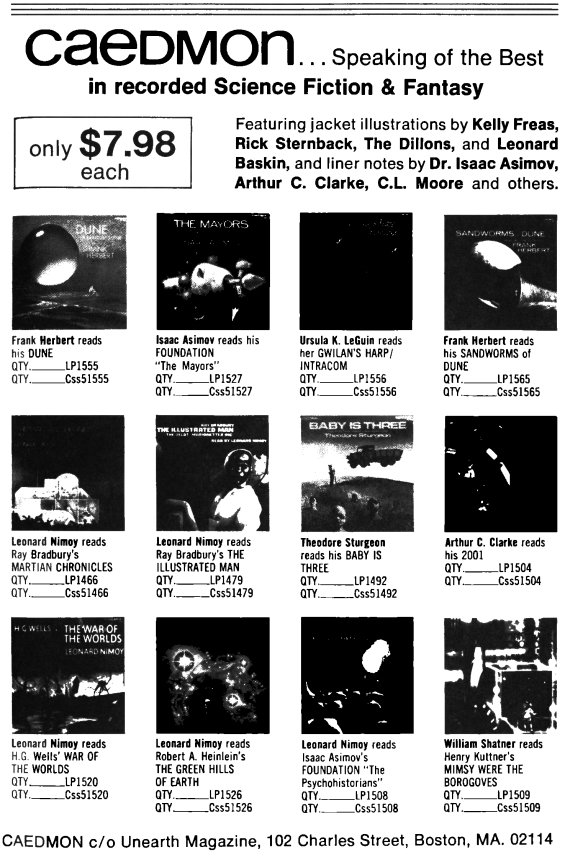
Harper Audio was founded in 1952 under the name “Caedmon.” Harper Audio still occasionally publishes under its Caedmon label but its real heyday was in the late 1970s. Uniquely, the back of each album featured unique liner notes typically written specifically for the LP. Witness this vintage magazine ad (from Unearth, Spring 1978):

CAEDMON ad from Unearth, Spring 1978

Posted by Jesse Willis

Alternate World Recordings

SFFaudio News

Alternate World Recordings was a record company releasing spoken word vinyl LP albums and cassettes, featuring SFF authors reading (or interpreting) mostly their own works. Here’s a magazine ad from a mag published in late 1977 (Unearth, Winter 1978):

Alternate World Recordings ad from Unearth, Winter 1978

Posted by Jesse Willis

It’s A Good Life by Jerome Bixby

SFFaudio Online Audio

It's A Good Life by Jerome Bixby

It's A Good Life by Jerome Bixby - illustration by Quinn

It's A Good Life by Jerome Bixby - illustration by Quinn

It’s A Good Life is a 1953 short story by Jerome Bixby. Set in the small town that used to be in Ohio. It’s entire population loves and fears three year old Anthony Fremont. Anthony is omnipotent.

This story has been adapted several times by The Twilight Zone. The original series did a very faithful adaptation, a sequel episode, “It’s Still A Good Life“, featured a grown-up Anthony and his daughter. There was also an adaptation within Twilight Zone: The Movie. Even The Twilight Zone radio drama series adapted it.

Here’s the audiobook, as podcast in two parts on Rick Jackson’s The Time Traveler Show (along with an interview with the narrator, William Dufris).

The Time Traveler Show PodcastIt’s A Good Life
By Jerome Bixby; Read by William Dufris
Part 1 |MP3| Part 2 |MP3| – Approx. 2 Hours 4 Minutes [UNABRIDGED]
Podcaster: The Time Traveler Show
Podcast: August 2006
Anthony Fremont can go anywhere he wants, he can read thoughts, he can project sensory information, he can create, he can destroy, he can mold reality, he can kill. Anthony Fremont is three years old. First published in Star Science Fiction Stories No.2.

Podcast feed:

http://www.timetravelershow.com/shows/feed.xml

Here’s a |PDF| made from the publication in Science Fantasy, #16, 1955.

Posted by Jesse Willis

Review of The Golem and the Jinni by Helene Wecker

SFFaudio Review

Book Cover for The Golem and the JinniThe Golem and the Jinni
By Helene Wecker; Read by George Guidall
Audible Download – 19 Hours 43 Minutes [UNABRIDGED]
Publisher: Harper Audio
Published: 2013
Themes: / Magical Realism / Contemporary Fantasy / Judaism / Immigration / Reincarnation

Every year brings new books. Some are sequels, new entries in beloved series, like favorite vacation spots we return to again and again. Others are new works by a proven author, a trusted tour guide taking us to someplace new. Still others are entirely new works by unknown authors who have received praise from the critics or the publisher’s marketing juggernaut, like learning that Costa Rica is the new cool place to visit. But every now and then, I stumble upon a new novel completely by chance, as if turning down the wrong alley in a crowded city and finding a new gem. Last year that novel was Mr. Penumbra’s 24-hour Bookshop. This year, it’s Helene Wecker’s The Golem and the Jinni.

Let’s start with the official blurb:

Helene Wecker’s dazzling debut novel tells the story of two supernatural creatures who appear mysteriously in 1899 New York. Chava is a golem, a creature made of clay, brought to life by a strange man who dabbles in dark Kabbalistic magic. When her master dies at sea on the voyage from Poland, she is unmoored and adrift as the ship arrives in New York Harbor. Ahmad is a jinni, a being of fire, born in the ancient Syrian Desert. Trapped in an old copper flask by a Bedouin wizard centuries ago, he is released accidentally by a tinsmith in a Lower Manhattan shop.

But a bit of cover copy can’t begin to capture the wonder of Wecker’s world. In theme and tone the novel sits squarely between contemporary fantasy in the vein of American Gods on the one hand and the subtle magical realism of books like Gabriel Garcia Márquez’s One Hundred Years of Solitude on the other. The scope is too intimate and the characters’ aims too prosaic for the novel to fall in line with contemporary or urban fantasy. Yet it’s also too relentlessly magical to keep company with literary fiction only spiced sparingly with magic. I say it sits between these two genres, but in another way it encompasses both at once. It’s both an incredibly human story and an entirely alien one. Yet the human and the mythical coexist comfortably on the streets of 19th-century New York City: they flirt, they fight, they even fall in love.

When I read the synopsis and the novel’s first few chapters, I was afraid The Golem and the Jinni would devolve into a thinly veiled commentary on the plight of New World immigrants or, worse, an anachronistic attack on Middle East cultures clashing in the United States. Fortunately, Wecker indulges in the former only sparingly and the latter not at all. Like most good literature, the book describes rather than proscribes. The poverty of the Jewish Quarter and Little Syria alike, where the respective mythical creatures take up residence, speaks for itself. Historical context and modern analogues are there to find if you dig for them, but ultimately Wecker is telling a story, a story of two beings entirely different in nature, one of Earth and one of Fire, who meet in the unlikeliest of places.

And yes, they do meet, but not until many hours into the audiobook. The novel takes a leisurely pace, but that doesn’t make it any less irresistably compeling. The narrative strikes that perfect balance between plot and characterization, both feeding off of and into one another. With a novel of this length there are the inevitable brief dry spells, but in those rare cases the strength of Wecker’s prose and the beauty of the world she has conjured carry the listener through. The book’s final chapters also felt a bit hurried, as endings often tend to be, but a lovely epilogue allows the listener to linger in the world a little longer and say goodbye to its charming cast of characters, human and otherwise.

I mentioned American Gods earlier, and it’s difficult not to think of Neil Gaiman’s masterwork when reading The Golem and the Jinni, since both novels tell the story of what happens when profoundly magical beings come to this profoundly un-magical land of America. As an audiobook listener, the similarities were all the more difficult to ignore because George Guidall lends his considerable voice talent to both works. His unhurried, understated narration fits the novel’s tone perfectly, and his voice moves mercurially from the demure speech of Chava the Golem to the taut clip of Ahmad the Jinni. It’s hard to imagine a better narrator for bringing this story to life.

I deeply hope this is but the first of many wondrous works to issue forth from the pen, or keyboard, of Helene Wecker. Rarely does a book’s world or characters captivate me so completely. If you’re looking for the next great work of contemporary fantasy, magical realism, or just plain old fiction, look no further.

Posted by Seth Wilson

The SFFaudio Podcast #232 – READALONG: The Prestige by Christopher Priest

Podcast

The SFFaudio PodcastThe SFFaudio Podcast #232 – Scott, Jesse, Jenny, and Tamahome talk about The Prestige by Christopher Priest.

Talked about on today’s show:
Simon Vance, Blackstone Audio, The Prestige (2006), explicit, cursing vs. casting spells, I’m going to trick you, a nice complement to the book, Jonathan Nolan and Christopher Nolan, Momento, The Princess Bride, epistolary, Dracula, Pike’s Peak, Colorado Springs, under the influence of the man on top of the mountain, David Bowie, Nikola Tesla, Any sufficiently advanced technology…, what is the genre?, Gothic fiction, old fashioned horror, Science Fiction, Scott’s review, Fantasy, a nice twist of Lovecraft, the deaths, “the other detective” (Jenny’s Freudian slip), a mystery, Sherlock Holmes, the prestige materials, Borden vs. Angier, Penn & Teller, seance (fake) vs. prestidigitation (the pact), the pledge -> the turn -> the prestige, you ruined our act, “when Simon Vance says…”, “some days you love me, some days you don’t”, did she know?, the honest liar, Christian Bale, does it matter who sired a child matter if you’re identical twin may have inseminated your wife?, which twin is it (the father or the uncle), Fallon, doubling, everything is doubled, a double agent, Olivia or Julia?, Andrew Wesley Borden -> Nicolas Julius Borden, Lord Caldlow, a book with two authors, revenge via tribute, A,B,C,D,E,F, what happened when the great-grandson of Borden was three years old?, a repeated pattern, a red herring, invited to Dracula’s castle, Franklin was imprisoned in California but his cult has a duplicator in the basement in England, another Angier wraith or the same one?, why Lovecraftian?, wiggling bodies, The Outsider by H.P. Lovecraft, a return to a Gothic home, an explanation for the premise of The Outsider, did the wraith of Angier fail?, 100 times, noir, can the Tesla machine duplicate the soul?, AMAZING!, a side trip, Infinite Jest by David Foster Wallace, wraiths, “waiting to wake up”, telepathy, addicted to transportation, pain and depression, is it a teleportation machine? a photocopier?, Star Trek‘s transporter, Think Like A Dinosaur by James Patrick Kelly, the metal rod, “that’s the thing about science”, “more like a real Tesla”, Tesla spoke English with an accent, Angier is American in the movie, Hugh Jackman, California, Jesus came out of the tomb, the cult denies the appearance of Franklin, a bi-locating religious fanatic, Angier’s first magic practice was at a pub called “The Land And Child”, The Church Of Christ Jesus, the history of the house, during WWII it was RAF Transport Command, Christopher Priest is really really smart, Angier -> Anger?, how the French get Angier and Angier and Angier!, his brother, because that’s what he’s looking for that’s what he sees, The Fly (1986), “explicit material”, The New Transported Man (PUN!) vs. In A Flash, a doubling and a denialing of the doubling, “he’s really stuck on the doubling”, The Lamb is The child, pointless and flat women, The Night Circus by Erin Morgenstern, wooden women, Katherine, Borden’s wife’s journals, it’s a guy show really, everybody gets the short shrift except for these two and a half guys, where in literature are women magicians, Now You See Me, stage performance magicians, why doesn’t Luke Burrage go into magic?, Luke is the evil twin, would she wear the tophat?, Zatana (DC Comics), a female magician who acts as the assistant, a missed opportunity, Lady Katherine is very enigmatic and is playing some sort of game, a wink from The Invisible Man (by H.G. Wells), playing cards hidden under pint glasses, the James Patrick Kelly problem, killing yourself is ok if you have a copy?, Identity Theft by Robert J. Sawyer, John Scalzi’s Old Man’s War handwaves the problem away, they don’t rot?, was the soul transported too?, What’s with the echo?, Angier’s cancer goes into remission when the ghostly Angier gets closer, Good Kirk vs. Rapey Kirk, wimpy Kirk need the rapey Kirk, recombination, complete transfers work well for the transported Angiers, Borden’s injury, Angier’s injury, the Borden seaside history is all lies, the Bordens were cartwrights and coopers, IT’S ALL LIES, stop with the woodworking (the JESUS motif again), one of the mes, when did they start living as one man, you’re supposed to apply the lesson of the Chinese magician to the entire story, one of the few things unchanged between the book and the movie, a fake that’s also true (doubling again), the timeline is somewhat mysterious, one of the Borden’s is more of a writer and the other is more of an editor, “I’m staying with my girlfriend”, fantastic narrative, a relatively modern book that will become and remain a classic, it’s porous and open and hard, book vs. movie, Tam fell asleep and became confused, beautiful moments, Tesla is almost like a magician, he is like a wizard, brilliant genius weirdo, the nemesis, Thomas Alva Edison vs. Tesla (doubling), AC vs. DC, Edison’s DC vs. Tesla’s AC, and ultimately a synthesis, electrifying an elephant, “it’s like they were two magicians competing”, Nyarlathotep by H.P. Lovecraft is about a Tesla-like character doing essentially a Tesla-show, possibly an elder god, Dracula Edison Gothic Horror Science Fiction Horror Detective Noir Fantasy, The Inverted World, The Islanders, twins, fraternal twins vs. identical twins, the Christopher Priest Wikipedia entry, denouement, a tie-in edition of the paperbook, the movie’s editing, The Magic by Christopher Priest, David Langford’s review:

“It seems entirely logical that Christopher Priest’s latest novel should centre on stage magic and magicians. The particular brand of misdirection that lies at the heart of theatrical conjuring is also a favourite Priest literary ploy – the art of not so much fooling the audience as encouraging them to fool themselves… The final section is strange indeed, more Gothic than sf in flavour, heavy with metaphorical power. There are revelations, and more is implied about the peculiar nature of the Angier/Tesla effect’s payoff or “prestige” – a term used in this sense by both magicians. The trick is done; before and after, Priest has rolled up both sleeves; his hands are empty and he fixes you with an honest look. And yet … you realise that it is necessary to read The Prestige again. It’s an extraordinary performance, his best book in years, perhaps his best ever. Highly recommended.”

a prestigious career in newspapers, he wants to be a dead body (or many), the great reveal was surprising, Frankenstein, very much in the Gothic tradition.

The Prestige by Christopher Priest - read by Simon Vance

The Prestige - LEGOized

Posted by Jesse Willis