Review of The Ocean at the End of the Lane by Neil Gaiman

SFFaudio Review

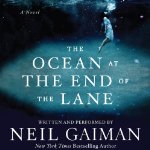
Cover for The Ocean at the End of the Lane by Neil GaimanThe Ocean at the End of the Lane
By Neil Gaiman; Read by Neil Gaiman
Audible Download – 5 Hours 48 Minutes [UNABRIDGED]
Publisher: Harper Audio
Published: 2013
Themes: / Supernatural / Metaphysics / Parallel Universe/ Young Adult

When I learned a year or so ago of Neil Gaiman’s first novel for adults since 2005’s Anansi Boys, I was thrilled. Sure, that last novel didn’t do much for me, nor did most of his subsequent writing for children, but I’m a lifetime Gaimanophile–I’ll read pretty much anything the British expatriate puts out. This is because he established such a solid early track record for me with NeverwhereStardust, and especially American Gods.

Enter The Ocean at the End of the Lane, a whimsically evocative title that itself encapsulates much of what I love about Gaiman. The tale is told from the perspective of an unnamed narrator, looking back on a defining period in his childhood. The young boy, whose name we never learn, witnesses a suicide that unleashes some strange, powerful cosmic forces in rural Sussex, where the novel takes place. The child is aided in the conflict by the enigmatic and archetypal Hempstock family. Bizarre events ensue.

As with any Neil Gaiman work, the writing is top-notch. Description, dialog, and action all shimmer off the page. When shit gets weird, pardon my French, the events are still grounded in vivid, expressive language that makes it feel as though we might encounter them in our own backyards. The characters, particularly the Hempstock trio, also deserve high praise. To me they evoke the best traits of Mrs. Who, Mrs. Whatsit, and Mrs. Which from Madeleine L’Engle’s A Wrinkle in Time. In the descrepancy of their age (at least their apparent age), they also allude to the Fates of Greek mythology or the Norns of the Old Norse cosmos.

If I had never read a Gaiman novel before, I may have written an unbridled encomium for The Ocean at the End of the Lane, as indeed most high-profile book critics and publishing reviews seem to have done. The problem is that I’ve read this Neil Gaiman book before. I’ve read parts of it in Stardust and found splinters of it in his short stories. And from plot to tone to motifs, many elements of the novel have appeared in Gaiman’s fiction for children and young adults.

This perhaps is my biggest qualm with the book. When the book was announced and I read the phrase “first novel for adults,” visions of the deep, nuanced character development of American Gods, or at least the slightly grimier, lived-in setting of Neverwhere, danced through my head. With the exception of a suicide early on, though, I challenge you to find much in Ocean that couldn’t be digested by high school readers. To be fair, marketing may be more at fault than Gaiman himself, but the result is the same. I came away from the book feeling as though I had been duped.

The plot also feels rather thin, “like butter scraped over too mcuh bread” as Bilbo famously said. The story begins with promise: cosmic powers in conflict with nothing less than reality at stake. But the stakes are never really raised, at least not for the world at large. Sure, the main characters undergo their own crises and transformations requisite in good literature, but the scope of the threat is never fully illustrated. Part of my objections to the novel’s plotting may come down to personal taste, but at least some of them, I think, are justified.

In a Tor.com article, Leah Schnelbach recounts that, at an event, Gaiman explained that the story was originall intended as a novella.

I told my publishers there was a novella on the way, but then I did a word count at the end, and realized I just wrote a novel by accident! […] It wasn’t plotted. Things kept taking me by surprise. It’s not making things up, it’s getting into what did actually happen.

Gaiman’s approach to the creative process is beautiful, but in the case of Ocean, it just doesn’t work. I might have enjoyed this story in a Gaiman collection, but by the end of a full-length novel edition I confess I was weary.

In the usual “crap sandwich” style of my reviews, I will conclude with more praise. I “read” this book in audio form, narrated by Gaiman himself. Most authors lack the voice acting chops to narrate their own work, though many still try, but Gaiman’s mellifluous rhythms and upturned sentence endings fit the charming, surreal tone of this novel particularly well. With the possible exception of Stardust, the audio edition of The Ocean at the End of the Lane is perhaps the finest specimen of the author’s narration you’ll find. Oh, except for his reading of his poem “Instructions”.

My dissatisfaction with The Ocean at the End of the Lane has not caused me to lose faith in Neil Gaiman’s work. I simply hope that, as he did in his early career, he finds ways to reinvent himself and push the boundaries of his nearly boundless imagination.

Posted by Seth Wilson

Silly Asses by Isaac Asimov

SFFaudio Online Audio

Silly Asses by Isaac Asimov

Maissa Bessada narrates for us Silly Asses a one page (400 word) satirical short story by Isaac Asimov.

|MP3|

Also available is a |PDF| made from a scan of the original publication in Future Science Fiction, February 1958.

And here is the complete text:

Silly Asses by Isaac Asimov

Naron of the long-lived Rigellian race was the fourth of his line to keep the galactic records.

He had a large book which contained the list of the numerous races throughout the galaxies that had developed intelligence, and the much smaller book that listed those races that had reached maturity and had qualified for the Galactic Federation. In the first book, a number of those listed were crossed out; those that, for one reason or another, had failed. Misfortune, biochemical or biophysical shortcomings, social maladjustment took their toll. In the smaller book, however, no member listed had yet blanked out.

And now Naron, large and incredibly ancient, looked up as a messenger approached.

“Naron,” said the messenger. “Great One!”

“Well, well, what is it? Less ceremony.”

“Another group of organisms has attained maturity.”

“Excellent. Excellent. They are coming up quickly now. Scarcely a year passes without a new one. And who are these?”

The messenger gave the code number of the galaxy and the coordinates of the world within it.

“Ah, yes,” said Naron. “I know the world.” And in flowing script he noted it in the first book and transferred its name into the second, using, as was customary, the name by which the planet was known to the largest fraction of its populace. He wrote: Earth.

He said, “These new creatures have set a record. No other group has passed from intelligence to maturity so quickly. No mistake, I hope.”

“None, sir,” said the messenger.

“They have attained to thermonuclear power, have they?”

“Yes, sir.”

“Well, thats the criterion.” Naron chuckled. “And soon their ships will probe out and contact the Federation.”

“Actually, Great One,” said the messenger, reluctantly, “the Observers tell us they have not yet penetrated space.”

Naron was astonished. “Not at all? Not even a space station?”

“Not yet, sir.”

“But if they have thermonuclear power, where do they conduct the tests and detonations?”

“On their own planet, sir.”

Naron rose to his full twenty feet of height and thundered, “On their own planet?”

“Yes, sir.”

Slowly Naron drew out his stylus and passed a line through the latest addition in the small book. It was an unprecedented act, but, then, Naron was very wise and could see the inevitable as well as anyone in the galaxy.

“Silly asses,” he muttered.

Asimov wrote Silly Asses on July 29, 1957. To put that in context, just ten days earlier (July 19, 1957), as a part of Operation Plumbbob the USAF filmed five Air Force officers standing directly under an atmospheric nuclear detonation. The idea was to demonstrate the safe usage of nuclear weapons over civilian populations.

Silly asses.

Posted by Jesse Willis

Sentry by Fredric Brown

SFFaudio Online Audio

Sentry by Fredric Brown

Scott D. Danielson narrates this short short story (320 words) by Fredric Brown. I think it encapsulates much of what Science Fiction is about – teaching by thought experiment. It may be that stories of this kind work almost like an inoculative vaccination, preventing certain mental processes that lead to damaging behavior.

|MP3|

And here’s a |PDF| made from a scan of the original magazine publication in Galaxy Science Fiction, February 1954.

Sentry by Fredric Brown

He was wet and muddy and hungry and cold, and he was fifty thousand light-years from home.

A strange blue sun gave light and the gravity, twice what he was used to, made every movement difficult.

But in tens of thousands of years this part of war hadn’t changed. The flyboys were fine with their sleek spaceships and their fancy weapons. When the chips are down, though, it was still the foot soldier, the infantry, that had to take the ground and hold it, foot by bloody foot. Like this damned planet of a star he’d never heard of until they’d landed him there. And now it was sacred ground because the aliens were there too. The aliens, the only other intelligent race in the Galaxy … cruel, hideous and repulsive monsters.

Contact had been made with them near the center of the Galaxy, after the slow, difficult colonization of a dozen thousand planets; and it had been war at sight; they’d shot without even trying to negotiate, or to make peace.

Now, planet by bitter planet, it was being fought out.

He was wet and muddy and hungry and cold, and the day was raw with a high wind that hurt his eyes. But the aliens were trying to infiltrate and every sentry post was vital.

He stayed alert, gun ready. Fifty thousand light-years from home, fighting on a strange world and wondering if he’d ever live to see home again.

And then he saw one of them crawling toward him. He drew a bead and fired. The alien made that strange horrible sound they all make, then lay still.

He shuddered at the sound and sight of the alien lying there. One ought to be able to get used to them after a while, but he’d never been able to. Such repulsive creatures they were, with only two arms and two legs, ghastly white skins and no scales.

Sentry by Fredric Brown - illustration by David Stone

Posted by Jesse Willis

Review of Extinction Machine by Jonathan Maberry

SFFaudio Review

Horror Audiobook - Extinction Machine by Jonathan MaberryExtinction Machine: The Joe Ledger Novels, Book 5
By Jonathan Maberry; Narrated By Ray Porter
14 hrs and 58 mins – [UNABRIDGED]
Publisher: Macmillan Audio
Published: 2013
Themes: / Science Fiction / Horror / Aliens /

“So, basically if we keep trying to save the country and maybe the world from a bunch of murderous assholes with outer space weapons, then we’re the bad guys?”

“In a nutshell.”

“Then, hey … let’s be bad guys.”

Joe’s back.

Pulled off vacation, Joe Ledger and Echo Team are knocking on research lab doors, looking into cyber-attacks so clever they can’t be tracked back to anyone. But no one’s answering, even though all the lights are on. Until a couple of strangely inhuman Men In Black step onto the loading dock.

Mayhem ensues.

Of course, anyone who is this far into the Joe Ledger series knows that whenever Joe is called in mayhem is always going to ensue, all to help save the good ol’ U. S. of A. Jonathan Maberry has tackled zombies, vampires, the seven plagues of Egypt and more, but this is the first time he’s gone beyond so-called supernatural creatures. Crop circles, space ships, and aliens are the topic of investigation.

And I (mostly) loved it for all the reasons I have enjoyed the entire series. These are adrenaline rides with Joe getting into and out of increasingly impossible, perilous situations while the reader hangs on by their fingernails wondering just how he can possibly escape. Meanwhile, Maberry weaves intriguing mysteries which may not keep us guessing since he enjoys giving us both sides’ points of view, but they do keep us wondering if Joe can stop the bad guys.

What kept me from completely loving this book?

I am as ready for a good invading aliens story as the next person, but at one point the action came to a grinding halt as Maberry wove together two story lines in a gigantic “aliens among us” info-dump. Indeed, this went on for so long and contained enough duplicate information that I began to wonder if the author had fallen into “true believer” status and wanted to be sure we came away converted. Whether that was his motive or it was simply imperfect editing, I wearied of the information long before it ceased flowing.

On the other hand, Maberry is going to have to work hard to top Joe’s accomplishment in the light house. I won’t say more so I don’t spoil it but I was literally laughing with delight as I heard what was happening. Adrenaline rush achieved!

Speaking of listening, Ray Porter does his usual excellent narration and is the reason I wait for the audio books rather than pick up print copies. As I’ve said before Ray Porter IS Joe Ledger. So let me say it again — Porter’s direct, blunt delivery can go from sarcastic to heart-felt to outraged in 60 seconds. Believably. That’s good because sometimes that’s the way Joe’s day goes.

Complaints aside, this book is great fun. Definitely recommended.

Posted by Julie D.

The SFFaudio Podcast #226 – READALONG: The Iron Heel by Jack London

Podcast

The SFFaudio PodcastThe SFFaudio Podcast #226 – Jesse, Jenny, and Bryan Alexander discuss The Iron Heel by Jack London.

Talked about on today’s show:
Jenny is not an economist, a Heinlein vibe, God Emperor Of Dune, The first half of this book is talk, a terrible novel but an interesting book, The Moon Is A Harsh Mistress, the distancing narrators, 700 years into the future, the audience is for seven hundred years in the future (or is that six hundred), prizefighting, grub = food, the purpose of the footnotes, The Sleeper Awakes by H.G. Wells, Avis Everhard, alternate history, Michael Bishop, an underground book, an underground society, that Buck Rogers stuff, Armageddon—2419 AD by Philip Francis Nowlan, exchanging socialism for the Yellow Peril, Asgard, Seoul, set in the year 419 B.O.M. (Brotherhood of Men), A Thousand Deaths by Jack London, The Island Of Doctor Moreau, predictions, war with Germany, a surprise attack on December 4th, William Randolph Hearst, war economy as a solution to national surplus, Trotsky’s letter to Jack London, London had good reason to be a socialist, work conditions and natural disasters, a chaotic time, Jackson’s arm, race vs. class, Jack London’s racism, The Heathen by Jack London, the dog stories, class consciousness, grinding out the middle class between the 1% and the people of the abyss, The Shadow And The Flash by Jack London, manly overachievers, oligarchy doesn’t use race to divide people, do you want you fruit to be picked or not?, Japanese segregation in California classrooms, Canadian politics, Cooperative Commonwealth Federation, Franklin D. Roosevelt, John Steinbeck, ‘temporarily embarrassed millionaires’, the quote attributed to Abraham Lincoln:

“I see in the near future a crisis approaching that unnerves me and causes me to tremble for the safety of my country… corporations have been enthroned and an era of corruption in high places will follow, and the money power of the country will endeavor to prolong its reign by working upon the prejudices of the people until all wealth is aggregated in a few hands and the Republic is destroyed.”

Dwight D. Eisenhower, “the military-industrial complex”, Eugene Debs, why was The Iron Heel not more popular?, The Black Hundreds, Das Kapital, Marxian fan-fiction, ‘social evolution is exasperatingly slow’, sooo sad, Marx’s essay on Napoleon III, a Darwinian model, do we live under an oligarchy?, government regulation (anti-trust and child labour laws), why socialism didn’t take hold in the early 20th century USA, Larry Summers, the Chilean cover of The Iron Heel, Salvador Allende, a novel read by revolutionaries, Science Fiction within the novel, the aesthetic end, the role of religion, the God of the Oligarchs, mostly air with a little bit of vertebra, Chicago, religious revivals and the apocalypse, Azusa Street Revival, the 1906 San Fransisco earthquake, William Randolph Hearst, Patty Hearst, John Waters, Cecil B. Demented, personal charisma and bulletproof arguments, Everhard is a porn star name, Benjamin Franklin, London’s didactic reading, Marx’s surplus theory of value, economy is not a science, power wins, the French Revolution, the Commonwealth of England, George Orwell’s review of The Iron Heel, 1984 is in The Iron Heel, coincidental dates, London’s insight into fascism, too much love from the strong and not enough love for the weak, Eric S. Rabkin, unmanning, ‘designed to be crucified’, father figures are destroyed, the chapter titles, The Call Of The Wild, a powerful beast is unmanned, builds up and builds through interaction with others, a sated king, a dominant primordial beast, The Sea Wolf, reading London is like a shot of adrenalin to the heart, surplus value, colonialism, the machine breakers, the trusts did not advertize, consumerism, Paul Krugman, petty bourgeoisie, the genocide of Chicago, the Paris Commune, gothic wooing, We by Yevgeny Zamyatin, Looking Backward: 2000-1887 by Edward Bellamy, the education of the oligarchy,

“They, as a class, believed that they alone maintained civilization. It was their belief that if ever they weakened, the great beast would ingulf them and everything of beauty and wonder and joy and good in its cavernous and slime-dripping maw. Without them, anarchy would reign and humanity would drop backward into the primitive night out of which it had so painfully emerged.”

excusing colonialism, the white man’s burden, ignoring the starving masses, the Roman Empire, steampunk, Lloyd Blankfein “doing God’s work”, Margin Call, oppositional films, “The Social Network deeply hates Zuckerberg and the online world”, Nine Inch Nails, Michael Douglas, Wall Street, the cleaning lady, why isn’t The Iron Heel more generally appealing to SF readers?, British Space Opera vs. American Space Opera, Commune 2000 A.D. by Mack Reynolds, a broken utopia, job cash vs. job love, the social end of SF, the storytelling technique doesn’t attract, the unsuccessful revolution, Winston Smith’s diary, looking back when writing doesn’t have the same power, the Goldstein Book, brainwashing, the bomb in congress, spy and counterspy, Starship Troopers is a series of lectures punctuated by gunfire, Frank Herbert, “a raving genius”, doing Dune (and Dune Messiah), Chilton Books, the boot crushing the human face forever, the leaky suspense, a Norton critical edition, how to record The Iron Heel, the footnotes are problematic, a crazy wild marvelous book, WWI, WWII, Metropolis, armoured cars or tanks, The Last Man by Mary Shelley, a terrifying future found in a cave written on leaves, A Journal Of The Plague Year by Daniel Defoe, The Scarlet Plague by Jack London, Idiocracy, The Marching Morons by C.M. Kornbluth, on Lenin’s deathbed he was read Jack London, The Cold Equations, To Build A Fire, The Empire Strikes Back,

“The cold of space smote the unprotected tip of the planet, and he, being on that unprotected tip, received the full force of the blow.”

cosmic and Lovecraftian, as snug as a Jedi in a hot tauntaun, Robert Sheckley, Metro 2033 by Dmitry Glukhovsky.

The Iron Heel by Jack London (Viva Allende)

The Iron Heel by Jack London - Capital V. Labour

Posted by Jesse Willis

Review of A Maze of Death by Philip K. Dick

SFFaudio Review

A Maze of DeathA Maze of Death
By Philip K Dick; Performed by Benjamin L. Darcie
Publisher: Brilliance Audio
[UNABRIDGED] 6 discs

Themes: / science fiction / anagrams / deities / cubes /

Publisher summary:

Delmak-O is a dangerous planet. Though there are only fourteen citizens, no one can trust anyone else and death can strike at any moment. The planet is vast and largely unexplored, populated mostly by gelatinous cube-shaped beings that give cryptic advice in the form of anagrams. Deities can be spoken to directly via a series of prayer amplifiers and transmitters, but they may not be happy about it. And the mysterious building in the distance draws all the colonists to it, but when they get there each sees a different motto on the front. The mystery of this structure and the secrets contained within drive this mind-bending novel. 

A Maze of Death is like a miniature picture of humanity: a bunch of egocentric, paranoid people are stuck on a strange planet where they spend their time wondering what their greater purpose is, judging each other, and trying to escape death.

Philip K Dick structured A Maze of Death so that you learn about the world through different characters’ psyches, but since every character has their own preconceptions and usually distrusts or discredits the others, you’re never quite sure what the objective reality is. On one level it’s a surreal murder mystery; on another it’s an exploration of our cognitive limitations and the authenticity of the subjective human experience.

Everything in the book is designed to unsettle. The characters are irresponsible and petty, and have weird habits or addictions. One is “sexually deranged,” one is constantly popping pills, another tends to psychoanalyze everyone, and another imagines his companions engaged in acts of bestiality.

Conversations repeat almost exactly except with trivial differences. Characters lie to each other and to themselves, or see things in conflicting ways: one notices how everyone is strange because they’re all overly bright, like prodigies; another says, “There’s something the matter with all of you. A kind of idiocy.”

The setting is also bizarre. Features of the landscape move, gelatinous lumps give cryptic answers to written questions, and artificial flies buzz past playing very faint music. Meanwhile a strange factory moves locations and has a different sign over its door depending on who’s looking.

The religion is weird too. People of this future consult a holy book called How I Rose from the Dead in my Spare Time and So Can You, by A.J. Specktowsky. Like in Do Androids Dream of Electric Sheep, religion is mechanized: people use technology to have religious experiences and send prayers electronically to “god worlds.” And the gods, which are natural and not supernatural, usually answer them. This is PKD’s idea of a “logical system of religious thought, based on the arbitrary postulate that God exists.”

A Christ-like figure, The Walker-on-Earth, sometimes shows up to prevent people from making stupid decisions. For example, after Seth Morely (who his wife says has no sense judgment but only “mutant-like luck”) picks a mechanically unsound ship called Morbid Chicken to travel in, because he likes the name, the mysterious robed figure of The Walker-On-Earth appears to tell him it’s a death trap and then kindly helps him reload his supplies (mostly marmalade) into a safer ship.

I loved the narrator’s work on this book. Benjamin L Darcie captured the tone brilliantly, and gave all the characters distinctive voices. The only thing really lacking from the audio version is the hilarious list of contents, which has nothing to do with the contents of the story at all. Maybe PKD’s joke to himself? Whatever it is, it seems a shame to miss out – so here it is for your bafflement:

CONTENTS

  1. In which Ben Tallchief wins a pet rabbit in a raffle.
  2. Seth Morley finds out that his landlord has repaired that which symbolizes all Morley believes in.
  3. A group of friends gather together, and Sue Smart recovers her faculties.
  4. Mary Morley discovers that she is pregnant, with unforeseen results.
  5. The chaos of Dr. Babble’s fiscal life becomes too much for him.
  6. For the first time Ignatz Thugg is up against a force beyond his capacity.
  7. Out of his many investments Seth Morley realizes only a disappointing gain– measured in pennies.
  8. Glen Belsnor ignores the warnings of his parents and embarks on a bold sea adventure.
  9. We find Tony Dunkelwelt worrying over one of mankind’s most ancient problems.
  10. Wade Frazer learns that those whose advice he most trusted have turned against him.
  11. The rabbit which Ben Tallchief won develops the mange.
  12. Roberta Rockingham’s spinster aunt pays her a visit.
  13. In an unfamiliar train station Betty Jo Berm loses a precious piece of luggage.
  14. Ned Russell goes broke.
  15. Embittered, Tony Dunkelwelt leaves school and returns to the town in which he was born.
  16. After the doctor examines her X-rays, Maggie Walsh knows that her condition is incurable.

Posted by Marissa van Uden