
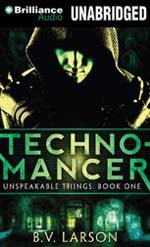
 Technomancer (Unspeakable Things, Book One)
By B.V. Larson; Read by Christopher Lane
Publisher: Brilliance Audio
[UNABRIDGED] – 9 discs – 11 hours
Themes: / mystery / thriller / magic /
Publisher summary:
When Quentin Draith wakes up in a private sanatorium, he has no memory of who he is or how he received the injuries riddling his body. All he knows is that he has to get out, away from the drugs being pumped into him and back to the real world to search for answers. His first question: How did his friend Tony’s internal organs fill with sand, killing him in a Las Vegas car crash? After a narrow escape, he tracks down the basic facts: he is an investigator and blogger specializing in the supernatural — which is a good thing, because Quentin’s life is getting stranger by the minute. It seems he is one of a special breed, a person with unusual powers. He’s also the prime suspect in a string of murders linked by a series of seemingly mundane objects. The deeper he digs and the harder he works to clear his name, the more Quentin realizes that some truths are better off staying buried….
This one had a lot of potential, but in the end didn’t live up to it. Technomancer starts off strong with the main character, Quentin Draith, waking up in a hospital, not remembering any details about his life…not even his name. From there, the reader (listener, in my case) is taken on a bit of a “mystery-thriller” type book with science fiction/supernatural elements thrown in. The reader learns about Quentin as he learns about himself. That part of the story is actually kind of fun, the act of discovery. Unfortunately, the book breaks one of my cardinal rules for books in a series: it doesn’t stand very well on its own and didn’t wrap up the story line in any satisfying way. At the end of the book, I was left bored and annoyed that I’d read the entire thing, let down by what it was compared with what it could have been.
Quentin discovers that there have been a variety of bizarre deaths in Las Vegas, odd happenings. Through one of the people he meets, he finds that he’s a blogger who writes about these strange things. As the story goes on, he meets a somewhat shady police officer who is the lead investigator for these events and comes to piece more of the story together. There are some people in the community who have special objects. These objects give them powers, or can be used against others. For example, one of the objects Quentin learns about early-on is a ring that makes the person wearing it lucky in games of chance (such as blackjack). Another power is used for a sort of mind control. Some of these powers have a limited range over which they can work; others can work anywhere. Some objects even allow the owner to create “rips” to other worlds or other places in this world, portals that can be used to travel around the Vegas area. These “rips” can lead to worlds, though, where other beings live, beings who can come through similar rips to our world. Quentin suspects that these beings (called “grey men”) are responsible for all the odd events in Vegas. Through his travels, he also learns that there are two groups of users of these special objects: the “community,” and the “rogues” or the “cultists.” The “community” are people who, to some extent, have banded together to collect objects. The “cultists” have objects of their own, but seem generally more interested in using them for new study. They compare the objects to witchcraft in the 1600’s: if you don’t understand the science behind something, then it is seen as magical, no? Eventually, Quentin forms a plan to destroy the grey men, and the story ends more or less after his attempt to do so…
All of that sounds like it has the potential to be an interesting story. Sadly, the book, taken on its own, didn’t form much of a complete story. Over 9 CD’s (10.5 hours), the book spent the first 8 with Quentin wandering around, finding objects and meeting people. Only three of the people he met (out of many) ended up being truly relevant by the end of the book. The final “battle” as it were didn’t start until the end of the 8th CD and was wrapped up 2/3 through the final CD; that is, the climax was only about 30 minutes long in total, and came right at the end. Instead of describing more of the how’s and why’s, Larson spent most of this book world- and character-building. Even the “battle” was rushed. It wasn’t clear, at the end of the story, if the battle made any difference. Or why Quentin survived. Or what happened to the others who went to battle with him. Or why some of them mattered. A quick look on Amazon indicates that this is the first in the “Unspeakable Things” series. This book was unsatisfying enough to me that I won’t go on to read the others. I kept holding out hope that the climax would come and the story would be resolved, but in the end, it wasn’t. It just felt like a very long introduction to a short book.
As this was an audiobook, I should probably mention something about the narration. In short, it was a pretty average narration, nothing to write home about, but nothing particularly bad or unpleasant, either. Lane did a fine job with the voices; there was never a question of which character was speaking, and his female voices weren’t as over-the-top as some male narrators do. In the end, when a narrator doesn’t distract from the book, they’re doing an alright job in my book, and that was the case here. I think it was probably better to listen to this book instead of reading the print version, so that I could do other things while reading.
Review by terpkristin.

 Here are links to four recent BBC programs. Myself, I’ve heard most of Neverwhere, and it’s terrific so far, but the others look pretty promising too.



 The SFFaudio Podcast #206 – Scott and Jenny talk about the seven short stories nominated for the Nebula Award.