BBCR4 + RA.cc: The Cookie Lady by Philip K. Dick

SFFaudio Online Audio

BBC Radio 4RadioArchives.ccBack in 2003 BBC Radio 4 produced a five part series of fantastic tales called, simply, Five Fantastic Tales.

Among them was a vignette, a horror tale, The Cookie Lady by Philip K. Dick. It’s the only audio production of this obscure story ever done.

Unfortunately, the reading is abridged.

Fortunately, it is well read by Liza Ross and is available, via torrent, from RadioArchive.cc!

The Cookie Lady by Philip K. Dick

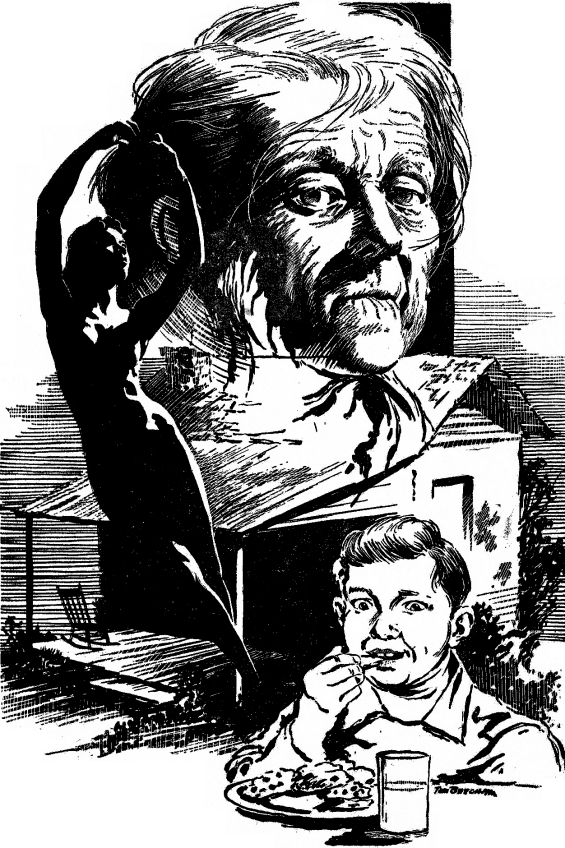
Here is the illustration, by Tom Beecham, from the original publication in Fantasy Fiction, June 1953:

The Cookie Lady by Philip K. Dick

Posted by Jesse Willis

The SFFaudio Podcast #182 – READALONG: The Odyssey by Homer (Books XXI to XXIV)

Podcast

The SFFaudio PodcastThe SFFaudio Podcast #182 – Scott and Jesse talk, in the sixth of a six part series, about the books XXI, XXII, XXIII and XXIV of The Odyssey by Homer.

Talked about on today’s show:
The E.V. Rieu translation and the , The Great Bow, Odysseus Strings His Bow, The Battle In The Hall, Slaughter In The Hall, Odysseus And Penelope, The Great Rooted Bed, The Feud Is Ended, Peace, flexing that bow, canny suitors, does Penelope know what’s going on?, the Wikipedia entry for The Odyssey (and the Slaying Of The Suitors):

The next day, at Athena’s prompting, Penelope maneuvers the Suitors into competing for her hand with an archery competition using Odysseus’ bow. The man who can string the bow and shoot it through a dozen axe heads would win. Odysseus takes part in the competition himself: he alone is strong enough to string the bow and shoot it through the dozen axe heads, making him the winner. He then turns his arrows on the Suitors and with the help of Athena, Telemachus, Eumaeus and Philoteus the cowherd, he kills all the Suitors. Odysseus and Telemachus hang twelve of their household maids, who had betrayed Penelope or had sex with the Suitors, or both; they mutilate and kill the goatherd Melanthius, who had mocked and abused Odysseus. Now at last, Odysseus identifies himself to Penelope. She is hesitant, but accepts him when he mentions that their bed was made from an olive tree still rooted to the ground. Many modern and ancient scholars take this to be the original ending of the Odyssey, and the rest to be an interpolation.

The next day he and Telemachus visit the country farm of his old father Laertes, who likewise accepts his identity only when Odysseus correctly describes the orchard that Laertes had previously given him.

The citizens of Ithaca have followed Odysseus on the road, planning to avenge the killing of the Suitors, their sons. Their leader points out that Odysseus has now caused the deaths of two generations of the men of Ithaca: his sailors, not one of whom survived; and the Suitors, whom he has now executed. The goddess Athena intervenes and persuades both sides to give up the vendetta, a deus ex machina. After this, Ithaca is at peace once more, concluding the Odyssey.

Melanthius prompts his own mutilation, a mutilating evil dude, “horror swept through the suitors”, on the question of the axe heads, the “battle master”, “cased in bronze”, a “turbid jet” of blood, how awesome would it be to see a bardic performance of The Odyssey?, Sir Ian McKellen, the compliant bard, the ancient Greek holy books, the host-guest relationship, the morality of killing your house-guests, why should you read The Odyssey? Because it doesn’t present a world classifiable into good and evil, the inviolability, Iranian hospitality, how Iranians talk (a circuitous path to making a point), why can’t Odysseus even trust his dad?, the primacy of patriarch, the killing of the twelve maidens, what is the moral message?, an unjustified liar, Agamemnon ghost, “that Penelope’s pretty great”, “talk about odd behavior”, the immovable (marriage) bed, an olive tree, “the gods have made you daft”, The Odyssey: A Modern Sequel, Odysseus in Antarctica?, Odysseus runs his life crazily, Odysseus’ name means “trouble”, impiety to Polyphemus, the Trojan War was Odysseus’s fault, a kind of comedy like Voltaire’s Candide, a satire of The Odysseus, True History by Lucian of Samosata, “the natural ending”?, Athena’s solution, the end of The Stand by Stephen King, is the deus ex machina ending satisfying?, Poseidon’s rage, the Norweigan version of The Odyssey (Beowulf), the Beowulf movie, Beowulf is tough braggart but is not wise, melancholy gods, the hero is the villain, the merciless Odysseus, the unquestionable Odysseus.
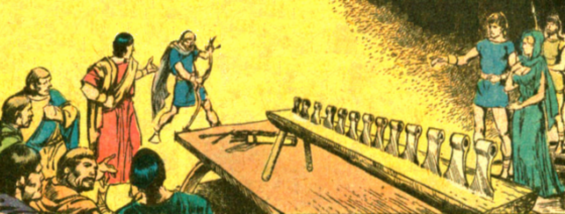
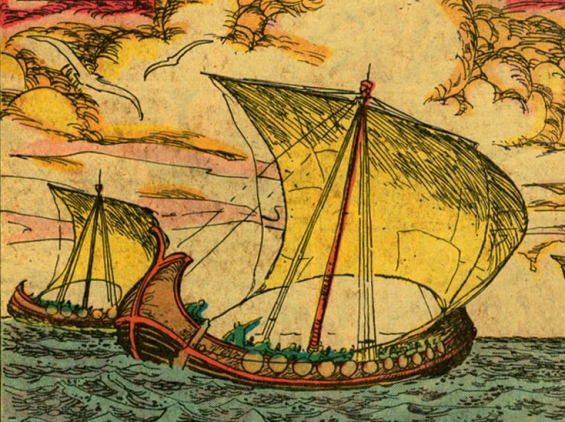
Thirteen Axe Heads?

The Odyssey - Marvel Classics art by Jeff Jodloman

The bard at work from Classics Illustrated

Posted by Jesse Willis

The Nameless City by H.P. Lovecraft

SFFaudio Online Audio

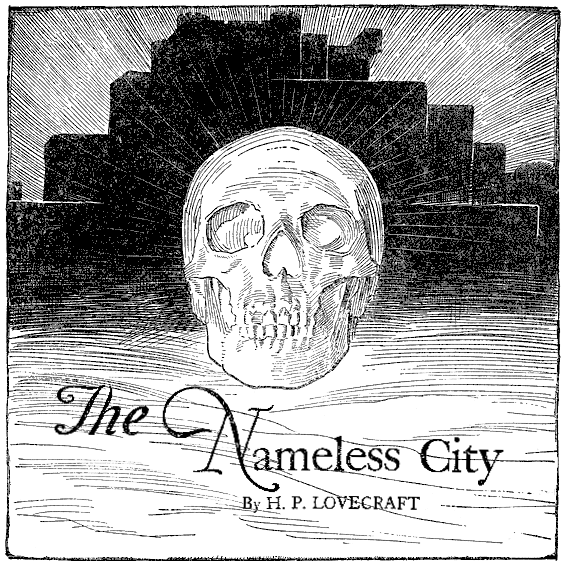
The Nameless City by H.P. Lovecraft (illustration by Jack Binder from Weird Tales, November 1938)

H.P. Lovecraft’s 5,000 word short story, The Nameless City, was based one of his dreams. That dream, in turn, was inspired by the last line of Lord Dunsany’s story The Probable Adventure Of The Three Literary Men, a story from 1911 (itself available as an |MP3| from LibriVox). Indeed, the line is even quoted within the tale:

“the unreverberate blackness of the abyss”

The eponymous, anonymous, city itself seems to have been inspired by “Iram, the City of Pillars” which was a mysterious lost city – a kind of “Atlantis of the Sands” – that is mentioned in the Quran.

And one critic, according to the detailed Wikipedia entry for the story, has it that Lovecraft was inspired by At the Earth’s Core by Edgar Rice Burroughs.

And for all those reasons The Nameless City is certainly worth looking at, if you can find it.

To help I’ve assembled a |PDF| made from a scan of the story, as published in the November 1938 issue of Weird Tales.

And here are several freely available narrations:

LibriVoxThe Nameless City
By H.P. Lovecraft; Read by Mark Nelson
1 |MP3| – Approx. [UNABRIDGED]
Publisher: LibriVox.org
Published: January 23, 2008
It lay silent and dead under the old cold desert moonlight, but what strange race inhabited the abyss beneath those cyclopean ruins?
First published in The Wolverine, No. 11, November 1921.

LibriVoxThe Nameless City
By H.P. Lovecraft; Read by Scott Carpenter
1 |MP3| – Approx. 28 Minutes [UNABRIDGED]
Publisher: LibriVox.org
Published: October 19, 2008
It lay silent and dead under the old cold desert moonlight, but what strange race inhabited the abyss beneath those cyclopean ruins?
First published in The Wolverine, No. 11, November 1921.

LibriVoxThe Nameless City
By H.P. Lovecraft; Read by Rebecca M.L.
1 |MP3| – Approx. 31 Minutes [UNABRIDGED]
Publisher: LibriVox.org
Published: April 14, 2011
It lay silent and dead under the old cold desert moonlight, but what strange race inhabited the abyss beneath those cyclopean ruins?
First published in The Wolverine, No. 11, November 1921.

Yog Radio PodcastThe Nameless City
By H.P. Lovecraft; Read by Michael Scott
1 |MP3| – 28 Minutes [UNABRIDGED]
Podcaster: Yog Radio
Podcast: May 7, 2006
It lay silent and dead under the old cold desert moonlight, but what strange race inhabited the abyss beneath those cyclopean ruins?
First published in The Wolverine, No. 11, November 1921.

Posted by Jesse Willis

Tantor Media HALLOWEEN audiobooks (and AUDIO DRAMA) sale

SFFaudio News

TANTOR - Halloween Deals

Tantor Media is offering 20% off their already low prices on a nightmarish set of 68 audio titles.

Many of them are just $6.99.

But the price being low doesn’t mean the quality is. This is some really great audio!

Among the collection are a Simon Vance read rendition of Frankenstein by Mary Shelley, the must own The Horror Stories Of Robert E. Howard, all three of Dan Wells’ John Cleaver books (that’s the one that starts with I Am Not A Serial Killer), some Ray Bradbury for good measure, Nightmares on Congress Street, Part IV (that’s AUDIO DRAMA folks!), The Best Of Edgar Allan Poe as read by by a monomaniacal sounding Todd McClaren, and of course there’s also an endlessly massive horde of zombie novels and other such unmentionables.

Check it out HERE!

Posted by Jesse Willis

The Forgotten Enemy by Arthur C. Clarke

SFFaudio Online Audio

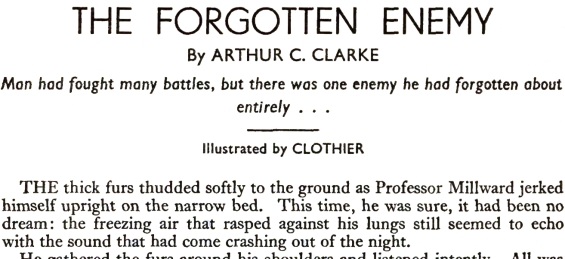
The Forgotten Enemy by Arthur C. Clarke

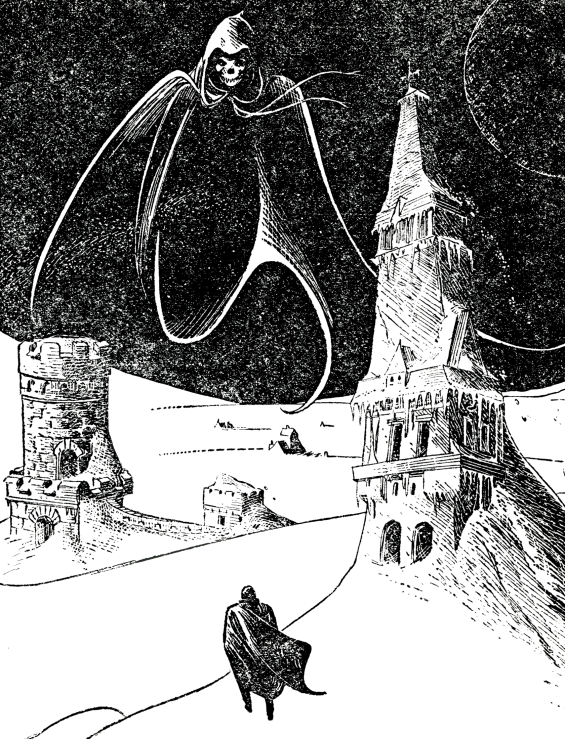
The Forgotten Enemy - from Avon Science Fiction And Fantasy Reader, January 1953 - Illustration by John Giunta

This is the third time I’ve posted about this wonderful podcast episode. The last time was just last year. But I’ve just come across another wonderful illustration, this time from a reprinting in an issue of Avon Science Fiction And Fantasy Reader, so I’ve just had top post about it again. It’s highly recommended listening.

The Forgotten Enemy by Arthur C. ClarkeA Bite of Stars, a Slug of Time, and Thou – The Forgotten Enemy
By Arthur C. Clarke; Read by Elisha Sessions
1 |MP3| – Approx. 1 Hour [UNABRIDGED]
Podcaster: A Bite Of Stars A slug Of Time And Thou
Podcast: 2008
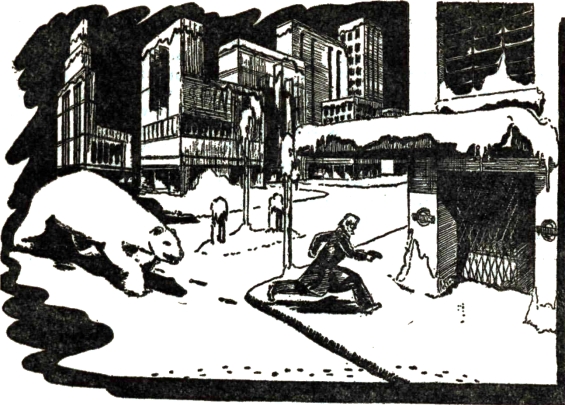
In a bleak snow and ice covered London, a lone survivor faces isolation, polar bears and loneliness. But even his one hope, the idea that a rescue team is crossing the Atlantic ice sheet isn’t enough to stave off The Forgotten Enemy. First published in December 1948, in an issue of King’s College Review.

First broadcast in 2008 on Resonance FM 104.4 FM in London, U.K, The Forgotten Enemy is an excellent Arthur C. Clarke tale. Set in London, it tells of solitary man waiting for rescue. He can almost hear the helicopters. Yes, the helicopters. The slow, loud, helicopters coming inevitably from the north. But what of the terrible white menace that threatens his lonely existence? Can he survive?

One aspect of the tale may remind you of 28 Weeks Later, another may remind you of The Day After Tomorrow. But fear not, this story pays far greater dividends than either of those.

In the discussion that follows the story is described as a “cozy calamity” and it’s compared to Who Goes There? and A Pail Of Air. It is a wonderful podcast – all around!

Here’s the accompanying art, by Clothier, from the New Worlds printing:

The Forgotten Enemy by Arthur C. Clarke

Posted by Jesse Willis

Lightspeed: The Streets Of Ashkelon by Harry Harrison

SFFaudio Online Audio

“For me, it’s one of those stories that does what SF does so very well, shining a light into those murky places where mundane fiction either will not or can not go: asking difficult questions about the nature of faith, belief and pride (and taking a few well aimed and accurate shots at the nature of colonialism along the way).” – James Lecky

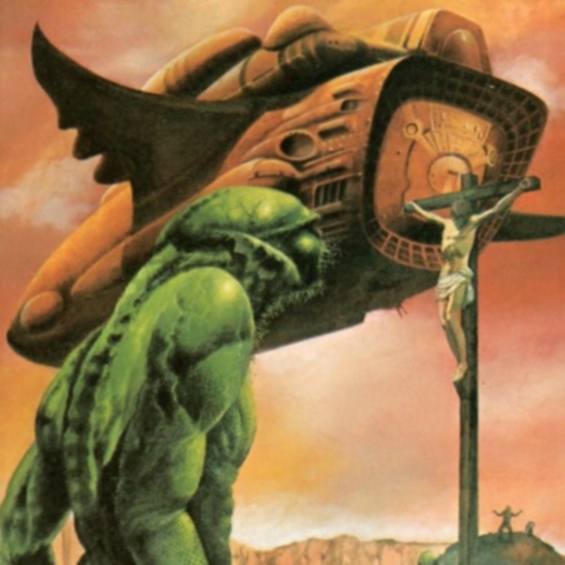
Two Tales And Eight Tomorrows by Harry Harrison - art by Jim Burns

The Streets Of Ashkelon is a terrific tale audiobooked as part of last month’s issue of Lightspeed. Sometimes classified as a horror, often reprinted, it’s a classic SF story that’s in dialogue with James Blish’s A Case Of Conscience. Maria Doria Russell’s The Sparrow could also be considered a part of this long conversation. But unlike either of those novels this fifty year old short story takes the other side, stridently offering a challenge to the authority of faith’s promulgators. It asks an important question:

Ought evangelists and proselytizers have any business promoting their religion to aliens?

This is an SF story in the vein of Star Trek and H.G. Wells, so ought we not to read the innocent aliens as an allegory for something a little closer to home?

Decide for yourself.

Lightspeed MagazineLightspeed – The Streets Of Ashkelon
By Harry Harrison; Read by Paul Boehmer
1 |MP3| – Approx. 49 Minutes [UNABRIDGED]
Podcaster: Lightspeed
Podcast: September 2012
First published in New Worlds Science Fiction, #122, September 1962.

Posted by Jesse Willis