News, Reviews, and Commentary on all forms of science fiction, fantasy, and horror audio. Audiobooks, audio drama, podcasts; we discuss all of it here. Mystery, crime, and noir audio are also fair game.
Here’s a recording of The Temple by H.P. Lovecraft. It was the his first professional sale. And, it’ll be the subject of an upcoming podcast.
It’s read for us by Mirko Stauch, a massive fan of Lovecraft, and a cool German dude with an authentic German accent – something highly appropriate for this story. He is a first time audiobook narrator, and yet, I think he’s done a fine job with it. Check it out for yourself!
The Temple
By H.P. Lovecraft; Read by Mirko Stauch
1 |MP3| – 37 Minutes [UNABRIDGED]
Provider: Mirko Stauch
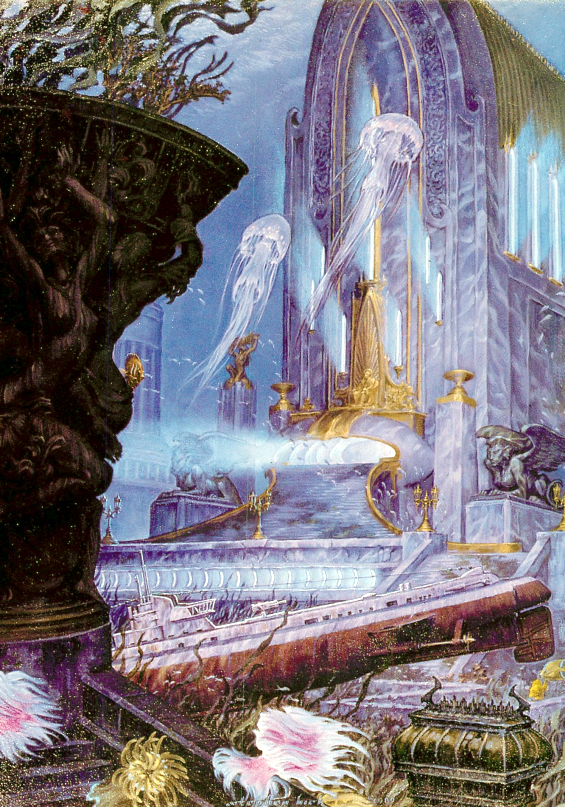
Provided: August 2012 The skipper of an Imperial German Navy U-boat, in World War I, documents the disaster and ruin of his ship and crew after they torpedo an enemy ship at sink it’s lifeboats. First published in Weird Tales, September 1925.
H.P. Lovecraft’s Book Of The Supernatural
Edited by Stephen Jones; Read by Bronson Pinchot, Stephen Crossley, Davina Porter, Madeleine Lambert, Mark Peckham
MP3 DOWNLOAD – [UNABRIDGED]
Publisher: AudioGo
Published: August 1, 2012 Written by arguably the most important horror writer of the twentieth century, H. P. Lovecraft’s 1927 essay Supernatural Horror in Literature traces the evolution of the genre from the early Gothic novels to the work of contemporary American and British authors. Throughout, Lovecraft acknowledges those authors and stories that he feels are the very finest the horror field has to offer: Washington Irving, Edgar Allan Poe, Henry James, Rudyard Kipling, Bram Stoker, Robert Louis Stevenson, Guy de Maupassant, Ambrose Bierce, and Arthur Conan Doyle, each prefaced by Lovecraft’s own opinions and insights in their work. This chilling collection also contains Henry James’ wonderfully atmospheric short novel…The Turn of the Screw. For every fan of modern horror, here is an opportunity to rediscover the origins of the genre with some of most terrifying stories ever imagined.
The audio sample says it includes “20 classics of the macabre.” I’ll try to get a list.
Here’s the TOC:
an introduction by editor Stephen Jones Notes on Writing Weird Fiction By H.P. Lovecraft The Tale of the German Student by Washington Irving Markheim by Robert Louis Stevenson Who Knows? by Guy de Maupassant The Invisible Eye by Erckmann-Chatrian The Torture by Hope by Villiers de l’Isle Adam Ms. Found in a Bottle by Edgar Allan Poe What Was It? by Fitz-James O’Brien The Middle Toe of the Right Foot by Ambrose Bierce The Turn of the Screw by Henry James The Dead Smile by F. Marion Crawford The Wind in the Rose-Bush by Mary E. Wilkins-Freeman The Yellow Wallpaper by Charlotte Perkins Gilman The Recrudescence of Imray by Rudyard Kipling The Hands of Karma (Ingwa-banashi) by Lafcadio Hearn The Burial of the Rats by Bram Stoker The Red Lodge by H.R. Wakefield The Captain of the Pole-Star by Sir Arthur Conan Doyle The Villa Desiree by May Sinclair The Voice in the Night by William Hope Hodgson Novel of the White Powder by Arthur Machen
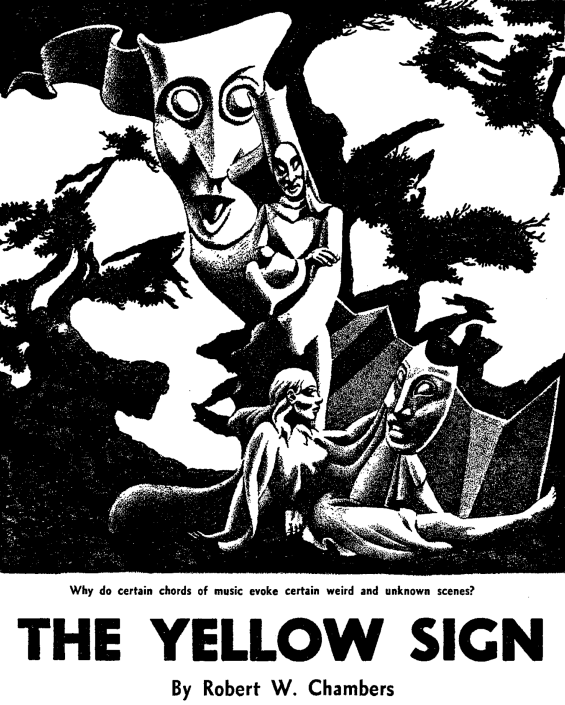
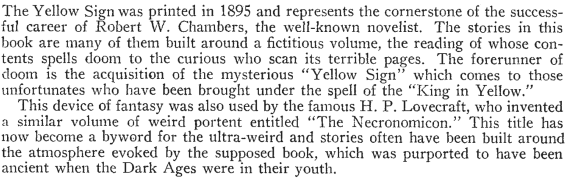
Have you read the Yellow Sign? Have you read the Yellow Sign? Have you read the Yellow Sign?
Here is snippet from Mary Gnaedinger’s editorial description of Robert W. Chambers’ The Yellow Sign, a wonderfully creepy novelette published in Famous Fantastic Mysteries, September 1943:
The Yellow Sign
By Robert W. Chambers; Read by CrowGirl
1 |MP3| – Approx. 39 Minutes [UNABRIDGED]
Publisher: LibriVox.org
Published: November 30, 2011 The King In Yellow is a monstrous and suppressed book whose perusal brings, fright, madness, and spectral tragedy. Have you seen the Yellow Sign? First published in 1895.
Canadians, particularly those in the Vancouver area, may be interested in this post – others not so much.
I’m switching internet service providers.
I’ve had Shaw cable internet for as long as they’ve been in business here. Before that it was Rogers who provided internet access. I only switched when the monopoly in this area was handed over from Rogers to Shaw.
Over the years Shaw has been pretty good. I don’t think they’ve engaged in a lot of the shitty practices I hear many ISPs have.
But, the price has never gone down, and the service hasn’t really improved.
So, when I saw that there was an $3.00 increase scheduled for September 1st, 2012, one without explanation as to how I was getting a better service for it, I decided to look around at the competition.
I think I first heard about Ontario based TekSavvy back in 2010, when the then CEO, Rocky Gaudrault, went on TVO’s Search Engine podcast to talk about usage based billing (here’s that |MP3|).
Gaudrault made a great impression, and I remember thinking that TekSavvy sounded like they were the ideal ISP.
Shortly after beginning my research today I discovered that TekSavvy has started operating in Coquitlam, I gave them a call. They use the same wires as Shaw, but they offer those same wires at a better price and with better download and upload numbers.
Shaw’s “High Speed Internet” for August cost me $58.24 per month (including taxes)
TekSavvy’s “Extreme Cable 25 Unlimited” $50.34 per month (including taxes)
TekSavvy promises numbers about double the download speed and quadruple the upload speed I am currently getting. And it’s cheaper.
The SFFaudio Podcast #173 – A Thousand Deaths by Jack London, read by Julie Hoverson (of 19 Nocturne Boulevard). This is a complete and unabridged reading of the short story (29 Minutes) followed by a discussion of it. Participants in the discussion include Jesse, Tamahome, Jenny, Julie Hoverson, and Matthew Sanborn Smith
Talked about on today’s show:
Jack London’s first professional sale, “the hirsute fruit”, the LibriVox version, is the protagonist supposed to be female?, “I don’t know what’s real”, a disintegrated Saint Bernard, a Freudian story, The Island Of Dr. Moreau by H.G. Wells, vivisection on a South Pacific Island, a mad scientist, oedipal literature, London’s own life, H.P. Lovecraft, re-animation, archaic language, Frankenstein, a well educated sailor with an interest in science, obliquely obtuse, The Call Of The Wild, peregrinating, “overly smarty-pantsy”, is it all a dream?, a conscious death, horror, drowned sailors owe their revivers, Poultrygeist, the catalyst event, “an amoral scumbag”, Phineas Gage, blowing smoke up the near drowned, the disintegration door, Doctor Manhattan, Fallout: New Vegas, the disintegration ray, dis-integrate, anti-gravity, electrolysis, synthetic clothing, “animal charcoal”, The Shadow And The Flash is Jack London’s take on The Invisible Man, not just dogs and boats, London’s Polynesian stories, sink the Farallones, San Francisco, suspended animation, chest tampering, death vs. approaching death, drowning vs. poisoning, exploring the boundaries of death, Premature Burial by Edgar Allan Poe, zombies, coffin bells, meteor insurance, “I brought you in [to this world] and I can take you back out”, Bill Cosby, Jack London’s writing voice, action³, verb heavy vibrancy, a raging socialist, is it interesting or is it good?, lockjaw, psychological damage, the ending is ambiguous, a dilettante and a wastrel, do deaths mature you?, an inversion of the prodigal son, what would Eric S. Rabkin say about this story?, time travel, early Stephen King and Ramsey Campbell, H.P. Lovecraft, Edgar Allan Poe -> Fitz-James O’Brien -> Lord Dunsany -> William Hope Hodgson -> Ambrose Bierce, “gonzo”, “where do your ideas come from?”, There’s a Crapp For That, picturemypoo.com, eww, Flatliners, spiritualism vs. materialism, ghosts, patents, olympics, Julie Hoverson’s copyright, patent and trademarks podcast?, shotgun shelled powered battering ram, Julie Hoverson is incredibly busy, thanks Julie!, Jonathan Davis, “don’t surprise the actors”,
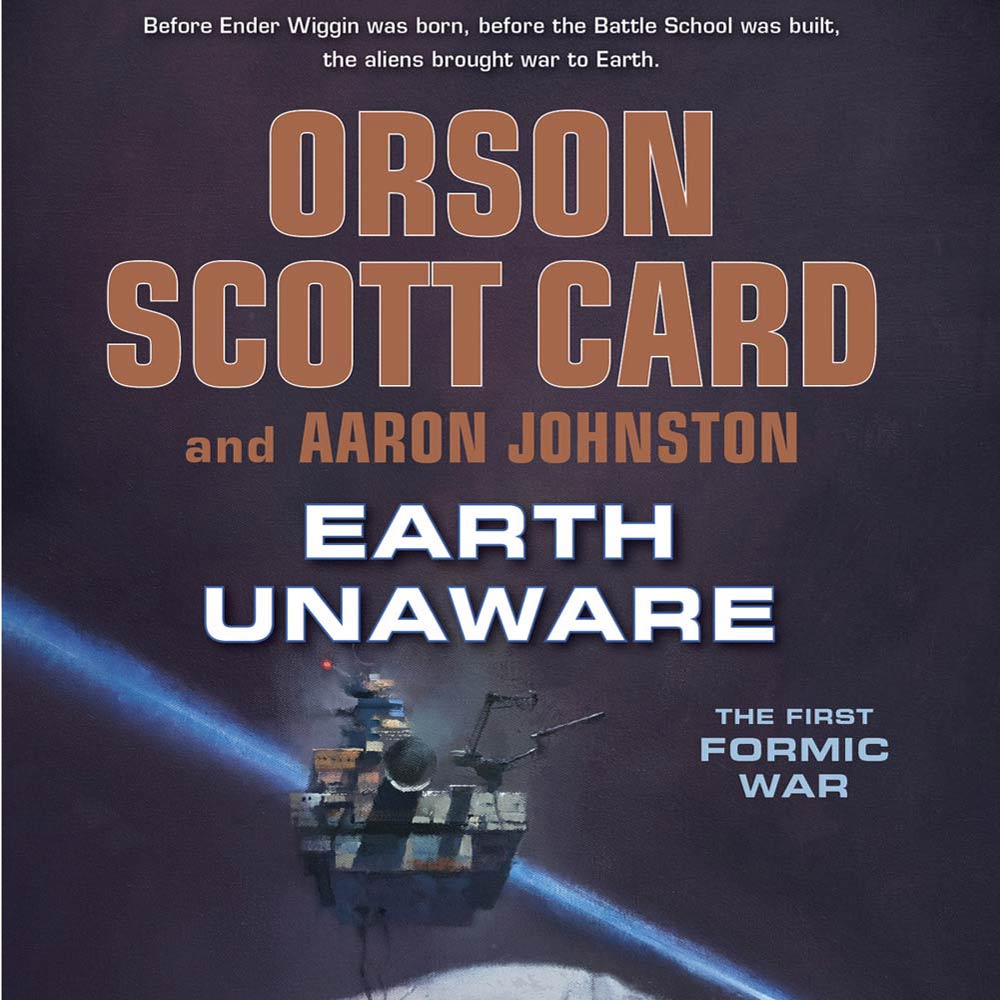
Earth Unaware
By Orson Scott Card and Aaron Johnston
Read by Stefan Rudnicki, Stephen Hoye, Arthur Morey, Vikas Adam, Emily Janice Card, Gabrielle de Cuir, and Roxanne Hernandez
14 Hours – [UNABRIDGED]
Publisher: Macmillan Audio
Published: 2012
Themes: / Science Fiction / Solar System / Asteroids / Mining / Gravity / Aliens / Alien invasion /
One of the pleasures of listening to science fiction audiobooks over the years has been hearing Orson Scott Card’s Ender series. Besides being expertly narrated by an ensemble led by Stefan Rudnicki, these audiobooks are entertaining because Card isn’t delivering the same book over and over. In Earth Unaware, Orson Scott Card and Aaron Johnston take the series in yet another direction.
I know, I know. It’s been proven time after time. When a book series gets to the point where [Original Author] picks up [Insert new author here (often a relative)], the results are just… not good. I’m happy to report that Earth Unaware is an excellent novel. I thoroughly enjoyed it.
Aaron Johnston and Orson Scott Card created and are telling the story of the First Formic War in the comic format. I haven’t read those, so I can’t say how similar this novel is, but Aaron Johnston says in the Afterword that Earth Unaware draws from the characters and events in those comics.
The subtitle (First Formic War) implies that we’re in for a military SF novel, but that’s not what this is. This novel is a tense near-space adventure set in the not too distant future and peopled with characters I cared about. The opening reveals the thoughts and feelings of teenager on the El Calvador, a mining ship in the Kuiper Belt. Close by, on a different ship, is a man who has invested much time and effort into the invention of a gravity laser. He needs to prove his worth to his corporate employer. And back on Earth, an elite military unit is being formed. These lives, some entwined, move forward as normal until all interests are altered in the face of the arrival of an alien ship in the solar system.
Even though the cover doesn’t say it, this is Book 1 of at least a few. I look forward to the continued development of the concept of difference. On Valentine Wiggin’s Hierarchy of Foreignness is Varelse. True aliens, aliens so alien that we can’t even communicate with them or even hope to understand them. How could war with such a race be avoided? Difference also extends to human beings, who seem so content to drop their conflicts in the face of greater danger. Why is that what it takes?
The audiobook is performed by multiple narrators in the style that fits Orson Scott Card’s stories so incredibly well. The narrators (all excellent) change with the POV of the story. Reading the story were: Stefan Rudnicki, Stephen Hoye, Arthur Morey, Vikas Adam, Emily Janice Card, Gabrielle de Cuir, and Roxanne Hernandez. Top notch!


 The Temple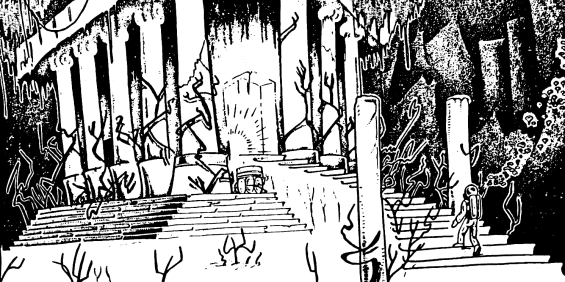


 The Yellow Sign