Review of The Summer Isles by Ian R. MacLeod

SFFaudio Review

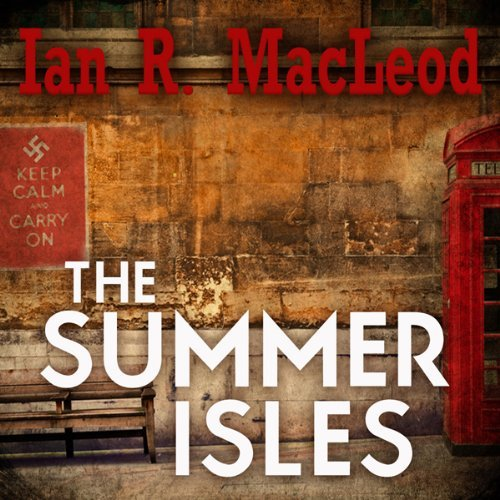
AUDIBLE FRONTIERS - The Summer Isles by Ian R. MacLeodThe Summer Isles
By Ian R. MacLeod; Read by Steve Hodson
Audible Download – Approx. 13 Hours [UNABRIDGED]
Publisher: Audible Frontiers
Published: 2012
Themes: / Alternative History / Dystopia / History / Fascism / Homosexuality /

I have always been intrigued by alternative histories. Unfortunately my knowledge of history sometimes limits my enjoyment, being more of an overview of the subject. I often can’t tell if an event has been changed, and if so, whether it is significant or not. In some of the better alternate histories you can get away with not knowing too much about the period and still enjoy the story. Thankfully, in this case, I had recently been reading a history of Europe covering the same period from the early 1910’s to 1940.

MacLeod’s The Summer Isles is set primarily in a 1940 where Great Britain lost The Great War in 1918. America doesn’t enter the war and France makes an appeasement with Kaiser Wilhelm II’s Germany. The result is that Britain, not Germany, is left in a state of shock, feeling betrayed by their supposed allies. A young soldier, John Arthur, rises to power in the bleak years that follow, suggesting a parallel to Hitler, who gets only a single reference, never having the opportunities to gain power that losing the war afforded. The great Empire that was Britain is stripped away in the reparations following the war. That sense of betrayal is used to fuel Arthur’s rise to power as he brings in his political movement “Modernism”. John Arthur’s portrait hangs everywhere, even in the men’s public toilets.

Modernism is a very British take on fascism and drove several of the same horrors that Naziism did in our own history. Jews, homosexuals, intellectuals, the Irish and any and all other ‘deviants’ are persecuted and ultimately removed from the new Modernist society. The Jews in particular are sent to be “resettled” on the eponymous Summer Isles.

The story is told by Geoffrey Brook, a secretly homosexual Oxford history Don, who had some prestige for having been a favourite teacher of John Arthur as a child. Brook is in his 60’s in 1940 when he receives the news that he has at terminal lung cancer.

Brook, in trying to reconcile himself with his past, recounts in flashbacks the one true love of his life that he lost in the Great War. More flashbacks fill in the years before and after that war; several of the scenes flowing together with the present day as Brook’s mind drifts in and out of his reminiscences. Particularly when he visits some of the same locations.

MacLeod’s writing is excellent, at times didactic, as the historian narrator recounts past political and social events, yet by turns touching, confused, detailed and frightened as more personal or recent events are recounted. Slow at times, this fits will with the drifting recollections of the narrator as the hidden story is gradually revealed. The final act of the novel moves at a much faster pace, while still holding convincingly onto the character of the narrator. The Summer Isles was nominated for the John C Campbell Memorial Award, the Sidewise Award for Alternate History and the World Fantasy Award.

The audio narration by Steve Hodson fits the character perfectly. The weariness with life, the broken rapture at prized but lost moments of love and of lust are all perfectly portrayed. He even nails virtually all of the Scottish pronunciations; a pet peeve sf mind, being Scottish myself, with several other narrators.

Posted by Paul [W] Campbell

Recent Arrivals: Justinian’s Flea: Plague, Empire, And The Birth Of Europe by William Rosen

SFFaudio Recent Arrivals

William Rosen’s appearance on The Daily Show with John Stewart, a couple of years ago, prompted me to pick up his audiobook The Most Powerful Idea In The World. It’s a terrific book, and a very solid audiobook (with Michael Prichard narrating). It delivered a concise, impressively researched and argued, history of the industrial revolution’s engine and it’s causes. I highly recommend that book (also available from Tantor). But what I hadn’t realized was that Rosen had already penned a book on another fascinating historical period.

Sample |MP3|

Tantor Media - Justinian's Flea: The First Great Plague And The Fall Of The Roman Empire by William Rosen

Justinian’s Flea: Plague, Empire, And The Birth Of Europe
By William Rosen; Read by Barrett Whitener
MP3 Download – Approx. 11 Hours 51 Minutes [UNABRIDGED]
Publisher: Tantor Media
Published: May 22, 2007
The Emperor Justinian reunified Rome’s fractured empire by defeating the Goths and Vandals who had separated Italy, Spain, and North Africa from imperial rule. At his capital in Constantinople, he built the world’s most beautiful building, married its most powerful empress, and wrote its most enduring legal code, seemingly restoring Rome’s fortunes for the next 500 years. Then, in the summer of 542, he encountered a flea. The ensuing outbreak of bubonic plague killed 5,000 people a day in Constantinople and nearly killed Justinian himself.Weaving together evolutionary microbiology, economics, military strategy, ecology, and ancient and modern medicine, William Rosen offers a sweeping narrative of one of the great hinge moments in history, one that will appeal to readers of John Kelly’s The Great Mortality, John Barry’s The Great Influenza, and Jared Diamond’s Collapse.

Posted by Jesse Willis

LibriVox: Moon-Face by Jack London

Aural Noir: Online Audio

There are few authors worthy of re-writing Edgar Allan Poe – few would dare – and of those few fewer still would succeed in the attempt. Jack London is one such and his short story, Moon Face, is one such success. Sometimes subtitled “A Story Of Mortal Antipathy” this story runs nearly the same length as the Poe story that I think inspired it. I’ve read one essay that argues it was inspired by The Tell Tale Heart, but I think it is another. Sure, the unnamed protagonist may be insane, but I think there’s still something to his lunacy – we can go for decades without encountering our own personal Claverhouse – then one day he will appear – and his mere presence is enough to set one’s teeth on edge.

LibriVox - Moon-Face by Jack London

LibriVoxMoon-Face
By Jack London; Read by Gregg Margarite
1 |MP3| – Approx. 13 Minutes [UNABRIDGED]
Publisher: LibriVox.org
Published: October 01, 2009
|ETEXT|
First published in The Argonaut, July 21, 1902.

Posted by Jesse Willis

READ: The New Mother by Lucy Clifford (it’s your homework for an upcoming SFFaudio Podcast)

SFFaudio Online Audio

The SFFaudio PodcastWe’re going to be recording a discussion for the SFFaudio Podcast this weekend. It’ll be centered around a wonderful, horrible, 19th century short story by Lucy Clifford. It’s called The New Mother.

Our narrator, Heather Ordover from the wonderful Craftlit podcast, has just sent me the file!

Happily it will be included in the podcast, along with our discussion of it, but I thought it might be interesting to share the audiobook with everyone early.

If you do download the audiobook |MP3| (which I’ll keep in my DropBox folder for the next week or so) and have a comment about the story, post it below. If it’s interesting we may refer to it in our discussion. And, for extra credit, we participants are planning on talking about The New Mother‘s relationship to Neil Gaiman’s Coraline and Philip K. Dick’s The Father Thing.

I’ve also put together a |PDF| from the original scans of The Anyhow Stories, Moral and Otherwise (1882) over on Archive.org.

Posted by Jesse Willis

Cinefantastique Spotlight Podcast: Sherlock Holmes: A Game Of Shadows

SFFaudio Online Audio

Cinefantastique The Cinefantastique Spotlight Podcast (which is somehow connected with the Mighty Movie Podcast) had me nodding in agreement yesterday when I heard their review of Sherlock Holmes: A Game Of Shadows. Recorded last year, the show features an hour long discussion that echoed many of the thoughts I had while watching the film. I liked the movie, thought it actually improved on the previous entry in the Downey/Law Holmes/Watson film series, but wasn’t exactly sure what to make of some of the more “fantastique” elements. This podcast mostly sorted me out. Here’s the official description:

Come join Cinefantastique Online’s Steve Biodrowski, Lawrence French, and Dan Persons as they weigh the merits and demerits of this further retooling of a literary classic.

The only part that still has me scratching my head is all the military hardware that’s used in the film. The movie is set in 1891 but some of the guns are about a decade (or two, or three, or four, or five) early.

|MP3|

Posted by Jesse Willis