The SFFaudio Podcast #127 – READALONG: Rainbows End by Vernor Vinge

Podcast

The SFFaudio PodcastThe SFFaudio Podcast #127 – Jesse, Scott, Tamahome, and Prof. Eric S. Rabkin discuss Vernor Vinge’s Rainbows End (no apostrophe).

Talked about on today’s show:
“Welcome to our belief circle”, pronouncing “Vinge”, why Eric picked the book, how to appreciate it, Jesse: “I’m not super impressed”, the Neuromancer connection, Robert Gu (the grouchy poet), The Rabbit, mind control, “affiliances”, this book is happy, “it’s a noir book (Neuromancer)”, the nature of Rabbit, the book is told in free indirect style (vs 3rd person limited vs 3rd person omniscient) (I guess “3rd person limited omniscient” is a contradiction), Sherlock Holmes, POV of Rabbit, a missing MacGuffin, we spoil both Neuromancer and Rainbows End, the book’s other inspirations, Alice In Wonderland, projected realities (belief circles), Vinge: “a very mellow extrapolation”, The Moon Is A Harsh Mistress (huh?), Mike the computer, the Jewish doxie of shim sung, Jesse: “I’m liking it more”, the original novella Fast Times At Fairmont High, Bob And Carol And Ted And Alice (sexy!), The Bear Came Over The Mountain by Alice Munro, nursing homes, “a proto-typical mainstream story”, no one likes Robert Gu, Rollback by Robert Sawyer, Vinge’s writing strengths, “big steaming mounds of infodump”, Faulkner’s Light In August, Away From Her (film of Munro story), let’s hear it for Canada, Dune, “The Doomsday Machine” (Star Trek), Saberhagen’s Berserkers, “destruction of the past for the future”, libraryoem = human genome, “tempest in a teapot”, the Geisel Library is named after Dr. Seuss, biological vs technical, “visceral”, The Space Merchants, Terry Pratchett, “DRM’d to the bone”, is it a dystopia?, reach out and touch someone, the word “apostrophe” in poetry, “that’s an extra cuteness”, the absent transitive like “do you ride?”, How do you write good science fiction?, Robert A. Heinlein, Virtual Light, Google Goggles app, Layers app, A Christmas Carol, The Mysterious Stranger by Mark Twain, “the snake of knowledge”, Eric takes notes when he reads, taking notes in an audio book (the Audible app can, Eric), ebook vs paper book, search skills, letmegooglethatforyou.com, Eric’s computer has all the answers, The Diamond Age, politics, Winston Blount, Miri, growth, Xiu Xiang, “Rainbows End is a pot of gold”, a heavenly minefield, rebirth, The City And The Stars by Arthur C. Clarke.

doomsday machine

Posted by Tamahome

Commentary: The Ethics Of Torrents

SFFaudio Commentary

Look at this screenshot. Just look at it!

The Pirate Bay - Ethics

It’s screenshot of a torrent for an audiobook about ethics. The audiobook in question (one from Recorded Books’ The Modern Scholar series) is entitled Ethics, A History Of Moral Thought. It’s a course by Peter Kreeft, a professor of philosophy at Boston College and the uploader is listed as “anonymous”.

Why did he or she upload it?

Why did he or she do so anonymously?

Was uploading it wrong?

Am I wrong to download it?

Am I wrong to even point it out?

You may have answers to these questions. If you do they’re probably swirling around somewhere inside of you – but if they are of the sort of answers that are ready to latch on to just about any reasonable sounding analogy, the kind of analogy that matches the conclusion you want to come to, I’m betting they are the wrong answers.

If your answers to those questions don’t originate in your brain (figuratively) as much as they do your gut (again figuratively) we’d probably call those answers moral answers.

If, on the other hand, your answers have a structure to them, are logically argued towards (rather than just intuitively felt) and have some basis in experience we’d probably call those ethical answers.

Let’s go through the old argument:

1. Theft is wrong.
2. Using torrents is stealing.
_________________________
3. Therefore torrents are wrong.

This argument sounds good. It is simple and has a morally satisfying conclusion.

But if the premises have something wrong with them, we must reject the conclusion.

The problem is with premise #2 .

Torrents are/is a technology, like podcasts and email. Technology doesn’t usually come in only one flavour, just good or wholly evil. Torrents are the same. Copyright owners torrent their own material – that isn’t wrong. Public domain material is torrented – that isn’t wrong. So torrents themselves aren’t the problem. Even if we associate 99% of all torrenting with wrongful behavior that doesn’t make the technology wrong. Etc. Etc.

So what is wrong exactly? Is it that copying is theft?

Let’s go through that argument:

1. Theft removes a thing from someone’s use.
2. Digital copying does not destroy the original.
__________________________________
3. Therefore digital copying is not stealing.

Makes sense right? So theft, at least the precise meaning of it isn’t the problem. How about this argument:

1. Harm is wrong.
2. To infringe upon copyrighting causes harm.
___________________________________
4. Therefore copyrights shouldn’t be violated.

I like this one. I think a lot of other people like it to. My only problem is with premise #2. What does it mean exactly?

Does it mean that someone is physically wounded? Clearly not. I’m betting this isn’t a physical thing at all. Maybe it is something else, or maybe it’s purely financial.

Is there a financial harm?

Maybe!

Let’s have a look at that one such argument:

1. Copyright generates revenue for copyright holders.
2. Infringing on copyright subverts copyright.
___________________________________
3. Therefore not infringing copyright helps copyright holders financially.

And if you believe #1 I’ll happily lease this post for 1¢ per day (minimum 100 days please). Premise #1 in the above argument just isn’t true. It can be true, but it sure doesn’t make for as compelling an argument:

1. Copyright can generate revenue for copyright holders.
2. Infringing on copyright subverts copyright.
___________________________________
3. Therefore not infringing copyright could help copyright holders financially.

That’s enough to start with.

If you would definitely not have paid for Ethics, A History Of Moral Thought would it have helped the copyright holder?

If you definitely would have paid for Ethics, A History Of Moral Thought, then why haven’t you?

If you once considered it, but didn’t buy it, I’m betting it is either price or convenience that’s prevented you.

Both can influence ethical arguments, but often don’t because they complicate matters.

Consider:
$49.95 + shipping used CD on Amazon (no DRM but slightly inconvenient format) – copyright remuneration $0.00
$38.95 on Audible (with DRM) – copyright remuneration UNKNOWN
$30.36 + shipping used on cassette (no DRM but inconvenient format) – copyright remuneration $0.00
FREE on Audible for first time customers (with DRM) – copyright remuneration UNKNOWN
FREE on ThePirateBay.org (with no DRM and no inconvenience) – copyright remuneration $0.00
FREE at your public library (variable formats and convienience) – copyright remuneration UNKNOWN

What we end up with is a lot of question marks. And if you suspect that the answers to the three UNKNOWNS above aren’t likely to be equal I agree with you. But what I find more interesting is that two of those $0.00 answers actually don’t generate any moral disgust in most people and I think that may be where our answer lies.

Yeah, I said it. The used versions of books are neither immoral nor unethical!

And why is it exactly that the arguments in favour of making the purchase of used books unethical have all failed to change our minds?

Now weigh those variable UNKNOWNS against these knowns:

Negatives regarding download of copyrighted material via torrent:

1. Copyright holders do not directly benefit monetarily.
2. You may be, depending on jurisdiction, in violation of a law – which may be scary.
3. You may feel guilty.

Positives regarding download of copyrighted material via torrent:

1. Convenience – torrents are fast and easy, they are often better labelled versions of the content, they lack DRM.
2. Price – torrents are free.
3. Intangibles – sharing makes you feel good, other torrent users benefit, copyright holders may benefit indirectly.

If our reasoning happens inside a big bag of blackness our reasoning is going to be poor. Ethics is hard. I’d like to hear some arguments.

What’s your answer to these questions?

Posted by Jesse Willis
Clarkesworld: Pack by Robert Reed

SFFaudio Online Audio

clarkesworld magazineIn another cute move similar to Sfbrp #138, see if you can understand what’s happening in this 30 minute Robert Reed story called Pack over at Clarkesworld online magazine.  *spoiler alert* Narrator Kate Baker gives her theory at the end.  By the way, in the beginning, I thought the story was all Web 2.0 about blogging, but Kate was talking about her acceptance speech for her Hugo.

|MP3|

Podcast feed:  http://feeds.feedburner.com/clarkesworldmagazine/podcast?format=html

Posted by Tamahome

SFBRP #138: Review of The Sword Of The Lictor by Gene Wolfe

SFFaudio Online Audio

The Science Fiction Book Review Podcast Luke Burrage is doing something very cute with his latest podcast, it’s a review of The Sword Of The Lictor (Book 3 in the “Book of the New Sun” series). Did he mention he’d had sex with his girlfriend last night? … Yes, he did. … Then I thought, “Hey?! What happened to the standard Luke intro?” And, “What’s with all the mentioning of his having had sex with his girlfriend last night?”

Is Luke being random?

Or is this something a little deeper?

I began laughing about half-way through when I think I twigged to what he was pointing at. Luke’s having some metafun.

Indeed:

I don’t want to spoil it too much, but I thought it was delightful. He drops some random things in there, playing with our expectations – all without spoiling it too much. He’s telling his own story, the review is flawed in some ways, but you actually start seeing a bit of his genius in a way. I thought I knew where the review was going but by the end of the podcast I must admit that he is way cleverer than I am. It’s a classic (review). Don’t blame me if you don’t stick with it.

That all said, do not make this your first SFBRP podcast – start elsewhere.

Have a listen |MP3|

Podcast feed: http://www.sfbrp.com/?feed=podcast

Posted by Jesse Willis

Eric S. Rabkin on EVIL NETWORKS

SFFaudio News

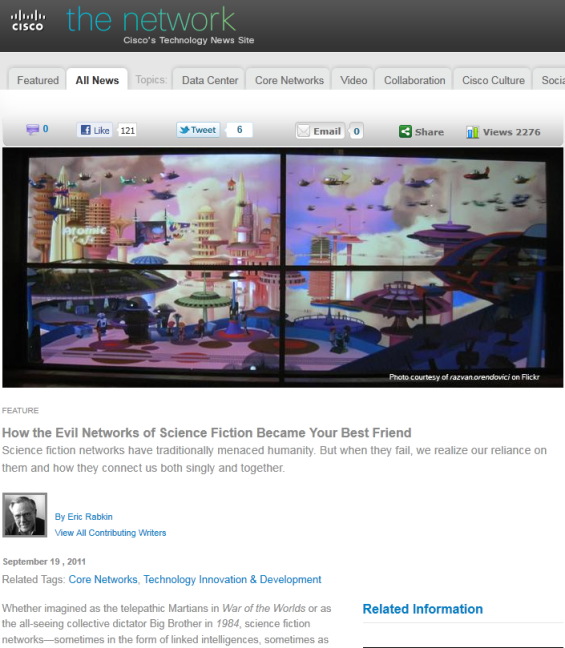
Eric S. Rabkin of the University of Michigan is a frequent guest on the SFFaudio Podcast. He’s also a professor of English at the University of Michigan! As such he is frequently called upon for his scholarly knowledge (just like on the podcast!). The latest such is an article entitled How The Evil Networks Of Science Fiction Became Your Best Friend.

Cisco Feature Article: How The Evil Networks Of Science Fiction Became Your Best Friend

Check it out HERE.

Posted by Jesse Willis

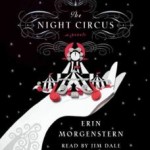
Review of The Night Circus by Erin Morgenstern

SFFaudio Review

The Night Circus
By Erin Morgenstern; Read by Jim Dale
13 Hours 39 Minutes [UNABRIDGED]
Publisher: Random House
Published: 2011
Themes: / Fantasy / Fairy Tale / Magic /

“The circus arrives without warning. No announcements precede it. It is simply there, when yesterday it was not. Within the black-and-white striped canvas tents is an utterly unique experience full of breathtaking amazements. It is called Le Cirque des Rêves, and it is only open at night.

But behind the scenes, a fierce competition is underway—a duel between two young magicians….” (from the publisher summary)

It isn’t often that I download a book as soon as it is released, but I’ve been hearing about The Night Circus for months.  A co-worker tracked down an ARC before it even came out, and declared that she loved it and so would I.  I believed her, but still thought I’d wait.  The tipping point was hearing that Jim Dale was the reader.

I first encountered Jim Dale when I listened to the audiobooks for Harry Potter.  Besides bringing the stories I already loved to life, I had the distinct impression that Jim Dale is the voice I’ve always heard in my head when I read a book that immerses me into another world.  His nuance in character voicing and compelling emotion increases the reading experience one hundred fold.  It was a no-brainer; I had to read this book.

The story bounces between different people who relate to the circus in some way, and moves at will between cities and years, just as the circus does.  Eventually the relationship between the characters starts to be revealed, starting with the midnight banquets, one of my favorite moments in the book. Details weave together to describe the mysterious, magical place of the night circus that kept me so absorbed that I would make up reasons to keep listening… taking the long way home, going through the  coffee drive-through, and taking on cleaning projects.

I have seen comparisons with Ray Bradbury and J.K. Rowling, but I keep thinking of Catherynne Valente, particularly the world she created for Palimpsest.  This is a time to believe the hype.  The Night Circus is magical.

Posted by Jenny Colvin