News, Reviews, and Commentary on all forms of science fiction, fantasy, and horror audio. Audiobooks, audio drama, podcasts; we discuss all of it here. Mystery, crime, and noir audio are also fair game.
As mentioned on SFFaudio Podcast #116 there is no commercially available audiobook edition of The Space Merchants. What I failed to mention, however, is that there is a two-part radio dramatization from 1957:
CBS Radio Workshop – The Space Merchants
Based on the novel by Frederik Pohl and C.M. Kornbluth; Performed by a full cast
2 MP3 Files – Approx. 1 Hour [RADIO DRAMA]
Broadcaster: CBS
Broadcast: February 17th and 24th, 1957
Provider: archive.org Mitch Courtenay, portrayed by Staats Cotsworth, is a rising star copywriter for the Fowler Schocken Advertising Agency. He’s just been given the company’s biggest campaign – he must promote the colonization of Venus. You’d think would be no problem at all given that Earth is an over-populated planet with polluted air and played-out resources. But there’s a wrinkle – somebody is working against Mitch, and an underground rebellion threatens the very foundations of Earth’s economy!
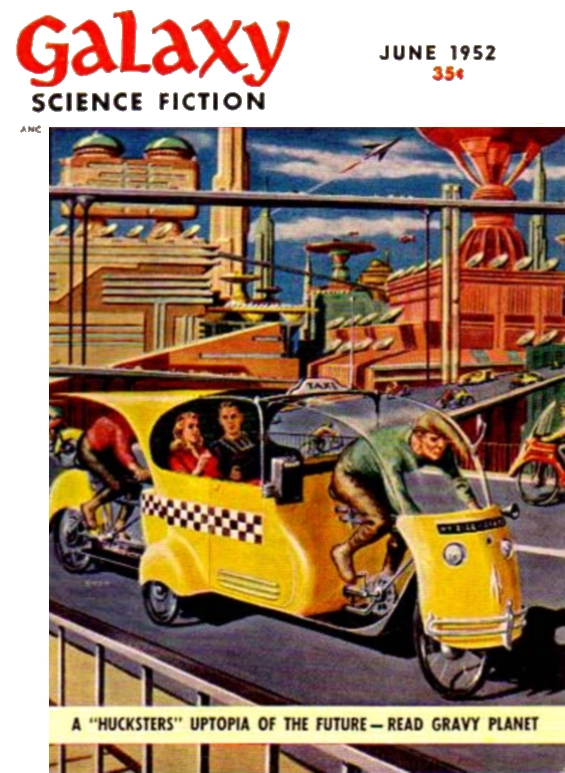
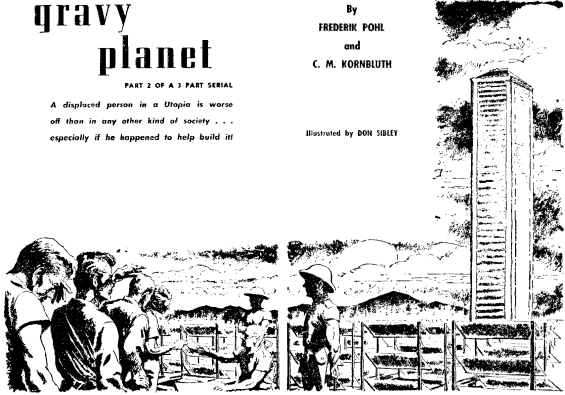
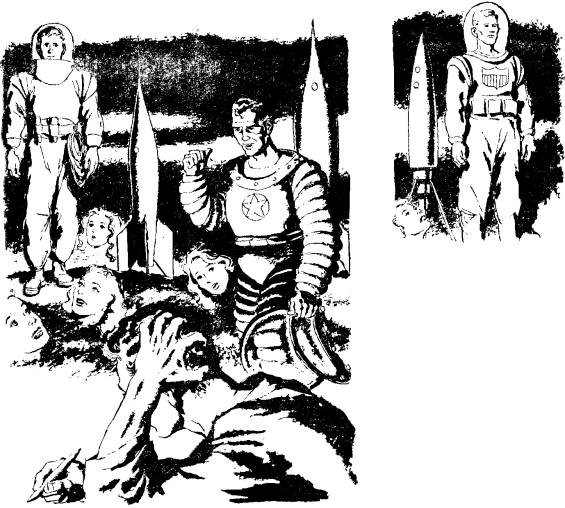
First serialized in the March through May 1952 issues of Galaxy Science Fiction under the title Gravy Planet, The Space Merchants by Frederik Pohl and C.M. Kornbluth was one of the most popular science fiction novels of the 20th century. Here’s the first ever depiction from it, by Ed Emshwiller, for the cover story from the March 1952 issue of Galaxy:
Darrell Sweet’s cover for the 1976 Ballantine Books paperback edition took inspiration from the original magazine appearance:
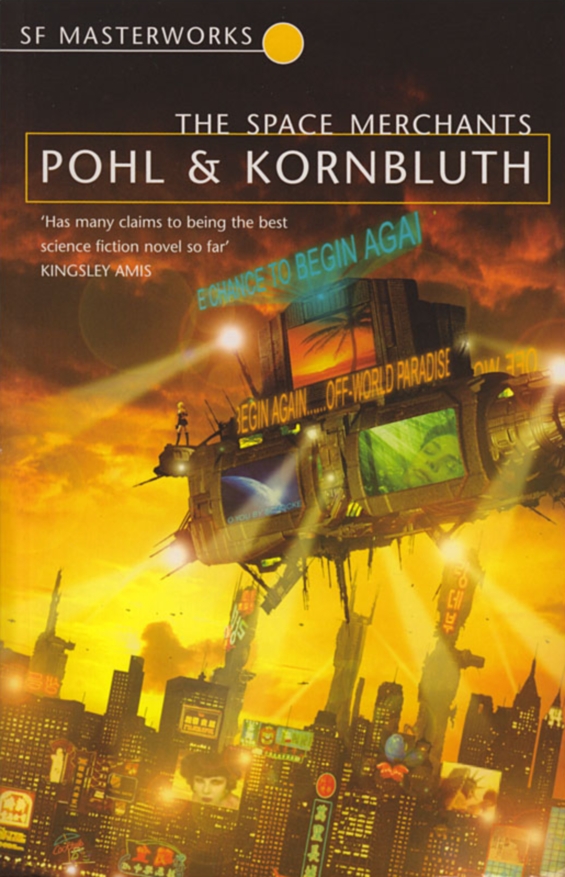
Whereas Steve Stone’s cover art for the Orion / Gollancz – SF MASTERWORKS (Volume 54) edition seems more inspired by Blade Runner:
The SFFaudio Podcast #116 – Scott, Jesse, Tamahome and Professor Eric S. Rabkin talk about The Space Merchants (aka Gravy Planet) by Frederik Pohl and C.M. Kornbluth
Talked about on today’s show:
Frederik Pohl’s blog, differences between Gravy Planet and The Space MerchantsCoca-Cola vs. Yummy Cola, com-pocalypse (a commercial apocalypse), advertizing, conservationists -> connies (or consies) is an analogue for communists -> commies, Tristan Und Isolde, Costa Rica, Chicken Little, Fowler Shocken, 1950s. Jews in “the Science Fiction ghetto”, H.L. Gold, Phlip Klass (William Tenn), Ray Bradbury, Isaac Asimov, the Wikipedia entry for The Space Merchants, a study guide for The Space Merchants, Levittown, Man Plus, The Merchants War, Pohl’s interest in psychiatry, Gateway, structural problems in The Space Merchants, identity theft, a hero’s journey, The Odyssey, katabasis, banana republic, the United Fruit Company, Cuba, U.S. Marines in Columbia, Vance Packard’s The Hidden Persuaders, Jack O’Shea, little people are the perfect astronauts, pilots tend to be small people, the continuing relevance of The Space Merchants, “transformed language”, The Left Hand Of Darkness by Ursula K. Le Guin, “the Glaciers didn’t freeze overnight” (Rome wasn’t built in a day), what side do you oil your bread on, pedaling your Cadillac into the future, are there more cars in the U.S.A. than people?, William Gibson, The future is already here — it’s just not very evenly distributed, corporatocracy, Oliver Stone, does Wall Street run the world or is it Madison Avenue?, representative government per capita (per head) or ad valorem (to value), The Marching Morons, dystopia, utopia, citizen vs. consumer, CBC’s The Age Of Persuasion podcast, the effectiveness of advertizing, feminine hygine products, “it has wings”, coffiest vs. Starbucks, Jon Huntsman, Tim Pawlenty, how effective is advertizing?, saturation of advertizing vs. the message of advertizing itself, does advertizing work?, who consumes dog food?, soyaburger, Chlorella, algae, soylent red, despite what he says Eric is not a jerk vegetarian, seitan (wheat gluten food), Moby Dick, Mountain Dew in the U.S.A. vs. Mountain Dew in Canada, energy drinks, Jolt Cola, phial vs. vile, Philip K. Dick’s Do Android Dream Of Electric Sheep?, the Penfield Mood Organ, caffeine, Tamahome likes unsweetened chocolate, what did Montezuma drink all day long?, does has the internet lessen the impact of advertizing?, the spillage from penis enhancement, Eric bought a wide cross section of pornography, “genuine spurious placebo”, Boeing “forever new frontiers”, the Dubai Ports controversy, Cisco Systems, I, Robot, Minority Report, gesture recognition, Yelp, Wikileaks: U.S. diplomats pressed Boeing deals, Bombardier, “he came from an old family”, Kennedy, Bush, Heddy and Hester, Hedy Lamarr, Hester Prynne, The Scarlet Letter by Nathaniel Hawthorne, Alfred Bester’s The Demolished Man, The Stars My Destination, “Eight sir, seven sir, six sir, five sir, four sir, three sir, two sir, one. Tenser, said the Tensor, Tenser said the Tensor. Tension, apprehension, and dissension have begun.” Rebecca Black’s Friday is a train wreck, Arthur C. Clarke‘s Tales From The White Heart, colonizing your brain, “you haven’t read a book until you’ve talked about it”, is solitary reading a different kind of thing than social reading?, satire, Monty Python’s “The Funniest Joke In The World” sketch, advertizing in books, advertizing in paperback novels, propaganda, recommendation vs. advertizing, making something available vs. thrusting it upon you, metaSFFaudio, The Reapers Are The Angels by Alden Bell, Flannery O’Connor with zombies, why SFFaudio doesn’t link to Amazon.com, Morning Joe, Fox News, Scott is now a politician, Douglas Adams, political debate being replaced by sound bites, Jon Stewart vs. Sean Hannity, Jon Stewart’s appearance on Crossfire, Will Rogers, communication vs. advertizing, jokes are revelations, brand awareness, why do kids want to see Transformers 3?, Cedar Rapids is a coming of age movie about the nature of friendship, why is there no commercial released audiobook of The Space Merchants?, The Puppet Masters by Robert A. Heinlein, Them!, anti-consumerism (anti-Americanism), tobacco packaging warning messages (are ads), the tobacco industry vs. the anti-tobacco industry, church advertizing, Scientology doesn’t sell the same message as many other religions, L. Ron Hubbard, A.E. van Vogt, Dianetics, the premise of Null-A, Friedrich Nietzsche.
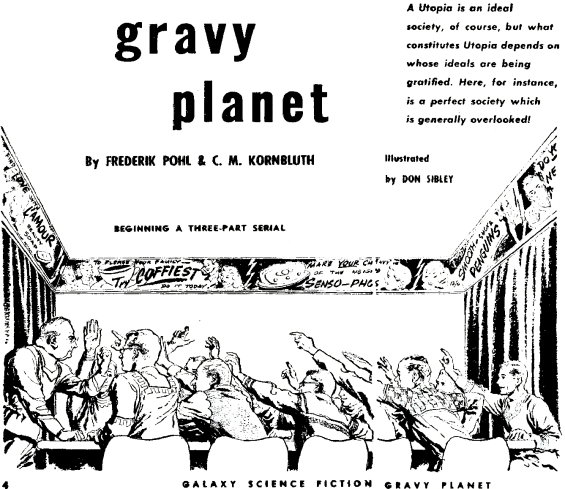
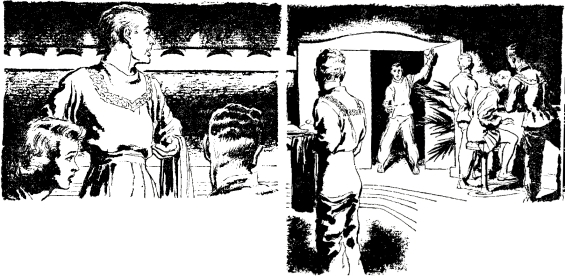
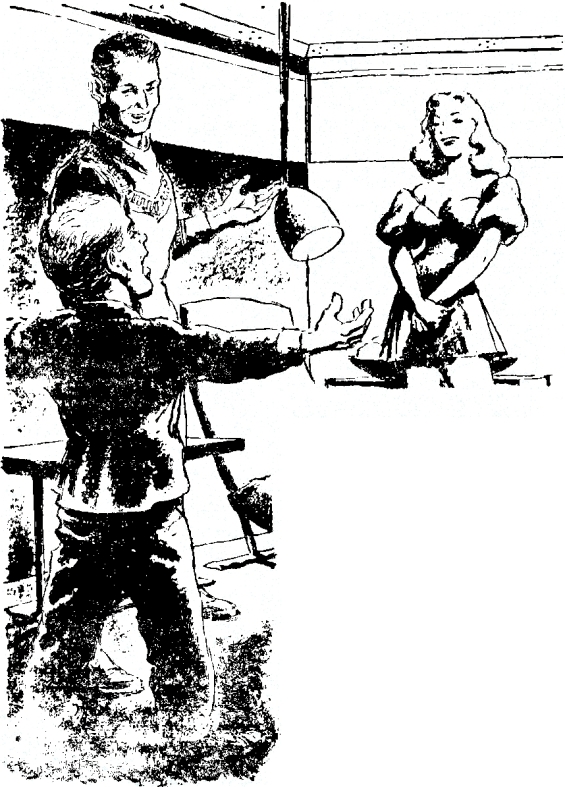
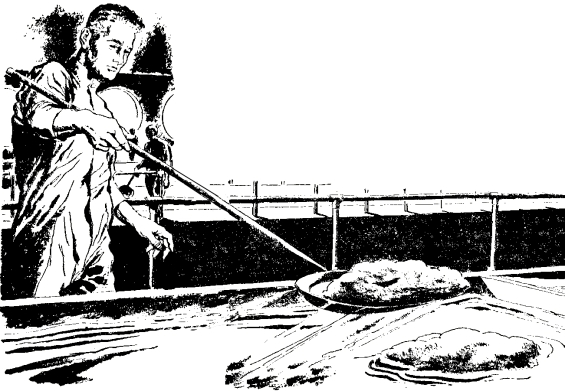
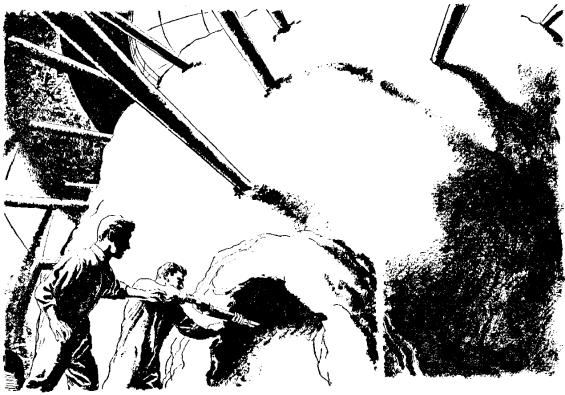
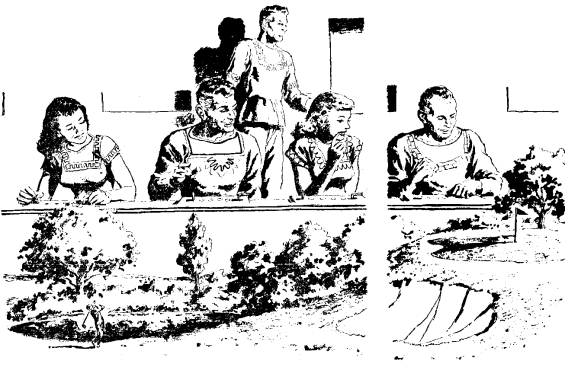
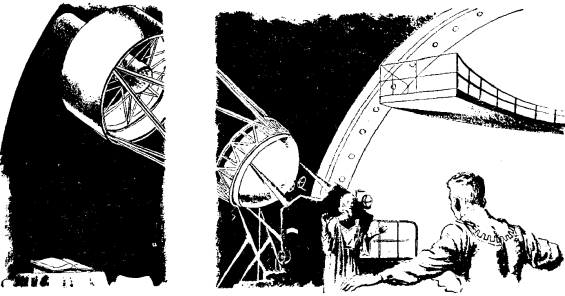
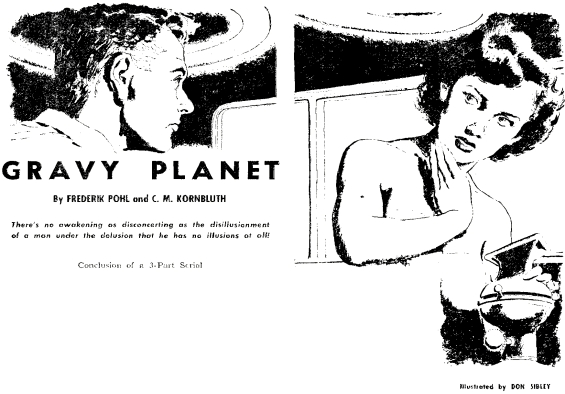
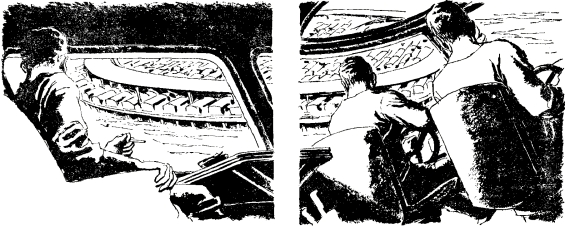
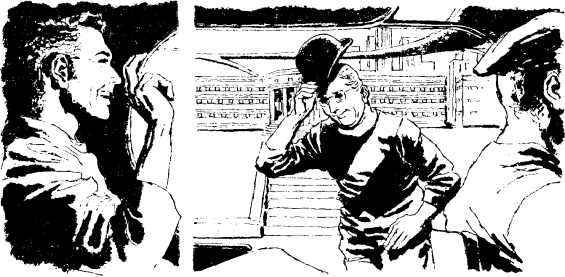
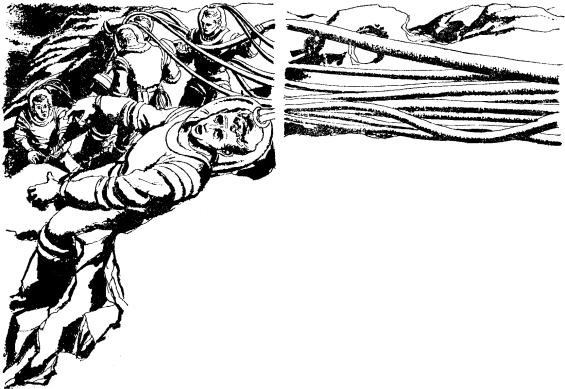
Illustrations from the original serialization of Gravy Planet (aka The Space Merchants) in Galaxy Science Fiction magazine’s July August and September 1952 issues:
The Outlaw Of Torn
By Edgar Rice Burroughs; Read by Richard Kilmer and Susan Umpleby 19 Zipped MP3 Files or Podcast – Approx. 7 Hours [UNABRIDGED]
Publisher: LibriVox.org
Published: March 31, 2010 The story is set in 13th century England and concerns the fictitious outlaw Norman of Torn, who purportedly harried the country during the power struggle between King Henry III and Simon de Montfort. Norman is the supposed son of the Frenchman de Vac, once the king’s fencing master, who has a grudge against his former employer and raises the boy to be a simple, brutal killing machine with a hatred of all things English. His intentions are partially subverted by a priest who befriends Norman and teaches him his letters and chivalry towards women.
Otherwise, all goes according to plan. By 17, Norman is the best swordsman in all of England; by the age of 18, he has a large bounty on his head, and by the age of 19, he leads the largest band of thieves in all of England. None can catch or best him. In his hatred for the king he even becomes involved in the civil war, which turns the tide in favor of de Montfort. In another guise, that of Roger de Conde, he becomes involved with de Montfort’s daughter Bertrade, defending her against her and her father’s enemies. She notes in him a curious resemblance to the king’s son and heir Prince Edward.
Finally brought to bay in a confrontation with both King Henry and de Montfort, Norman is brought down by the treachery of de Vac, who appears to kill him, though at the cost of his own life. As de Vac dies, he reveals that Norman is in fact Richard, long-lost son of King Henry and Queen Eleanor and brother to Prince Edward. The fencing master had kidnapped the prince as a child to serve as the vehicle of his vengeance against the king. Luckily, Norman/Richard turns out not to be truly dead, surviving to be reconciled to his true father and attain the hand of Bertrade
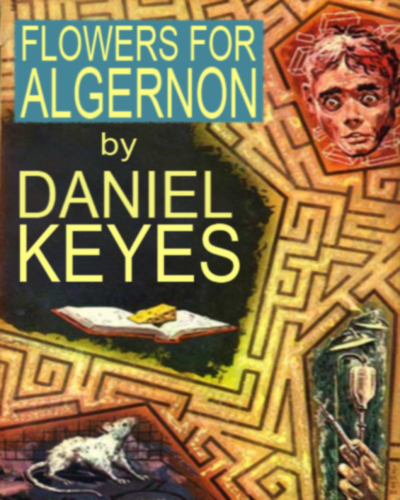
Some stories adapt better than others. I think a straight narration of an audiobook of Daniel Keyes’ novelette of Flowers For Algernon would be an easy and natural way to experience most of the story’s power. Sadly, that’s still yet to happen.
The original story, of course, makes great use of spelling mistakes which could not fully be illustrated in any audiobook narration, but a straight single voiced reading of the story still provides the main thrust of the tale’s dramatic technique; we get the grammar of the main character, his account of what his doctors ask of him, and we get what his”friends” think of him.
The film and television versions that I’ve seen have, with video’s visually orientation, have all eliminated much of the very valuable power inherent in the epistolary.
Indeed, as editor James Gunn puts it in his introductory essay to Flowers For Algernon, found in The Road To Science Fiction #4 – From Here To Forever, “Part of the appeal of the story is the comparison of the reader’s knowledge to Charlie’s, and the ability to see more in Charlie’s reports than he knows is there.” Once you actually get out of Charlie’s head you lose his perspective and lose the unreliable narration.
So I was thinking about all of this as I was downloading a 1991 BBC Radio dramatization, via torrent, from RadioArchive.cc.
I was pretty skeptical of any radio dramatization’s ability to convey the story’s full power. Now though, after listening, I’ve come away convinced that it retains much of its power, and offers up a very innovative use of the aural medium. It is actually quite a tricky balance but it totally worked in the way it is put together.
Bert Coules, who adapted the novelette had this to say:
“In 1991 the BBC asked me to suggest some SF material for a short season. I drew them up a list and at the same time put in a claim to do Flowers, which I think is a tremendous story: it completed knocked me out when I first read it as a kid. I was delighted when I got the commission.”
In Flowers For Algernon the central character keeps a diary – in fact, the entire story consists of his diary entries. I changed the diary into a series of audio recordings made on a personal tape machine, and interspersed them with dramatised scenes which are mentioned or implied in Daniel Keyes’ original but which don’t actually appear in the story at all. When you’re writing new material like that, the challenge of course is to keep it consistent with the stuff that does come more or less straight from the book.
Flowers posed a particular problem: if you’ve read the story you’ll know that Charlie Gordon, the central character, goes through some huge changes which are brilliantly depicted by the way his diary entries are written: as he develops, so does his spelling, grammar and punctuation. I had to find a spoken way of reflecting the same journey.”
I believe he’s done a fantastic job with it.
Incidentally, the other plays in that series included: Brave New World, Kaleidoscope, The Midas Plague, The Chrysalids, Space Ache, Who Goes There? and Tiger! Tiger!.
So, like I was saying, if you haven’t read the original novelette, I recommend you experience the story that way, as a piece of text, first. If you have read it, then I heartily recommend you try the audio drama. It’s a wonderful adaptation with excellent acting and a highly innovative use of the microphone.
Flowers For Algernon
Adapted from the novelette by Daniel Keyes; Dramatized by Bert Coules; Performed by a full cast
Approx. 59 Minutes [RADIO DRAMA]
Broadcaster: BBC Radio 4
Broadcast: September 5, 1991
Source: RadioArchive.cc The play featured as part of a series of forward-looking productions collectively named “The shape of things to come.” Tom Courtenay stars as the intellectually challenged Charlie, who as part of an experiment is offered a “cure” for his low IQ…..First published in The Magazine Of Fantasy And Science Fiction’s April 1959 issue.
Cast: Tom Courtenay ………………… Charlie
Algernon …………………….. Himself
Joanna Myers …………….. Miss Kinnian
Barrie Cookson …………….. Dr Strauss
Ronald Herdman ………………. Dr Nemur
Clarence Smith ………………….. Bert
Nigel Carrington …………. Joe/Donnegan
Auriol Smith ………….. Mrs Flynn/Ellen
Alan Barker …………. Frank/Sherrinford
Adapted by Bert Coules
Produced by Matthew Walters
Recorded Books produced an unabridged edition of the novelized expansion of the story:
Flowers For Algernon
By Daniel Keyes; Read by Jeff Woodman
8 CDs – Approx. 9 Hours [UNABRIDGED]
Publisher: Recorded Books
Published: 1998
ISBN: 9781402550348 Charlie Gordon knows that he isn’t very bright. At 32, he mops floors in a bakery and earns just enough to get by. Three evenings a week, he studies at a center for mentally challenged adults. But all of this is about to change for Charlie. As part of a daring experiment, doctors are going to perform surgery on Charlie’s brain. They hope the operation and special medication will increase his intelligence, just as it has for the laboratory mouse, Algernon. Meanwhile, each day Charlie keeps a diary of what is happening to him. This is his poignant record of the startling changes in his mind and his life. Flowers for Algernon was first published as a short story, but soon received wide acclaim as it appeared in anthologies, as a television special, and as an award-winning motion picture, Charly. In its final, expanded form, this haunting story won the Nebula Award for the Best Novel of the Year. Through Jeff Woodman’s narration, it now becomes an unforgettable audio experience.
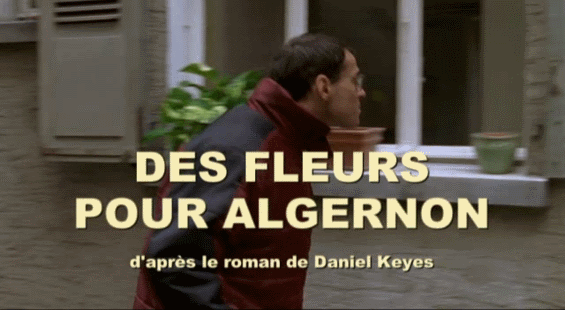
As mentioned earlier there have been four major video adaptations of Flowers For Algernon (three television movies and on theatrical film): Des Fleurs Pour Algernon (a 2006 French TV movie), Flowers For Algernon (a U.S. TV movie from 2000), Charly (a U.S. theatrical release from 1968) and a live broadcast teleplay that aired as a part of The United States Steel Hour in 1961 (it was titled The Two Worlds of Charlie Gordon).
And I’m afraid there was also a frightening looking musical theater version:
Audio dramatist Marty Ross recommends we check out a new audio drama producer called 3D Horror Fi. Sez Marty:
I’m a professional writer of audio drama, specializing in the genres of SF and horror. Much of this has been for BBC Radio (the serials GHOST ZONE and CATCH MY BREATH, the anthology series THE DARKER SIDE OF THE BORDER.) Most recently, I’ve had a couple of Doctor Who audio books produced by Big Finish, NIGHT’S BLACK AGENTS and Lurkers At Sunlight’s Edge (which is basically Doctor Who meets H.P. Lovecraft!). But what I’m really seeking to plug here is my play BLOOD & STONE, which has recently been produced by 3DHorrorFi, a new web-based company specializing in horror and SF audio, using seriously state of the art technology. My play for them is gothic horror: you may be acquainted with the true story of Elizabeth Báthory, the Hungarian ‘bloody countess’ who bathed in the blood of innumerable servant girls to preserve her own beauty and was then punished by being locked away in a tower of her own castle. Well, my play imagines what would have happened if she had escaped, after convincing a seemingly naive servant girl of her innocence. I think it’s really good and this company deserves all the encouragement they can get – they’re just starting out, but with a little help, they could become major producers in the horror/SF field. If you check their website, www.3Dhorrorfi.com you could investigate what they offer: their other plays (not written by me) are good too, including the best adaptation of The Cask of Amontillado I’ve ever heard.
Thanks Marty! Yep, that sounds like some stuff we are interested in!
Fear of disease is probably just as old as disease itself. But the modern fear, the fear that a single individual carrying a vial full of specific incurable pathogen – the fear that one crazed fanatic could decimate an entire city’s population by poisoning its water supply – that fear can probably be traced back to the late 19th century and perhaps even to the inventor of the first true Science Fiction short stories, Mr. H.G. Wells. Had the ending of The Stolen Bacillus been done in a slightly different way it may have spawned the whole zombie contagion phenomenon a century early.
The Stolen Bacillus
By H.G. Wells; Read by Dawn Keenan
1 |MP3| – Approx. 16 Minutes [UNABRIDGED]
Publisher: Voices In The Dark
Published: 2005 An anarchist, intent on wreaking ruin on a city, steals a phial from a bacteriologist. First published in the Pall Mall Budget’s June 21, 1894 issue.

 CBS Radio Workshop – The Space Merchants