Every time I read a Robert Sheckley story I become re-enamored with the cutting burn of his insights. The latest Sheckley tale that I’ve been reading is his 1953 futuristic fable Watchbird. It’s about a new policing tool, a device that can prevent murder at the point of action. It’s not funny exactly, but it is satirical, and quite beautiful in parts:
“Over the town, the watchbird soared in a long, lazy curve. Its aluminum hide glistened in the morning sun, and dots of light danced on its stiff wings. Silently it flew.
Silently, but with all senses functioning. Built-in kinesthetics told the watchbird where it was, and held it in a long search curve. Its eyes and ears operated as one unit, searching, seeking.”
The watchbirds of the title are flying robots equipped with the tools to do their jobs – they sniff out the “outpouring of certain glands” and “taste” the “deviant brain wave” of a murderer before he or she can strike. But the watchbirds have also been programmed with the knowledge that not all murderers are wrathful, some like one hit-man who shows up in the story, have no feelings about the murders they commit. And so, they must learn to watch out for these hidden murders, to look out for the precursors to cold killings. And that’s where I think Sheckley’s radical departure comes in.
Denotation is at the heart of human conflict.
I take this as the thesis of Robert Sheckley’s short story Watchbird. Like many of those classic Science Fiction stories, Watchbird is nothing like plausible. I can’t imagine that Galaxy’s editor, Horace Gold, accepted Sheckley’s tale on the grounds that it was a logical extrapolation of where technology was going. This, even despite the long history of unmanned aerial vehicles which I am sure both Sheckley and Gold were aware of. Indeed, though we now live in a world where the likes of the General Atomics MQ-9 Reaper, equipped with air-to-ground AGM-114 Hellfire missiles, can strike any target – the technology was never the issue. Sheckley’s concern is in what motivates their use. So the question then, as now, is: “What’s the difference between a killing and a murder?”
In answer to that question I think Watchbird should be better known, more read, and perhaps like Orwell’s novels Animal Farm and 1984, it should be read by those who would seek to govern. Sadly, I think this unlikely. I’m not convinced Watchbird‘s epistemological skepticism is as palatable as the simplicity of: a “boot stamping on a human face— forever” or that of a megalomaniacal pig.
Epistemology is a hard, hard sell, but as we strive for the moral conclusions we so desire, we must, if we are to be clever, first reconcile all the varied definitions that we think we know.
This kind of story is of history and humanity, written as with an exploded view. Words like “right” and “wrong”, “murder” and “kill” are used to map the world and as such they are the explanation of, and sometimes the reasons for, the actions we see all around us. As evidence I can only submit Watchbird:
Audiobooks:
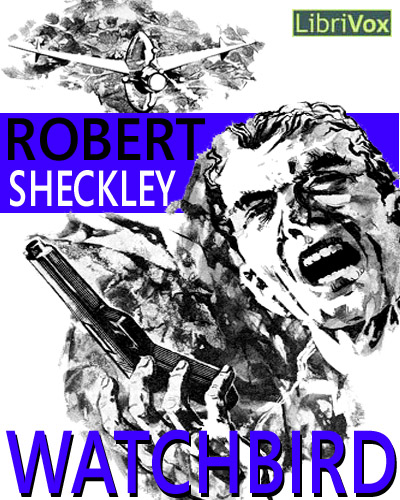
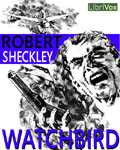 Watchbird
By Robert Sheckley; Read by Gregg Margarite
1 |MP3| – Approx. 47 Minutes [UNABRIDGED]
Publisher: LibriVox.org
Published: May 16, 2010
Strange how often the Millennium has been at hand. The idea is peace on Earth, see, and the way to do it is by figuring out angles. First published in the February 1953 issue of Galaxy Science Fiction.
Audio Drama:
 Tales Of Tomorrow – Watchbird
Based on a story by Robert Sheckley; Performed by a full cast
1 |MP3| – Approx. 28 Minutes [RADIO DRAMA]
Broadcaster: ABC Radio (American Broadcasting Company)
Broadcast: 1953
Provider: OTR-Cat.com
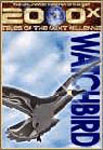 2000X – The Watchbird
By Robert Sheckley; Performed by a full cast
Audible Download – Approx. 35 Minutes [RADIO DRAMA]
Publisher: The Hollywood Theater of the Ear / Audible
Published: 2000
Science invents a flying robot that prevents murder, but there’s a fateful glitch. Adapted for audio by William F. Nolan and Ytzhak Berle, with a cast featuring Newell Alexander, Janet Carroll, Jerry Castillo, Joe Greco, Melissa Greenspan, Allan Miller, Stefan Rudnicki, Hamilton Camp, Brian Finney, and Bradley Schreiber.
 SF’68 – Watchbird
Based on the story by Robert Sheckley; Adapted by Michael McCabe; Performed by a full cast
1 |MP3|* – Approx. 30 Minutes [RADIO DRAMA]
Broadcaster: Springbok Radio
Broadcast: 1968
Provider: The Zombie Astronaut’s Frequency Of Fear #0.048
*The adaptation begins at approx. the 43 minute mark.
SF’68 was produced in Johannesburg, South Africa in 1968.
Other:
-The original publication in Galaxy Science Fiction |ETEXT|HTML|
-Video adaptation in The Masters Of Science Fiction TV series.
Posted by Jesse Willis