Review of Darkside by Tom Becker

SFFaudio Review

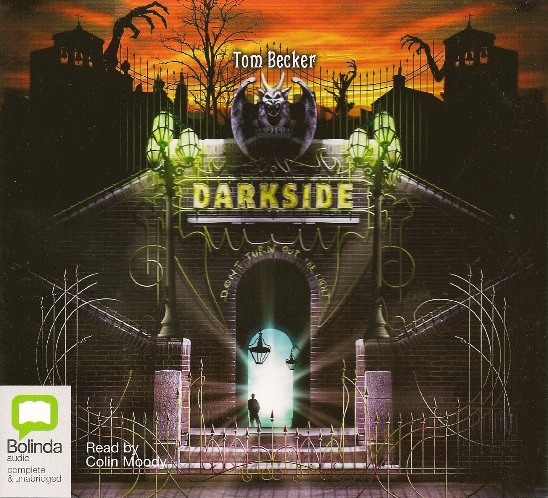
Darkside by Tom BeckerDarkside
By Tom Becker; Read by Colin Moody
6 CDs – Approx. 6 Hours 12 Minutes [UNABRIDGED]
Publisher: Bolinda Audio
Published: 2008
ISBN: 9781921415340
Themes: / Fantasy / Urban Fantasy / Crime / London / Werewolves / Vampires / Magic / Kidnapping / Evil / Jack The Ripper /
Your home’s been attacked. Your dad’s in an asylum. You’re running for your life. And there’s nowhere to hide.

You’ve stumbled on the city’s greatest secret: Darkside. Incredibly dangerous and unimaginably exciting. Darkside is ruled by Jack the Ripper’s children – a place where nightmares walk the streets. You think you’re in trouble now, but your problems have just begun…

I usually do a fair mount of research about the books I plan to read. Before I pick one up I’ve usually either heard an author interview, read a review, discussed it with people who’ve already read it, or at least got a recommendation from an author whose work I already respect. But I also know these techniques aren’t a very good way to branch out beyond what’s already familiar to me, and so, every so often I just pick up a book, almost at random, and start reading. That’s what I did with Darkside by Tom Becker.

Maybe one of the initial appeals of Darkside, other than the terrific cover, was that it was from a publisher whose audiobooks I’d never heard before. Bolinda Audio is from Australia. And because of that it’s doing things a little differently. First off, it’s narrators are Australian. And second, they’ve got a lot of authors in their catalogue that I’ve never heard of. That’s cool!

Darkside is an interesting tale in itself. In terms of plot, it kind of falls halfway between two Neil Gaiman novels: Neverwhere and The Graveyard Book. It features Jonathan Starling, an unremarkable misfit fourteen-year-old with an ailing father and a deceased mother. He lives in London and is mostly taken care of by a kindly neighbor woman. Other than her, he’s nearly friendless and spends most days skipping-out of school and hanging out at one of the city’s many libraries. His father, an avid book collector himself, suffers some sort of recurring full body paralysis and perhaps it’s related to some of the books he collects. One day, right out in the open on a London street Jonathan is nearly kidnapped by a seemingly invisible giant and a woman with fluorescent hair. He quickly learns that London isn’t going to be safe for him anymore and so his father sends him away. He is to flee, for his own safety, into the arms of a protector. Jonathan takes with him a knife and a bullet. The knife is for protection from the kidnappers, and the bullet is for protection against his would-be protector, a mysterious old friend of his father’s, a man named Carnegie. Plot ensues.

Where the novel falls short is in comparison to the two Neil Gaiman novels I mentioned earlier. A hidden city within London isn’t really new. And neither is a young kid being protected by a paranormal monster-man. More importantly, Becker doesn’t have anywhere near the mastery of English fiction that Gaiman has. But that’s really not a fair comparison. For my money very few living English authors can compare favorably with Neil Gaiman. Apparently Darkside was written when Becker was just 25! When Gaiman was 25 he hadn’t written a single novel, comic, nor even Don’t Panic, his wonderful biography of Douglas Adams. As a result I think Darkside can stand pretty proudly on its own. It’s quickly paced, pretty fun and most of all it’s got a story that keeps your attention all the way through. Good job new guy.

Narrator Colin Moody, a talent stage trained actor, has an Australian accent, except when performing the dialogue of the characters. When in character Moody cowls him reading with various Londoner regionalisms. There are many sinister sounding villains in this novel and he voices all of them extremely well. If you’re a voracious reader looking for swiftly plotted urban fantasy novel (for the juvenile set), and you’ve already read both Neverwhere |READ OUR REVIEW| and The Graveyard Book |READ OUR REVIEW| do check out Darkside. Series fans will also be pleased to hear that four more Darkside novels follow this one, and that Bolinda has the “audio sequel forthcoming.”

Posted by Jesse Willis

Seeing Ear Theatre: Nancy Kress and Bruce Holland Rogers

SFFaudio Online Audio

Here are two more releases from the long deleted Seeing Ear Theatre collection. They were lovingly uploaded to Archive.org and they shall be just as lovingly added to our master list of Seeing Ear Theatre‘s goodness.

Seeing Ear Theatre - ReadingsUnto The Daughters and Margin Of Error
By Nancy Kress; Read by Nancy Kress
1 |MP3| – Approx. 30 Minutes [UNABRIDGED]
Publisher: Seeing Ear Theatre
Published: 1999
Provider: Archive.org
Recorded at the 1998 Baltimore WorldCon.

Seeing Ear Theatre - ReadingsThe Goblin King and The Dead Boy At Your Window
By Bruce Holland Rogers; Read by Bruce Holland Rogers
1 |MP3| – Approx. 11 Minutes [UNABRIDGED]
Publisher: Seeing Ear Theatre
Published: 1999
Provider: Archive.org

[You’re indispensable Roy. Thanks!]

Posted by Jesse Willis

Review of The Blade Itself by Joe Abercrombie

SFFaudio Review

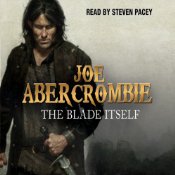
The Bade Itself by Joe AbercrombieThe Blade Itself (The First Law: Book One)
By Joe Abercrombie; Read by Steven Pacey
Audible Download – 22 Hours 18 Minutes [UNABRIDGED]
Publisher: Orion Publishing Group
Published: 2010
ISBN: 9781409111443
Provider: Audible.com
Sample |MP3|
Themes: / Fantasy / Sword and Sorcery / Dark Humor / Revenge / Violence /

For a couple years now, Joe Abercrombie’s The First Law Trilogy has been at the top of my to-read list, but as I’m a slow print reader, the series inevitably yielded to more readily available audiobooks. Imagine my delight, then, when I recently realized that Orion Publishing Group had published the series in audio last June. The wait was worth it. The opening volume, The Blade Itself is a darkly humorous tale full of antiheroes and intrigue. Abercrombie’s strong writing and wry wit set The Blade Itself a cut above other novels in the reactionary subgenre of fantasy spawned by George R.R. Martin.

At first blush, the world of the First Law Trilogy looks like your average fantasy world. The bulk of the action takes place in Adua, capital city of The Union, a land with a dotard king facing imminent war on two fronts: the newly-unified North and the Gurkish Empire to the South. The city, and especially its central citadel the Agriont, is teaming with ambitious councilman, posturing soldiers, and brutal inquisitors. The North, as one might epect, is a sparse unwelcoming land peopled by warrior clans recently unified under the iron fist of King Bethod. In The Blade Itself we see only snatches of the Gurkish Empire, but it follows the usual desert formula for southern kingdoms. (Why do most fantasy series seem to be set in the Northern hemisphere?) This opening volume hints at an intricate magic system that underlies and informs the world, but so far it’s rather underdeveloped.

The viewpoint characters bring this seemingly run-of-the-mill fantasy world to life in vibrant color. Each character is an antihero, in some sense of the word. Like George R. R. Martin, Richard K. Morgan, and other recent writers, Abercrombie is writing against the tropes of the traditional good-versus-evil format of epic fantasy. Unlike some other writers in this vein, though, Abercrombie rarely seems too self-conscious about what he’s doing. Logen Ninefingers, dubbed the “bloody-nine” in the North, does not read like an anti-Aragorn, nor does Bayaz, First of the Magi, read like an anti-Gandalf. Rather, they’re fully developed characters in their own right.  Then there’s San dan Glokta, survivor of a horrible ordeal of torture at the hands of the Gurkish Empire who has in turn become a torturer for the inquisition. Rounding out the cast is Jezal, a headstrong noble youth determined to win the year’s fencing contest. With the exception of Jezal, these characters have endured tremendously hard lives, so naturally their thoughts aren’t filled with sunshine and butterflies. This is a dark book.

The fun lies in watching these characters come together and interact with one another. As in any good book, too, it’s fun to watch these characters, who we’ve come to empathize with even if we don’t actually like them, overcome their internal and external challenges. The most obvious case is Jezal and his fencing contest, which is brought to a most satisfying concentration. Then there’s Glokta, trying to stay afloat in the political post of Inquisitor, all while struggling merely to get out of bed. Then there’s Logen, fleeing his reputation as the “bloody-nine.” And at the heart of it all is Bayaz, First of the Magi, whose story hints at the direction the series may ultimately take. Bayaz, though not a point-of-view character, drives the plot in many ways, either subtly or overtly manipulating events to suit his needs.

If the book has a weakness, it’s the ending. Endings are always tricky things to pull off, especially in the first novel of a trilogy, where an author must bring the present volume to a satisfying conclusion while enticing the reader to continue with the series. Unfortunately, Abercrombie leans too far towards the latter. While the last hour or two of audio will be a treat for fans of vividly-depicted action sequences, they’re light on any satisfying story development. The ending certainly isn’t bad, it just left me a bit disappointed. On the other hand, it also did its job in whetting my appetite for the next volume.

As alluded to earlier, the standout character in The Blade Itself is perhaps Abercrombie’s deft writing style. Admittedly, it took some getting used to. I remember complaining on Twitter back when I first had a go at reading the print edition that the book was too full of sentence fragments and “said bookisms.” I stand by that complaint. The thing is, the style really fits the world and especially the characters. The dialogue reads like you’re sitting in on the conversation, especially under the standout narration by Steven Pacey. And while I’m not personally a fan of long action sequences, there’s no doubt that Abercrombie writes them masterfully. You can feel every bone-jarring sword blow and taste the tang of blood in the air.

I approached this audiobook with some hesitation. I feared that no narrator could match Michael Page’s performance of Abercrombie’s Best Served Cold. At best, I feared, I’d be disappointed; at worst, I wouldn’t even be able to listen to the book in its entirety. Fortunately, Steven Pacey is equal to the task of narrating such an ambitious work. His narration walks the fine balance of capturing the characters’ voices–literally and figuratively–without calling too much attention to them and thereby detracting from the story. The toothless Glokta, for instance, speaks with just a hint of a lisp, a slight slurring. Every now and then, his narration moves a touch too far toward the dramatic, but for the most part it’s spot on.

The Blade Itself, if it were a film, would carry a solid R rating, and therefore isn’t for everyone. Strong language and violence abound. Under its dark veneer of brutality, however, the novel shines with complex characters, compelling writing, and a story that, though not yet fully baked, promises to yield great rewards in subsequent novels.

Posted by Seth Wilson

Radio Drama Revival: BBC Radio 4’s The Handmaid’s Tale

SFFaudio Online Audio

Radio Drama RevivalThough Margaret Atwood denies it, along with denying that humans landed on the Moon, I genuinely and truly believe she has written an excellent Science Fiction novel. In fact, BBC Radio 4’s production of that very Science Fiction novel, The Handmaid’s Tale, is truly excellent Science Fiction drama too! That’s why I’m so excited to pass along this post from Radio Drama Revival‘s Fred Greenhalgh:

Oh, dear listeners, today we have a treat for you! It’s a story commissioned by the the gold standard in audio drama – the BBC!

The show is producer John Dryden’s inspired adaptation of The Handmaid’s Tale, by Margaret Atwood. The story tells of a dismal future where the lines between church and state are no longer distinguishable, and the nature of femininity has been revised to fit a more religious bent.

Free young women are conscripted to become “handmaid’s” – women used as stand-ins for infertile wives in a world where sterility seems rampant… And this is the story of one of those Handmaids.

Part 1 is available now, parts 2 and 3 will appear in future podcasts…

Part 1 of 3 |MP3|

A full-cast dramatization based on one of the 20th century’s most outstanding novels about the future. When religious extremists take over the US government, they create the Republic of Gilead where women are prohibited from owning property and all money is transferred to male relations.

Podcast feed:

http://feeds2.feedburner.com/FinalRune

Also recommended, for those interested, there is a very different CBC Radio adaptation of The Handmaid’s Tale (as dramatized by Michael O’Brien). It aired in 2002 and was later released on CD by BTC Audiobooks.

Posted by Jesse Willis

The SFFaudio Podcast #075 – TALK TO: Hugh McGuire

Podcast

The SFFaudio PodcastThe SFFaudio Podcast #075 – Jesse and Scott talk to Hugh McGuire, the founder of LibriVox.org.

Talked about on today’s show:
LibriVox’s Wikipedia entry, Ear Ideas, Book Oven, Hugh’s top secret audiobook project [coming soon], the free software movement, Richard M. Stallman, Lawrence Lessig, how are things going on the web, viruses and spam, WordPress, Internet Archive, volunteer staffing, the 2010 $20,000 fundraiser, the Wayback Machine, Project Gutenberg, TV Archive, the Library Of Congress Twitter archives, better Twitter than Facebook, “if the aliens ever arrive and look at the YouTube comments we’re screwed”, innovation comes from a wealth of public commons, a looser copyright system will result in more innovation to the benefit of society, The Iliad by Homer (translated by Samuel Butler), the Recorded Books version of The Iliad, solo vs. collaborative recordings, The Most Powerful Idea In The World: A Story of Steam, Industry, and Invention by William Rosen, patents, rewarding innovation with temporary monopolies, the captains of capitalism, innovators should be given prizes vs. a permanent monopoly, extracting rent, rent seeking behavior, legislation to extend copyrights and patents is damaging, the orphan works problem, the chilling effect of a murky copyright regime, Bill C-32 (Canada’s crappy copyright legislation), Canadian libraries don’t promote LibriVox, the Dewey Decimal system, search LibriVox by genre, “I love the 714 section of the library”, redesigning LibriVox (hopefully by the end of 2010), non-English audiobooks on LibriVox, English is just too kick-ass, volunteerism is embraced by Americans, Canadians are more conservative (than Americans), short non-fiction on LibriVox, the Short Non-Fiction Collection Volume 1 on LibriVox, The Somnambulists by Jack London, ratings on LibriVox, solos vs. collaborative readings, plays on LibriVox, the dramatized LibriVox Othello, LibriVox’s King Lear, public domain materials, putting LibriVox audiobooks into the commercial marketplace (Amazon.com and eBay), creative commons vs. public domain, professional narrators getting their start on LibriVox, Mark Douglas Nelson, Gilgamesh, The King by Robert Silverberg, people write books for reasons other than money, five free audiobook editions of Anne Of Green Gables by L.M. Montgomery, you don’t want me asking you for permission!, a monopoly is the ability to sue your way to profits, 39 Steps by John Buchan (read by Adrian Praetzellis), Treasure Island by Robert Louis Stevenson, Aural Noir, literary fiction then crime and mystery and THEN Science Fiction, going straight to the authors, “its piddly for the publisher but it’s NOT piddly for the author”, the bureaucracy of corporations, “Any authors interested getting their books turned into audiobooks…”

Posted by Jesse Willis

Seeing Ear Theatre: Bruce Sterling, James Patrick Kelly, Samuel R. Delany

SFFaudio Online Audio

More additions to the ongoing (and quixotic) project to restore access to Seeing Ear Theatre‘s fantastic audio content.

Seeing Ear Theatre - ReadingsBruce Sterling reads from Distraction
By Bruce Sterling; Read by Bruce Sterling
1 |MP3| – Approx. 31 Minutes [EXCERPT]
Publisher: Seeing Ear Theatre
Published: 1998
Provider: Archive.org

Seeing Ear Theatre - ReadingsFruitcake Theory
By James Patrick Kelly; Read by James Patrick Kelly
1 |MP3| – Approx. 34 Minutes [UNABRIDGED]
Publisher: Seeing Ear Theatre
Published: 1998
Provider: Archive.org

Seeing Ear Theatre - ReadingsSamuel R. Delany reads from The Einstein Intersection
By Samuel R. Delany; Read by Samuel R. Delany
1 |MP3| – Approx. 24 Minutes [EXCERPT]
Publisher: Seeing Ear Theatre
Published: 1999
Provider: Archive.org

[Thanks Roy, we appreciate it!]

Posted by Jesse Willis