The SFFaudio Podcast #067 – TALK TO: Dan Carlin

Podcast

The SFFaudio PodcastThe SFFaudio Podcast #067 – Scott and Jesse talk to Dan Carlin, of the Hardcore History and Common Sense podcasts!

Talked about on today’s show:
Hardcore History, Common Sense, the Rashomon effect, Gilligan’s Island, Fox News, MSNBC, ABC, defensive reporting, nuance vs. talking points, BBC, NPR, PBS, Wikileaks, Common Sense Show #179 – GenX Journalism, the Martian political position, comics, What If…, Niall Ferguson, “counterfactual history“, “how different would voting be if there were no money impacting the political system at all?”, the toothless United Nations, the Canadian political system vs. the U.S. political system, the Congress Of Vienna, WWI, WWII, the Napoleonic Wars, the Rwandan Genocide, the Korean War, the Gaza flotilla incident, Bosnia and Herzegovina, Iraq War, unilateral action, Panama, NATO, imagine if the United Nations wasn’t toothless, Wikileaks’ “Collateral Murder” video, Grenada, a “muscular” foreign policy, “air on the side of reality”, Julian Assange, unreleased Abu Ghraib prison video, podcasting, “how cool is it to have an international program?”, Pierre Trudeau, “we live in reaction to you”, U.S. foreign policy, Barack Obama, first contact in Science Fiction, first contact in history, Despoilers Of The Golden Empire by Randall Garrett, Fransisco Pissaro, United States expedition to Korea, “Korea is a dagger, in the hand of China, pointed at the heart of Japan”, Globalization Unto Death, “the hermit kingdom”, Magellan expedition, Steppe Stories, an island off the coast of India, Commodore Perry‘s expedition to Japan, Sid Meier’s Civilization, Civilization (board game), Sparta, the freedom of podcasting.

Posted by Jesse Willis

LibriVox: The Iron Heel by Jack London

SFFaudio Online Audio

LibriVoxThe Iron Heel, one of the books from our 4th Annual SFFaudio Challenge. It is now complete and available free from LibriVox! Narrator Matt Soar sez:

I have just this afternoon finally finished the last chapter of Jack London’s The Iron Heel. Phew! It’s been quite an experience – begun in Montreal, completed in France, six months in the making.

He actually wrote that two months ago. See, Matt decided to make a planned creative commons release release PUBLIC DOMAIN! Woohoo! It’s on LibriVox and it has now been catalogued!

And, over in the “about” section of Matt’s site, TheIronHeel.net Matt wrote:

The entire expe­ri­ence has been intrigu­ing, if not uncanny: The story, about an over­bear­ing, immoral gov­ern­ment char­ac­ter­ized by decep­tion, tor­ture, and war­mon­ger­ing, against a back­ground of civil­ian exploita­tion and reli­gious zealotry, is mainly remark­able for the fact that it was writ­ten a hun­dred years ago — rather than, say, five.

Per­haps the only aspects of The Iron Heel that really age it are its breath­lessly roman­tic hero­ine, occa­sion­ally pro­saic lan­guage, and the author’s fleet­ing use of dubi­ous terms to describe eth­nic minori­ties. These quib­bles aside, I’m really glad I took the time to record it, and hope you enjoy it too.

LIBRIVOX - The Iron Heel by Jack LondonThe Iron Heel
By Jack London; Read by Matt Soar
26 Zipped MP3 Files or Podcast – Approx. 8 Hours 18 Minutes [UNABRIDGED]
Publisher: LibriVox / TheIronHeel.net
Published: July 16, 2010
Generally considered to be the earliest of the modern dystopian novels, The Iron Heel chronicles the rise of an oligarchic tyranny in the United States. It is arguably the novel in which Jack London’s socialist views are most explicitly on display. A forerunner of “soft science fiction” novels and stories of the 1960s and 1970s, the book stresses future changes in society and politics while paying much less attention to technological changes.

Podcast feed: http://librivox.org/rss/4342

iTunes 1-Click |SUBSCRIBE|

[Thanks a ton Matt!]

Posted by Jesse Willis

JAMES BOND: Doctor No by Ian Fleming

Aural Noir: Online Audio

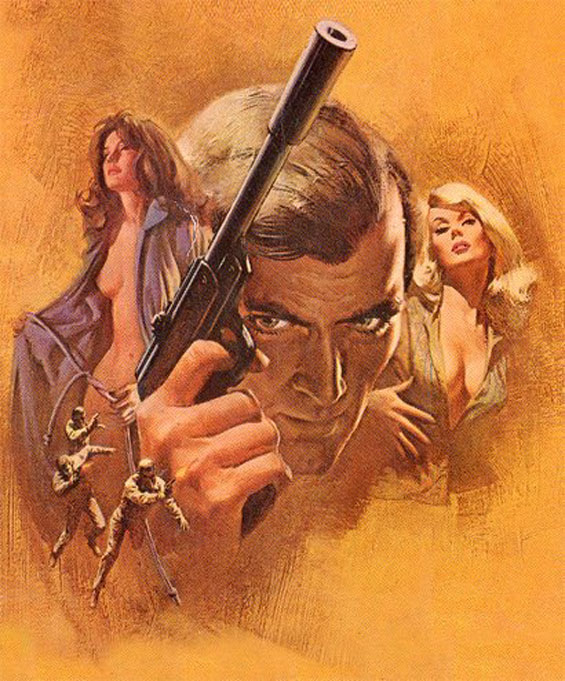
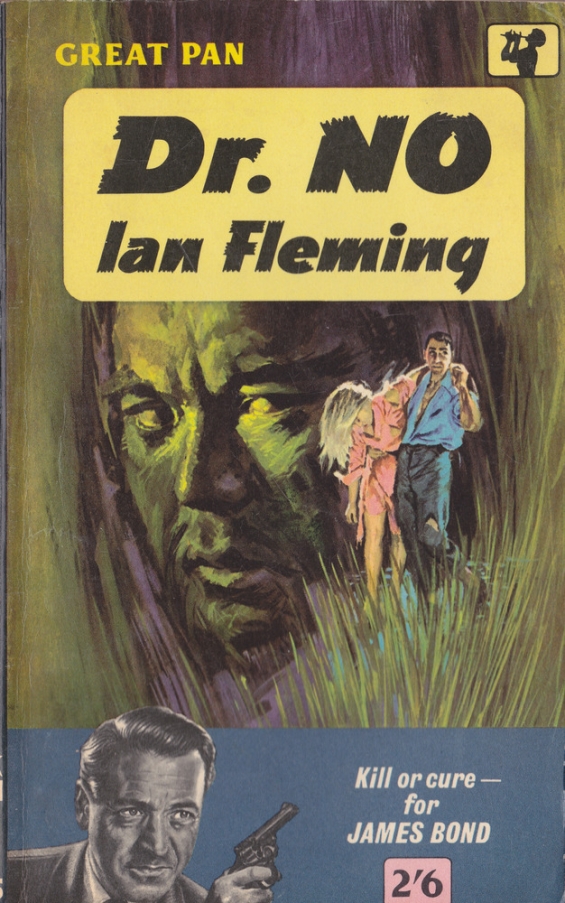
Doctor No art from a paperback edition

ca·lyp·so – /kəˈlɪpsoʊ/ – a musical style of West Indian origin, influenced by jazz, usually having topical, often improvised, lyrics.

I’ve only been the Caribbean once. But I still greatly feel its tropical magnetism. Ian Fleming did too. The first James Bond film, Doctor No was set in Jamaica. It’s where Ian Fleming lived and where he wrote Doctor No. I think he really brought the flavour of the Caribbean to the story. Throw in a mysterious Chinese, a yellow peril type, complete with fire-breathing dragon – and that’s entertainment folks!

When you think about it, Doctor No has just about everything a James Bond movie would later come to epitomize. First, there’s the exotic locale, Jamaica! Then there’s the titular villain with a body quirk, Doctor No has functional metal hands. And finally there’s the beautiful and headstrong woman, Honey Rider. Her first appearance, on screen, is perhaps the best known scene in any James Bond movie. As we first meet this enterprising shell collector she’s singing a song to herself on the beach. It’s a calypso tune that goes … “Underneath the mango tree me honey and me…” |MP3|

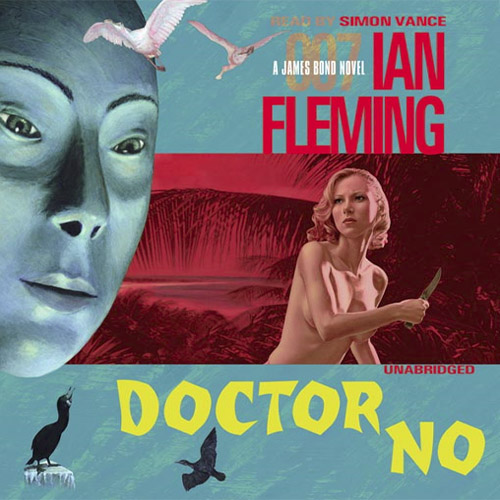
Now while that’s a great scene, the original novel ain’t no slouch either. Check out the unabridged reading by Simon Vance…

BLACKSTONE AUDIO - Doctor No by Ian FlemingDr. No
By Ian Fleming; Read by Simon Vance
7 CDs or 1 MP3-CD – Approx. 7 Hours 13 Minutes [UNABRIDGED]
Publisher: Blackstone Audio
Published: 2001
ISBN: 9781433258572 (cd), 9780786190720 (mp3-cd)
Sample |MP3|
M called this case a soft option. Bond can’t quite agree. The tropical island is luxurious, the seductive Honey Rider is beautiful and willing. But they are both part of the empire of Dr. No. The doctor is a worthy adversary, with a mind as hard and cold as his solid steel hands. Dr. No’s obsession is power. His only gifts are strictly pain-shaped.

In the novel, “Honeychile Rider” is described as “Botticelli’s Venus as seen from behind.” The movie has her in a bikini, in the novel she’s nude, except for a belt. In the movie she’s singing “Underneath The Mango Tree,” in the novel she’s whistling “Marianne.” Fleming describes “Marianne” as “a plaintive little Calypso that has now been cleaned up and made famous outside Jamaica.”

And it’s “Marianne” that’s used in the most recent incarnation of the Doctor No story, the BBC audio dramatization! And, in case you were wondering, it returns Honeychile to the nude.

I really like the movie, and the novel is definitely up there, but for me, now that I’ve heard it, the 2008 BBC audio dramatization of Doctor No is now my preferred version. It has that, sense of place, that a film gives, it plays up the mystery element, (which the movie downplays) and compresses the narrative with a “show, don’t tell” way that good audio drama really excels at.

I got a copy from RadioArchive.cc. The uploader there describes the audio dramatization like this:

Ian Fleming was never satisfied by the movie world’s take on James Bond. This dramatisation by Hugh Whitemore would meet with his approval as it is so faithful to the original novel. Bond, played here by Toby Stephens, is a wistful, vulnerable man as much as he is a fabulously fit and sexy hero. We hear him throwing up with fear after being crawled upon by a giant killer centipede, for example, which would never have done for Sean Connery. But both script and performances are true to Fleming’s vision of Bond.

And of course once you start looking into the actors biographies you start seeing all sorts of fascinating connections. Lucy Fleming, Ian Fleming’s neice plays a role. Toby Stephens has been in a Bond film and John Standing, who plays “M”, came from the family that owned Bletchley Park (the ultimate in espionage HQs if there ever was one)!

Now read a couple more of the listener reviews:

“Were this a movie, David Suchet [playing Dr. No] could have seriously expected an Oscar nomination, best Bond villain in any medium ever. Fantastic production all in all.”

“A splendid, sharp, slick adaptation, very faithful to Fleming’s writing. Makes you wonder why BBC hasn’t tackled more of these. And Toby Stephens is terrific as Bond.”

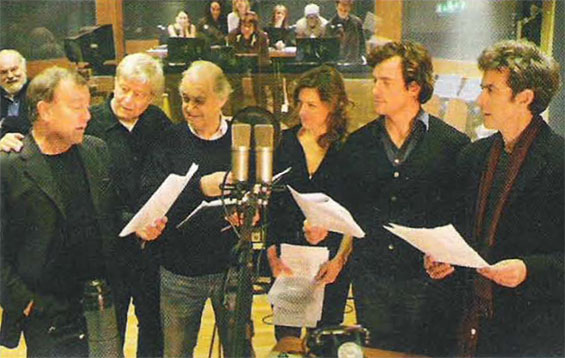
BBC Radio 4: Doctor No RADIO DRAMA - From left to right Nicky Henson, Martin Jarvis, John Standing, Janie Dee, Toby Stephens and Peter Capaldi

BBC Radio 4Dr. No
Based on the novel by Ian Fleming; Adapted by Hugh Whitemore; Performed by a full cast
Broadcast – Approx. 90 Minutes [RADIO DRAMA]
Broadcaster: BBC Radio 4 – The Saturday Play
Broadcast: May 24, 2008
Provider: RadioArchive.cc
Bond is sent to investigate a strange disappearance on the island of Jamaica, and discovers that the heart of the mystery lies with a sinister recluse known as ‘Dr No’.

Cast:
‘M’ …… John Standing
Moneypenny …… Janie Dee
James Bond ……Toby Stephens
The Armourer …… Peter Capaldi
Chief of Staff …… Nicky Henson
Airport Announcer/Receptionist/Inika …… Leigh Wright
Airport Official/Pus-Feller/Henchman …… Kobna Holdbrook-Smith
Quarrel …… Clarke Peters
Miss Chung/ Sister Lily …… Kosha Engler
Pleydell Smith …… Samuel West
Miss Taro/Telephonist/ Sister May/Tennis girl …… Jordanna Tin
Librarian …… Lucy Fleming
Honey Rider …… Lisa Dillon
Guard/Henchman/Crane Driver …… Jon David Yu
Dr No …… David Suchet
Acting Governor of Jamaica …… Simon Williams
Voice of Ian Fleming …… Martin Jarvis

Crew:
Music by Mark Holden and Samuel Barbour
Producer Rosalind Ayres
Director Martin Jarvis

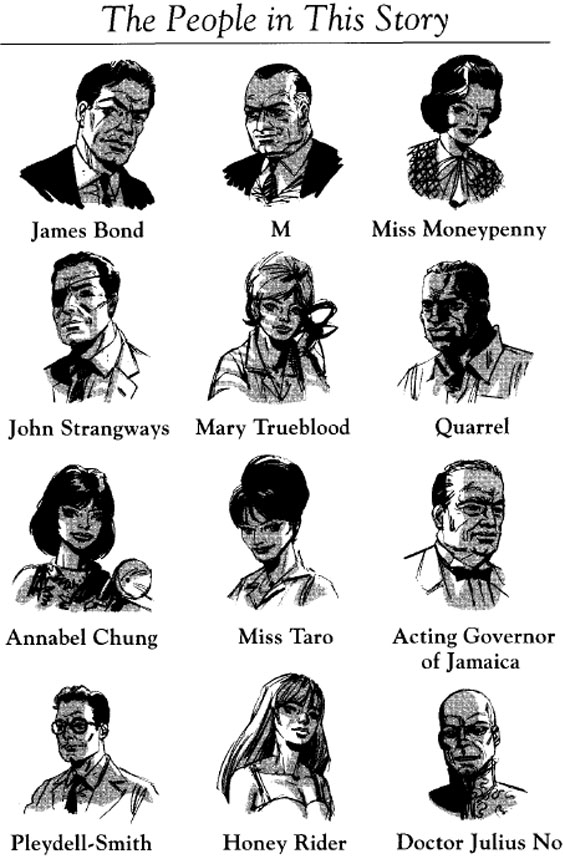
DOCTOR NO - The People In This Story - From the Macmillian Readers Edition

PAN - Doctor No by Ian Fleming

[via Dictionary.com, BondMovies.com, Illustrated007 and Audible.com]
Posted by Jesse Willis

Review of IT by Stephen King

SFFaudio Review

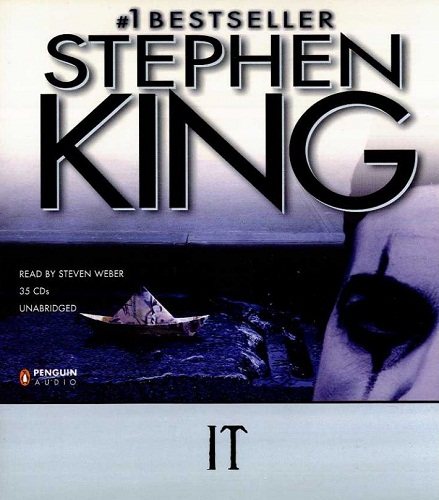
Horror Audiobook - IT by Stephen KingIT
By Stephen King; Read by Steven Weber
45 hours – [UNABRIDGED]
Publisher: Penguin Audio
Published: 2010
Themes: / Horror / Childhood / Adulthood / Monsters /

You don’t have to look back to see those children; part of your mind will see them forever, live with them forever, love with them forever. They are not necessarily the best part of you, but they were once the repository of all you could become.
—Stephen King, IT

What quality separates an adult from a child? Is it responsibility in the former and unbridled freedom in the latter? Do adults possess a higher order of thinking? Or, to take a cynical view, are adults merely physically larger (perhaps they/we never really do grow up)?

I happen to think there is a difference, though it’s hard to say precisely what. You could describe adulthood as a phase through which we all must pass, else we remain stunted and undeveloped, looking backward instead of forward, unable to transform into the mature beings that the hard world requires. Indefinable and amorphous, you may as well call this period of transition it. Stephen King did, and in 1985 he wrote a massive book by the same name about this very subject.

As is King’s forte, IT is also a horror story, and a terrifying one at that. The villain of IT is a creature that lurks in the sewers of Derry, Maine, one that takes the shape of our worst fears. IT’s favorite shape is a painted clown known as Pennywise, friendly at first glance but whose greasepaint smile reveals a double-row of Gillette razor teeth. Pennywise can also take the form of a werewolf, the Creature from the Black Lagoon, Frankenstein, and more. Whatever a particular child finds most terrifying, Pennywise can take its shape.

Pennywise has been preyed on the children of Derry for untold generations, emerging from a deep slumber in the sewers every 27 years to feed. After a year of gruesome killings (written up in the press as mysterious child disappearances, or frequently blamed on other sources), the cycles end with a culminating event, typically an awful orgy of destruction, after which the creature resumes its hibernation.

But Pennywise—aka., IT—always comes back. Derry is perennially under its pall and seems to accept the darkness as “just the way things are” and the horrors continue in cyclical fashion. But then comes the summer of 1958. A group of 10 and 11-year-old children called the Loser’s Club, led by a stuttering, charismatic child known as Bill Denbrough, unite to battle Pennywise. All have had close brushes with the monster. Scarred by their experiences but united in purpose (Bill’s six year old brother Georgie is dragged into the sewer and killed in a gruesome scene at the beginning of the novel, and Bill vows revenge), they travel into Derry’s byzantine sewer systems to put an end to the monster. Following an epic confrontation in the creature’s den the children vow to return to Derry should Pennywise/IT ever return.

One of the club, Mike Hanlon, remains behind in the ensuring decades to watch and wait. When Pennywise does re-emerge 27 years later the children of the Loser’s Club are now adults in their late 30s. Some higher power has mercifully allowed them to forget the terrible events of their childhood and move on with their lives. But now they have to fight the terrible evil once more and growing up has diminished them in some way. This time around they find themselves less equipped to fight.

IT is a great story full of memorable events, places, and characters. King imbues Derry with its own personality, and the town feels like a member of the cast. King skillfully weaves in events from Derry’s awful past, including past murder sprees and the culminating bloodbaths that sent IT back into the sewers, including a horrific nightclub fire (The Black Spot) and the explosion of the Kitchener Ironworks.

But in the end, what I like most about IT, and what separates the book from much of the rest of King’s oeuvre, is its thoughtful exploration of that amorphous crossing of the bar from youth to maturity. To get where you want to go in life you have to grow up, King says, but it’s not a simple process. The transition from childhood to adulthood is a complex and bittersweet, its benefits equivocal. Adulthood brings with it at least some measure of financial, parental, and geographic freedom. We can leave those hometowns that are so frequently a source of shame and failure and hidden darkness. But in so doing we lose a lot, too—our dreams, our innocence, our closest friends, and sometimes even our faith in a higher power. And the only way to defeat Pennywise—that monstrous, childhood IT—is through faith.

King has been accused by his critics of being shallow, all style and no substance (he did himself no favors by once calling himself “the literary equivalent of a Big Mac and Fries”). But I’ve found that his best material has more depth than meets than eye. IT is not just about battling monsters. Or rather it is about that, but the monsters are also the real, adult fears of loneliness, guilt, and dependency, of growing up, of confronting the monsters of one’s past and trying to move on. We are all incomplete until we face our past and determine who we are, what we stand for, and how we want to live our lives. This personal struggle, as much as visceral, horrific battles with Pennywise, is what brings me back to IT again and again.

I will say that IT is not without its problems, including a sequence that remains controversial among King’s readers. Without spoiling the story, it involves a coming of age ritual in the sewers that is a bit off-putting and jarring, even though I do understand its purposes. Some of the characters feel a bit one-trick and allegorical (representative of concepts rather than three-dimensional human beings). Other readers have complained that IT’s big secret—Pennywise’s final reveal—a bit of a let-down after 1,000 pages of build up. King is unfortunately often guilty of unsatisfying endings to otherwise great novels, and IT arguably suffers from the same problem. I don’t necessarily agree, as I find the epilogue incredibly satisfying, but others have made this criticism.

But despite its flaws, IT is one of my favorite books by King. With a memorable monster, a nice cast of characters, and a compelling, decades-spanning storyline with an epic final showdown, IT is a horrific page turner with deeper literary ambitions that it mostly fulfills.

Posted by Brian Murphy

The SFFaudio Podcast #066 – TALK TO: Harlan Ellison

Podcast

The SFFaudio PodcastThe SFFaudio Podcast #066 – Scott talks to Harlan Ellison, in the vintage 2006 interview, about audiobooks and audio drama.

Talked about on today’s show:
SFWA, Harlan Ellison’s Grand Master of Science Fiction award, Ray Bradbury, Isaac Asimov, Alfred Bester, Repent Harlequin Said The Tick-Tock Man, A Boy And His Dog, Shatterday, Alternate World Recordings, Shelly Levinson, Roy Torgeson, The Prowler In The City A The Edge of the World, Yours Truly Jack The Ripper by Robert Bloch, Dangerous Visions, The Bloody Times Of Jack The Ripper, radio drama, Orson Welles, reading your own work aloud, Joseph Patrich, in the tradition of Geoffrey Chaucer, Ovid, Plato, auctorial performance, teaching English at universities, autodidact-ism, the Harlan Ellison Recording Collection, Caedmon, Harper Audio, The Ellison Audio Archipelago, Stefan Rudnicki, Dove Audio, A Sinner In The Hands Of An Angry God by Jonathan Edwards, Guglielmo Marconi, Voices From The Edge: I Have No Mouth But I Must Scream by Harlan Ellison |READ OUR REVIEW|, Audio Literature, Blackstone Audio, Deep Shag Recordings, On The Road With Harlan Ellison series, Jack Williamson, Robert A. Heinlein, performing an audiobook, reading for the blind, Scott Brick, the wonderful voice of Stefan Rudnicki, City Of Darkness by Ben Bova, A Wizard Of Earthsea by Ursula K. Le Guin |READ OUR REVIEW|, Ben Bova’s writing style, Mars by Ben Bova (read by Harlan Ellison), cryonics vs. cryogenics, fixing mistakes in other people’s books, the popularity of Science Fiction in radio’s heyday, Mysterious Traveler, Suspense, Lights Out, X-Minus One, Dimension X, I Love A Mystery, War Of The Worlds, 1950s “giant ant movies”, Galaxy Magazine, Radio Yesterday, Sea Legs by Frank Quattrocchi, the radio serials: Space Cadet, Superman, Flash Gordon, Buck Rogers, 2000X, the man Harlan Ellison won’t mention the name of (Yuri Rasovsky), Robin Williams, By His Bootstraps by Robert A. Heinlein, Richard Dreyfuss, NPR, the sense of belonging, The Green Hornet, The Hitchhiker’s Guide To The Galaxy (Tertiary Phase), Douglas Adams.

Posted by Jesse Willis

FREE LISTENS Review: The Lost World

Review

The Lost World
by Arthur Conan Doyle
Source: LibriVox (zipped mp3s)
Length: 8 hr, 22 min
Reader: Mark F. Smith

The book: Not to be confused with the Michael Crichton novel of the same name, Conan Doyle’s The Lost World is an unbelievable adventure, in both senses of “unbelievable”. Like Watson in Conan Doyle’s more famous Sherlock Holmes series, the narrator, Edward Malone, is a tag-along to the real main character of the book, the conceited and quarrelsome Professor Challenger. Malone, a newspaper reporter, accompanies Challenger on  an expedition to a plateau in the jungles of South America, where dinosaurs and other prehistoric beasts are rumored to live.

Although the premise for the book can now be seen as impossible, Challenger’s assertion of living dinosaurs is met with extreme skepticism by his colleagues in the novel, effectively removing the reader’s ability to criticize it. The story proceeds at a gallop, with new adventures happening every chapter. This book is fast and fun, making it a great light read for the summertime.

Rating: 8/10

The reader: You probably know by now that Mark F. Smith is one of LibriVox’s best readers. He’s done a wide range of books, and I can’t think of any of them that is bad. Smith’s dialog puts the listener into the story and his narration carries a bit of sarcasm at the right places, to help the listener see the wittiness in Conan Doyle’s writing. The recording, as always with Smith, is beautifully done.

Posted by Seth