Review of Daemon by Daniel Suarez

SFFaudio Review

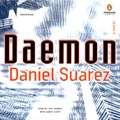
Daemon by Daniel SuarezDaemon
By Daniel Suarez; Read by  Jeff Gurner
Audible Download – approx. 16 hours [UNABRIDGED]
Publisher: Penguin Audiobooks
Published: 2009
Themes: / Science Fiction / Cyberpunk / Techno-Thriller / Virtual Reality / Online Gaming / Politics /

Daemon‘s success as a self-published novel that crossed over to attain mainstream success is a testament to its cultural relevance, especially among the technorati. Suarez, who moonlights (sunlights?) as a systems analyst, promoted the novel to the movers and shakers in the technology community, Its positive reception even among this tech-savvy elite suggests that Daemon has its finger on the pulse of technological developments and their implications for politics and culture.

Daemon opens with the death of game developer Matthew Sobol, acclaimed developer of multiplayer games such as first-person shooter Over the Rhine and RPG The Gate, which bears a strong resemblance to World Of Warcraft. Some successful entrepreneurs leave money to their kids when they die, others give it all away to charity. Not Sobol. His legacy is the book’s eponymous daemon, a background process which through distributed computing has spread itself across the net and continues to carry out the developer’s will through a series of intricate commands. The capabilities of this daemon, and Sobol’s talent as a developer of artificial intelligence, become apparent when the police raid Sobol’s mansion in Thousand Oaks, California, and find themselves outclassed by a network of elaborate automated booby-traps, including an almost-sentient Humvee.

The novel pans cinematically between several characters who, in one way or another, become embroiled in the daemon’s plot, which ultimately proves to be global in scale. Dramatis personae include police detectives, government agents, a gamer, a laid-off fashion reporter, a white-hat hacker, ad a convict. It’s not clear from the outset whether these characters will become heroes or villains as the story progresses, and even when battle lines are more firmly drawn most of them still defy simple caricature, exhibiting complex motives and emotions.

The real show-stopper, of course, is the daemon itself, who possesses a high degree of intelligence and resourcefulness despite residing in lines of code. The novel’s conceit still demands the willing suspension of disbelief, but the concept and the technical specifics are so finely conceived and executed that the reader is left with a small but nagging suspicion that somewhere, sometime in a future that may be all too near, Daemon could become a reality. Suarez achieves this feat by investigating the wider political, economic, and social implications of a self-aware autonomous computer system.

The living Matthew Sobol embedded many elements of his daemon into his multiplayer games, and several characters venture into these online worlds in search of clues. These scenes are among the strongest in the book, and they carry favorable resonances with both the Metaverse in Neal Stephenson’s Snow Crash and the simulator in Orson Scott Card’s Ender’s Game. Like the virtual reality elements in these novels, the online gaming sequences in Daemon succeed because they maintain a strong causal relationship to events in the “real” world.

The action battle sequences in Daemon are high-octane, and like all good action sequences they manage to incorporate the book’s themes rather than standing as mere set pieces. For the most part, the protagonists are fighting against computer-controlled contraptions. Nevertheless, I felt that these ultimately visceral and superficial scenes occupy too much space in the novel, and detract from the book’s otherwise deep and intellectually stimulating themes. Paramount Pictures has optioned the movie rights for Daemon, and I shudder to think that the cultural significance of this novel may be boiled away, leaving only two hours of car chases.

The pacing of Daemon also leaves something to be desired. Suarez has revealed that a sequel is in the works, and the book’s cliffhanger ending promises an exciting continuation to the story. Lots of loose ends also remain dangling free, mostly in the arc of character development. The novel’s ending was certainly climactic, but it somehow failed to provide satisfactory closure. As I’ve said in other reviews, even books in a multi-volume series need to retain a high level of internal cohesion.

Jef Gurner’s narration for Daemon is spot-on. His performance is varied enough that each character’s unique identity extends into the aural sphere. Through some tricks of distortion, Penguin Audio has turned the dialogue of the daemon itself into a performance worthy of classic cinematic computerized villains.

Fans of cyberpunk in particular should consider Daemon essential reading, but any science fiction fan looking for an intriguing and visionary techno-thriller should add this audiobook to their summer reading list. The novel’s fascinating themes make it worth slogging through some scenes of gratuitous violence and tugging in vein on a few loose plot threads. Daemon is an impressive debut novel by Daniel Suarez, hopefully presaging an illustrious writing career.

Posted by Seth Wilson

The Agony Column SF in SF Recordings

SFFaudio Online Audio

The Agony Column The Agony Column has a recording of the following SF in SF Readings and panels:

Peter Beagle  (“Oakland Dragon Blues”) |MP3|

Richard Lupoff  (“T-Shirts”) |MP3|

Panel Discussion Terry Bisson, Richard Lupoff, Peter Beagle |MP3|

You can subscribe to the feed at this URL:

http://bookotron.com/agony/indexes/tac_podcast.xml

Between The Covers Podcast – Memory Book: A Benny Cooperman Mystery

Aural Noir: Online Audio

CBC Radio One - Between  The Covers podcastThere’s always a ton of Canadian fiction airing on CBC Radio One’s terrific Between The Covers Podcast. Sadly too little of it is Science Fiction, Fantasy and Horror. The good news is they occasionally throw us another kind of bone in the form of a solid mystery story.

Do you know old cliche about the p.i. who get’s conked on the head at least once per investigation as a plot point? Ya, I knew you would. Well, in the newest book in the BTC feed that well worn chestnut finally faces reality: A blow to the head can cause more than a quick dip into a black velvet pillow -it can cause a brain injury!

When Benny Cooperman, an Ontario private detective, wakes up in the hospital, he has no idea how or why he got there. The real mystery then is who hit him and why? But solving the case aint going to be easy as the medical professionals inform him he’s got partial amnesia, memory loss and his ability to read (but not write). It seems he’s suffering from alexia sine agraphia. This novel was inspired by the same thing happening to Howard Engel (but from a stroke not a blow to the head). The paperbook of this novel includes an afterword by Oliver W. Sacks.

Between The Covers Audio Books - Memory Book: A Benny Cooperman Mystery by Howard EngelMemory Book: A Benny Cooperman Mystery
By Howard Engel; Read by Ron Halder and Donna White
3 CDs – 3.5 Hours [ABRIDGED]
Publisher: BTC Audiobooks
Published: October 6, 2006
ISBN: 0864924704

The first two episodes, read by a terrific pair of narrators, are already in the feed: Episode 1 |MP3| Episode 2 |MP3|. I suggest you subscribe now so as not to forget.

Podcast feed:

http://www.cbc.ca/podcasting/includes/betweenthecovers.xml

iTunes 1-Click |SUBSCRIBE|

Posted by Jesse Willis

P.S. Hey CBC! Don’t think we’ve forgotten about the J. Michael Straczynski radio drama series you’re still sitting on.

Review of Academ’s Fury by Jim Butcher

SFFaudio Review

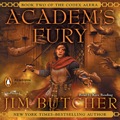
Academ's Fury by Jim ButcherAcadem’s Fury
By Jim Butcher; Read by Kate Reading
17 CDs – 21 Hours [UNABRIDGED]
Publisher: Penguin Audio
Published: 2008
ISBN:  0143143772
Themes: / Fantasy / High Fantasy / Elementals / Battle / Primitive Culture / Rome /

Having been a fan of Jim Butcher’s urban fantasy Dresden Files series for some time, as well as a consummate reader of traditional fantasy, I recently decided to delve into the author’s Codex Alera series. I found the series opener, Furies of Calderon, to be a solid entry for Butcher into the epic fantasy genre, but my recent review also pointed to some room for improvement. After devouring its sequel, Academ’s Fury, I’m happy to report that Butcher has found his voice and set the tone for the series.

A brief refresher: the Codex Alera series takes place in the land of, you guessed it, Alera, whose inhabitants possess the ability to control elemental powers called furies. The lone exception is the series’s prime protagonist, Tavi, who has come of age without developing any apparent skill in furycrafting.

Academ’s Fury skips ahead two years from the conclusion of the previous book, and finds Tavi studying at the Academy of Alera Imperia, the land’s capitol city. The novel thus adopts many tropes of the “school novel”: bullies, arrogant teachers, and mischievous rule-breaking. Tavi also gains a window into the realm’s politics by serving as page to First Lord Gaius Sextus. Further raising the stakes, an isolated adventure in Furies of Calderon turns out to have disastrous implications both for the valley of Calderon and for the imperial city itself. The result is a novel that weaves these plot treads together into a rich, satisfying tapestry.

Like its predecessor, Academ’s Fury follows the viewpoints of several characters, although Tavi is clearly the linchpin. The Cursor Amara, siblings Bernard and Isana, and the treacherous Fidelias all reprise their roles, and all these develop in significant and sometimes surprising ways. The Marat wolf tribe, which played a pivotal part in Furies of Calderon, also returns under the capable leadership of Chieftain Doroga. The chieftain’s spirited daughter Kitai also figures heavily in the story. Several new characters join these veterans in the tale’s events. The only notable standout from among them, for me, is Antillar Maximus, Tavi’s fiercely loyal friend at the Academy.

More importantly, Academ’s Fury expands the scope of the world of Codex Alera by introducing two new races: the wolf-like canim and the insectile Vord. Both races possess serious martial prowess and present a serious threat to Alera. Unlike the Canim, however, the cold, calculating Vord cannot be reasoned with. By means of worm-like parasitic scouts, the Vord take possession of humans, preserving their physical stature and mental abilities but blotting out their souls. This dynamic makes for a few horrific scenes of which Stephen King might be proud, and the Vord warriors and queens ooze vileness and evil both literally and metaphorically. The battle scenes in Academ’s Fury resemble those of R. A. Salvatore or early Terry Brooks in their invention and frenetic pace.

Jim Butcher utilizes the novel’s setting in the Academy at Alera Imperia to disseminate information about the world without resorting to mere “info-dump” modalities. Through Tavi’s readings, dialogues, and examinations, the book takes a deeper look into the history of Alera, including its tenuous connections to the Rome of our world. We also get a brief glimpse under the hood at the mechanics of furycrafting.

The novel’s greater breadth of scope and its focus on Romanesque political intrigues address the major complaints I had with the first book, but Academ’s Fury still isn’t perfect. For one thing, the pacing flags somewhat near the end. A bigger defect, to my mind, has to do with the character development. Most of the characters do develop in interesting and believable ways, but a few of them come off as flat. Sadly, this is true in some ways of Tavi, who always seems to get the better of his rage, his fear, or his other negative traits. He’s a fascinating character, but his lack of internal conflict and teenage angst diminishes his believability. Similarly Doroga, the Marat chieftain, fits too perfectly the archetype of the “noble savage”. He’s a lovable character, but he exists in a hundred other variations in a hundred other fantasy books.

Kate Reading’s performance once again brings the Codex Alera series to life. Each character receives full articulation, so that even without dialogue tags it’s clear who’s doing the talking. The Latin scholar in me occasionally winces at her non-classical pronunciation of certain words (she renders princeps “prin-SEPS” instead of “prin-KEPS”), most listeners probably won’t take issue with  such minor details.

Minor qualms aside, Academ’s Fury improves on the first novel of the Codex Alera and continues to promise great things for the series.

Posted by Seth Wilson

Yog Radio: Interview with Charles Stross

SFFaudio Online Audio

Yog Radio PodcastPaul Maclean (aka Paul Of Cthulhu) kindly wrote in to say that he’s got An interview With Charles Stross up and ready for listening over on Yog-Sothoth.com. It was recorded at a EasterCon 2009. Here’s the |MP3| or you can subscribe to the Yog-Sothoth podcast feed:

http://www.yog-sothoth.com/podcast.xml

Posted by Jesse Willis