
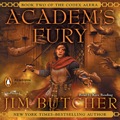
Review of Academ’s Fury by Jim Butcher

SFFaudio Review

Academ's Fury by Jim ButcherAcadem’s Fury
By Jim Butcher; Read by Kate Reading
17 CDs – 21 Hours [UNABRIDGED]
Publisher: Penguin Audio
Published: 2008
ISBN:  0143143772
Themes: / Fantasy / High Fantasy / Elementals / Battle / Primitive Culture / Rome /

Having been a fan of Jim Butcher’s urban fantasy Dresden Files series for some time, as well as a consummate reader of traditional fantasy, I recently decided to delve into the author’s Codex Alera series. I found the series opener, Furies of Calderon, to be a solid entry for Butcher into the epic fantasy genre, but my recent review also pointed to some room for improvement. After devouring its sequel, Academ’s Fury, I’m happy to report that Butcher has found his voice and set the tone for the series.

A brief refresher: the Codex Alera series takes place in the land of, you guessed it, Alera, whose inhabitants possess the ability to control elemental powers called furies. The lone exception is the series’s prime protagonist, Tavi, who has come of age without developing any apparent skill in furycrafting.

Academ’s Fury skips ahead two years from the conclusion of the previous book, and finds Tavi studying at the Academy of Alera Imperia, the land’s capitol city. The novel thus adopts many tropes of the “school novel”: bullies, arrogant teachers, and mischievous rule-breaking. Tavi also gains a window into the realm’s politics by serving as page to First Lord Gaius Sextus. Further raising the stakes, an isolated adventure in Furies of Calderon turns out to have disastrous implications both for the valley of Calderon and for the imperial city itself. The result is a novel that weaves these plot treads together into a rich, satisfying tapestry.

Like its predecessor, Academ’s Fury follows the viewpoints of several characters, although Tavi is clearly the linchpin. The Cursor Amara, siblings Bernard and Isana, and the treacherous Fidelias all reprise their roles, and all these develop in significant and sometimes surprising ways. The Marat wolf tribe, which played a pivotal part in Furies of Calderon, also returns under the capable leadership of Chieftain Doroga. The chieftain’s spirited daughter Kitai also figures heavily in the story. Several new characters join these veterans in the tale’s events. The only notable standout from among them, for me, is Antillar Maximus, Tavi’s fiercely loyal friend at the Academy.

More importantly, Academ’s Fury expands the scope of the world of Codex Alera by introducing two new races: the wolf-like canim and the insectile Vord. Both races possess serious martial prowess and present a serious threat to Alera. Unlike the Canim, however, the cold, calculating Vord cannot be reasoned with. By means of worm-like parasitic scouts, the Vord take possession of humans, preserving their physical stature and mental abilities but blotting out their souls. This dynamic makes for a few horrific scenes of which Stephen King might be proud, and the Vord warriors and queens ooze vileness and evil both literally and metaphorically. The battle scenes in Academ’s Fury resemble those of R. A. Salvatore or early Terry Brooks in their invention and frenetic pace.

Jim Butcher utilizes the novel’s setting in the Academy at Alera Imperia to disseminate information about the world without resorting to mere “info-dump” modalities. Through Tavi’s readings, dialogues, and examinations, the book takes a deeper look into the history of Alera, including its tenuous connections to the Rome of our world. We also get a brief glimpse under the hood at the mechanics of furycrafting.

The novel’s greater breadth of scope and its focus on Romanesque political intrigues address the major complaints I had with the first book, but Academ’s Fury still isn’t perfect. For one thing, the pacing flags somewhat near the end. A bigger defect, to my mind, has to do with the character development. Most of the characters do develop in interesting and believable ways, but a few of them come off as flat. Sadly, this is true in some ways of Tavi, who always seems to get the better of his rage, his fear, or his other negative traits. He’s a fascinating character, but his lack of internal conflict and teenage angst diminishes his believability. Similarly Doroga, the Marat chieftain, fits too perfectly the archetype of the “noble savage”. He’s a lovable character, but he exists in a hundred other variations in a hundred other fantasy books.

Kate Reading’s performance once again brings the Codex Alera series to life. Each character receives full articulation, so that even without dialogue tags it’s clear who’s doing the talking. The Latin scholar in me occasionally winces at her non-classical pronunciation of certain words (she renders princeps “prin-SEPS” instead of “prin-KEPS”), most listeners probably won’t take issue with  such minor details.

Minor qualms aside, Academ’s Fury improves on the first novel of the Codex Alera and continues to promise great things for the series.

Posted by Seth Wilson

Yog Radio: Interview with Charles Stross

SFFaudio Online Audio

Yog Radio PodcastPaul Maclean (aka Paul Of Cthulhu) kindly wrote in to say that he’s got An interview With Charles Stross up and ready for listening over on Yog-Sothoth.com. It was recorded at a EasterCon 2009. Here’s the |MP3| or you can subscribe to the Yog-Sothoth podcast feed:

http://www.yog-sothoth.com/podcast.xml

Posted by Jesse Willis

ADDED: an AUTHOR PAGE for ROBERT J. SAWYER

SFFaudio Online Audio

Robert J. SawyerROBERT J. SAWYER now has his own entry in our AUTHOR PAGES section. On it you’ll find a listing of all the Robert J. Sawyer audiobooks, MP3s of interviews and lectures he’s given, as well as a podcast short story. We’ve also added a HuffDuffer podcast feed for him too!

Podcast Feed: http://huffduffer.com/jessewillis/tags/robert_j._sawyer/rss

iTunes 1-Click |SUBSCRIBE|

Posted by Jesse Willis

Review of Slaughterhouse-Five by Kurt Vonnegut

SFFaudio Review

Slaughterhouse Five by Kurt VonnegutSFFaudio EssentialSlaughterhouse-Five
By Kurt Vonnegut; Read by Ethan Hawke
5 CDs – 6 hours – [UNABRIDGED]
Publisher: Blackstone Audio
Published: 2009
ISBN: 9781433269691
Themes: / Science Fiction (or maybe not) / World War II / Time Travel / War / Aliens / Mind /

And Lot’s wife, of course, was told not to look back where all those people and their homes had been. But she did look back, and I love her for that, because it was so human.

So she was turned to a pillar of salt. So it goes.

—Kurt Vonnegut, Slaughterhouse Five

During World War II, author Kurt Vonnegut was taken prisoner by the Germans and held captive in the city of Dresden, which was later reduced to flaming rubble during a harrowing fire-bombing by American forces. According to Vonnegut, the city was a gorgeous center of art, architecture, and fine civilian life; its value as a military target was negligible. “What I’ve said about the firebombing of Dresden is that not one person got out of a concentration camp a microsecond earlier, not one German deserted his defensive position a microsecond earlier,” Vonnegut said.

Somewhere between 25,000 and 120,000 civilians (the upper figure is an early estimate, which has since been revised downward to 25,000-40,000) were killed in the inferno of incendiary and high explosive bombs. As such, Dresden remains a controversial, dark chapter of America’s involvement in the war.

Slaughterhouse-Five is Vonnegut’s look back on this dreadful event. It’s not a traditional biography, but a modified account of his own experiences as seen through the eyes of Billy Pilgrim, a tall, awkward, disconnected dreamer who is drafted into the army and thrust into combat. Pilgrim is a pathetic soul with the appearance of a “filthy flamingo,” involved in tragic events beyond his control.

Captured during the Battle of the Bulge, Pilgrim and 100 other soldiers are shipped to Dresden to serve as prison-labor. At night they sleep in a storage-cave beneath a slaughterhouse amidst the butchered carcasses of animals, and it’s this arrangement that allows them to survive the attack. After the firebombing, they emerge the next morning to find the once-beautiful Dresden so utterly destroyed that it resembles the surface of the moon.

A part of me feels guilty for reviewing Kurt Vonnegut’s Slaughterhouse-Five on a science fiction/fantasy Web site. The connections of this classic anti-war novel to the science fiction genre are tenuous, but it attains this designation (in some circles) due to the presence of the Tralfamadorians, a race of aliens that capture Pilgrim and bring him back to their planet for examination. During his months on Tralfamadore, Pilgrim is placed in a sort of zoo, his body and mind laid bare to the curious aliens.

The Tralfamadorians may be simply the imagination of an unwell, traumatized mind. Pilgrim is emotionally unbalanced, suffers a head injury after the war, and reads voraciously of the novels of science fiction writer Kilgore Trout, one of whose novels concerns an alien abduction that sounds suspiciously like Pilgrim’s own experiences on Trafalmadore. But the Tralfamadorians—real or not—allow Vonnegut to explore the concept of time and our place in it, which is the larger theme of the novel. The Tralfamadorians can see in four dimensions and have no concept of time; life just is, and human existence is a series of events and happenings with no beginnings and ends. Events simply occur; wars are fought, we are powerless to stop them and it’s ridiculous to think we can. Free will is a farce.

Pilgrim’s time among the Tralfamadorians allows him to experience his life in this fourth dimension, moving his mind back and forth to the past and future, seemingly at will. He is able to see his own death, and relive events from his childhood, his marriage, and his career as an optometrist. But Pilgrim’s wandering, time-traveling mind returns again and again to the terrible events of Dresden, an experience so powerful that his mind is unable to make sense of it. It just is, and all he can do with the rest of life is to try and look upon the good times in his life, the moments of joy, and not linger too long over the blackened, shrunken bodies, or a fellow American and friend executed for salvaging a teapot from the ruins.

Actor Ethan Hawke (of Dead Poets Society and Hamlet fame) serves as the narrator and does a nice job reading with an understated, dispassionate voice that perfectly fits the tone of the novel. This Blackstone Audio production also includes an unexpected and enlightening 10-minute interview with Vonnegut on the final disc. Here Vonnegut reveals that Pilgrim’s character was based on a real person, Edward Crone, an American who died in Dresden. “He just didn’t understand the war at all, what was going on, and of course there was nothing to understand—he was right,” Vonnegut says.

Posted by Brian Murphy

StarShipSofa: Aural Delights No. 82 Michael Bishop

SFFaudio Online Audio

Aural Delights No 82 Michael Bishop

Editorial: Michael Bishop by Tony C. Smith

Poetry: Jamie’s Hair by Michael Bishop 02:00

Intro to Main Fiction: Michael Bishop

Main Fiction: Vinegar Peace by Michael Bishop 07:41

Sofa Art Cover: Ed Bellisimo

Narrators: Diane Severson, Dale Manley

Published in the July 2008 issue of Asimov

StarShipSofa narrates Vinegar Peace, an SF story writtten by Michael Bishop for his son Jamie Bishop who died two years ago at the Virginia Tech shooting.

Michael Bishop says:

I wrote “Vinegar Peace” — in August of 2007 — because I had to. Our 35-year-old son, Jamie, died on the morning of April 16, 2007, as one of thirty-two victims of a disturbed shooter on the campus of Virginia Tech in Blacksburg, Virginia.

Jamie, an accomplished digital artist who did lovely covers for four or five of my books, was holding forth in Room 2007 of Norris Hall in his German class more than two hours after his eventual murderer had slain two students in a dormitory on another part of campus. The administration failed to issue a warning — a warning that might well have saved many lives — in a timely fashion. However, some of its members secured their own offices and notified their own family members of this initial event; and so the worst school shooting in the history of the United States claimed our son, four other faculty members (including a man, Dr Librescu, who had survived the Holocaust and who held a table against his classroom door until all own students could escape), four of Jamie’s students, and twenty-one other young people in Norris Hall, not to mention the first two victims in West Ambler-Johnston dorm. Another twenty-eight students were wounded by bullets or injured leaping from upper-story windows. Some of these young people will live with their injuries the rest of their lives.

All of the administrators, with the exception of a woman who later died of a stroke or a heart attack (a death that my wife and I can’t help but attribute partially to the stress of living with the mistakes of the President and the other Policy Group members), remain in their positions. So much for accountability, and so much for justice.

In any case, “Vinegar Peace” grew from this disaster and from a grief that I can’t imagine ever laying totally aside. Jeri and I mourn Jamie’s loss every day in some private way, and we think continually of all the other parents and loved ones of the slain and injured who will carry a similar burden with them until they die. We think, too, of the parents and loved ones of the dead and wounded from the United States’s optional war in Iraq, who long for their dead and who pray for their injured with an intensity not a whit different from our own. How ironic that our son died on American soil. How sad the wasted potential and disfigured lives resulting from violence everywhere. And forgive me the inadequacy of these remarks. Clearly, I wrote a story because I could not address either my outrage or my grief in any other way.

-Mike Bishop

StarShipSofa is very honoured and humbled to be allowed to bring this story to a wider audience. I know I speak for the SF community when I say our hearts and prayers go out to Mike and Jeri and all the families who have to live with this grief every day.

Posted by Tony C. Smith

Broken Sea: Escape From New York

SFFaudio Online Audio

Broken Sea Audio Productions - Escape From New YorkBLACK SCREEN, RISING MUSIC…

In the year 1988 the crime rate in the United States rises 400%. The once great city of New York becomes the one maximum security prison for the entire country. A fifty foot containment wall is erected along the New Jersey shoreline, across the Harlem river, and down along the Brooklyn shorline. It completely surrounds Manhattan Island. All bridges and waterways are mined. The United States Police Force, like an army, is encamped around the island. The prison’s name: New York Maximum Security Penitentiary, Manhattan Island. There are no guards inside the prison, only prisoners, and the worlds they have made. The year now… 1997.

Stevie Farnaby, (aka the voice of Conan from Queen Of The Black Coast) writes in to boast of his new project with Queen Of The Black Coast scripter Bill Hollweg. It’s a fan audio drama version of Escape From New York. Sez Stevie:

“This was a total joy of a series to produce. Bill Hollweg did an absolutely amazing job adapting the scripts, and there’s quite simply some of the finest VAs [voice actors] in the business on the show, giving some of their finest performances. As for the Production values, I went into sonic overdrive on this one, and created the audio equivalent of a thermo nuclear Strike ! – LOL I genuinely believe this to be one of the most groundbreaking and innovative shows around. The word, ‘explosive’ seems to fall woefully short of describing it.”

This isn’t exactly a re-imagining, more of a tribute to the original, but one that fills in more details. My hope is that in a later episode we’ll see the head of the Statue Of Liberty lying on a Manhattan Street (like in the poster).

Episode one is online now check it out |MP3| or subscribe…

Podcast feed:

http://brokensea.com/efny/feed/

iTunes 1-Click |SUBSCRIBE|

Posted by Jesse Willis