OSC’s Intergalactic Medicine Show – New Plan

SFFaudio News

A letter from the editor has been posted along with the latest issue of Orson Scott Card’s Intergalactic Medicine Show. Editor Edmund R. Schubert says that IGMS will be released bi-monthly (used to be quarterly), the number of stories in each issue will be reduced to five (used to be seven), and that, instead of writing a new story for each issue (which he was having trouble keeping up with), Orson Scott Card will record a story for each issue.

The audio story he records might be one of his own previously published stories; it might be a story by another author published in IGMS; or it might be something from a novel-in-progress.

The latest issue, which went live just yesterday, contains text and audio versions of “The Man in the Tree” by Orson Scott Card, a story from the upcoming novel The Lost Gate.

Posted by Scott D. Danielson

Review of January Dancer by Michael Flynn

SFFaudio Review

The January Dancer by Michael FlynnThe January Dancer
By Michael Flynn; Read by Stefan Rudnicki
1 MP3-CD or 9 CDs – Approx. 10.5 Hours [UNABRIDGED]
Publisher: Blackstone Audio
Published: 2008
ISBN: 9781433250996 (MP3-CD), 9781433250972 (CD)
Themes: / Science Fiction / Space Opera / Aliens / Space Flight /

Captain Amos January, and crew, are forced to look for ship repair materials on an unknown planet. There they discover an alien ship filled with fascinating artifacts, among them a shape-changing sculpture that becomes known as “The Dancer.” We learn of some of The Dancer’s attributes as known in ancient legends and confirmation is received as we watch the story unfold. It is sought by cabals, pirates, governments, and other powers who unleash different characters to acquire The Dancer. Not unexpectedly these characters are scoundrels, idealists, and romantics whose tracks intersect and form their own sort of dance as they maneuver to best one another. This tale is told to us as a story within a story as a Harper hears the tale, a bit at a time, from the Scarred Man. This is an interesting device as not only are we told the story but Flynn uses the framing story to give us his ideas about storytelling as an art.

It is a trend these days, or so it seems to me, for modern science fiction authors to attempt to write “space opera.” As an aficionado of that subgenre who has recently been browsing among the past masters of the art (in large part thanks to Librivox), my view is that the modern take tends to be drawn-out, unfocused, and sprawling by comparison. Sadly, although I also am an aficionado of Michael Flynn’s work, I believe he has fallen prey to the desire to expand the story past the demands of the genre. The original writers wrote snappy, bold, romantic adventures that did not worry overmuch about expostulation and got to the point. Flynn, on the other hand, gives a bewildering combination of too much philosophical conversation and not enough details about the characters’ lives. There is a plethora of characters as well, almost too many to track, and this often leaves the listener bewildered as to just who has suddenly popped up unexpectedly in a scene. As well, in the last couple of chapters the tone shifts unexpectedly, as if Flynn suddenly was told he had to finish up, and thus the novel swung into abrupt action and snapped out a strangely sparse finale. The revelations were not illogical or even unsatisfying. However, after dragging on and on in the middle of the book it was quite disconcerting to suddenly be flung headlong into the finish in the style of “a shot rang out and everyone fell dead.”

Stefan Rudnicki narrates with his usual expertise, adroitly affecting slight voice changes that communicate character when voicing dialogue. One wishes that the editors had added a slight aural indicator when there were scene changes. In a book of many characters who are flung from one exotic location to another at a second’s notice, it is very difficult to tell when there is a scene change immediately with nothing other than a slight pause between sections. I must also note, that my above complains about Flynn’s book overall may have been due to the fact that a complex book is necessarily more difficult to grasp when listening rather than reading as it was written. In this instance, the editors would have done well to help the listener all they could.

If you are a Michael Flynn fan, this book will not be a complete waste. I did enjoy it initially, but I simply wished it had been truly the space opera that it purported to be.

Note: should readers think that there are no modern writers capable of space opera that is worthy of comparison with those of older times, I refer you to the “Agent of Change” series by Sharon Lee and Steve Miller (Agent of Change, Conflict of Honors, Carpe Diem, Plan B, and I Dare) and Space Vulture by Gary K. Wolf and John J. Myers. None of these are in audiobook format that I know of but are well worth seeking out.

Posted by Julie D.

CBC Radio One’s Q talks RIP a copyright manifesto and WATCHMEN

SFFaudio Online Audio

CBC Radio One - Q: The PodcastThis morning I got a phone call.

My mom: “Jesse turn on the radio.”

Jesse: “I’ll get the podcast.”

And here it is Q: The Podcast for Tuesday, March 3rd, 2009.

Do newspapers need public funding?* ‘RIP: A Remix Manifesto‘, Canadian doc about mash-up culture* Jesse Wente on comic-inspired movies* Watchmen illustrator Dave Gibbons.

Download |MP3| or subscribe:

http://www.cbc.ca/podcasting/includes/qpodcast.xml

Here’s the trailer for RIP…

On Watchmen: Everybody’s talking to artist Dave Gibbons (Q included) because author Alan Moore isn’t involved with the WATCHMEN movie. Moore has sworn off a lot of big corporations in fact. In the case of one deposition he’d had to give with regards to his dealings with the big corps he said – he would have been better treated had he “molested and murdered a busload of retarded children after giving them heroin.”

Which leads me to point out that the latest WATCHMEN merchandise, a DVD that turns the DC Moore/Gibbons graphic novel into a quasi-audiobook/animated movie. The credits for it do not include Alan Moore.

Posted by Jesse Willis

P.S. CBC, please FREE Apocalypse Al!

The Agony Column Interviews Dan Simmons

SFFaudio Online Audio

The Agony Column The Agony Column interviews Dan Simmons (Drood) |Part 1| |Part 2|

You can subscribe to the feed at this URL:

http://bookotron.com/agony/indexes/tac_podcast.xml

Posted by Charles Tan

New Releases – Elantris by Brandon Sanderson

New Releases

Elantris by Brandon SandersonElantris, Part 1
By Brandon Sanderson; Performed by a full cast
6 CDs or 1 MP3-CD – 6 hours – [AUDIO DRAMA]
Publisher: Graphic Audio
Published: 2009
ISBN: 9781599505558

This is wonderful news. Graphic Audio has been publishing a bunch of material as full cast dramatic reading – the ones that interested me most were the superhero stuff, but now they are publishing Brandon Sanderson’s Elantris, an epic fantasy novel. This is the first of three parts.

The city of the gods. Elantris once stood as the symbol of all that is beautiful. A sprawling metropolis of unrivaled grandeur, it was a symbol of power and strength, built to be as imposing as it was magnificent.

The only thing more glorious than the city itself was its inhabitants, Godlike beings, with silvery skin and hair of the purest, flowing white. Able to create powerful magics with a mere wave of their hands, the Elantrians were able to heal mortal wounds and create any object they desired. To be an Elantrian was to be without sickness, without pain and without want.

And anyone could become a god. Through a process known as the “Shaod”, a normal person could go to bed one night, and awake the next morning to throw away the shackles of mortality and become a being of incomparable power and grace. With Elantris as their beacon, the light inside all humanity was allowed to shine, elevating it to new heights.
 
CLICK HERE for all of Graphic Audio’s new releases.
Posted by Scott D. Danielson

Review of Elric of Menibone by Michael Moorcock

SFFaudio Review

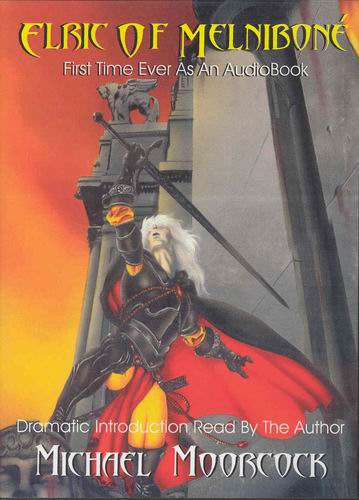
Science Fiction Audiobooks - Elric of Melnibone by Michael MoorcockElric of Melniboné
By Michael Moorcock, Read By Jeffrey West and Michael Moorcock
5 CD’s – 5.5 Hour [UNABRIDGED]
Publisher: Audio Realms
Published: 2003
ISBN: 097315960X
Themes: / Fantasy / Epic Fantasy / Magic / War / Gods /

It’s a testament to the imaginative might of author Michael Moorcock that his most famous creation, Elric of Melnibone, has become a permanent and prominent thread in the fabric of fantasy. Though he may not be quite the same household name as Conan, what fantasy fan hasn’t heard of the albino warrior/sorcerer, he of the tortured soul and wielder of the black demon sword Stormbringer.

The character of Elric first appeared in print in 1961 in a short story entitled “The Dreaming City.” Author Michael Moorcock later expanded the work into a short novel, Elric of Melnibone (1973). Though not perfect, I consider this latter a must-read for fans of fantasy fiction. It’s a marvelous work of imagination whose beautiful trappings include Imrryr, a city of alien architecture and strange, often abhorrent customs; demon-summoning sorcerers; and appearances by elementals and the gods of chaos. It combines the fast-pace and adventurous swagger of pulp fiction with a main character prone to brooding meditation and
self-doubt.

The Elric stories are deliberately iconoclastic, taking an ironic stance in opposition to traditional/Tolkienian high fantasy and their often conservative worldviews. Elric is the reluctant emperor of Melnibone, a decadent, fading, yet still powerful kingdom that has dominated the Young Kingdoms of the earth for 10,000 years (think of Rome had it never lost its military might, ruled by emperors like Caligula for millennia). Drunk on the blood of conquest, immoral to the core, and frequently under the influence of dream-inducing drugs, the Melniboneans live by the philosophy, “seek pleasure, however you would.” Slaves perform all the menial work, and some have been surgically altered/bred to perform single functions like singing a single, perfect note, or rowing a war-galley.

The army is unwaveringly loyal to the lineage of the Ruby Throne, as are its emperors—until Elric inherits the throne. He begins to question the old traditions, including the Melnibonean’s right to rule the Young Kingdoms with an iron fist. At heart Elric wants to abdicate the throne and run away with his love, Cymoril. But he’s afraid that the next in line to the throne—his cousin, the wicked Yrkoon, a throwback to the cruelest lords of Melnibone—will institute a reign of terror in his stead.

Yrkoon and his followers despise Elric, whom they perceive as weak and a threat to Melnibone’s place of power. They devise a plot to kill him during a barbarian invasion from the sea. Elric leads a successful attack that routs the barbarians, but at his lowest ebb (Elric’s weak constitution requires him to take a potent concoction of daily drugs to maintain his energy), Yrkoon shoves him into the sea. Weak and weighed down by his armor he begins to drown.

Thinking Elric slain, Yrkoon sails home and assumes the throne. Elric, however, is saved by a whispered spell to an elemental god of the sea and returns to Melnibone to punish and exile his cousin. Aided by a handful of followers, Yrkoon takes Cymoril hostage and escapes the Dragon Isle to start an uprising in one of the barbarian kingdoms. The remainder of the book includes Elric’s quest to get Cymoril back, which culminates with Elric’s recovery of the powerful but cursed Stormbringer.

Elric of Menibone starts off exceedingly strong with some memorable description and characters. Moorcock succeeds in making Melnibone feel like an alien place, as torture, incest, and dining on human flesh are routine occurrences (a scene with the sinister court torturer/chief interrogator Dr. Jest—a thin, sinuous man wielding a merciless, razor-thin scalpel—is forever seared into my memory). Moorcock’s portrayal of magic is exactly the way I like it—powerful and capricious, accessed through great grimoires capable of summoning great powers of darkness, but also prone to turn on the caster in unpredictable ways.

For all its strengths, however, Elric of Melnibone—and in particular its sequels—are not perfect. Moorcock is blessed with a tremendous imagination, but at times I find that he fails to deliver on his promise. For example, we’re told that the Melnibonean sorcerer-kings engage in drugged dream-sleep that allows them to wander other worlds and universes, “consort with angels, demons, and violent, desperate men,” and learn the accumulated lore and magic of the Melnibonean race, all from their dream couches. As a result of these dream-quests, their minds are millennia old. It’s a great concept. And yet how does this activity result in a character like the impetuous Yrkoon, who acts like a spoiled 25-year-old prince instead of a thoughtful sage suffused with the wisdom of ages? I also found the Elric series slips into repetition in later books as Elric battles one demon after another. His world-weary attitude in itself grows tiring after several books as well.

Finally, I must state that I found this Audio Realms AudioBooksPlus presentation a mixed bag. The reader, Jeffery West, was talented and altered his voice enough to create recognizable characters. This version also featured a brief overview/introduction read by Moorcock himself, a very nice, unexpected bonus. But the production was marred by the head-scratching decision to play music in the background throughout the entire reading. This included a loud heartbeat sound played during dramatic scenes. After a while I ceased hearing the music, but at times it was jarring and took me out of the flow of the story.

Note to Audio Realms and other audio book producers: The thought is appreciated, but please drop the soundtracks and stick to the text.

Posted by Brian Murphy