Riya’s Foundling by Algis Budrys

SFFaudio Online Audio

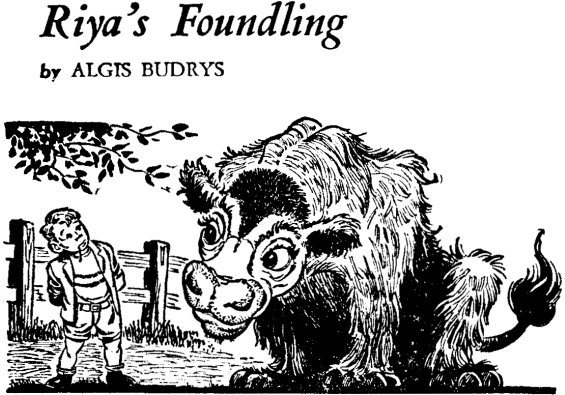
Riya's Foundling by Algis Budrys

Julie Hoverson recently recorded Riya’s Foundling. It’s a little Science Fiction gem from the hands of Algis Budrys and the pages if Science Fiction Stories, #1 (1953).

It’s a story about an intelligent cow (actually a cow-like alien being) that adopts a young human calf.

I’m not very much interested in the earthbound setup – frankly it’s weak – but there’s something very Alfred Besterian about the writing and the alien POV is really fascinating (and somehow familiar).

Here’s the audio, |MP3| Approx. 19 Minutes [UNABRIDGED]

And here’s the |PDF| version!

Posted by Jesse Willis

Review of Conquest by B.V. Larson

SFFaudio Review

ConquestConquest – (Star Force #4)
By B.V. Larson, Performed by Mark Boyett
Publisher: Brilliance Audio
[UNABRIDGED] – 12 hoursThemes: / aliens / military sci-fi / fighting bugs / machines / invasion /

Publisher summary:

Conquest is the next chapter in the great interstellar war between all living creatures and the machines. Star Force must stop the machine invaders once again – but how? In the fourth book of the Star Force series, Kyle Riggs has freed Earth from the chains of the Macros – but at what cost? The Macros no longer trust him. He is a mad dog that must be put down – and all Star Force must be stamped out with him. The war expands in this story, and mankind is once again faced with annihilation.

Conquest is the fourth book in the Star Force series by B. V. Larson and, while it continues the well-established tradition of this series for thrilling military action, it also brings several of the flaws of the series into sharp focus.

Over the course of the previous three novels in the Star Force series, Kyle Riggs has made some bad calls. He has sworn Earth to provide troops for a dangerous enemy, ordered thousands of his troops to their deaths, and cast aside strategic alliances with little thought to the long-term consequences of his actions. Throughout it all, I continued to root for Riggs and the rest of his band, even as I questioned his actions. Now, though, I can’t help but wonder if Star Force is the right team for the job.

Of course, they never were supposed to be the first best choice. Riggs and Crow, the co-leaders of Star Force, were plucked from their homes by brutal machines and only came to command the most technologically advanced army in human history because they managed to survive a brutal series of tests, so it should come as little surprise that these two often resort to brute force to solve their problems. Still, I couldn’t help feeling that these two men were woefully unfit for command when the first few chapters of this book consisted of little more than a super-powered grudge match between them. Riggs, as the narrator and protagonist, does his best to justify his actions to the reader, but many of his arguments can be boiled down to, “I did my best, but I’m not really a soldier.” Meanwhile, Crow is written as a chameleon who repeatedly vacillates between careless pirate and brilliant strategist, with little to no transition between.

One might expect that the return of the giant Macro robots would bring some unity to Star Force, or at least some sound strategic planning, but it doesn’t. Instead, Crow runs away (as usual) and Riggs comes up with some brilliant modifications to the Star Force battle equipment, then fails to use them to their potential (as usual). The one piece of brilliant strategizing that Riggs does manage to pull off, which results in the Macros focusing their attacks on Star Force’s home base rather than assaulting the entire planet, backfires spectacularly when he forgets the lessons learned in his previous fights against both the Macros and the Helios Worms. Riggs knows the Macros are underground, but makes no plans to defend against an attack from below. He gives his troops the ability to fly, but rarely uses that to his strategic advantage. Mistake compounds mistake until only nuclear weapons and convenient force-field failures can save Earth.

Apparently I am not the only one dissatisfied with the leadership of Kyle Riggs, as the author included a subplot of ongoing assassination attempts in Conquest. Obviously, I won’t say who or what was behind the attempts, but I like to imagine that there was some level of symbolism to B. V. Larson’s decision to introduce this plot element. I have to wonder if maybe there is some chance that, by the time he reached this book, Larson had realized that Riggs needs to develop further as a leader and a character.

Mark Boyett does an admirable job narrating this series, navigating the wide range of accents with ease. I did think, as I listened, that I caught a few errors, but I am more inclined to believe that these were missed during the editing of the book, rather than introduced in the recording of the audio. At a running time of just over eleven hours, spanning ten CDs, the book is just long enough to tell the story of the second invasion of Earth without overstaying its welcome. I plan to continue reading this series, but I truly hope to see some growth in strategic thinking from Riggs, or I could see myself beginning to feel sympathetic towards Conquest’s failed assassins.

Posted by Andrew Linke

Protecting Project Pulp: Letter From The Stars by A.E. van Vogt

SFFaudio Online Audio

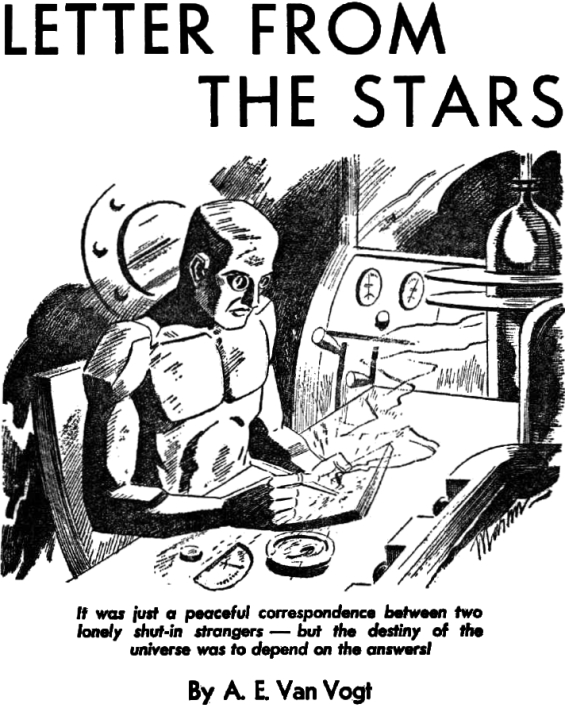
Letter From The Stars by A.E. van Vogt

This short epistolary Science Fiction story, Letter From The Stars (aka Dear Pen Pal), is about a foolish person who writes to an alien criminal. Like many episodes of PPP lately it is straight-up pulpy fun, but with a twist.

Protecting Project PulpProtecting Project Pulp No. 60 – Letter From The Stars
By A.E. van Vogt; Read by Josh Roseman
1 |MP3| – Approx. 18 Minutes [UNABRIDGED]
Podcaster: Protecting Project Pulp
Podcast: September 17, 2013
It was just a peaceful correspondence between two lonely shut-in strangers — but the destiny of the universe was to depend on the answers! First published in The Arkham Sampler, Winter 1949.

Posted by Jesse Willis

The SFFaudio Podcast #228 – READALONG: Last And First Men by Olaf Stapledon

Podcast

The SFFaudio PodcastThe SFFaudio Podcast #228 – Jesse and Jenny talk about the Last And First Men by Olaf Stapledon.

Talked about on today’s show:
the near and far future, not a novel, an imagined planetary history, the scope, Penguin Books, philosophy, the introduction, The Iron Heel by Jack London, a future history, human civilizations, two thousand million years (two billion years), universes => galaxy, man is a small part of the universe, Starmaker by Olaf Stapledon, Doctor Who, 2001: A Space Odyssey, what the plot would look like if there was one, the eighteen periods of man, evolution and construction, it’s set in 1930, is there ever an end to humanity?, Last Men In London by Olaf Stapledon, Last And First Men was popular in its day, Stapledon served in the ambulance service in WWI, plotlessness, period themes, the flying theme, the depletion of fossil fuels, The Mote In God’s Eye by Larry Niven and Jerry Pournelle, Venus, Mars, Neptune, the Martians, the Venusians, the genocide on Venus, Luke Burrage (the Science Fiction Book Review Podcast), racism, a Science Fiction mythology, the poetic musical ending, deep time, to the end of the Earth and beyond, Stapledon as an historian, civilizations always fall, there’s no one thing that ends civilizations, humanity as a symphony, the returns to savagery, establishing the pattern, Arthur C. Clarke, The House On The Borderlands by William Hope Hodgson, The Night Lands, The Time Machine by H.G. Wells, H.P. Lovecraft and cosmicism, the Wikipedia entry for Last And First Men, Fritz Leiber, Forrest Ackerman, scientificion, matchless poignancy, S. Fowler Wright, Lovecraft’s love of the stars (astronomy), one of the species of man is a monkey, another a rabbit, no jokes but perhaps humour, a cosmic joke, monkeys have made human their slaves, Planet Of The Apes, an ability to hear at the subatomic level, intelligence, a fourteen foot brain supported by ferroconcrete, obsession with gold, obsession with diamonds, pulping people, it’s written like a history textbook or essays, the Patagonia explosion, the upstart volcanoes, Earth Abides by George R. Stewart, The Scarlet Plague by Jack London, chiseling knowledge into granite, Olaf loved coming up with different sexual relationships, the 20 year pregnancy, suicide, euthanasia, an unparalleled imagination, groupthink, telepathy, oversimplification, we must press on, the baboon-like submen, the seal-like Submen, the divergence of man into other ecological niches, the number of ants in New York, ecosystems, nuclear weapons, robots are missing, where is the robot man?, the over-emphasis on fossil fuels as the only source of energy, if you could see us now, post-humans, ultimately a love letter to humanity, not aww but awwww!, Starmaker as a masterpiece, Sirius, uplifting a dog, a fantasy of love and discord, dog existentialism, who am I and where is my bone?, Olaf Stapledon in the PUBLIC DOMAIN, influential vs. famous, a very different read.

Last And First Men by Olaf Stapledon

Olaf Stapledon illustration by Neil Austin

Posted by Jesse Willis

Review of Rebellion by B.V. Larson

SFFaudio Review

rebellionRebellion (Star Force #3)
By B.V. Larson, Performed by Mark Boyett
Publisher: Brilliance Audio
[UNABRIDGED] – 12 hours

Themes: / aliens / military sci-fi / fighting bugs / machines /

Publisher summary:

Rebellion is the turning point in the great interstellar war between all living creatures and the machines. Star Force is on the side of the machines – but for how long? In the third book of the Star Force series, Kyle Riggs learns just what kind of war Earth is caught up in. At the mercy of the Macros, his marines fight against new alien races, big and small. They battle the innocent and the vile alike, until their situation becomes grim.

Rebellion is the third novel in B. V. Larson’s Star Force series starring computer science professor turned interstellar marine Kyle Riggs. It stands on its own better than the previous novel, Extinction, but I would still recommend reading the previous books first as the plot throughout the series thus far has been mostly linear. In Rebellion, Larson takes his Star Force formula, throws in a couple new atomic grenades, and keeps blasting right along with the story of humanity’s fight against alien machines known as the Macros.

Given the title, it should come as no surprise that in this novel Kyle Riggs leads the battered remnants of his Star Force marines in a rebellion against their Macro masters. His reasons for this are many, but the decision point comes when he discovers that, while the Macros are scrupulous in abiding by the letter of their agreements, they have no compunction in their networked silica minds against taking advantage of every loophole in an agreement. In this case, they use Riggs’s nanotized marines to attack a race that had failed to include a prohibition against indirect assault using mercenaries in their peace treaty. Riggs concludes that the Macros will employ similar tactics against Earth and the near future and determines that it is better to restart the war now. On his own terms. With only five thousand men. With no way of alerting Earth.

Draw your own conclusions about Kyle Riggs’s big-picture tactical planning capabilities but, as in the previous novels, it is hard to fault his individual decisions in the heat of the moment. Indeed, I’m starting to wonder if Larson intends his hero to be an object lesson in the difficulty of making good choices under stress.

The structure of the Macro / Nano division continues to frustrate me. I’m beginning to accept that Nanos can not simply swarm a Macro and take it apart, though this acceptance is less for any logical reason than just because it continues to not happen, even though there are specific scenes of destroyed Macros being disassembled by Nanos and reprocessed. Perhaps my worst gripe along these lines for Rebellion is the revelation that Macro ships are difficult to pilot because the cockpits are built for pilots with seven arms. Now, I’ll accept that there is some sort of fundamental programming element that requires all Macros to be large, but when their entire command structure is built on networked parallel processing, why aren’t the ships just built into that network? There is simply no reason for the Macros to have physical ship controls, any more than there is a need for their ships to have pressurized compartments.

All complaints aside, I was pleasantly surprised to discover that Rebellion features more, and far more interesting, revelations about the Star Force universe than its predecessor. The best of these are the emergence of a new machine intelligence and Sandra finally coming into her own as a character. This new intelligence starts off as little more than another of the nanobot “brain boxes” that Riggs uses in every aspect of his military. Riggs names the over-achieving brain box Marvin, in what I can only hope is an unacknowledged tip of the hat to The Hitchhiker’s Guide to the Galaxy, and the interactions between Marvin and the human characters are probably the best part of this novel. As for Sandra, she spends half the novel in a coma, then wakes up just in time to reprise her roll as Riggs’s shallow, hot-tempered girlfriend. Literally her first action after waking up is to punch another woman for kissing Riggs in a moment of desperation. Fortunately, Sandra seems to blow most of her daft behavior allocation in that first moment as, with the help of some sentient microbes who have been tortured into assisting Starforce, she quickly evolves into a strong, self-motivated character.

Development of characters other than Kyle Riggs has been a weakness for this series from the beginning, and Rebellion does little to change this. Other than the introduction of Marvin and the growth in Sandra, the only supporting characters to see a change are Jasmine, who develops a crush on Riggs, and Kwan, who gets a girlfriend and learns a few new English idioms. But you don’t read Star Force novels for character development or fully coherent plot. If you are a fan of fast-paced science fiction featuring liberal quantities of bloody, laser-scorched human versus robot combat, Rebellion will quench your thirst for action.

The audiobook narrated by Mark Boyett has the usual quality of production and performance. Three books into the series, I do have to admit that I am starting to get annoyed by the accents of characters other than Kyle Riggs, as it seems that any human character who merits a name also has an accent. Mark Boyett does a fine job with his reading, and I do appreciate that B. V. Larson is attempting to show the global nature of Star Force, but the continual shifting of accents and genders from a single male reader grows tiresome after about six hours.

Posted by Andrew Linke

Review of The Humans by Matt Haig

SFFaudio Review

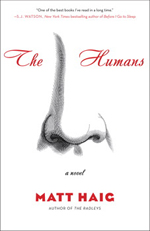
The Humans by Matt HaigThe Humans
By Matt Haig; Read by Mark Meadows
Publisher: Simon & Schuster
Published: July 2013
ISBN: 9781442366497
[UNABRIDGED] – 8 hours, 11 minutes
Excerpt: |MP3|

Themes: / aliens / ethnography / humanity /

Publisher summary:

“I know that some of you reading this are convinced humans are a myth, but I am here to state that they do actually exist. For those that don’t know, a human is a real bipedal life form of mid-range intelligence, living a largely deluded existence on a small waterlogged planet in a very lonely corner of the universe.”

When an extraterrestrial visitor arrives on Earth, his first impressions of the human species are less than positive. Taking the form of Professor Andrew Martin, a prominent mathematician at Cambridge University, the visitor is eager to complete the gruesome task assigned him and hurry back home to the utopian world of his own planet, where everyone enjoys immortality and infinite knowledge.

He is disgusted by the way humans look, what they eat, their capacity for murder and war, and is equally baffled by the concepts of love and family. But as time goes on, he starts to realize there may be more to this weird species than he has been led to believe. Disguised as Martin, he drinks wine, reads poetry, develops an ear for rock music and a taste for peanut butter. Slowly, unexpectedly, he forges bonds with Martin’s family, and in picking up the pieces of the professor’s shattered personal life, he begins to see hope and beauty in the humans’ imperfections and begins to question the mission that brought him there.

This book couldn’t be anything other than fiction, since it is from the perspective of an alien who was sent to earth to hold back dangerous scientific progress, but it has a feeling of ethnography to it from the alien’s perspective. As he becomes an insider, he discovers that what is assumed or known about humans around the universe – their selfishness, their monetary motivation – isn’t accurate. His commentary is more about what it is to be human, and the story was really secondary, in the sense that the story in Among Others is a secondary framework. The stories aren’t the same, but they seem to serve the same purpose.

If you’re looking for a rousing story of alien invasion and infiltration, this isn’t for you. But if you are interested in reflecting on the human condition, this will be right up your alley.

I had the luxury of listening to this entire book in one day. The narrator, Mark Meadows, does a good job of reading and drew me right in, keeping my attention for the entire book. In fact, I hardly thought about him at all, a quality I prefer in my readers!

Posted by Jenny Colvin