Review of Star Trek: Vulcan’s Soul by Josepha Sherman and Susan Shwartz

Star Trek Audiobooks - Star Trek Vulcan's SoulStar Trek: Vulcan’s Soul Book I: Exodus
By Josepha Sherman and Susan Shwartz; Read by Boyd Gaines
3 Cassettes or 4 CD’s, 4 hours [ABRIDGED]
ISBN: 0743529995 (Cassette), 0743530004 (CD)
Publisher: Simon and Schuster Audio
Published: 2004
Themes: / Star Trek / Vulcans / Aliens /

A disheartening thing about being a fan of Star Trek is that one of its most beloved characters, Spock, has been left with an unfinished story. The last time we saw him on the screen was during the two-part Star Trek: The Next Generation episode entitled Unification. That the ratings for that episode are among the best Star Trek has ever gotten demonstrates the fan’s desire to see more of Spock. Alas, the business world encroaches, and for whatever reason, Spock was left on Romulus, his fate uncertain.

Enter Josepha Sherman and Susan Shwartz. Their previous two Star Trek novels, Vulcan’s Forge and Vulcan’s Heart (both available on audio) were excellent science fiction, focusing on Spock in particular and Vulcan culture in general. Vulcan’s Soul Book 1: Exodus continues that story in the same manner, focusing both on the character of Spock and the Vulcan world during the time of Surak, the great Vulcan philosopher who championed logic over emotion, and to whom we were first introduced during the Original Series.

The story takes place one year after the Dominion War. A hostile and powerful race called the Watarii, claiming to have an ancient score to settle with the Romulans, invade Romulan space. Spock and his wife, Captain Saavik, swoop in to help, enlisting the assistance of old friends Admiral Uhura and Admiral Chekov. They work to unravel the mystery of the Watarii while doing their best to assist in defending against them. Frequent flashbacks tell the interwoven story of Surak’s effect on the planet Vulcan.

The story is fast paced and extremely well-read by Boyd Gaines. The sound effects and music typical of previous Star Trek audiobooks is also present, effectively used to establish setting and tone.

My only quibble with this one is that I hadn’t heard from Uhura and Chekov in so long that I had to seriously question whether or not they would be alive one year after the Dominion War. The answer is: apparently so. They’d be over 150 years old, but possibly still kicking. Uhura is mentioned in a previous novel (Catalyst of Sorrows) as being the “centenarian head of Starfleet Intelligence.” I’m certainly finding this kind of thing old. I assume Sherman and Shwartz have a valid reason for using these two particular characters, but I’m currently not sure why they would bring yet another couple of TOS characters into the TNG/DS9/VOY era rather than using some contemporary characters from other series. Perhaps the Enterprise-A encountered some kind of strange nebula which had a hypnotic effect that prevents these folks from retiring… Another story, perhaps.

Other than that annoyance, this was a very good Star Trek novel with lots of Vulcan mythos, lots of eyebrow-raising conundrum, and a fantastic battle scene.

Find more on Star Trek audiobooks here!

(I’d like to acknowledge the kind assistance of Scott Armstrong, who did some research for me for this review. Any mistakes, of course, are my own.)

Posted by Scott D. Danielson
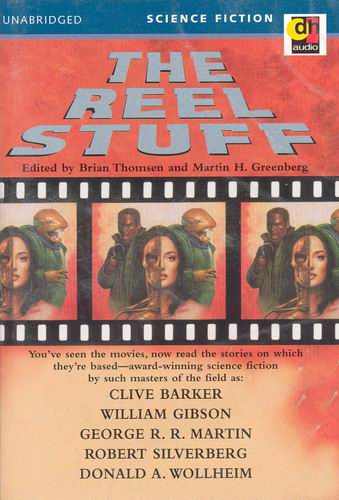
Review of The Reel Stuff edited by Brian Thomsen and Martin H. Greenberg

The Reel Stuff
Edited by Brian Thomsen and Martin H. Greenberg
Read by Various
6 Cassettes – 9 Hours [UNABRIDGED]
ISBN: 0886465745
Publisher: dhAudio
Published: 2000 [OUT OF PRINT]
Themes: / Science Fiction / Horror / Computers / Memory / Aliens / Urban Legend / Space Travel / Time Travel /

The Reel Stuff is a collection of stories that have been adapted into films. They are all great stories, and this collection has the added attraction of comparing these stories to the films. dhAudio really did a fabulous job with this one. The stories:

Johnny Mnemonic by William Gibson, read by Christopher Graybill
FILM: Johnny Mnemonic (1995)
Johnny Mnemonic was published in 1981, a few years before Gibson’s Hugo and Nebula-award winning Neuromancer hit the scene, illuminating the whole Cyberpunk sub-genre. This story is a clear view of that sub-genre as it has all the elements; human/computer interfaces, plenty of violence, and quick-witted characters. In this story, the title character holds a piece of data in his brain that is wanted by some powerful folks who are willing to do plenty to get it. Christopher Graybill does a great job with it.

Amanda and the Alien by Robert Silverberg, read by Colleen Delany
FILM: Amanda and the Alien (1995 – TV)
This tale, by the great Robert Silverberg, is humourous and sexy. The main character is a ditzy teenage girl named Amanda who takes an alien who can morph into anyone it eats under her wing. Definitely a B-movie kind of story, but purposefully so. Colleen Delany performs well, capturing the Amanda character perfectly.

Mimic by Donald A. Wollheim, read by Terence Aselford
FILM: Mimic (1997)
Mimic is a very short tale that reads almost like a documentary about the peculiar ways in which animals hide from other animals. This is then extrapolated in a very spooky way to humans. Terence Aselford didn’t have a heck of a lot to work with here, but he kept it interesting.

The Forbidden by Clive Barker, read by Vanessa Maroney
FILM: Candyman (1992)
Clive Barker drums up some modern mythology here as a female professor explores urban legend among the lower class in London. The story is effective and chilling in the hands of Vanessa Maroney, who navigates Barker’s weirdness as if it were really happening.

We Can Remember It For You Wholesale by Philip K. Dick, read by Terence Aselford
FILM: Total Recall (1990)
Terence Aselford gets another chance in this collection, reading this reality-bender by Philip K. Dick. The main character wants to go to Mars in the worst way, but can’t afford it. The solution? Take a virtual vacation! Have memories implanted so you can “have gone” to Mars. But here, things get complicated when the implantee’s supressed memories surface during the procedure. Dick again manages to leave me wondering what the heck is really real – where exactly is the immovable bedrock? Nothing is sacred in Philip K. Dick’s hands.

Nightflyers by George R.R. Martin, read by Christopher Graybill
FILM: Nightflyers (1987)
Martin here spins a science fiction horror story. Think Psycho meets Lost in Space and maybe you’ll have a feel… a group of people ride on a ship that is controlled by a mystery man who never leaves the cockpit. Christopher Graybill again is impressive in his reading.

Air Raid John Varley, read by Nannette Savard
FILM: Millenium (1989)
Nannette Savard reads a very strange, very affecting story about Earth’s future. In it, humans have evolved just a bit, but the Earth’s biosphere has been destroyed, its people diseased. Varley’s descriptions are vivid and graphic – these people are in a bad way. To keep the species going, they go back in time to retrieve healthy airline passengers, mid-flight, since history shows they are on the verge of fiery death. These passengers become humanity’s hope. Varley is a very affecting writer, and through the main character we experience much. Savard does a great job conveying this to the listener.

Sandkings by George R.R. Martin, read by Richard Rohan
FILM: The Outer Limits: Sandkings (1995)
Simon Kress wants a pet, but something interesting… something out of the ordinary. He finds what he’s looking for when he purchases a group or creatures called sandkings which live in a large terrarium with plenty of sand lining the bottom. They build castles and fight battles. They even worship. And they are endlessly fascinating. Well, they were. Perhaps a little prodding from Kress will end the monotony… This one is my favorite of this excellent collection. Sandkings is original and fascinating, both as a character study of a man with too much comfort and as an exploration of an alien animal species.

Posted by Scott D. Danielson

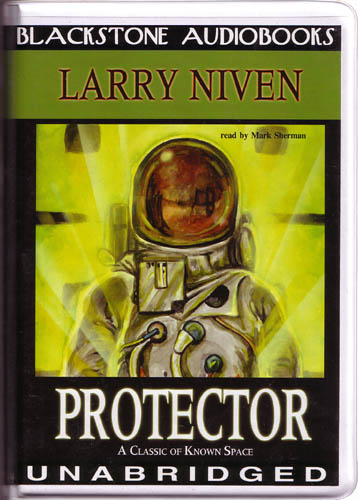
Review of Protector By Larry Niven

Science Fiction Audiobook - Protector by Larry NivenProtector
By Larry Niven; read by Mark Sherman
5 cassettes – 7.5 hours [UNABRIDGED]
Publisher: Blackstone Audio
Published: 2003
ISBN: 0786123907
Themes: / Science Fiction / Aliens / Interplanetary Travel / Solar-System Civilization / Asteroid Belt / Mars / Evolution / Genetics / Biology / Ballistic Physics /

Phssthpok the Pak had been traveling for most of his thirty-two thousand years. His mission was to save, develop, and protect the group of Pak breeders sent out into space some two and a half million years before. Brennan was a Belter, the product of a fiercely independent, somewhat anarchic society living in, on, and around an outer asteroid belt. The Belters were rebels, one and all, and Brennan was a smuggler. The Belt worlds had been tracking the Pak ship for days, and Brennan figured to meet that ship first. He was never seen again, at least not by those alive at the time.

Humanity has become an interplanetary species; Luna, Mars, Mercury, the Asteroid Belt and the gas giants of Sol are the playground of mankind. But it wasn’t meant to be that way… an alien race from near the galactic core has set its sights on Earth and the cargo it brings will bear some really strange fruit.

Protector is absolutely bursting with awesome SF ideas, and the twists on them, everything from a precursor to Richard Dawkin’s “Selfish Gene Theory”, to realistic spaceship ballistics and sexual politics. Niven himself has been a giant in the SF field since the early 1970s, of the many living authors who still haven’t been bestowed with the honorific “Grand Master,” Niven is the most deserving. Protector was first published in 1973, and is a part of Niven’s ongoing “Known Space” series, one of the foremost continuing visions of the future by an SF author. Like Robert A. Heinlein’s Future History series, the Known Space novels and stories follow the expansion of humans into the galaxy. And Protector is perhaps the best of the Known Space novels, it offers some of the hardest of the Hard SF ever written, something Larry Niven has a particular talent for, and it’s a great story, both unpredictable and fun! But I can’t stress enough just how good this novel is, the plot is unpredictable but relentlessly logical and enthralling at the same time, even better this novel like Richard Matheson’s classic I Am Legend, has a deep psychological and philosophical impact on the reader, and it also has a similar twist ending. It’s simply fantastic!

Reader Mark Sherman appears to have prepared well for what really could have been a very difficult reading. Larry Niven gave the alien names a real alien sound – I had no idea how to pronounce names like “Phssthpok”, but Mark Sherman does a great job in putting voice to it and numerous other unpronounceable words. Blackstone Audiobooks’s production is super smooth, sound quality is terrific, the cassettes come packaged in the awesome library style clamshell case and the original cover art is simply amazing to behold. For those who prefer other formats, Blackstone has also released Protector in two other media types, a 6 CD set or a single MP3-CD. Whatever format you choose you must choose one as this production of Larry Niven’s Protector is nigh unto perfect.

Posted by Jesse Willis

Review of The Moon Moth [AUDIO DRAMA] adapted from the novella by Jack Vance

SFFaudio Review

The Moon MothSFFaudio EssentialThe Moon Moth
By Jack Vance; adapted by George Zarr
Performed by a Full Cast
Duration: 73 minutes 22 seconds
Available at: http://www.scifi.com/set/playhouse/moth/
Producer: Seeing Ear Theater
Themes: Science Fiction / Mystery / Aliens / Identity / Sociology /

A tone-deaf detective pursues a singing assassin through an opera of blood in this classic satirical thriller by Jack Vance. On the planet Sirene everyone wears a mask according to his status — or strahk — in society. Communication is accomplished through singing accompanied by a plethora of instruments, each of which signifies a different emotional mood or is used to talk to a different social caste. The problem is, the assassin Angmark is a master of Sirenese customs and — like everyone else on Sirene — his face is hidden behind a mask. Our doddering ambassador-detective’s only hope: to learn to use his own mask — the lowly Moon Moth — before Angmark relieves him of a head to put it on.

“The Moon Moth” is one of the best short science fiction stories tackling ideas of alternative social systems. Most stories of this type are found in full length novels like Robert Silverberg‘s A Time Of Changes or Ursula K. Le Guin‘s The Left Hand Of Darkness, but what is so delightful about this story is how densely packed with excellence it truly is. “The Moon Moth” is whimsical story with a truly original alien culture, the tale is part social commentary, part social satire and an absolutely terrific variation on the locked room mystery all packed successfully into 73 minutes of goodness! David Garrison and the rest of the Seeing Ear Theater cast are hilarious and effective but the real kudos has to go to George Zarr who so skillfully adapted Jack Vance‘s 1961 short story to the audio drama form. And unbeleivably, this play is still available for free on the internet! Very highly recommended!

Review of Ender’s Game by Orson Scott Card

Science Fiction Audiobooks - Ender's Game by Orson Scott CardEnder’s Game
By Orson Scott Card; Read by Stefan Rudnicki, Gabrielle De Cuir, David Birney and others
10 Hours [UNABRIDGED]
Publisher: Fantastic Audio
Published: 2002
ISBN: 1574535145 (Cassette) – 1574535366 (Audio CD)
Themes: Science Fiction / Military / Space / Youth / Politics / Alien races /

In the not too distant past, the Earth survived a war with the Buggers, an insect-like alien race. One military man, Mazer Rackham, was able to make the difference in the war for humanity, but it is widely feared that the Buggers will be back. To prepare, the government has taken to monitoring the Earth for the next military genius. Everyone who is considered a candidate is taken from their families at a young age and placed into an orbital Battle School. Ender Wiggin, at 6 years old, is considered to be the best candidate – Ender’s Game is his story.

Ender’s brother (Peter) and sister (Valentine) also play a large role. They are both older than Ender, and both extremely intelligent. They also were both passed over for Battle School, one for being too dangerous and one for being too compassionate. They have their own way of influencing the events of the world, even though they are no longer considered for the military.

The Battle School is centered on a game in which teams (armies) of kids fight each other in a zero-g environment. They carry guns that shoot low power lasers and wear suits that react to those lasers by freezing wherever they are hit. By playing the game, the students are training in three dimensional combat, and the competition aboard the Battle Station is fierce.

Ender not only deals with the other students in this competition, but also the teachers of the School as they place him in more and more difficult circumstances. The story has much to say about means and ends, both personal and political.

Even though I had read it three times over the past 14 years, I was glued to this audio version as if I didn’t know what was going to happen. The audio is a treat. Stefan Rudnicki performs the main narrator duties, while a number of others perform the conversations amongst the adults, which occur at the beginning of each chapter. Orson Scott Card also recorded a postscript in which he discusses the origins of Ender’s Game as a novel. First-rate.

Review of Startide Rising by David Brin

Science Fiction Audiobooks - Startide Rising by David BrinStartide Rising
By David Brin; Read by George Wilson
12 cassettes – 17.5 hours [UNABRIDGED]
Publisher: Recorded Books
Themes: / Science Fiction / Galactic Civilization / Genetic Engineering / Aliens / Dolphins / Chimpanzees / Series /

The Terran exploration vessel Streaker is on the run from the combined forces of five galactic civilizations that are hunting for them. Low on resources and staying just one step ahead of their pursuers the ship and crew crash-land on an obscure water-world called Kithrup. Soon after, in orbit above Kithrup, the might of all five galaxies fights each other for the right to claim “the prize”. The prize being that the crew of Streaker has the co-ordinates of what may be the most important discovery in millennia, the coordinates of mothballed fleet of starships that may be over two billion years old.

The second book of the Uplift Series, Startide Rising is the winner Nebula, Hugo, and Locus Awards for Best Novel of the year (1983). At the center of the Uplift Series is the idea that an “uplift” of intelligent life is necessary in order to create sentient and spacefaring races. The species that uplifts another is called a “patron species”, the species being uplifted is called a “client species”, this process is deemed absolutely necessary for the development of intelligent spacefaring civilizations. This makes sense to the Humans because on Earth the Humans have by this point genetically re-engineered both Dolphins and Chimpanzees, uplifting them to sentience. Which immediately begs the question of “who uplifted humanity”?

Recorded Books did a beautiful job on the cover, the specially commissioned painting is perhaps the nicest ever done for an audiobook. Unfortunately the cover and the packaging, are the best thing about this novel. As with many multi-volume series the paperback and hardcover versions of this book include: A glossary, a cast of characters list, a prologue, an epilogue, a postscript and a drawing (in this case of the Terran starship). Now obviously the drawing wouldn’t be able to be conveyed by a narrator, so it’s loss isn’t a big deal. But the exclusion of the glossary and the cast of characters was probably a mistake, for this novel especially, this information might have helped. I don’t really blame the producers for excluding it though, at 462 pages (making it 12 cassettes) this beast is way too long as it is.

David Brin‘s has peppered some very interesting ideas throughout the novel. Some of the ideas presented are new spins on old themes, others are quite original and interesting, at least to my ears. The overall premise of “uplift” is interesting, and would definitely be worth reading about, except for one minor issue. This is a horrible novel. Its very very very talky, there are way way way too many characters, virtually every scene that WOULD be of interest takes place off-stage, in the past or is happening and being related by a third party indirectly! George Wilson, the reader, does his best to sort out much of the muddle, no small task with more than a dozen characters, none of which are major players in the plot. These flaws along with reading the unreadable voices of many dolphins, are almost too much for poor George. And it was certainly too much for me. I lost track of who was speaking and what they were talking about many times! This is an unforgivable and deadly sin for a novel and makes me wonder how both readers and writers of science fiction could give this novel an award of any type let alone both the Hugo and the Nebula! I’ll admit that, much of the difficulty here is probably a result of this novel being a part of a series, with established characters and continuing themes. One reason for which all in all I much prefer stand alone novels. But even among series novels this was perhaps the worst novel I’ve read in years. Were I not writing a review for it I wouldn’t even bothered to have finished it. That said, maybe like Neville, the last living man on the Earth in Richard Matheson’s I Am Legend, I’m really the one who’s abnormal. Maybe this isn’t a bad novel at all. Maybe, it really is a good novel and I’ve got something wrong with me! Maybe a cast of dozens talking endlessly about events that just happened, are happening elsewhere are happening now but being related by a no-name character reading a sensor bank really is interesting. If that really is interesting and I just can’t appreciate it I’ll just have to live without it because I’m not going to listen to any more of the Uplift Series.