

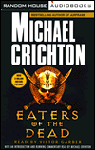
 Eaters of The Dead
By Michael Crichton; Read by Victor Garber and Michael Crichton
2 cassettes – 3 hours [ABRIDGED]
Publisher: Random House Audiobooks
Published: 1998
ISBN: 0679460330
Themes: / Fantasy / Historical Fiction / Alternate History / Vikings / Arabs / Mythology / Neanderthals / Epic /
In the year A.D. 922, Ibn Fadlan, a devout Muslim nobleman, left his home in Baghdad on a mission to the King of the Bulgars. During his journey, he met various groups of “barbarians” who he reported as having varying degrees of bad hygiene and alcoholism. It was a classic clash of cultures story that revealed more about both societies than any other type of narrative could. Whilst encamped in a Norseman trading village word came of a request for warriors to return to Scandinavia to battle an unnamed foe. Because the Norsemen were so superstitious, Fadlan was shanghaied as the “13th warrior”, a necessary foreigner, and forced to accompany the war party. Under the leadership of Buliwyf, Fadlan and eleven other Norsemen journeyed far to the North, to a land where the nights last only a few minutes, where sea monsters abound in the oceans and where shimmering lights in the sky are a nightly occurrence. Once there he and his companions must fight a battle against the Eaters Of The Dead.
If the premise is familiar it may be because you’ve seen the movie “The 13th Warrior,” which is based upon this novel. Supposedly this is a true story taken from the journals of an Arab courtier named Ahmad Ibn Fadlan. In reality it is only partially based on those writings. Crichton wrote Eaters Of The Dead based on a bet. He argued that Beowulf, the oldest surviving epic in British literature, could be successfully turned into a satisfying adventure story. In the real life writings of Ibn Fadlan Crichton found a viewpoint chracater who’d be able to witness the adventure of Beowulf and his fight against Grendel first hand. Starting with actual journal entries from Ibn Fadlan, Eaters Of The Dead begins as non-fiction. About a third of the way into the reading, Crichton stops using Fadlan’s journals, starts writing in the style of Fadlan, and begins telling his version of Beowulf. Sounds simple, but because Crichton doesn’t tell us any of this in his introduction, it isnt.
Confusing things further, Victor Garber’s reading of the story is interupted every so often by commentary by Michael Crichton! Crichton doing commentary on Crichton confuses things to a high degree, and yet somehow it works! This is a compelling story, likely because it draws so heavily from the deeply rooted mythology including snippets of ideas from everything from J.R.R. Tolkien’s The Hobbit to modern anthropological theories regarding the extinction of the Neanderthals.
Victor Garber does a good job reading, his only flaw is that his Arbaic accent sounds a bit to much like a Punjabi accent. Crichton too reads his commentaries well. As with many abridgments this one leaves the listener wanting more of the story, though thankfully it doesn’t suffer from the equally common failing of being incomprehensible.
As with all Michael Crichton novels, this turns into a Frankestienian morality tale in the vein of “there are some things men wernt meant to know”. For the most part it works, but what bothers me most about Eaters Of The Dead is its fence sitting nature. Not strictly fiction nor strictly non-fiction, Crichton has chosen to deliberately blend the reality and the fantasy without any disclaimer of even the most generous “based on a true story” or even the weaker “inspired by true events”. Instead he deliberately tricks us into thinking this is a true story by interspersing his own commentaries about the translation! True stories are inherently more interesting than fiction, no doubt Crichton chose to capitalize on this by deliberately obscuring the fact that he basically made up the whole last 2/3rds of the book! Had there been a disclaimer about this at the beginning of the book I’d have been much happier with it. That said, the story is fun, an interesting ride, and certainly one of Crichton’s best novels, but it isn’t even in the same class as say Robert Silverberg’s terrific A Hero Of The Empire, which also deals with historical figures in ancient Arabia.. If you absolutely insist on reading Michael Crichton novels I’d recommend you actually NOT read his Science Fiction! Read his fantasy, read Eaters of The Dead and then if you want a non-SFF treat try Crichton’s admirable The Great Train Robbery (also based on a true story), which is far better than his constant rehashing of Frankensteinian plots about cloning, time travel, etc.
 The Man In The High Castle