News, Reviews, and Commentary on all forms of science fiction, fantasy, and horror audio. Audiobooks, audio drama, podcasts; we discuss all of it here. Mystery, crime, and noir audio are also fair game.
Radio Drama Revival‘s Episode #221 features a short, but very moving, audio dramatization called Moon Graffiti. It depicts what might have happened one clear summer night in July, 1969. It is followed by an interview with Jonathan Mitchell, its producer.
“That’s one small step for a man; one giant leap for mankind.” We all know the quote, the triumphant story. It seems written in stone. But Buzz Aldrin and Neil Armstrong came within inches of tragedy when they landed Apollo 11. Moon Graffiti imagines what it might have sounded like if things had gone a little differently. Based on a contingency speech written by William Safire for Richard Nixon titled “In the Event of Moon Disaster.”
Produced by Jonathan Mitchell
Edited by Hillary Frank
Cast:
Matt Evans as Neil Armstrong
Ed Herbstman as Buzz Aldrin
John Ottavino as Richard Nixon
The SFFaudio Podcast #102 – Scott, Jesse and Tamahome talk about new audiobook, book, and comic book releases.
Talked about on today’s show: The Infinite Worlds Of H.G. Wells, Sherlock Holmes, Memory by Donald E. Westlake, Hard Case Crime, A Good Story Is Hard To Find, nihilism, SFSignal’s 122 books that bring Scott to tears, All The Lives He Led by Frederik Pohl (a semi-nihilistic novel), Yellowstone, “half minus negative zero”, A Matter Of Time by Glen Cook, The Black Company, Abel One by Ben Bova, blood and flesh and shirtless, Deathless by Catherynne M. Valente, BoingBoing, Russian Ark, Enigmatic Plot vs. Enigmatic Pilot, Enclave (aka Razorland) by Ann Aguirre, The Maze Runner by James Dashner, The Scorch Trials, The Hunger Games, Hunt The Space Witch and Other Stories by Robert Silverberg, WWW: Wonder by Robert J. Sawyer, Starstruck, Blair Butler, “Geoff Boucher’s Los Angeles Times Hero Complex ‘Get Your Cape On’ pick of the week”, The Quantum Thief by Hannu Rajaniemi, Macmillan Audio, Audible.com, Brilliance Audio, Warriors edited by George R.R. Martin and Gardner Dozois, Forever Bound by Joe Haldeman, Lawrence Block, O. Henry-ish, “I see no reason to buy through iTunes” (vs. Audible.com), Limitless (aka The Dark Fields) by Alan Glynn, F. Scott Fitzgerald, Flowers For Algernon, Understand by Ted Chiang, acquiring a whole bag of pills, “smart people are neat”, Tantor Media, History Is Wrong by Erich von Däniken, Jesse becomes momentarily depressed, The Guns Of August by Barbara W. Tuchman, John Lee, the John Cleaver series, have world events have sped because of modern technology?, Libya, Tripoli, “The Graveyard Of Empires”, “from the halls of Montezuma to the shores Tripoli”, NPR, A History Of The World In Six Glasses by Tom Standage, beer, wine, spirits, tea, coffee, cola, the Today In Canadian History podcast, the Canadian Navy, I Don’t Want To Kill You by Dan Wells, I Am Not A Serial Killer, “normally I don’t do this”, Dexter, the Writing Excuses podcast, Homeward Bound by Harry Turtledove, alternate history, We by Yevgeny Zamyatin, Grover Gardner, Eric S. Rabkin, George Orwell’s 1984, Herland by Charlotte Perkins Gilman, William Dufris, binary fission, Tantor Media is very innovative in including ebooks with their audiobooks, we need a new demarcation to desperate urban fantasy romance from SF, “conspiracy and ignorance based books”, The Prefect by Alastair Reynolds, Tales From A Thousand Nights And The Night (aka 1,001 Nights!) translated by Richard Burton, The Thousand Nights And A Night is the first fix-up novel, Nostromo by Joseph Conrad, South America, Three Men In A Boat (To Say Nothing Of The Dog) by Jerome K. Jerome, To Say Nothing Of The Dog by Connie Willis, Have Spacesuit, Will Travel by Robert A. Heinlein, Atlantis And Other Places by Harry Turtledove, Slave To Sensation shouldn’t be a science fiction novel, Orson Scott’s Card Intergalactic Medicine Show, Rejiggering The Thingamajig by Eric James Stone on Escape Pod #277, body-swapping, I Will Fear No Evil by Robert A. Heinlein, gender-swapping, For Us The Living: A Comedy Of Customs by Robert A. Heinlein, Heinlein’s old theme: “naked people talking to each other”, Heinlein likes to examine social preconceptions and social prejudices, “not a Heinlein classic but still classic Heinlein”, Eifelheim, Luke Burrage, Idiot America by Charles P. Pierce, George Washington riding a dinosaur, The Broken Sword by Poul Anderson, contemporary with Tolkien (rather than derivative of Tolkien), Michael Moorcock, Eric Birghteyes by H. Rider Haggard, Bronson Pinchot, The Plague Dogs by Richard Adams, anthropomorphic fiction, quasi-Science Fiction, quasi-Fantasy, Coyotes In The House by Elmore Leonard |READ OUR REVIEW|, The Call Of The Wild by Jack London, We Three by Grant Morrison, Transmetropolitain, Warren Ellis, Tama’s pet peeve in comics is silent panels, Audible Frontiers, The Death Of Grass by John Christopher, The Tripods, The Sam Gunn Omnibus, The Steel Remains, Cliffs Notes are now available as audiobooks, Brave New World, The Spiral Path by Lisa Paitz Spindler, Eat Prey Love by Kerrelyn Sparks, William Coon’s Eloquent Voice titles, Andre Norton’s The Time Traders, Gilgamesh The King by Robert Silverberg |READ OUR REVIEW|, Philip K. Dick, Henry James, Anton Chekov, Paul of Cthulhu, Yog-Sothoth.comThe Whisperer In Wax, wax cylinder tech, Embedded by Dan Abnett, SFSignal.com.
Talked about on today’s show:
The virtues of short stories, metafiction, Fair Game by Philip K. Dick, If magazine, Anthony Boucher, The Garden Of Forking Paths, Ellery Queen Mystery Magazine, espionage, fantasy, alternate history, WWI, “start the scene as close to the action as possible”, labyrinth, recursion, the Wikipedia entry on The Garden Of Forking Paths, choose your own adventure, parallel worlds, The Hitchhiker’s Guide To The Galaxy, the Necronomicon, H.P. Lovecraft, “The Garden of Forking Paths is an incomplete, but not false, image of the universe as Ts’ui Pên conceived it.”, why doesn’t Luke review short stories on SFBRP?, Eifelheim by Michael Flynn |READ OUR REVIEW|, The Merchant And The Alchemist’s Gate by Ted Chiang, Gene Wolfe, The Book Of The New Sun, Labyrinths: Selected Stories And Other Writings by Jorge Louis Borges, A Solar Labyrinth by Gene Wolfe, “dense as in wonderfully deep”, Penguin Audio, Collected Fictions by Jorge Louis Borges, how are Fair Game and The Garden Of Forking Paths connected?, “how you read a story matters to your understanding of a story”, Professor Anthony Douglas, “An immense eye gazed into the room, studying him.”, The Twilight Zone, “The damn thing was looking at me. It was me it was studying.” Douglas’s voice rose hysterically. “How do you think I feel — scrutinized by an eye as big as a piano! My God, if I weren’t so well integrated, I’d be out of my mind!”, Colorado, “we are the face in the sky staring down at this paper”, physics, the observer effect, the wave function collapses, Schrödinger’s cat,
“What is Doug? About the best nuclear physicist in the world. Working on top-secret projects in nuclear fission. Advanced research. The Government is underwriting everything Bryant College is doing because Douglas is here.”
“So?”
“They want him because of his ability. Because he knows things. Because of their size-relationship to this universe, they can subject our lives to as careful a scrutiny as we maintain in the biology labs of — well, of a culture of Sarcina Pulmonum. But that doesn’t mean they’re culturally advanced over us.”
“Of course!” Pete Berg exclaimed. “They want Doug for his knowledge. They want to pirate him off and make use of his mind for their own cultures.”
“Parasites!” Jean gasped. “They must have always depended on us. Don’t you see? Men in the past who have disappeared, spirited off by these creatures.” She shivered. “They probably regard us as some sort of testing ground, where techniques and knowledge are painfully developed — for their benefit.”
big brother, 1984, “money and sex and food”, To Serve Man by Damon Knight, Fredric Brown, Space by James A. Michener, Apollo 18, payoff first – ironic twist next, Dick vs. Borges, is Dick cynical?, mountains and religion, the atmosphere is an ocean of air around the Earth, “Colorado is the shallows in the Earth.”, what does ample mean?, science fiction, “Ts’ui Pên was a brilliant novelist, but he was also a man of letters who doubtless did not consider himself a mere novelist.”, is Dick taking the piss?, high-minded Science Fiction, what is the significance of the title Fair Game?, this is not a podcast for people aren’t going to read the books, “I think Philip K. Dick bases all of his stories on his own life.”, Upon The Dull Earth by Philip K. Dick, Luke’s novels, is Luke as clever as PKD and Borges?
Talked about on today’s show:
alternate history, Luke Burrage, “if it leaves a lasting impression that says something about its artistic character”, why write alternate history, Nathaniel Hawthorne, The Scarlet Letter, historical fiction, 1941 vs. 1978, what is the relationship between Science Fiction and detective fiction, tales of ratiocination, Fatherland by Robert Harris, the Fatherland TV movie, BBC audio drama, Philip K. Dick’s The Man In The High Castle, what would it be like under Nazi rule?, utopia vs. dystopia, fantasy, Dracula vs. Frankenstein, Karl Marx, “alternate history does what Science Fiction does without pretending to set it in a logical future – it sets it in a logical past”, racism, bureaucracy in 1978 London, Michael Caine, Operation Sea Lion, why did Len Deighton set SS-GB in 1941?, The Plot Against America by Philip Roth, are historical forces inevitable?, fate and destiny in alternate history, the great man vs. social forces, Adolph Hitler, Alexander The Great, Napoleon Bonaparte, The Decline And Fall Of The Roman Empire, Behold The Man by Michael Moorcock, Lest Darkness Fall by L. Sprague de Camp, the individual vs. the community, Douglas Archer, if there was a just war it was WWII, the Holocaust, collecting militaria, Spain’s fascist dictatorship, the tale of the great detective, Sherlock Holmes, John le Carré, Agatha Christie, complicated vs. simple (le Carré vs. Christie), fathers and sons, historical fiction, The Battle Of Britain, Inside The Third Reich by Albert Speer, Mother Night by Kurt Vonnegut, when you’re helping the bad guys aren’t you one of them?, King George VI is a MacGuffin, The King’s Speech, Mackenzie King, police are the most cynical people in the world, the role of ambiguity in fiction, Channel Islands, every fiction is alternate history, is history a collection of things that happened or is it forces and rules?, The Sun Also Rise by Ernest Hemingway, The War Of The Worlds by H.G. Wells, Startide Rising by David Brin |READ OUR REVIEW|, uplift, The Island Of Doctor Moreau by H.G. Wells, disarming puns, Arma virumque cano, “I can’t imagine anyone smarter than me”, Sir Arthur Conan Doyle, The Remains Of The Day, Pavane by Keith Roberts, Catholicism, the Protestant Reformation, the Industrial Revolution, Inglourious Basterds vs. Dirty Rotten Scoundrels, The Most Powerful Idea In The World by William Rosen, steam engines (and atmospheric engines).
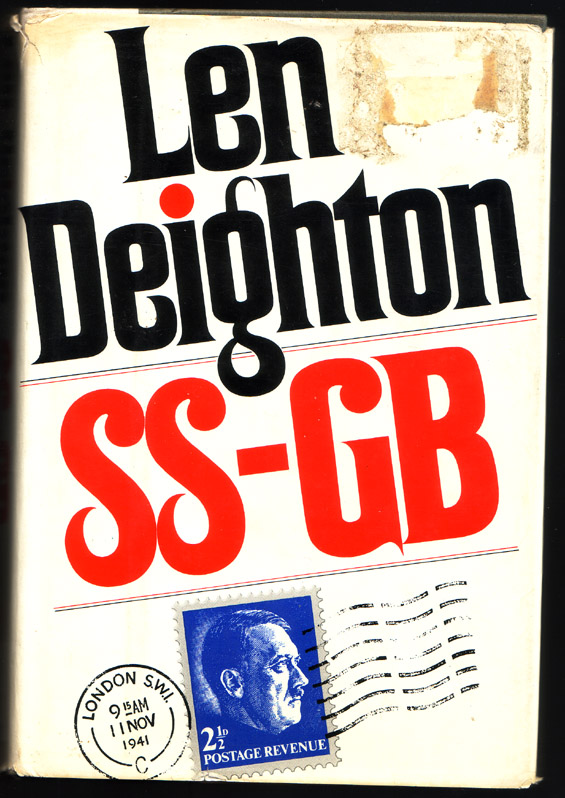
In SFFaudio Podcast #051 we talked to Professor Eric S. Rabkin. In that show he mentioned a novel which will be the subject of an upcoming SFFaudio Podcast readalong (scheduled to be recorded in mid-February). That 1978 novel is this book:
SS-GB depicts a Britian under Nazi occupation. It sounds rather similar to two other novels, Robert Harris’ Fatherland and Philip K. Dick’s The Man In The High Castle. More specifically, it is set in alternate history world in which Unternehmen Seelöwe (Operation Sea Lion) was a complete success. The novel begins in November 1941, nine months after a German invasion led to the British surrender. Detective Superintendent Douglas Archer, a British homicide detective assigned to Scotland Yard, is called in to investigate a murder.
Cool huh? I’m afraid that the audiobook is currently out of print – bringing it new attention may rectify that – but, the paperbook is readily available at paperbook stores.
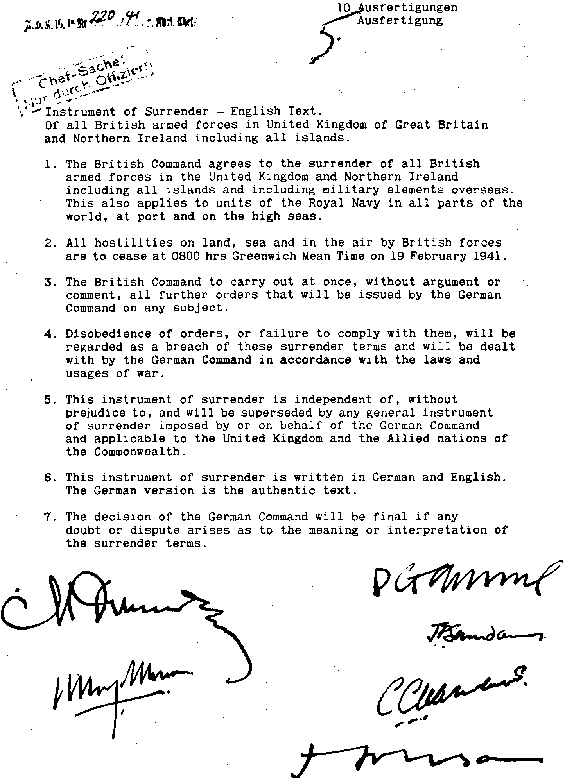
Here is the printed matter preceding Chapter 1 of SS-GB:
The SFFaudio Podcast #088 – Scott and Jesse talk about audiobooks, the recent arrivals and the new releases.
Talked about on today’s show:
Why was Scott gone?, Scott fought off a zombie apocalypse, an angry letter to Santa, Last Call by Tim Powers, Subterranean Press, On Stranger Tides, Bronson Pinchot, “gritty magic realism”, Scott likes lists, top 10 best horror novels, Ghost Story, The Stand, divinationary tarot cards, The Fisher King, “blended weirdness”, StarStruck, The Audio Comics Company, Starstruck’s Wikipedia entry, William Dufris, Simon Vance, Portland (Maine), Simon Vance’s YouTube, Infinivox, Starship Vectors, Stephen Baxter, Elizabeth Bear, Sarah Monette, Charles Coleman Findlay, Gwenyth Jones, Nancy Kress, Robert Reed, “spacey Science Fiction is very refreshing”, BoingBoing’s “The Beginning Of The End Of A Trend” post – is the death of Paranormal Romance approaching?, Brilliance Audio, The God Engines by John Scalzi, The Geek’s Guide To The Galaxy podcast, The Android’s Dream (as read by Wil Wheaton), Audible.com, Debt Of Bones by Terry Goodkind, the Legends anthology, Frank Muller, The Hedge Knight by George R.R. Martin, The Hedge Knight II, Legends II, Dreamsongs, Pump Six And Other Stories by Paulo Bacigalupi, The Fluted Girl, biopunk, Lord Of The Changing Winds: The Griffin Mage Book One by Rachel Neumeier, epic fantasy, Griffins, hard-boiled YA?, noir YA?, The Stainless Steel Rat Wants You by Harry Harrison, Gregg Margarite, the Stainless Steel rat is wry and slick and rascally, well written candy, West Of Eden, prehistorical Science Fiction, alternate history, Catalyst by Anne McCaffrey and Elizabeth Ann Scarborough, barking cats?, Scott is a cat person, Parasite Rex by Carl Zimmer, “Mood-altering cat parasites make women friendly and men into jerks”, fantasy, The Runelords: Book Four: The Lair Of Bones by David Farland, Shadowheart by Tad Williams, Dick Hill, The Habitation Of The Blessed by Catherynne M. Valente, Prester John, immortality, She: Who Must Be Obeyed by H. Rider Haggard, “the literal tree of knowledge”, A Dirge For Prester John, Patient Zero by Jonathan Maberry, “the fate of the world is always hanging in the balance” ,The Walking Dead TV vs. The Walking Dead comic, “a zombie movie that never ends”, Robert Kirkman‘s plan, reading contest, Robert Kirkman’s Invincible, upcoming readalongs: Gulliver’s Travels and Oath Of Fealty, Alas, Babylon by Pat Frank, On The Beach by Nevil Shute, Wil Patton, Neon Rain by James Lee Burke, Heart Of Darkness, Sherlock Holmes vs. Jack The Ripper, Time For The Stars, Will Patton, Richard Matheson, Somewhere In Time, Ross Macdonald, The New Adventures Of Mike Hammer, Stacey Keach, Max Allan Collins, SS-GB by Len Deighton, Fatherland, Eric S. Rabkin, “I don’t want to say I like Nazis”.


 Radio Drama Revival‘s Episode #221 features a short, but very moving, audio dramatization called Moon Graffiti. It depicts what might have happened one clear summer night in July, 1969. It is followed by an interview with Jonathan Mitchell, its producer.