Review of Legends II: Volume III

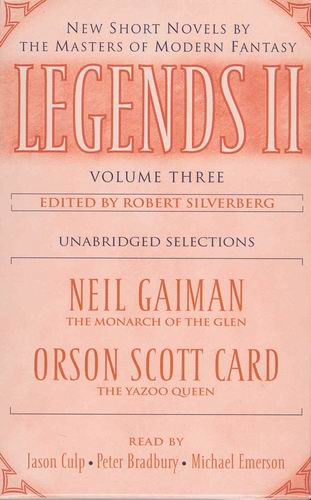
Legend II: Volume IIILegends II: Volume III
Edited by Robert Silverberg
Containing stories by Robert Silverberg, Neil Gaiman, and Orson Scott Card
Read by Jason Culp, Peter Bradbury, and Michael Emerson
4 Cassettes – 7 hours [UNABRIDGED]
Publisher: Random House Audio
Published: 2004
ISBN: 0739310860
Themes: / Fantasy / Majipoor / Mythology / Alternate History / Gods /

The cover of this audiobook prominently displays the names “Neil Gaiman” and “Orson Scott Card”, so I was a bit surprised to find a Robert Silverberg story leading off the collection. It probably shouldn’t have been unexpected, because a look at the back of the audiobook includes blurbs from all three stories – it’s just from the front, the audio appears to include two stories, not three.

“The Book of Changes” is set in Silverberg’s Majipoor universe and is a fine story about an epic poet’s discovery and subsequent writing of his masterwork. The story is steeped in the history of Majipoor, but is clear and enjoyable to a person unfamiliar with that history, as I am. Silverberg has created a world that is as much science fiction as it is fantasy. In Majipoor’s past, humans colonized then got into a war with the native inhabitants. These past events are discussed in Silverberg’s story, but the tale is firmly focused on the poet and the act of creation – something Silverberg knows much about. Jason Culp’s performance was near perfect.

The second novella in the collection is “Monarch of the Glen”, written by Neil Gaiman. The story starts in a hotel bar where Shadow (the main character from Gaiman’s American Gods) is talking to a Scotsman. It is immediately notable that the story is in good hands with Peter Bradbury, whose crisp, clear accents place the listener firmly in the setting which in this case is Northern Scotland. The scotsman offers Shadow a job as a bouncer, but Shadow knows that something is afoot beyond the obvious. Neil Gaiman provides a story that is just as mythic and mysterious and unexpected as his previous fiction. This is a Gaiman story through and through, which is as marvelous a thing as a visit from a good friend.

Last up is Orson Scott Card’s “The Yazoo Queen,” which is set in his Alvin Maker universe. It’s read by Michael Emerson, who performs a sort of old-west style voice which works very well with the prose Card writes with throughout the series – conversational with plenty of 19th century slang and pronounciation. THe story is a prologue to The Crystal City, the sixth novel in the series. In the story, Alvin Maker and Arthur Stuart meet Jim Bowie and Abraham Lincoln while travelling on the Mississippi River. Card’s world is early 19th century America where the Revolutionary War never took place and the magic (called “knacks”) that superstitious folks believed in back then really works. Alvin, the focus of all the stories, is a maker – he can see into things and change them, making them better. He’s chasing after the Unmaker and each volume in the series is building toward a confrontation between the two.

Another notable thing about this audio is that each story is preceded by a summary of what the series is all about. I found each one interesting – in the case of Silverberg’s Majipoor, it was all new information and in the case of the other two, it was a recap for me. But in all three cases it was very welcome.

Three very enjoyable stories read by three top-notch narrators – highly recommended!

Posted by Scott D. Danielson
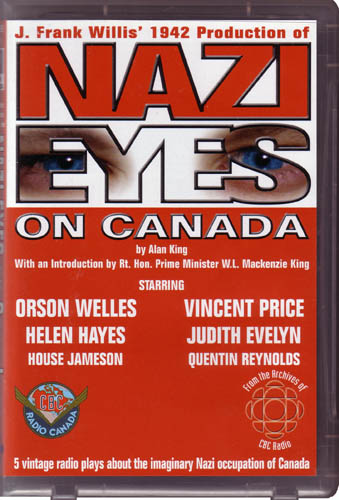
Review of Nazi Eyes On Canada Produced by J. Frank Willis

Nazi Eyes on CanadaNazi Eyes On Canada
Produced by J. Frank Willis; Performed by a FULL CAST
2 Cassettes – Approx 2 Hours [UNABRIDGED]
Publisher: Scenario Productions
Published: 2000
ISBN: 1894003136
Themes: / Science Fiction / Alternate History / World War II / Propaganda /

1942. From the West, from the East, the war draws near to Canadian shores. Canada is saying goodbye to her sons who are off to serve in all parts of the world. Taxes, the restrictions on unessential services, and the re-allocation of man power bring the war into the life of every Canadian. But Canadians are still living in relative luxury, and they still hold fast to the greatest of blessings – freedom. “Nazi Eyes on Canada” shows how all this would have changed in the Nazi lust for power on the North American continent had been fulfilled.

Nazi Eyes On Canada was a dramatized radio series produced by the Canadian Broadcasting Corporation (CBC Radio) during Canada’s fourth year in World War II. Its purpose was not so much to entertain as to sell war bonds, the rationale being ‘if you buy war bonds you’ll prevent the Axis powers from winning the war as depicted in these dramatizations’. The series was inspired by a German publication (contemporary to the time) written by a Nazi spy who used the alias “Colin Ross”. Ross traveled throughout Canada in the 1930s assessing the military and industrial capacity of Canada for a Nazi think tank. The purpose was to investigate first-hand the strategic requirements for an eventual North American invasion. Based on Ross’ reports, Nazi Eyes On Canada depicts exactly what such a Nazi occupation by the Third Reich would mean for the average Canadian. Broadcast over five weeks, each week looked at a particular province under the heel of the fascist jackboot: Episode 1: Ontario, Episode 2: Alberta, Episode 3: New Brunswick, Episode 4: British Columbia and Episode 5: Saskatchewan. Scenario Productions has also included a speech by then Prime Minister of Canada William Lyon Mackenzie King which serves as an introduction to the series.

This is one of the most unusual radio drama series I’ve ever heard. It puts big Hollywood stars, CBC staffers, and regular citizens together for each episode. CBC announcer Lorne Greene works with the likes of Helen Hayes, Quentin Reynolds, Vincent Price and Orson Welles! One factoid not mentioned in the liner notes of Scenario Productions’ two cassette version is that Orson Welles showed up late to the live broadcast of episode five. Welles had been at the rehearsal but at airtime he was nowhere to be found, so producer J. Frank Willis had to imitate Welles until he showed up during the third scene – something to listen for.

I found the series on the whole deeply disturbing. It was effectively scary and fascinating at the same time. But I have many reservations about it. Nazi Eyes On Canada is poorly written, jingoistic and commercial. The real life Canadian citizens (who get tell us their responses to the dramatization of their lives under Nazi occupation) read their lines woodenly. Much repetition is made with regards to the source material – to be expected I guess as they were originally broadcast a week apart. But the worst part of the experience was the blatant racism displayed during Episode 4. That episode is set in Vancouver, which in Colin Ross’ book would be given to Germany’s Axis ally the Empire of Japan, along with all lands west of the rocky mountains. So during Episode 4 we are invited to visit Vancouver under Imperial Japanese occupation. Unlike the Nazis who though are portrayed as thoroughly evil, the Japanese are painted evil by nature and are implied to be ‘a deceptive yellow race’. Such racist filth absolutely disgusted me.

But it wasn’t just this broadcast. During the time of the live airing of Nazi Eyes On Canada in 1942, widespread anti-Japanese sentiment in British Columbia led to internment of all Japanese males between the ages of 14 and 45. In 1942 Canada set up eight internment camps in the interior of British Columbia where over a nine month period 22,000 innocent Canadian Japanese were locked up for racist reasons. Make no mistake; it was racism pure and undiluted. German Canadians were not subjected to the same treatment.

So what exactly makes this science fiction?

Well for one thing Philip K. Dick’s excellent The Man in the High Castle uses the exact same premise and if that isn’t science fiction my name is J.R.R. Tolkien. The projection into the future as depicted in Nazi Eyes On Canada is an earmark of SF too. But most importantly this vintage radio drama series does what the greatest works of science fiction do; preventing the future. It’s a good thing so many Canadians bought war bonds, because expansionist fascism was defeated in no small part because of it. It is just too bad we didn’t have more science fiction dealing with racism before the Second World War. Science fiction isn’t a cure-all, but it is the vaccination against future horrors we can foresee. But you have to hear its message to be protected.

So keep listening and never forget.

Posted by Jesse Willis

Review of 84.2 Minutes with Algis Budrys

84.2 Minutes with Algis Budrys84.2 Minutes Of Algis Budrys
By Algis Budrys, Read by Algis Budrys
1 Cassette – 84.2 Minutes [UNABRIDGED]
Publisher: Unifont Company
Published: 1995
ISBN: 1886211019
Themes: Science Fiction / Interstellar Travel / War / Immortality / Post Apocalypse / Fairy Tales / Alternate History / Parallel Worlds /

The four stories in this rare collection are densely packed with terrific science fiction ideas and all four share a haunted bittersweet quality. Algis Budrys lets the power of his text completely rule over his performance. Budrys barely distinguishes between the characters; he reads it in an almost conspiratorial style saying, “If you don’t like them, there’s very little more I can say. But I secretly think you will like them, in which case there’s nothing much more I need to say”. His philosophy has extended into the production as well, this is a very utilitarian audiobook, pages can be heard turning in the background while he reads, the cover art is completely non-existent and the title is hardly evocative of much at all, but despite it all 84.2 Minutes Of Algis Budrys is a worthy addition to any science fiction audio fan’s library. The only hard part may be getting a hold of one!

Stories Included:

“The Distant Sound Of Engines”
Severely maimed in an automotive accident, a patient recovering in hospital listens as his roommate, a dying man spouts formulas for faster than light travel, the alloy specifications for ultra strong spacecraft hulls and everything else necessary to make humans an interstellar species. First published in The Magazine of Fantasy and Science Fiction’s March 1959 issue.

“Explosions!”
On a distant water-world that was long ago colonized by humans, a pirate king comes up with a plan to unify the many islands of his planet, and do it by force. “Explosions!” was written under the pseudonym William Scarff and first appeared in Tomorrow Speculative Fiction’s April 1993 issue.

“The Price”
The Earth’s civilizations have been destroyed, fewer than 100 people survive, mankind’s last hope is an enigmatic hunchback who’s been imprisoned for more than 150 years. He’d been chained in various dungeons or enslaved in forced labour camps, but when Europe was annihilated in a global war, and every person there was destroyed, he alone walked out. First published in The Magazine of Fantasy and Science Fiction’s February 1960 issue

“Never Meet Again”
England surrendered in 1940, by 1941 German U-boats ruled the Atlantic, by 1942 the Russian’s had surrendered at Stalingrad. Now fifteen years later a respected researcher in the Greater German Reich has finished his life’s work, a machine that can access alternate worlds. “Never Meet Again” was first published in the 1958 anthology The Unexpected Dimension.

Posted by Jesse Willis

Review of Voyage by Stephen Baxter

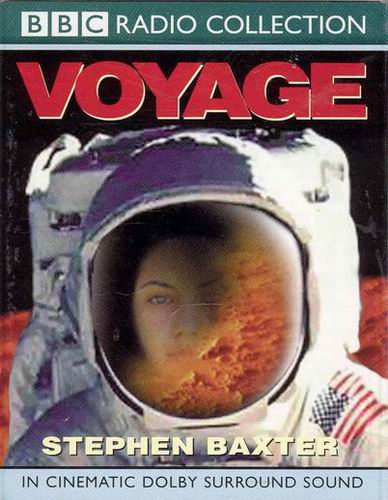
Science Fiction Audio Drama - Voyage by Stephen BaxterVoyage
By Stephen Baxter; Directed/Produced by Dirk Maggs, Performed by a Full Cast
2 Cassettes – 2 hours [AUDIO DRAMA]
Publisher: BBC Audiobooks
Published: May 1999
ISBN: 0563552417
THEMES: / Science Fiction / Alternate History / Space Program / Mars / Moon / Politics /

Voyage is a work of alternate history, in which the seed is President John F. Kennedy’s survival of the attempted assassination in Dallas in 1963. The impact of this historical change on the United States Space Program is the focus of the story.

In one of the many striking scenes in this audio drama, a wheelchair bound Kennedy joins president Nixon in the Oval Office in sending a message of congratulations to Neil Armstrong and crew during the first moon landing. But Kennedy takes it a little farther than a simple greeting – he challenges humanity to go farther. He challenges NASA to send people to Mars. Nixon at first is appalled, then goes along with the program after an aide tells him the voters love the idea.

The story is about the struggle from that point on to send people to Mars, building up to and including the story of Project Ares, which lifts off in 1986 with a three-person crew headed for Mars.

Dirk Maggs directed the production which was absolutely first-rate. I put on a pair of headphones and was instantly taken away to this alternate history. I enjoyed every minute of it. I’d even go so far as to say that it solidified the power of audio drama to my ears – I couldn’t help but to think of the many excellent works of science fiction that could – and SHOULD – be done in this medium.

I also agree with the message of the story. It’s a unconscionable that humanity reached the moon 35 years ago and has gone nowhere since. Let’s get on with our own history!

Posted by Scott D. Danielson

Review of A Green Thumb By Tobias S. Buckell

A Green Thumb
By Tobias S. Buckell; Read by Alexander Wilson
MP3 DOWNLOAD – 15 minutes, 21 seconds [UNABRIDGED]
Publisher: Telltale Weekly
Published: 2004
Themes: / Science Fiction / Alternate History / Genetic Engineering /

First published in Analog Science Fiction and Science Fact’s Jul/Aug 2002 issue, “A Green Thumb” posits an alternate world where consumer goods, like automobiles, are planted and nutured like trees instead of being manufactured. These plants grow directly into products, taking their final shape via genetic engineering. No chemicals or pollution, just sunshine and earth. Unfortunately, this short story is missing an interesting consequence or any sort of twist. Instead it relies on juvenile emotions for direction and energy. Like a sitcom without the humor, a family problem arises, a mild crisis ensues ending with a happy ever after resolution. Alexander Wilson’s reading was good with clear enunciation, though the characters voices could have used a little more distinctiveness. Available online at Telltale Weekly, “A Green Thumb” sells for only $.75 USD, merely the cost of a vended soda, making it a worthwhile listen.

Posted by Jesse Willis

Review of A Hero Of The Empire By Robert Silverberg

Science Fiction Audiobooks - A Hero of the Empire by Robert SilverbergA Hero Of The Empire
By Robert Silverberg; Read by George Guidall
Audio Download [UNABRIDGED]
Publisher: Random House Audible
Published: November 2000 – No Longer Available
ISBN: 0375417982
Themes: Science Fiction / Alternate History / Roman Empire / Islam /

A Hero Of The Empire is one of Robert Silverberg’s “Roma Eterna” stories, set in alternate history world where the Roman Empire never fell. A homosexual Roman nobleman is sent in punishment to a remote corner of the Empire – the Arabian city we know as Mecca. The time is 600 years after the reign of the Emperor Augustus – by this time the Empire has expanded to include the entire Arabian Peninsula. Written in the style of a letter to a dear friend, this novella is a fascinating examination of both Roman and Islamic history. George Guidall’s excellent reading infuses every word of this novella with his unique vocal magic. Audible’s recording is good, and even includes appropriate music, but the sound has been degraded by heavy compression – it sounds digitized. Unfortunately, and inexplicably, Audible.com has pulled A Hero Of The Empire from its catalogue and it is no longer available by itself. This was one of the best science fiction audio downloads ever available. And its disappearance from Audible.com makes me want to download and listen to all their titles immediately, for fear that they too will disappear!

NOTE: A Hero Of The Empire is no longer available singly, but is available as a portion of “Audible Exclusive Sci-Fi, Volume 1”.