Posted by Jenny Colvin
News, Reviews, and Commentary on all forms of science fiction, fantasy, and horror audio. Audiobooks, audio drama, podcasts; we discuss all of it here. Mystery, crime, and noir audio are also fair game.
Posted by Jenny Colvin


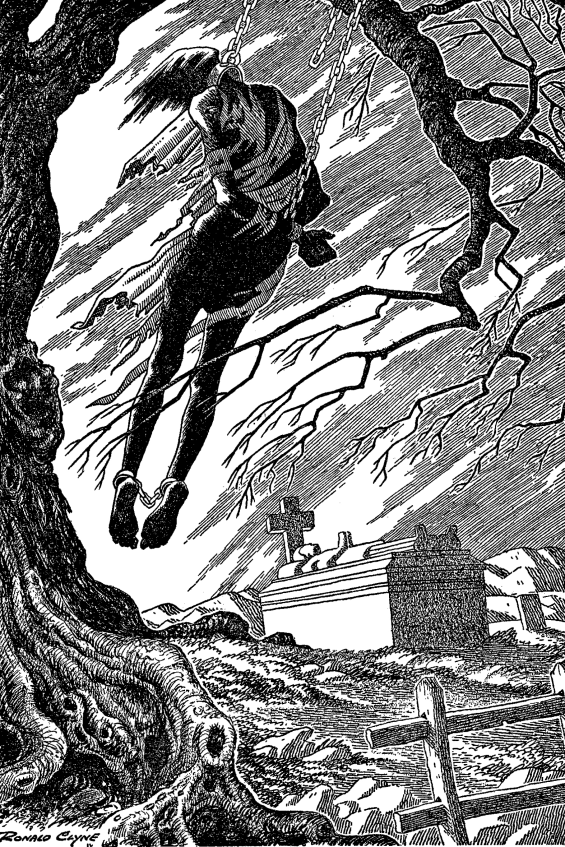
Sometimes titled The Highwayman, sometimes The Highwaymen, Lord Dunsany’s elegant prose poem is an 1,800 word tale about a scabrous gang of bastard highwaymen. And it has something for almost everyone.
I think, despite the sacrilege and desecration in the story, that my Christian friends will like it – it’s got a lot of that redemption stuff they are big on.
I’m confident that fans of capital punishment will like it – because it certainly doesn’t repudiate legalized killing.
And my friend, Gregg Margarite, who didn’t believe in any of the underlying mythology, liked it enough to read it for LibriVox.
And me?
Yep, I like The Highwayman too.
I like the overarching premise, about friendship, I think it’s heartwarming.
Plus it’s got lot of ghoulish shit in it, and I like that stuff too.
The Highwayman
By Lord Dunsany; Read by Gregg Margarite
1 |MP3| – Approx. 12 Minutes [UNABRIDGED]
Publisher: LibriVox.org
Published: January 13, 2010
First published in 1908.
Here’s a |PDF| made from the publication in Famous Fantastic Mysteries, December, 1944.
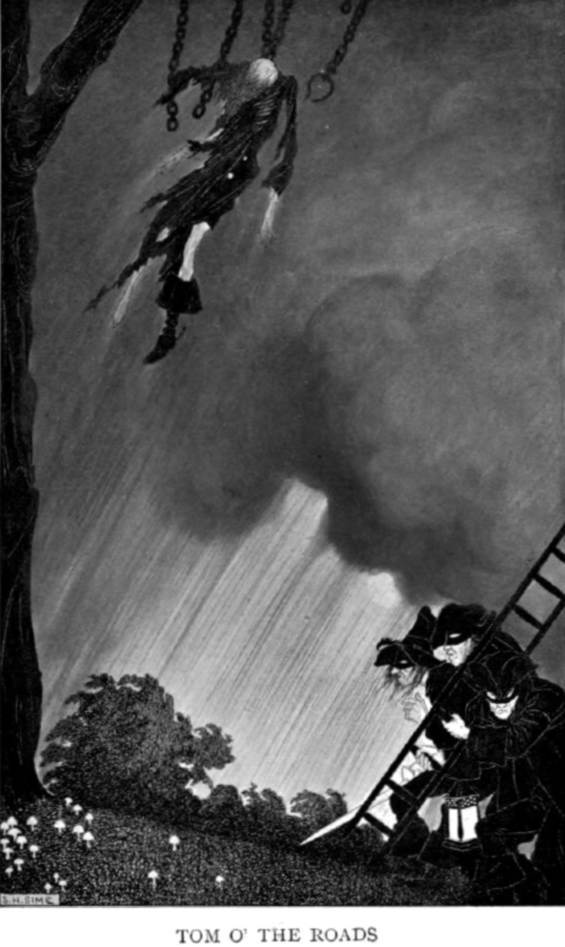
And here’s the Sidney H. Sime illustration from the original 1908 publication in The Sword Of Welleran and Other Stories:
Posted by Jesse Willis
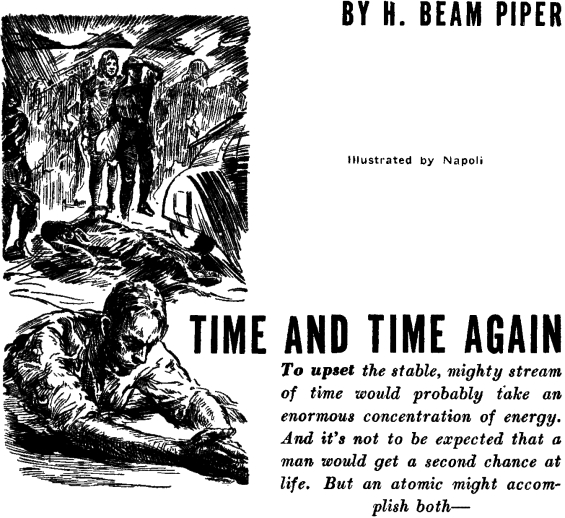

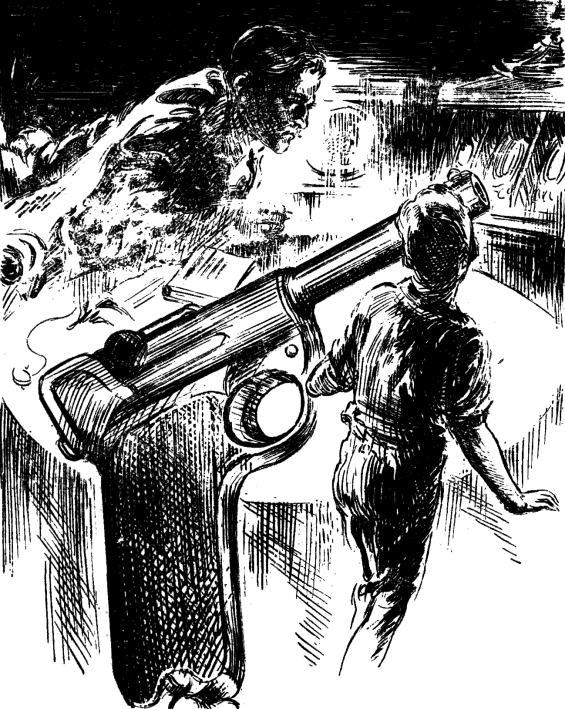
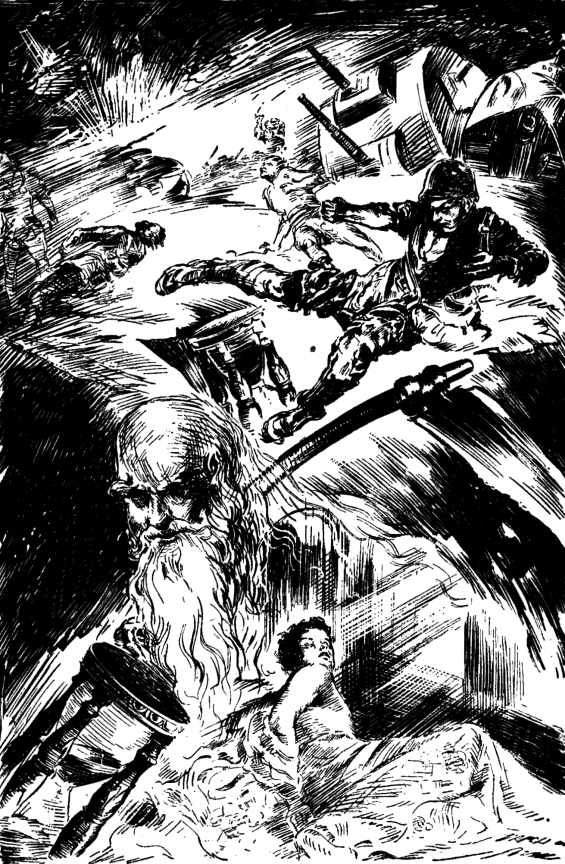
Time and Time Again was H. Beam Piper’s first published story. It first appeared in the April 1947 issue of Astounding Science Fiction. Time and Time Again features many of the themes of Piper’s later writing, including time travel, evidence of his electric reading habits, and a love of firearms.
Set in part during both WWII and WWIII Time and Time Again features time travel of the type made famous in both Back To The Future and Quantum Leap.
Time And Time Again
By H. Beam Piper; Read by Bellona Times
1 |MP3| – Approx. 45 Minutes [UNABRIDGED]
Publisher: LibriVox.org
Published: August 09, 2010
To upset the stable, mighty stream of time would probably take an enormous concentration of energy. And it’s not to be expected that a man would get a second chance at life. But an atomic might accomplish both— First published in Astounding, April 1947.
For some reason the ending to the X-Minus One version has been changed – to it’s determent in my view.
X-Minus One – Time And Time Again
Adapted from the story by H. Beam Piper; Performed by a full cast
1 |MP3| – Approx. 30 Minutes [RADIO DRAMA]
Broadcaster: NBC
Broadcast: January 11, 1956
A soldier is wounded in a future war and is transported back to 1945 when he was thirteen years-old with his future memory and past memory intact.
Here’s a |PDF| made from its appearance in Astounding.
One other interesting bit from the original story is the mention of a B-25 bomber crash into the Empire State Building, here’s a contemporary newsreel about that:
Posted by Jesse Willis

The Sum of All Men: Runelords, Book 1
By David Farland; Read by Ray Porter
17 CDs – 20.4 hours – [UNABRIDGED]
Publisher: Blackstone Audio
Published: 2008
Themes: / Fantasy / Epic Fantasy / Attributes / Magic / War /
I’ve read other works by this author, written under a different name, and I knew coming into this one that he was an excellent writer and storyteller. Indeed, I’ve heard him speak at conventions and workshops and have nothing but praise for him as a person and a writer.
That being said, I wasn’t sure what to expect from this book. Reading the dust cover is not always enough to know if you’ll end up satisfied at the end of the book or if you want to throw it across the room. (Okay, I’ve only thrown ONE book across the room. It was a paperback. I was so displeased with the denouement that I threw it away. I didn’t want to inflict that book upon anyone else.)
So, with a little trepidation I began to listen to the book. Could it live up to my high expectations? Would I be satisfied with the resolution? Would I want to read the next book? The answer was a resounding yes!
The book centers on Prince Gaborn Val Orden, son of Mendellas Draken Orden, king of Mystarria. He travels to Herredon to ask King Jas Laren Sylvarresta of Herredon for the hand of his daughter, Iome Sylvarresta. While en route he learns that Raj Ahten, king of Indhopal, who is also referred to as “The Wolf Lord” plans an attack on Castle Sylvarresta. Raj Ahten has taken over a number of minor kingdoms and is intent of conquering all of Rofehaven, taking endowments from as many people as he can so that he may become “The Sum of All Men,” a man who is invincible and immortal. As such, he wants to live forever and rule the world.
It is up to Gaborn, with the help and support of Iome, the Earth Warden Binnesman, Gaborn’s bodyguard Borenson and as many soldiers as he can gather, to stop Raj Ahten from achieving his goal.
Is the book good? Definitely. The characters are well developed. They have depth and personality. They are flawed. The world is rich in legends, heroes and chronicles of past events.
From time to time there will be an insert of a story from this history. It is a teaching moment, so the reader understands who the person is and why they are mentioned, or why an event is important, but it does so in a way that adds to the richness of the story. It builds on it, making the world live and breathe as much as the characters do.
The magic system is also impressive. Those who have the ability and training for magic can use the power of the elements to create magic. Runes are used to give endowments. A king or lord can take endowments from his subjects. Strength, stamina, wit, brawn, metabolism. In so doing they themselves have greater abilities, but the subject that gives an endowment must be cared for the rest of their life, or the life of their king. Such rulers are called “Runelords.” But the cost of such power is great and the reader gets a very real idea of what it costs the people who give such endowments.
There are few books that take the time to create a world that feels as real as this one does. Farland is so good at it that it feels effortless. He doesn’t beat you over the head with his world. Instead, it simply IS. You learn only what is necessary for the story, but you are left with the belief that there is so much more to the world if you had the time to explore it. He also uses herbs and herb lore to great effect. This is a world of magic, but it is also a world unique to itself.
I highly recommend this book. It’s a rich experience that will leave you both contented and wanting more. Which is a very good way to end the book. The book is not quite perfect, but on a scale of one to ten, I definitely give it a near-ten. Although I honestly don’t know if it could be improved upon.
Get the audiobook, get the book, and experience the magic of David Farland for yourself.
Posted by Charlene Harmon

The SFFaudio Podcast #183 – An unabridged reading of Out Of The Storm by William Hope Hodgson (10 minutes), read by Brian Murphy) followed by a discussion of it. Participants in the discussion include Jesse, Tamahome, and Brian Murphy.
Talked about on today’s show:
Stefan Rudnicki, Brian Murphy should peruse audiobook narration, Julie Hoverson (of 19 Nocturne Boulevard), The Frost Giant’s Daughter (aka Gods Of The North) by Robert E. Howard, William Hope Hodgson, the dragon, Gustav Dore, Leviathan, naturalistic vs. super-naturalistic, anthropomorphism, literal vs. metaphorical readings of the Bible, Thomas Hobbes, Behemoth, The Book Of Job, H.P. Lovecraft, The Statement Of Randolph Carter, wireless telegraphy, Supernatural Horror In Literature, Hodgson’s career in the merchant seaman, physical culture, photography, nautical phenomena, Edgar Allan Poe, like a nautical version of H.P. Lovecraft, Sargasso sea stories, is it merely madness?, a previously unreportable phenomenon, why doesn’t the scientist (John) respond?, an audio dramatization would be interesting, an extremely disturbing message, cosmic horror, the mother and the child, “like a foul beast”, contemplating the unimaginable, “God is not He, but It”, the universe is either cruel (Hodgson) or indifferent (Lovecraft), “her soul hideous with the breath of the thing”, spirit as breath, “this is the most horrific thing ever”, uncontrollable laughter, unstoppable, an undignified death in the face of an indifferent, the Titanic disaster, Schindler’s List, a greater good calculation, unconscionable selfishness, “to talk of foul things to a child”, the evil in itself and the evil of sharing the knowledge of that evil, Jaws, if this was a true account…, did Jaws cause Shark Week?, this guy is a little bit off, putting on a King James accent, skies the colour of mud, a sky monster?, aliens, Cthulhu, tentacles or waterspouts?, flotsam or an iceberg or a shark or just the waves themselves, “oh crap I’m nuts”, “tell her how it was”, is it like telling or not telling war stories?, clarity before death, so many ideas per square centimeter, Murf plays the Call Of Cthulhu RPG, sanity points, everybody loses, investigation vs. hack and slash, the Big Cypress Swamp, will acquaintance with Lovecraft’s stories harm or enhance your enjoyment of the game?, The Miskatonic University Podcast, “actual play” podcast, Skype of Cthulhu podcast, dice rolls on the honour system, Paranoia, Chaosium, The Horror On The Orient Express Kickstarter project, single player computer RPGs vs. pen and paper RPGs with real people, would Lovecraft play the Call Of Cthulhu RPG?, MMOs, World Of Warcraft, Dungeons & Dragons.


Posted by Jesse Willis

The Twelve
By Justin Cronin; Read by Scott Brick
CD or MP3 -[UNABRIDGED]
Publisher: Random House Audio
Published: October 16, 2012
ISBN: 9780307702043/9780739366523
Themes: / Vampires / Post-apocalypse / Virus /
Publisher summary:
The end of the world was only the beginning.
In his internationally bestselling and critically acclaimed novel The Passage, Justin Cronin constructed an unforgettable world transformed by a government experiment gone horribly wrong. Now the scope widens and the intensity deepens as the epic story surges forward with . . .
THE TWELVE
In the present day, as the man-made apocalypse unfolds, three strangers navigate the chaos. Lila, a doctor and an expectant mother, is so shattered by the spread of violence and infection that she continues to plan for her child’s arrival even as society dissolves around her. Kittridge, known to the world as “Last Stand in Denver,” has been forced to flee his stronghold and is now on the road, dodging the infected, armed but alone and well aware that a tank of gas will get him only so far. April is a teenager fighting to guide her little brother safely through a landscape of death and ruin. These three will learn that they have not been fully abandoned—and that in connection lies hope, even on the darkest of nights.
One hundred years in the future, Amy and the others fight on for humankind’s salvation . . . unaware that the rules have changed. The enemy has evolved, and a dark new order has arisen with a vision of the future infinitely more horrifying than man’s extinction. If the Twelve are to fall, one of those united to vanquish them will have to pay the ultimate price.
I wasn’t going to read this book. I wasn’t! I felt like The Passage was a well-contained story and I didn’t understand where else it could go. I will let the author explain what he focuses on in The Twelve, because I find it too difficult to summarize. (This is from an older post from 2010 on io9.com.)
The next two books each go back to Year Zero at the outset, to reset the story, and to deal with something you didn’t see and didn’t know was as important as it was. It’s not a linear quest story, which I would find dull and plodding. With each book, you need to have the narrative terms reestablished with fresh elements. Also, if you didn’t see [a character] die, they’re not necessarily dead. There’s a big cast in the first book, and plenty of unresolved stuff. I will resolve it by the end. [Early vampire character] Anthony Carter? No, not abandoning him.
In [The Twelve], you go back to what happened in Denver after the outbreak took place. The story will resume in that location a few days after breakout. So you can see another angle on what occurred and certain elements will affect our band of heroes 100 years in the future. It will be called The Twelve – and it’s not who you think.
This means that the story starts with where Amy is, and follows up with an assortment of other characters. Just like in The Passage, storylines are dropped completely as others are followed. Since I was listening to the audio, it was a bit more difficult to keep track of, just because it was harder to flip back and get a refresher on names, etc.
The author provides a lot more information about what happened to various people at the very beginning, explaining how some of the communities were formed, the horrific actions of the USA government (including events like “The Field”), and other parts of the novel jump around up to 97 years from when the virus originally took hold. This kind of information is usually my favorite part of post-apocalyptic stories – the rebuilding. What kind of societies form? How do they work? Who has control? I think Justin Cronin shows a lot of creativity and variety in these situations, since it isn’t just one story, but multiple. Many of the characters, locations, and situations overlap throughout the story, and I had this sense of the author as a puppeteer, drawing strings of stories around each other. Kudos to him that they never seem to tangle in disaster.
Scott Brick is the narrator for the audiobook of The Twelve, and does a fantastic job. He doesn’t bother doing a lot of voices, but his inflection is perfect. He has this ability to get out of the way of the story that I really appreciate when I’m listening. It just comes to life and I’m not constantly thinking of HIM, but of the story.
And The Twelve requires a lot of thinking and paying attention. The multiple story lines, the jumping around in time and history, and the sprinkling of quotations that Cronin throws in kept my attention. He started with a Mark Strand poem, almost as if I needed something to clinch whether or not I’d read this book.
I won’t have that dilemma for the final book. While this story has a satisfying climax, I was left with far more questions this time around. I’m not sure I know which side everyone is on. I’m not sure I even know what sides there are, anymore. What I am sure about is that this book is hard to put down.
Posted by Jenny Colvin