The SFFaudio Podcast #173 – AUDIOBOOK/READALONG: A Thousand Deaths by Jack London

Podcast

The SFFaudio PodcastThe SFFaudio Podcast #173 – A Thousand Deaths by Jack London, read by Julie Hoverson (of 19 Nocturne Boulevard). This is a complete and unabridged reading of the short story (29 Minutes) followed by a discussion of it. Participants in the discussion include Jesse, Tamahome, Jenny, Julie Hoverson, and Matthew Sanborn Smith

Talked about on today’s show:
Jack London’s first professional sale, “the hirsute fruit”, the LibriVox version, is the protagonist supposed to be female?, “I don’t know what’s real”, a disintegrated Saint Bernard, a Freudian story, The Island Of Dr. Moreau by H.G. Wells, vivisection on a South Pacific Island, a mad scientist, oedipal literature, London’s own life, H.P. Lovecraft, re-animation, archaic language, Frankenstein, a well educated sailor with an interest in science, obliquely obtuse, The Call Of The Wild, peregrinating, “overly smarty-pantsy”, is it all a dream?, a conscious death, horror, drowned sailors owe their revivers, Poultrygeist, the catalyst event, “an amoral scumbag”, Phineas Gage, blowing smoke up the near drowned, the disintegration door, Doctor Manhattan, Fallout: New Vegas, the disintegration ray, dis-integrate, anti-gravity, electrolysis, synthetic clothing, “animal charcoal”, The Shadow And The Flash is Jack London’s take on The Invisible Man, not just dogs and boats, London’s Polynesian stories, sink the Farallones, San Francisco, suspended animation, chest tampering, death vs. approaching death, drowning vs. poisoning, exploring the boundaries of death, Premature Burial by Edgar Allan Poe, zombies, coffin bells, meteor insurance, “I brought you in [to this world] and I can take you back out”, Bill Cosby, Jack London’s writing voice, action³, verb heavy vibrancy, a raging socialist, is it interesting or is it good?, lockjaw, psychological damage, the ending is ambiguous, a dilettante and a wastrel, do deaths mature you?, an inversion of the prodigal son, what would Eric S. Rabkin say about this story?, time travel, early Stephen King and Ramsey Campbell, H.P. Lovecraft, Edgar Allan Poe -> Fitz-James O’Brien -> Lord Dunsany -> William Hope Hodgson -> Ambrose Bierce, “gonzo”, “where do your ideas come from?”, There’s a Crapp For That, picturemypoo.com, eww, Flatliners, spiritualism vs. materialism, ghosts, patents, olympics, Julie Hoverson’s copyright, patent and trademarks podcast?, shotgun shelled powered battering ram, Julie Hoverson is incredibly busy, thanks Julie!, Jonathan Davis, “don’t surprise the actors”,

Posted by Jesse Willis

LibriVox: The Facts In The Case Of M. Valdemar by Edgar Allan Poe

SFFaudio Online Audio

LibriVoxIn my reading about The Frozen Pirate, back in 2010, I discovered that Edgar Allan Poe’s The Facts in the Case of M. Valdemar was possibly the first account of suspended animation.
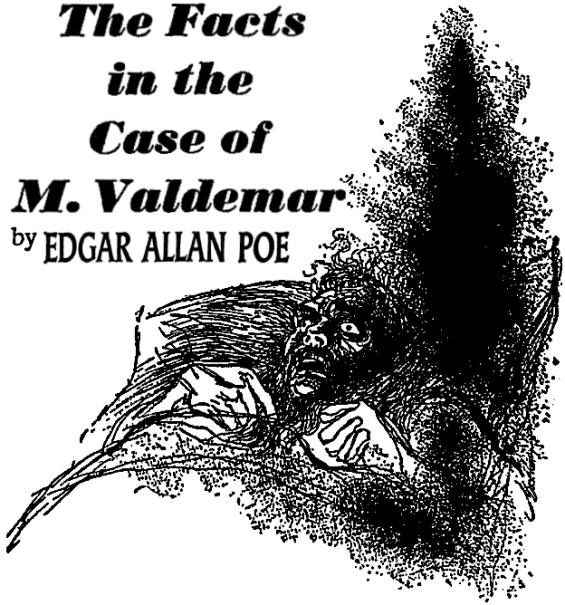
I normally mention The Case Of M. Valdemar as part of a set lecture I give, explaining to my students why root words are important. I start by asking them if they’ve read any Harry Potter. They usually have, and that’s when I point out that they know, just from the sound of his name, that Voledemort is a bad guy. I point out that J.K. Rowling chose this name carefully, even pointing out that “Voldemort is pronounced with a silent ‘t’ at the end, as is common in French.” I point out that Draco Malfoy’s name too, is just as connotatively powerful. Then I point out that J.K. Rowling didn’t invent these names in a vacuum. I point to Edgar Allan Poe’s The Facts In The Case Of M. Valdemar.

Hypnosis itself is a somewhat mysterious psychological phenomenon. It arose from the proto-psychological work of the 18th century physician Franz Mesmer. For those in the know “mesmerism” and “animal magnetism” had, by the time of Poe, lost most of their occult mystique. But for the general public, even today, there is a left-over supernatural feel – to the phenomenon – owing in part to the the strangeness of the phenomenon itself, and in part to Poe’s stories about it.

Etymologically the word itself, “hypnosis”, takes its name from Greek – “Hypnos” meaning “sleep” and the suffix “-osis” meaning “disorder” or “abnormal state”.

LIBRIVOX - The Facts In The Case Of M. Valdemar by Edgar Allan PoeThe Facts In The Case Of M. Valdemar
By Edgar Allan Poe; Read by Gregg Margarite
1 |MP3| – Approx. 22 Minutes [UNABRIDGED]
Publisher: LibriVox.org
Published: August 12, 2009
In an attempt to halt rumors surrounding a widely publicized incident, the author gives the facts about a grisly experiment in mesmerism that he recently conducted. First published in the December 20, 1845, issue of the Broadway Journal.

Here’s a |PDF| version of the story as taken from the April 1926 issue of Amazing Stories (the very first issue).

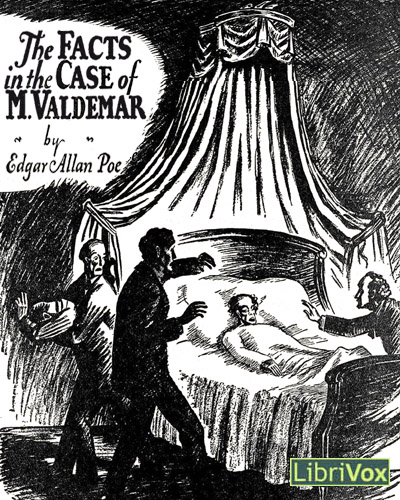
The Facts In The Case Of M. Valdemar - illustration by Irv Docktor

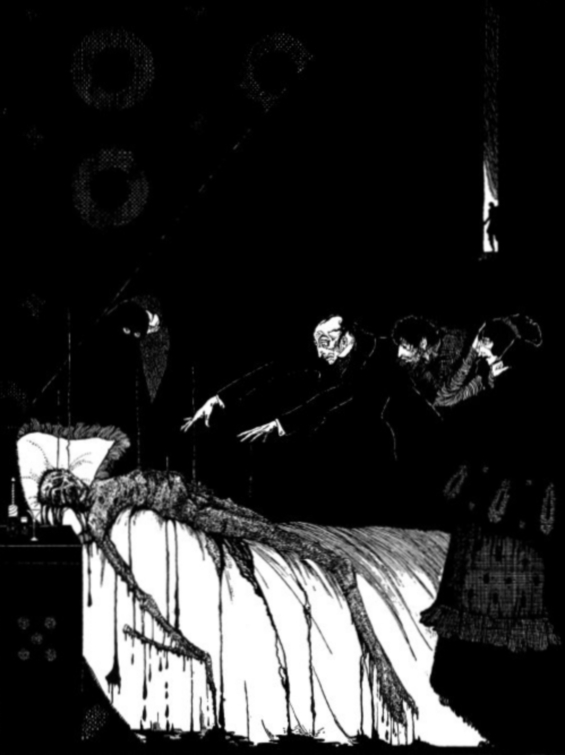
The Facts In The Case Of M. Valdemar - illustrated by Harry Clarke

Posted by Jesse Willis

Printable PDFs Posted

SFFaudio News

SFFaudio MetaI’ve created a PDF Page, that is a page full of printable PDFs. Most are short stories, most are in the public domain (in most places). There are more than fifty PDFs there. All ready for download and printing.

Now I’m afraid that most have no OCR. But on the other hand the files are unlocked and so you could OCR them yourself should you so desire.

It’s currently filed under out FEATURES page, but HERE‘s the direct link.

Please let me know if any of the files there don’t download.

Authors included:
Charles Beaumont, John Buchan, Ambrose Bierce, Ray Bradbury, Anthony Boucher, Emily Brontë, Lucy Clifford, John Collier, Philip K. Dick, Sir Arthur Conan Doyle, Laura Lee Hope, Robert E. Howard, W.W. Jacobs, Henry Kuttner, Jack London, H.P. Lovecraft, C.C MacApp, William Morrison, Fitz-James O’Brien, Edgar Pangborn, Edgar Allan Poe, Robert Sheckley, T.S. Stribling, Voltaire, H.G. Wells, and Manly Wade Welman.

Posted by Jesse Willis

The Dog And The Horse by Voltaire

Aural Noir: Online Audio

One of the earliest detectives in history, or at least the history of literature, is Zadig. Zadig is the main character of Voltaire’s philosophical novel Zadig; Or The Book Of Fate – An Oriental History. I stumbled across it’s existence while reading an old issue of Ellery Queen’s Mystery Magazine in which one chapter was featured under the title The Dog And The Horse. The brief editorial introduction, and some further researches on my own, assert that Zadig in this chapter may have been the inspiration for Edgar Allan Poe’s C. August Dupin!

I can sort of see it too, for The Dog And The Horse shows a kind of giant first step in an evolutionary process of the detective – seeing his marriage turn sour Zadig turns to the study of nature for his joy. A kind of passionate interest in the world is necessary for both the scientific detective and the more Sherlockian sort of detective.

The story is damn funny too.

LibriVoxThe Dog And The Horse
By Voltaire; Read by Lucy Burgoyne
1 |MP3| – Approx. 13 Minutes [UNABRIDGED]
Publisher: LibriVox.org
Published: January 31, 2008
First published in 1747.

|ETEXT|
|PDF|

Posted by Jesse Willis

The SFFaudio Podcast #166 – TOPIC: SFF FORMS (Short Story, Novella, Novellete, Novel, Fix-up, Trilogy, World)

Podcast

The SFFaudio PodcastThe SFFaudio Podcast #166 – Jesse, Luke Burrage, and Eric S. Rabkin discuss, at length, the SFF FORMS (Short Story, Novella, Novellete, Novel, Fix-up, Trilogy, World). Here’s the premise:

Science Fiction Forms: Short Story, Novella, Fix-Up, Novel, Trilogy, and World. Respectively, they might be exemplified thus: Short Story (“Mars Is Heaven!“), Novella (“Flowers for Algernon“), Fix-Up (The Martian Chronicles, which contains a revised version of “Mars Is Heaven!” or The Seedling Stars, Accelerando, and Beggars In Spain, all of which began as novellas), Novel (originals, like 1984, and derivatives like Flowers for Algernon or Varley’s novel Millennium coming from his short story “Air Raid“), Trilogy (original Foundation series), World (the ultimate Foundation world or Heinlein’s Future History [shared with others] or Banks’s Culture or LeGuin’s Hainish series [created just for the authors, but let’s not forget about fan fiction]). What are the special challenges and rewards in reading and writing in these diverse forms? What special challenges or rewards attend on reusing material in another form? Is the formal plasticity of SF unique among literary genres?

Talked about on today’s show:
Eric’s suggestion, literature with a capital “L”, The Dead by James Joyce, The Portrait Of The Artist As A Young Man, Doomsday Book by Connie Willis, Luke’s Science Fiction Book Review Podcast, the format, the themes, the variability of short story form, the feghoot, Day Million by Frederik Pohl, Accelerando, Stories Of Your Life And Others by Ted Chiang, The Tower Of Babel, stripped away vs. embellished to the nth degree, Flowers For Algernon by Daniel Keyes, Understand by Ted Chiang, The Bells by Edgar Allan Poe, The Black Cat, fantasy, the unexplicit story, valid reactions, the etymology of “text”, Earth Abides by George R. Stewart, a persuasive existential journey, The Scarlet Plague by Jack London, San Fransisco, short stories as objects of frivolity or training, the brilliance of an idea is not always enough, a novel can act as a community to an individual, Fahrenheit 451 by Ray Bradbury vs. The Fireman by Ray Bradbury, is the novel inherently more participatory than a short story?, the failure of technology vs. the power of nature, The Masque Of The Red Death, teaching Science Fiction with short stories and novels, The Science Fiction Hall Of Fame (Volume 1), the composite novel, Winesburg, Ohio by Sherwood Anderson, A.E. van Vogt, the fix-up, The Martian Chronicles by Ray Bradbury, Accelerando by Charles Stross, Lobsters by Charles Stross, the cat changes function, “an intellectual framework”, Robert A. Heinlein’s future history, the composite novel, Isaac Asimov, future history vs. psychohistory, Michael Moorcock, I, Robot, Robbie, the three laws, Stephen Byerly and Susan Calvin, unAsimovian assumptions, the full dose of SF, Reason, The Evitable Conflict, is Stephen Byerly a robot or a man?, the Mérode Altarpiece (a medieval iconographic trope), art history, Luke doesn’t think Asimov is that clever, R. Daneel Olivaw, the three laws are fairytale laws, positronic brains are positive, the three laws are for people (not just robots), The Bicentennial Man, Asimov’s powers, Asimov’s business acumen, Brandon Sanderson, shared worlds, gods, Mormonism, Daniel Clowes, The Death Ray, Elantris, “The Alexandria Quartet” by Lawrence Durrell, reading The Martian Chronicles backwards, Luke’s fiction, Alastair Reynolds, Sherlock Holmes, Baker Street Irregulars, whodunit ain’t the attraction, The Adventure Of The Speckled Band, a matter of cutting, A Clockwork Orange, it’s better without the extra chapter, the commercial effect (or the effect of commercialism), popular literature, the flabby novel, Robert J. Sawyer, Hominids, Calculating God, William Shakespeare, The Royal Ontario Museum, horse evolution, God needs a starship!?, where to find a paleontologist, “a hundred pages of nothing happening”, a circular argument, writing to the story’s demands, Kevin J. Anderson, commercial constraints shouldn’t be points of pride, the thickness of books, The Lord Of The Rings, does more succinct = more better?, novellas are novels with threads missing?, The Hobbit, the ambition of the author, Luke is rejecting the basic premise, The Stand by Stephen King, is it a better story short or long?, changes and updates and additional material, don’t let Asimov near a typewriter unless you want something written, Against The Fall Of Night by Arthur C. Clarke, The City And The Stars, expanding everything, Monster Story, “it came to me in a dream”, Minding Tomorrow, Nightfall (the short story) vs. Nightfall (the novel), “it’s a lot like a perfectly nice novel that eventually becomes a masterpiece”, The Lion of Comarre, it’s not a commercial podcast, a civil rowdiness, Eric’s Coursera course: Fantasy and Science Fiction: The Human Mind, Our Modern World, rechunking, forums, essays, 18,000 registered students, University of Michigan, only the competitors are qualified to judge the competitors, a history of the U.S. Civil War, Luke’s kitchen, grades, “there is no absolute abstract grade for anything”, Science Fiction and Politics (Courtney Brown), the governor of a steam engine, Luke confuses two professors, “yes, by golly, that was a very good thing of it’s kind”, The Odyssey by Homer, a foundational classic, The Bible, the Benjamin Franklin bible, there should be an SFBRP review of The Odyssey, Luke’s Matthew Mark Luke Skywalker, Star Wars, Joseph Campbell, time for coffee!

The Mérode Altarpiece

Startling Stories, November 1948 - Against The Fall Of Night by Arthur C. Clarke

Against The Fall Of Night by Arthur C. Clarke (page 11 of Startling Stories, November 1948)

Against The Fall Of Night by Arthur C. Clarke (page 12 and 13 of Startling Stories, November 1948)

Posted by Jesse Willis

Fantasy and Science Fiction: The Human Mind, Our Modern World with Eric Rabkin

SFFaudio News

Our good friend, Professor Eric S. Rabkin, is teaching one of the free summer Coursera courses. It’s entitled Fantasy and Science Fiction: The Human Mind, Our Modern World and all of the required readings, except for two of the novels, are available free online!

Here’s the official description:

Fantasy is a key term both in psychology and in the art and artifice of humanity. The things we make, including our stories, reflect, serve, and often shape our needs and desires. We see this everywhere from fairy tale to kiddie lit to myth; from “Cinderella” to Alice in Wonderland to Superman; from building a fort as a child to building ideal, planned cities as whole societies. Fantasy in ways both entertaining and practical serves our persistent needs and desires and illuminates the human mind. Fantasy expresses itself in many ways, from the comfort we feel in the godlike powers of a fairy godmother to the seductive unease we feel confronting Dracula. From a practical viewpoint, of all the fictional forms that fantasy takes, science fiction, from Frankenstein to Avatar, is the most important in our modern world because it is the only kind that explicitly recognizes the profound ways in which science and technology, those key products of the human mind, shape not only our world but our very hopes and fears. This course will explore Fantasy in general and Science Fiction in specific both as art and as insights into ourselves and our world.

This course comprises ten units. Each will include a significant reading, typically a novel or a selection of shorter works. I will offer video discussions of each of the readings and also of more general topics in art and psychology that those readings help illuminate. Each unit will include online quizzes and ask you to write a brief essay offering your own insights into the reading. In order, the units are:

Grimm — Children’s and Household Tales
Carroll — Alice’s Adventures in Wonderland and Through the Looking-Glass
Stoker — Dracula
Shelley — Frankenstein
Hawthorne & Poe — Stories and Poems
Wells — The Island of Dr. Moreau, The Invisible Man, “The Country of the Blind,” “The Star
Burroughs & Gilman — A Princess of Mars & Herland
Bradbury — The Martian Chronicles
LeGuin — The Left Hand of Darkness
Doctorow — Little Brother

In Unit I, the specific stories are the ones in the Lucy Crane translation (1886) which was published by Dover and is available online through Project Gutenberg (http://www.gutenberg.org/ebooks/5314). In Unit V, the specific readings are: Hawthorne’s “The Birthmark,” “Rappaccini’s Daughter,” “Dr. Heidegger’s Experiment,” and “The Artist of the Beautiful“; Poe’s “The Fall of the House of Usher,” “The Tell-Tale Heart,” “The Black Cat,” “The Facts in the Case of M. Valdemar,” “The Bells,” “The Raven,” “Annabel Lee.” All the readings except Ray Bradbury’s The Martian Chronicles and Ursula K. LeGuin’s The Left Hand of Darkness will be available online at no charge.

[thanks Jenny!]

Posted by Jesse Willis