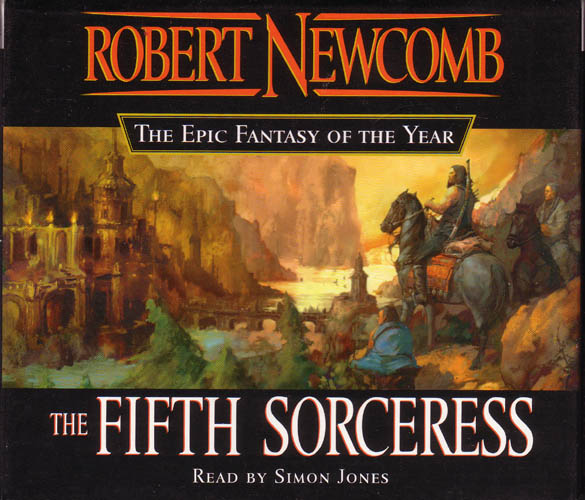
Review of The Fifth Sorceress by Robert Newcomb

Review

Fantasy Audiobooks - The Fifth Sorceress by Robert NewcombThe Fifth Sorceress
By Robert Newcomb; Read by Simon Jones
5 CDs – 6 Hours [ABRIDGED]
Publisher: Random House Audio
Published: 2002
ISBN: 0553713922
Themes: / Fantasy / Magic /

“It is more than three centuries since the ravages of a devastating war nearly tore apart the kingdom of Eutracia. In its wake, those who masterminded the bloodshed-a quartet of powerful, conquest-hungry Sorceresses-were sentenced to exile, with return all but impossible and death all but inevitable. Now a land of peace and plenty, protected and guided by a council of immortal wizards, Eutracia is about to crown a new king. And as the coronation approaches, the spirit of celebration fills every heart. Except one.”

Ya, mine! That’s mostly a joke, mostly. Overall this novel wasn’t terrible. I didn’t have my mind wander off too often, and whenever it did Newcomb would throw a shocking scene at it to bring me back. But I have a number of problems with The Fifth Sorceress:

1. It is yet another in the irrepressibly publishable world-saving magic fest novels. You know the kind where some editor says, “Wait I know, let’s tell another Tolkien story, but not do it as well.” Ya that kind.

2. The pseudo-mystic blood based magic system at the story’s core. This magic system has provenance which could have come straight from bullshit artist Madame Blavatsky. Untrue is not a possible criticism of fiction so I’ll just say “distasteful”. It might be possible or even interesting to tell a story like this straight faced, but it’d have to be with a damn impressive point to it. This didn’t.

3. Magic use. Generic and temporary bodily weakness seems to be the only consequence of the use of magic. Depressing in its unoriginality.

4. Women “of the blood” are always evil and men “of the blood” always good. So much for subtlety and complexity in gender relations. Newcomb could have done a lot more with his bifurcated magic system than making it bad girls vs. good guys.

5. The cookie-cutter world itself. Planets full of improbably named bodies of water and calcified quasi-medieval governments don’t do much for me – not after the 40 or 50th iteration of them anyway. Be more creative please.

Despite these problems there are some genuinely original and shocking scenes peppered throughout the novel and Newcomb handles these all well. Another point in its favor is that Newcomb doesn’t leave the reader hanging at the end, even though this is the first book in a series. Leaving us hanging is something he could have done in an attempt to get us to read the next installment in “The Chronicles of Blood And Stone” series. He leaves open the possibility for you to read on but doesn’t punish you by withholding an ending.

On the audio end, this is a fully digital recording so The Fifth Sorceress sounds phenomenal. But the real kudos goes to narrator Simon Jones (of The Hitchhiker’s Guide To The Galaxy fame) who does a fine job keeping the aural end up. When he voices the hapless Prince Tristan he invokes his old Arthur Dent persona. The centuries old wizard named Wigg sounds like a more put-upon Gandalf and most of the females voiced by Jones sound either wicked or seducing or both at the same time – a neat trick. If you’re in the mood for a light listen The Fifth Sorceress may suit you. Overall I really can’t say I hated it. I credit this mostly to the abridger. The abridgement may, in fact, have made an hefty and mostly indigestible novel far more palatable. After all that can you believe I’m going to attempt the sequel?

Posted by Jesse Willis

Review of Something Wicked This Way Comes (with A Sound of Thunder) by Ray Bradbury

Fantasy Audiobooks - Something Wicked This Way Comes by Ray BradburySomething Wicked This Way Comes (with A Sound of Thunder)
By Ray Bradbury; Read by Stefan Rudnicki
8 CD’s – 9.5 hours [UNABRIDGED]
Publisher: Blackstone Audio
ISBN: 0786175354
Date Published: 2005
Themes: / Fantasy / Halloween / Carnival / Magic / Supernatural / Aging /

Sometime each October, a line is crossed; the line between falling leaves and fallen leaves, between shirtsleeves and a jacket, between the relief that summer has ended and the slight dread of the upcoming winter. Most of us don’t really notice the moment of crossing; we look up sometime afterwards and wonder where all the pumpkins came from. Some people, though, are exquisitely aware of this moment; they live in it, they draw it out and savor it, and a special few of them create art about it that allows the rest us to actually experience it. Dave McKean captures it with his eerie photo collages, M. Ward puts his old-young-man voice to good use singing about it, particularly in a track called “One Life Away,” and Terry Gilliam almost-but-not-quite captured it on film in the recent The Brothers Grimm. Ray Bradbury did some of his best work while inhabiting it. In The Illustrated Man and The October Country, he told stories about people’s lives intersecting that weird border. In The Halloween Tree, he abandoned story for the most part, and spent his time describing the sensory experience of the moment of crossing. In Something Wicked This Way Comes, recently released as an audiobook by Blackstone Audio, he skillfully combined plot and description to examine this and life’s other unnoticed, but profound, sea changes.

Will Halloway and Jim Nightshade are the young protagonists of the story, best friends born just two minutes apart, but each on a different side of the line. Each of the boys personifies their respective border country; Will is blue-eyed and blonde, responsible, mannered, charming, the type of kid who looks like he was born wearing a scout uniform. Jim is darker, his eyes and his hair, but also his mood and personality. While it would be easy (and tempting) to say that Will is “better” than Jim, Bradbury shows his wisdom by describing the value of both of the boys’ attributes, how one, without the other, is vulnerable and incomplete, and how the different elements each boy bring to the friendship ultimately strengthen it.

The story follows Will and Jim as they cross a number of boundaries; the October line, the line between boyhood and adolescence, and the line between innocence and experience. The arrival of a strange carnival to the boys’ idyllic town complicates these passages. “Cougar and Dark’s Pandemonium Shadow Show” is indeed something wicked, and the danger it presents to the boys and their town makes for an engaging, suspenseful tale.

Audiobook veteran Stephen Rudnicki reads Something Wicked, and gives a largely enjoyable performance, with only a few rough spots. Listeners familiar with Rudnicki will understand that dialogue between two pubescent boys isn’t exactly the perfect material for his sonorous voice. Everything is forgiven, however, when Mr. Dark makes his entrance. Rudnicki’s reading of the tattooed ringmaster’s introductory sentence literally gave me chills. Mr. Cougar, the Dust Witch, and the rest of the Shadow Show freaks are also done justice by Rudnicki’s interpretations.

Blackstone Audio seems to have heard my pleas for more DVD-type extra features on audio books, and have included an extra disc with a Bradbury short story, “A Sound of Thunder,” also read by Rudnicki. The story, a powerful exploration of the dangers of time travel, was recently made into a motion picture starring Edward Burns (and almost universally panned).

An interesting element of this audio book is that, whether by accident or design, the discs almost invariably ended at a point of terrific suspense. Rather than simply turning a page to assuage my anxiety about the fate of the characters, I was scrambling to eject discs, open cases, balance discs on my various fingers and insert new discs. Call me a masochist, but I thought it actually made the experience more enjoyable. Even listeners who don’t share my Hitchockian penchant for prolonging a story’s tension will have a hard time finding a better group of guides than Bradbury, Rudnicki, Jim, Will, and Mr. Dark for this year’s passage over that peculiar line.

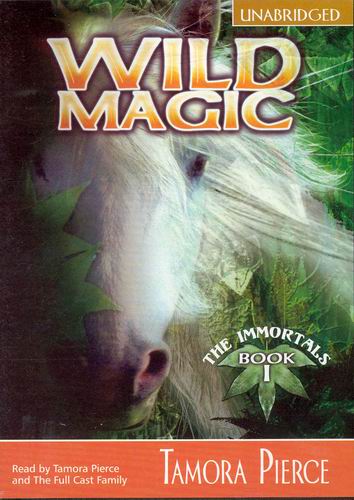
Review of Wild Magic (The Immortals, Book 1) by Tamora Pierce

Fantasy Audiobooks - Wild Magic by Tamora PierceWild Magic (The Immortals, Book 1)
by Tamora Pierce, read by Full Cast Audio
8 CDs – 8 Hours [UNABRIDGED]
Publisher: Full Cast Audio
Published: 2005
ISBN: 1932076832
Themes: / Fantasy / Magic / Wizardry / Youth / Magical Creatures / Horses /

In Wild Magic’s Book One: The Immortals, Tamora Pierce has created a cast of strong women and made a world in which they fit naturally. The whole book takes place from the point of view of Diane (Carmen Viviano-Crafts), a young girl escaping from a dark secret in the highlands. Daine hires on with a horsetrader, Ouna (Raquel Starace) How delightful to meet a female horsetrader in a fantasy novel. Too often, such strong female characters overplay their roles but each of the characters in Wild Magic seems balanced and very real. So it troubles me that I felt like Ms. Pierce was playing games by withholding information that Daine surely knew, especially because she does such a delightful job at inviting me into Daine’s thoughts.

I do not mind the tension she tried to create by keeping Daine’s “dark secret” from me at the beginning, but after a time, it began to wear on me. I spent chapters hearing Daine’s thoughts about how she had to escape her past, without ever knowing what that past was. I finally discovered that she had gone mad and was afraid that it would happen again. Once I knew that, I was able to really worry with Daine. But poor Daine wouldn’t tell her friends what was bothering her. While I can understand her reluctance, as the book continued she was given no reason to continue hiding her secret and plenty of reasons to ask for help. When she finally does reveal her past in all its gory detail, Numair the Mage, basically says, “Oh, well I can fix that.” And does, in two sentences.

So, after all of that build up, Daine’s problem is solved with, almost literally, the wave of a magic wand.

In a similar vein, I listened to paragraphs of buildup as something was attacking the band of travellers over the water without having a clue about what it was. I knew everyone was preparing for an attack. I knew people were frightened, but I had no idea why. It turned out to be a gryphon that Daine was able to befriend.

With that said, the world of Wild Magic is fascinating. I am curious about which of the threads in this volume will carry over to the next books. Many of the scenes were resonant with emotion, I just wish I hadn’t had to guess what was happening in so many of the others.

Full Cast Audio does a fantastic job of bringing Ms. Pierce’s book to audio life. In particular, I need to note Daniel Bostick who played Numair the Mage. His voice built pictures in my head every time his character spoke.

Posted by Mary Robinette Kowal

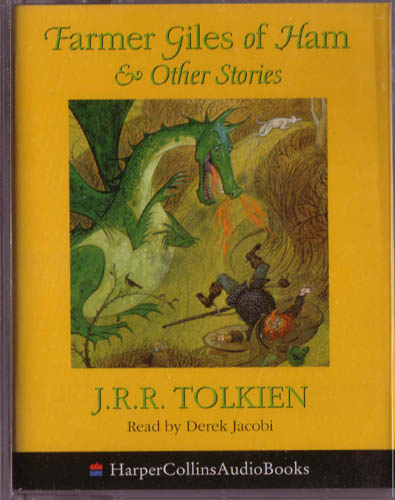
Review of Farmer Giles of Ham & Other Stories by J.R.R. Tolkien

Fantasy Audiobook - Farmer Giles of Ham by J.R.R. TolkienFarmer Giles of Ham & Other Stories
By J.R.R. Tolkien; Read by Derek Jacobi
2 Cassettes – 3 hours [UNABRIDGED]
Publisher: Harper Audio
Published: 1999
ISBN: 0001056107
Themes: / Fantasy / Dragons / Giants / Magic / Humor / Art /

*Includes three tales from The Perilous Realm:

Farmer Giles of Ham
One of Tolkien’s most popular stories. Full of wit and humor and set in the days of giants and dragons, it tells the tale of a reluctant hero Farmer Giles, his grey mare, and his talking dog Garm, who all three conspire to save Ham and the middle kingdom first from the a deaf giant and again from the dreaded dragon Chrysophylax.

Smith of Wootton Major
Tells of baking a Great Cake to mark the Feast of Good Children and the magical events that follow.

Leaf by Niggle
Recounts the adventures of a painter trying to capture a tree on canvas.

A wonderful treat for the lovers of Tolkien. Though far overshadowed by his stories about Hobbits and rings the author of The Lord Of The Rings and The Hobbit also wrote some great short stories, and here they are! Three amusing and interesting stories, by the greatest English fantasist since William Shakespeare. If you enjoyed The Lord Of The Rings for more than the battle scenes you should definietly try this two little cassette package on for size. Performed by Sir Derek Jacobi, best known for his role in “I, Claudius”, this is a skillful reading that transforms each character into a person, even the dog in the title story has his own voice. Jacobi captured my attention fully, I was really delighted to have a performer of such skill as his read it to me. Worth hunting down!

Posted by Jesse Willis

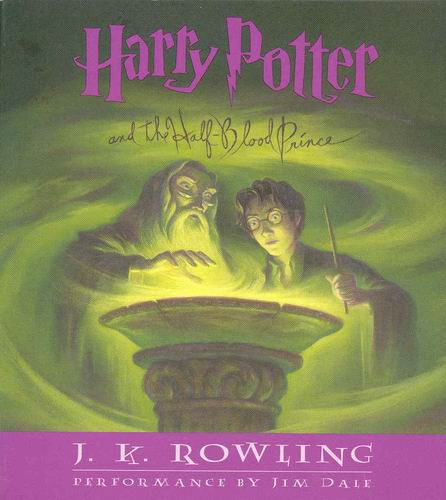
Review of Harry Potter and the Half-Blood Prince by J.K. Rowling

Fantasy Audiobooks - Harry Potter and the Half-Blood PrinceHarry Potter and the Half-Blood Prince
By J.K. Rowling; Read by Jim Dale
17 CDs – 19 hours [UNABRIDGED]
Publisher: Listening Library
Published: 2005
ISBN: 0307283658
Themes: / Fantasy / Magic / Wizardry / Youth / Magical Creatures / School /

At this point, the Harry Potter universe has become so entrenched in our culture that it’s impossible to approach the newest installment of the series, Harry Potter and the Half-Blood Prince, with anything like objectivity. Most readers already care so much about Harry and his associates that the reading experience has become less like enjoying a good novel and more like continuing the biography of a good friend or beloved celebrity. Which isn’t to say that The Half-Blood Prince isn’t a good novel; on the contrary, it ranks right up there with The Prisoner and Azkaban and The Goblet of Fire, and is a damn sight better than 2003’s gloomy and ultimately disappointing The Order of the Phoenix. For those of us who feel better when things are given in Star Wars terms, The Half-Blood Prince is most similar to The Empire Strikes Back; it advances and complicates our views about the series and its characters, while apparently moving backward from the hero’s inevitable triumph over the villain.

In The Half-Blood Prince, author J.K. Rowling maintains her own tradition of opening the novel without the titular hero in sight. In this case, the muggle Prime Minister of England is anxiously awaiting a visit from the Minister of Magic and reminiscing about their previous, mostly unpleasant, meetings. When Cornelius Fudge arrives, he brings news that the wizarding world is in an uproar; Lord Voldemort is apparently growing more and more powerful, Voldemort’s followers, the Death-Eaters are becoming more brazen in their attacks, and wizards, witches, and muggles are all at increasing risk of severe harm or death.

While Rowling never mentions real-world events in the books, the tone and situations of the two novels published since 9-11 indicate that the world inside her head is not completely insulated from the world outside. It’s telling of Rowling’s own views that the Ministry of Magic is, at best, ineffectual in dealing with these threats, and is often outright dangerous; in The Half-Blood Prince, the Ministry of Magic detains individuals it knows to be innocent, in order to give the appearance of making some progress against the enemy.

The initial expository scene, combined with a tantalizingly ambiguous revelation about one of the Hogwart’s professors, makes for such a dark opening that it’s an almost tangible relief when Harry finally makes an appearance. The likeable young wizard is now 16 years old, and Rowling has again taken pains to ensure that the novel has matured along with Harry. Passages dealing with the magical comeuppance of the Dursleys, the pointless ins and outs of Quidditch matches (why bother with anything but the snitch?), and the minutiae of wizard candy are fleeting and widely spaced, while more chapters are devoted to fairly violent magical battles (a faithful movie adaptation could very well garner an “R” rating), career counseling, and “snogging,” (making out, for those of us on the Yankee side of the pond).

Once the novel starts in earnest, Rowling doesn’t stray from Harry’s point of view, but she cheats somewhat by using the “pensive,” a magical device that allows Harry to explore the memories of others. The pensive is put to good use in the book, as its main function is to investigate the background of “He-who-must-not-be-named.” Readers who are hoping for a complicated, even sympathetic, take on Lord Voldemort (ala Thomas Harris’s Red Dragon) will be disappointed. It turns out that Voldemort is just plain bad, always has been, and apparently, always will be. More psychopath than sadist, Voldemort never hurts or kills just for enjoyment, his villainies are always means to an end. Voldemort’s particular brand of evil means that the guilt that might be expected to accompany these activities just isn’t there.

Other magical items are used less effectively in the story. An episode involving a bottle of “liquid luck”, called “felix felicis,” (the letters of which do not rearrange to spell deus ex machina) feels so contrived, requires a such a lengthy and complicated set-up, and requires Harry, Ron, and Hermione to act so outside their characters, that it’s one of the few times the book feels like something that somebody made up, rather than a description of actual events.

All told, however, the sixth installment in the Harry Potter series is excellent, and the unabridged recording of the novel makes for a very enjoyable listen. The folks at Listening Library made an inspired choice when they chose Jim Dale to read The Sorcerer’s Stone, and, five books, two Audie Awards, five Headphone Awards, three Grammy nominations and one actual Grammy later, his performance of The Half-Blood Prince is, to borrow a word from Harry, brilliant. Even without sound effects, music, or multiple actors, The Half-Blood Prince plays like a good BBC radio drama. Dale lends nuance and individuality to each of the characters, while his “normal,” narration voice is dignified, yet accessible. Dale also has an uncanny knack for interpreting speech adverbs; where Rowling writes “reprovingly,” or “reminiscently”, Dale puts reproach or reminiscence into the dialogue, so much so that very often the listener will be able to predict Rowling’s choice of adverb before Dale reads it. Maybe the highest compliment that can be paid to the audio book is that at no point is the reader reminded of the sub-par (but increasingly better) film adaptations of the books. While listeners who desire an experience closer to reading, with more neutral performances that allow for more personal interpretation, might resent having Dale’s vigorous interpretation thrust upon them, most listeners, particularly younger ones, will enjoy all 19 hours of Harry Potter and the Half-Blood Prince.

Review of Imagination X: The First Album by Jeffrey Adams

Science Fiction Audio Drama - Imagination XImagination X: The First Album
By Jeffrey Adams; Performed by a Full Cast
1 CD – 1 hour [AUDIO DRAMA]
Publisher: Bud C. Productions
Published: 2003
ISBN: 0974201200
Themes: / Fantasy / Horror / Ghosts / Artificial Intelligence / Dreams /

If you are a fan of Twilight Zone fiction, you are going to enjoy Imagination X. There are eight dramatized stories included in this 1-hour album, each performed by a full cast:

“The House in the Woods” – A woman is haunted by visions in her dreams of a house in the woods.

“Box Love” – A hilarious look at love between two artificially intelligent kitchen appliances.

“Up on the Rooftops” – Something’s moving up on the roof – is it Santa Claus?

“Background” – A researcher goes to a haunted house and tape records notes while he looks around. But the tapes contain more than his voice…

“Mandible Hill” – Do you know what the person sitting next to you is capable of?

“The Prisoner” – A tortured soul cries out his torment – or does he?

“Distance” – A space traveler deals with his computer which is also trying to deal with him.

Find this audio at Bud C. Productions – you’ll be glad you did. The website leaves quite a bit to be desired, but there is some interesting information there. If you click on an episode, you can find some of Jeffrey Adams’ notes on the production along with cast info. A piece of data I found interesting: The computer voice was played by the ‘Speakable Items’ function of my iMac computer, the existence of which was the inspiration for the episode, and, to some extent, for the entire series.

I enjoyed the time I spent with these stories, and am looking forward to more from Jeffrey Adams and crew.

Posted by Scott D. Danielson