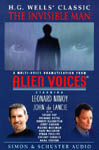
Review of Alien Voices: The Invisible Man

Science Fiction Audio Drama - Alien Voices The Invisible ManAlien Voices: The Invisible Man
By H.G. Wells; Performed by John de Lancie, Leonard Nimoy and a full cast
2 Cassettes or 2 CDs – Approx. 114 minutes [UNABRIDGED DRAMATIZATION]
Publisher: Simon & Schuster Audio
Published: 1998
ISBN: 067158104X (Cassette); 0671581058 (CD)
Themes: / Science Fiction / Invisibility / Fantasy / Star Trek / Classic / Philosophy /

One of Science Fiction’s seminal works is The Invisible Man by H.G. Wells. It’s premise is intriguing. What would it be like to be hidden from view? At first, there would be the advantage of watching others without being noticed. But, what would you do when the novelty wore off and the invisibility didn’t? Would you become a prisoner of your own freedom? Or perhaps a madman bent on enslaving others?The novel was written in 1897 when the world believed that science could cure all ills, but as we will glean from the story of The Invisible Man, the achievements of the human mind are worthless without a human soul to guide them. Come with us now, as Alien Voices explores the tragic life of a young scientist who seemed to be on the threshold of a brilliant future and something quite unexpected happens.

This loose adaptation of H.G. WellsThe Invisible Man is quite…fascinating. It has been adapted in the style of an old time radio drama, the majority of the plot is there, but it has been compressed and massaged to fit the actors and sensibilities of the Alien Voices team. Alien Voices formed in 1996 to create multi-media works of science fiction and fantasy, drawing upon the copyright expired classics and the languishing resources of the Star Trek alumni. Its three founding members are actor/director Leonard Nimoy, actor/director/writer John de Lancie, and writer/producer Nat Segaloff. de Lancie and Nimoy headline the dramas, in this case playing the title character and his university professor respectively. The rest of the cast is rounded out by: Susan Bay, Richard Doyle, Robert Ellenstein, Jerry Hardin, Marnie Mosiman, Kate Mulgrew, Ethan Phillips, Dwight Schultz and Nana Visitor.

This production is very good, the sound effects, voice talent and music are all very well done. The script is quite different from the original novel, but those modifications are very well done. The packaging is merely adequate, a traditional cd jewel case, a cardboard box and some quickie photoshop art. But most conspicuous by its absence is a cast and character list. The cast is named at the end of the program, but we are never told which actor is playing which character. It is easy to tell Ethan Phillips and Nana Visitor, but its hard to identify many of the others. Of the other actors the only one who sounded at all familiar was one who sounded like Mark Twain. A little investigation, and I determined that it was likely Jerry Hardin who played Twain in Star Trek: The Next Generation‘s two part episode Time’s Arrow!

The story itself has been modified and compressed, most of the original Wells’ version of The Invisible Man remains in this production. H.G. Wells is best remembered for The War Of The Worlds, which itself was adapted very early on by Mercury Theater and Orson Welles. That adaptation and a later film version had a  lasting impact upon popular culture, making the idea of “alien invasion” almost synonymous science fiction, at least to the majority who don’t read it. But science fiction isn’t always about the future, or about space travel, or aliens invading the Earth. Sometimes it is subtler, and in the case of The Invisible Man, it proves itself deeply rooted in philosophy.

Those who examine science fiction closely will see a profound connection between science and philosophy. In the case of The Invisible Man, Wells started to explore what would be necessary for invisibility to work, (for it to be rooted in science and not merely magic), AND to explore the consequences of invisibility actually working. But Wells himself was drawing upon resources of an even earlier time. In the philosopher Plato’s famous book The Republic (itself a work of proto-science fiction), we are introduced to Gyges, a shepherd who finds a magic ring which can turn him invisible. Gyges soon discovers that he can act unjustly without anyone knowing. For Plato this was a story to make us think about what being just and injust really is. For Wells and Alien Voices it is more about telling a good story. But a little philosophy does manage to sneak into the plot; For the Invisible Man, invisibility is power, and possessing that power he can do a great many things, like get revenge. But revenge is hindered by a few stumbling blocks, first he has to go out naked, his clothing isn’t invisible so he can’t wear it. He can’t eat or smoke or walk in dusty areas, all of those things make him visible. Also he can’t carry anything, so if he steals money (he can’t earn it), it appears to float about of its own accord, making people chase after him! It is almost as bad as king Midas’s dilemma, like Midas, The Invisible Man got his wish but it isn’t quite working out for him. Dust and moisture make his body visible in a ghostly way. His footprints appear in the dirt and snow. Oh yes and the small matter that the accumulated effect of these things has driven him to the edge of madness.

I liked the story, but I was constantly reminded of one glaring problem not mentioned in production. Wouldn’t an invisible man also be blind? If his corneas are absolutely transparent and his retinas are absolutely transparent, how would light be turned into mental images? The answer…. they wouldn’t be! An invisible man would be blind! For us to see the world a fraction of the light that hits our retina must be absorbed into our rods and cones, our corneas must focus the light. This issue made the whole story so implausible, in my mind it made me question whether this was science fiction at all! Thankfully I got over it. And have come to realize that even if it is flawed by this oversight, at least it demonstrates that philosophical fiction like all good science fiction is able to make us think out problems that don’t seem obvious at first. Who’d have thought invisibility would require blindness? Not me, at least not before listening to Alien Voices: The Invisible Man.

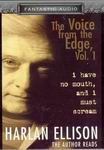
Review of The Voice from the Edge Vol 1: I Have No Mouth and I Must Scream by Harlan Ellison
Science Fiction Audiobooks - The Voice from the Edge Vol 1 by Harlan EllisonThe Voice from the Edge Vol 1: I Have No Mouth and I Must Scream
By Harlan Ellison; Read by Harlan Ellison
5 CD’s – 6 hours [UNABRIDGED]
Publisher: Fantastic Audio
Published: 2002
Themes: / Science Fiction / Fantasy / Short Stories / Artificial Intelligence / Time / Demons /

This is a collection of Harlan Ellison’s best (well… most popular) stories. The most oft-reprinted tales are here, among them: “I Have No Mouth and I Must Scream”, “‘Repent, Harlequin,’ Said the Ticktockman”, “Paladin of the Lost Hour”, and “A Boy and His Dog”. The stories are read by the author, who himself is a first-rate reader, lending an infectious energy to every story in the collection.

I personally know of no other author’s stories with which to compare Harlan Ellison’s. He’s arguably the finest writer of short fiction on the planet, building stories of great impact in such a short space. In “‘Repent, Harlequin'”, he gives us a parable of society’s dependence on the clock, making schedules look ridiculous enough to make one wonder what the heck we’re all doing. And this was written in the 1960’s! In “Paladin of the Lost Hour”, a man is given responsibility over the world’s last hour. The characters in “I Have No Mouth and I Must Scream” are trapped by a malevolent computer. These are great stories, every one. I thoroughly enjoyed this collection.

Stories included in the collection: “I Have No Mouth and I Must Scream”, “Laugh Track”, “Grail”, “‘Repent, Harlequin,’ Said the Ticktockman”, The Very Last Day of a Good Woman”, “Paladin of the Lost Hour”, “The Time of the Eye”, “The Lingering Scent of Woodsmoke”, and “A Boy and His Dog”.

Review of The Wind from a Burning Woman by Greg Bear

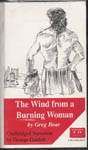
Science Fiction Audiobooks - The Wind from a Burning Woman by Greg BearThe Wind from a Burning Woman
By Greg Bear; Read by George Guidall and Christina Moore
7 Cassettes – 10 Hours [UNABRIDGED]
Publisher: Recorded Books
Published: 1992
ISBN: 1556907672
Themes: / Science Fiction / Fantasy / Terrorism / Asteroids / Metaphysics / Religion / Utopia / Dystopia / Future City / Cloning / Aliens

This superior anthology collects several early Greg Bear stories. The narrators, George Guidall and Christina Moore, guide us skillfully through Bear’s dense prose and do so with obvious relish. This collection features only top-notch stories — any single tale alone would be sufficient evidence that Bear is a future Grandmaster of science fiction and fantasy. Bear’s later novels occasionally suffer from a density that makes reading difficult. Very little of this is evident in this collection. The stories are generally clear in the telling, and where they are not, the confusion is brief. The wholly original and infinitely interesting ideas contained within each story make worthwhile any brief confusion of style.

The Wind from a Burning Woman, the title story, was later to serve as a prequel to Bear’s novel Eon, and describes the possible consequences of the ultimate act of terrorism.

The White Horse Child is an great allegory about a curious young boy who will grow up to become a writer. Written in a style that owes a debt to Clifford D. Simak, this pastoral fantasy story is an instant classic. Petra is a very unusual fantasy tale, its religious theme tackles the hard boiled consequences of taking certain biblical prophecies events as actual future events. So brilliantly does it achieve originality it reminds us why Greg Bear is so exceedingly interesting to read.

Scattershot is my personal favorite in this collection. Its sheer inventiveness and exploration of the consequences of metaphysical physics makes it a fascinating listen.

Mandala is an almost satiric examination of the far end of the curve of utopian ideals. It could almost be thought of as Greg Bear’s take on Arthur C. Clarke’s The City and the Stars.

Hardfought is a Hugo-winning novella that follows the viewpoints of both the aliens and the humans in their interstellar war. It could be considered Greg Bear’s take on Robert Heinlein’s Starship Troopers or Joe Haldeman’s The Forever War. In order to fight their battle, humans have adapted in strange ways. It’s an absolutely fascinating read.

Stories included:
The Wind from a Burning Woman
The entire crew of Psyche, an asteroid turned into a spaceship, is murdered. Giani, the granddaughter of the project’s administrator commandeers the spaceship in an attempt to uncover the truth.

The White Horse Child
An odd allegory about a boy becoming a writer. God fearing, book burning, censoring Auntie Dancer tries to stop a child from becoming a storyteller.

Petra
“God is Dead”, when stone comes alive after reality rearranges itself. Petra is a half-caste, a lowly figure in the world of the cathedral. His father was a living statue, his mother a human nun.

Scattershot
Francis Geneva finds herself allied with a robotic Russian teddy bear after her starship has an accident. She and her new companion are forced to explores the consequences of the many-worlds interpretation of quantum mechanics. In a reality where every possibility exists coping can be quite stressful. Sometimes the aliens are from Earth.

Mandala
In order to become perfect the sentient cities of Earth cast off their final flaw, the problem causing people. Mandala explores a future where mankind has reverted to a stone age existence after losing access to their technology.

Hardfought
Insular aliens known as the Sylexy are at war with humanity, in an attempt to understand their strange enemy they capture and clone a human soldier.

Review of The Hedge Knight by George R.R. Martin

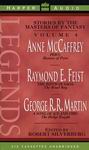
Science Fiction Audiobook - Legends 4The Hedge Knight
Contained in: Legends: Stories by the Masters of Fantasy, Volume 4
by George R.R. Martin; Read by Frank Muller
4 Cassettes [UNABRIDGED]
Publisher: Harper Audio
Date Published: 1996
ISBN: 0694521132
Themes: / Fantasy / Knights / Jousting / Court Intrigue /

I’m not a big epic fantasy fan. I have nothing at all against them – it’s just that I enjoy good science fiction more than I enjoy good epic fantasy. I’ve read and enjoyed Tolkien, then the first three books in Terry Brook’s Shannara series… with that my appetite for epic fantasy novels was sated.

But then came George R.R. Martin. Several people told me to read the first book in his A Song of Ice and Fire series, A Game of Thrones. I finally picked up the thousand-pager, and am now hooked, impatiently waiting for Martin to finish the fourth book (of six!) in the series.

The Hedge Knight is a short novel set in the A Song of Ice and Fire series, but well before the events in the first novel. We follow the travels of Dunc, a squire to an aged hedge knight. When this hedge knight dies in the middle of nowhere, Dunc takes on the role of knight himself and gets into trouble when he crosses a prince at a tournament.

Like the the larger series, The Hedge Knight is filled with interesting, realistic characters, none of which are all good or all bad. There is plenty of intrigue and political maneuvering along with the medieval action.

The story is ably performed by Frank Muller, who’s considerable skill along with Martin’s excellent prose makes this recording one I return to again and again.

The Legends 4 audiobook also contains a Pern story by Anne McCaffrey and a Riftwar story by Raymond Feist.

Review of Eaters of the Dead by Michael Crichton

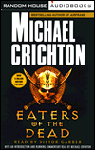
Fantasy Audiobooks - Eaters of the Dead by Michael CrichtonEaters of The Dead
By Michael Crichton; Read by Victor Garber and Michael Crichton
2 cassettes – 3 hours [ABRIDGED]
Publisher: Random House Audiobooks
Published: 1998
ISBN: 0679460330
Themes: / Fantasy / Historical Fiction / Alternate History / Vikings / Arabs / Mythology / Neanderthals / Epic /

In the year A.D. 922, Ibn Fadlan, a devout Muslim nobleman, left his home in Baghdad on a mission to the King of the Bulgars. During his journey, he met various groups of “barbarians” who he reported as having varying degrees of bad hygiene and alcoholism. It was a classic clash of cultures story that revealed more about both societies than any other type of narrative could. Whilst encamped in a Norseman trading village word came of a request for warriors to return to Scandinavia to battle an unnamed foe. Because the Norsemen were so superstitious, Fadlan was shanghaied as the “13th warrior”, a necessary foreigner, and forced to accompany the war party. Under the leadership of Buliwyf, Fadlan and eleven other Norsemen journeyed far to the North, to a land where the nights last only a few minutes, where sea monsters abound in the oceans and where shimmering lights in the sky are a nightly occurrence. Once there he and his companions must fight a battle against the Eaters Of The Dead.

If the premise is familiar it may be because you’ve seen the movie “The 13th Warrior,” which is based upon this novel. Supposedly this is a true story taken from the journals of an Arab courtier named Ahmad Ibn Fadlan. In reality it is only partially based on those writings. Crichton wrote Eaters Of The Dead based on a bet. He argued that Beowulf, the oldest surviving epic in British literature, could be successfully turned into a satisfying adventure story. In the real life writings of Ibn Fadlan Crichton found a viewpoint chracater who’d be able to witness the adventure of Beowulf and his fight against Grendel first hand. Starting with actual journal entries from Ibn Fadlan, Eaters Of The Dead begins as non-fiction. About a third of the way into the reading, Crichton stops using Fadlan’s journals, starts writing in the style of Fadlan, and begins telling his version of Beowulf. Sounds simple, but because Crichton doesn’t tell us any of this in his introduction, it isnt.

Confusing things further, Victor Garber’s reading of the story is interupted every so often by commentary by Michael Crichton! Crichton doing commentary on Crichton confuses things to a high degree, and yet somehow it works! This is a compelling story, likely because it draws so heavily from the deeply rooted mythology including snippets of ideas from everything from J.R.R. Tolkien’s The Hobbit to modern anthropological theories regarding the extinction of the Neanderthals.

Victor Garber does a good job reading, his only flaw is that his Arbaic accent sounds a bit to much like a Punjabi accent. Crichton too reads his commentaries well. As with many abridgments this one leaves the listener wanting more of the story, though thankfully it doesn’t suffer from the equally common failing of being incomprehensible.

As with all Michael Crichton novels, this turns into a Frankestienian morality tale in the vein of “there are some things men wernt meant to know”. For the most part it works, but what bothers me most about Eaters Of The Dead is its fence sitting nature. Not strictly fiction nor strictly non-fiction, Crichton has chosen to deliberately blend the reality and the fantasy without any disclaimer of even the most generous “based on a true story” or even the weaker “inspired by true events”. Instead he deliberately tricks us into thinking this is a true story by interspersing his own commentaries about the translation! True stories are inherently more interesting than fiction, no doubt Crichton chose to capitalize on this by deliberately obscuring the fact that he basically made up the whole last 2/3rds of the book! Had there been a disclaimer about this at the beginning of the book I’d have been much happier with it. That said, the story is fun, an interesting ride, and certainly one of Crichton’s best novels, but it isn’t even in the same class as say Robert Silverberg’s terrific A Hero Of The Empire, which also deals with historical figures in ancient Arabia.. If you absolutely insist on reading Michael Crichton novels I’d recommend you actually NOT read his Science Fiction! Read his fantasy, read Eaters of The Dead and then if you want a non-SFF treat try Crichton’s admirable The Great Train Robbery (also based on a true story), which is far better than his constant rehashing of Frankensteinian plots about cloning, time travel, etc.

Review of Dark Tower II: The Drawing of the Three by Stephen King

SFFaudio Review

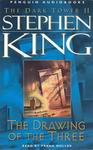
The Dark Tower II: The Drawing Of The Three by Stephen KingThe Dark Tower II: The Drawing of the Three
By Stephen King; Read by Frank Muller
Publisher: Penguin Audiobooks [UNABRIDGED]
Date Published: November 1997
ISBN: 0140867155
Themes: / Fantasy / Parallel worlds /

This is the second book in Stephen King’s Dark Tower series. I read the first volume a few months ago (in print) and found it very different from Stephen King’s other work. To start with, it was not set in our world, where King sets nearly all of his novels. This volume is set both in the wasteland of the first novel and this world. King expertly uses the setting along with his unforgettable characters to explore the notions of Good and Evil in a grand fashion.

The main character in the books is Roland, a gunslinger, possibly the last gunslinger, who travels in a world separate but somehow connected to our own. This second volume starts within hours after the first ends. Roland is required to draw three people from our world into his to help him on his quest to reach the Dark Tower. If none of this makes sense, that’s okay. I’m hesitant to provide too much detail. It is enough to say that what you have here is a contemporary fantasy novel written by one of the finest creators of believable characters in fiction.

And Frank Muller does the narrating. I’ve never been disappointed in a Muller narration, and this certainly is no exception. His voice is perfect for this material – I imagine Roland’s voice to be Muller’s – and the great energy which he provides this novel probably made it more interesting than it actually was. Several times when listening time came to and end, I took an extra lap around the block or listened for an extra ten minutes… and Muller’s reading is as responsible for that as King’s writing.

I am definitely a Stephen King fan. I enjoy nearly all of his stories. My favorites are from his early career, The Stand and Salem’s Lot especially. Neither of those have audio versions, unfortunately. (Well, there is a version of The Stand available from Books on Tape, but it is not the complete version of the novel that King released later in his career.)

For more info on the Dark Tower series, check the Dark Tower Compendium.