Wireless Theatre Company + Moonlight Audio Theatre: Burke And Hare

SFFaudio Online Audio

Up the close and doun the stair,
But and ben wi’ Burke and Hare.
Burke’s the butcher, Hare’s the thief,
Knox the boy that buys the beef.
—19th-century Edinburgh skipping rhyme

Burke And Hare

There may never have been a blacker comedy than this horrifying (and horrifyingly funny) audio drama about a pair of real life murderers. William Burke and William Hare apparently killed sixteen people in the early 19th century selling the corpses to an anatomist named Dr. Robert Knox.

This audio drama, which I found in the Moonlight Audio Theatre podcast feed, is well written, smartly acted, and full of ripe innuendo. Burke And Hare is clever and creepy. If you’ve seen the 1999 horror/comedy film Ravenous, also based on a true story, you know how disturbing this kind of mix can be.

Moonlight Audio TheatreBurke And Hare
By Terence Newman; Performed by a full cast
2 MP3 Files – Approx. 77 Minutes [AUDIO DRAMA]
Podcaster: Moonlight Audio Theatre
Podcast: June 2013
This is the story of the infamous 19th Century Scottish Grave-robbers who weren’t Scottish and didn’t rob graves. They were actually Irish and as robbing graves to supply the needs of Edinburgh’s anatomists proved to be rather hard work, they just took to murdering people – usually their neighbours – for profit. In collaboration with their common-law wives they set about supplying corpses for Dr John Knox an eminent Scottish surgeon with considerable enthusiasm and gusto. The play follows their business exploits from small beginnings, through their days of peak output to the final reckoning – set against a world that is becoming recognisably modern.

Part 1 |MP3|
Part 2 |MP3|

Podcast feed: http://moonlightaudio.libsyn.com/rss

Starring:
Rob Crouch
Jonathan Clarkson
Genevieve Swallow
Holly McLay
Clive Greenwood
Neil McCormack
Adam Hall

Edited by: Joe Siddons
Directed by: Robert Valentine
Music by: Adam Bernstein

Posted by Jesse Willis

Review of The Invisible Hook: The Hidden Economics of Pirates by Peter T. Leeson

SFFaudio Review

AUDIBLE - The Invisible Hook by Peter T. LeesonThe Invisible Hook: The Hidden Economics of Pirates
By Peter T. Leeson; Read by Jeremy Gage
Audible Download – Approx. 7 Hours 41 Minutes [UNABRIDGED]
Publisher: Audible, Inc.
Published: September 4, 2009
Themes: / Economics / Piracy / History / Slavery / Democracy / Anarchy /

Pack your cutlass and blunderbuss–it’s time to go a-pirating! The Invisible Hook takes readers inside the wily world of late seventeenth- and early eighteenth-century pirates. With swashbuckling irreverence and devilish wit, Peter Leeson uncovers the hidden economics behind pirates’ notorious, entertaining, and sometimes downright shocking behavior. Why did pirates fly flags of Skull & Bones? Why did they create a “pirate code”? Were pirates really ferocious madmen? And what made them so successful? The Invisible Hook uses economics to examine these and other infamous aspects of piracy. Leeson argues that the pirate customs we know and love resulted from pirates responding rationally to prevailing economic conditions in the pursuit of profits.

I love non-fiction, and I love books that look at history, books that look at history through one lens or another are even better! And so there is much to love in The Invisible Hook. The title is a play on Adam Smith’s elegant metaphor for how markets work, the invisible hand. Most of the examples cited deal with the Atlantic and Caribbean pirates, rather than earlier Roman era or modern day pirates. But we get a sense of how it likely worked in other regions and times. Chapters on the paradoxical attitudes towards pirate slavery, the wildly contradictory stories about piratical impressment, and the chapter on the Jolly Roger, the pirate flag, are absolutely fascinating. And, as something of a piratical hobbyist myself, I’m pleased to report they deliver clear insights only hinted at in other non-fiction books about piracy. You know you’ve got a good book in hand when you find yourself relating the premises, arguments, and conclusions of whole chapters to friends.

How good is the analysis really? That’s kind of hard to tell. Democracy and equality as a function of economics? Wonderful! Seems logical, seems plausible. And that’s the sort of thing you don’t hear often enough. Indeed, economist Steven Levitt, of Freakonomics fame, gets a shout out early on in The Invisible Hook. This is a book in that vein, a kind of entertaining pop-economics, well written, and very thoughtful. But it also boasts the same kind of inarguable psychohistory-style post-analysis of such books. It reminds me of books like William Rosen’s The Most Powerful Idea in the World, and Jared Diamond’s Collapse. Well written history looked at through the lens of a soft science makes the seemingly inexplicable events of history seem almost inevitable. That is to say, this book should be just one of many such on such topics. In the end though how can you not wanto to read a book that makes piracy, as depicted in The Princess Bride, actually very plausible?

But this is not as merry a ship as it might be. As with many book published these days, there’s some bit of puffery. Concepts well illustrated in a paragraph or two are revisited, whole passages nearly reworded, and I’m betting that this for reasons of market driven economics. It might be that each chapter can be looked at on it’s own, textbook style, but listened to as I did, back to back the chapters have a tendency to revisit the same ports too often. This is one of my major complaints about books these days. Too many books are being published with too many words that don’t say different things. At under eight hours even this relatively slim volume, by today’s market standards, but it’s still puffier than any pirate’s shirt really ought be. It is like a pirate cutter on the stalk, slowed down by a sea-anchor of unneeded repetition. Saying the same thing over and over and over. Get my point? Okay, its the market, and to be fair Adam Smith’s own The Wealth Of Nations is a bloody long book, 36 hours! I’d be willing to bet my strong right arm that the original article, as published by Levitt (mentioned in the book), would be an even better audiobook than this very fine one, and no doubt it’d measure at least a peg leg shorter.

Narrator Jeremy Gage is from the old school of audiobook narration, the kind I like. He doesn’t so much as perform a book as read it. His conspiratorial tone typically him a great choice for first-person POV novels, like Lawrence Block’s Burglars Can’t Be Choosers. This is the first non-fiction book I’ve heard him narrate. So now I can say he’s great for non-fiction too.

Posted by Jesse Willis

The SFFaudio Podcast #207 – READALONG: Galactic Pot-Healer by Philip K. Dick

Podcast

The SFFaudio PodcastThe SFFaudio Podcast #207 – Jesse, Julie Davis, and Rose Davis talk about Galactic Pot-Healer by Philip K. Dick.

Talked about on today’s show:
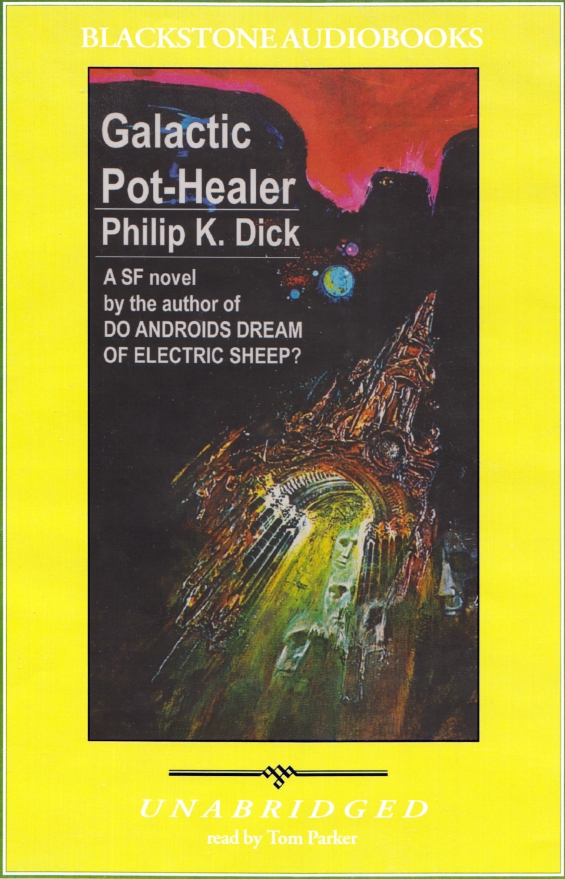
the premise, a Lovecraftian monster, malign desires upon the Earth, The Call Of The Cthulhu, H.P. Lovecraft and Philip K. Dick, dead and not dead, city vs. cathedral, what if Cthulhu was a nice god?, Robert Sheckley, Voltairian style of comedic adventure, even the ending is a joke, super-depressing dystopian earths, “a machine-like” state of being, everyone in the book is suicidally depressed, the Glimmung, everyone is afraid of failure, I want you to map all the themes and the rising action, an existential book, the value and importance of work, the best pot-healer on Earth, failed marriage, “the game is so depressing”, clever but not uplifting, this is about our society (Twitter and podcasts), totally relevant for the internet age, Molly Yoyez, Richard Matheson’s repeated theme of the disconnection between people, “he you should listen to my podcast”, at least you can laugh, the last line of the book, the best of them, instead of just fixing or healing what is broken he is becoming a creator, “the pot was awful”, Philip K. Dick’s personal relationship with religion, history, church history, Roman history, wordplay, the meaning of “Mare Nostrum”, medicine of secret composition a placebo or patent medicine, to give them hope, agape, keritas, Happy Catholic, a body of Christ analogy, the power of Jesus, Christ stands empty handed, pointless existence, existential ennui or a disaffection with a lack of meaning in the universe (going back to Lovecraft), a symbolic version of deep time, a Jungian interpretation, the collective unconscious, is Joe Fernwright trying to find his soul?, his dead self, come to terms with death, “it’s your corpse”, “I have a box I’ve made”, it’s a coffin, distraction, the book title game, there are more allusions per square inch than other novels, Faust, albatrosses, “what Christ really was”, Willis the robot, unlimited power and unlimited knowledge, why does this cathedral need to be raised?, you love things that are stronger than you, forbidden love, “he felt apathy and there was nothing to be apathetic about”, incest, Amalita and Borel, God the creator, what is a cathedral essentially?, it is a church or THE Church, the bivalve character, the Book of the Calends, people being saved through work, “the robots are more alive (and human) than the people”, “the whole thing about robots”, ignoring your programming, Costco robots, “you can’t take pictures in here”, she could disregard the policy but she chooses not to, buckle your seat-belt, “whether you have a fate or not”, Willis doesn’t just do this roboting thing (he has aspirations to be a writer), thinking of other people not as people, The Best Exotic Marigold Hotel, LEGOing, WiFi vs. wireless, “be a human being for a minute”, programmed dreams, is the book prescient?, colostomy bag installation, it is inhumane not to be full of agape and keritas and worry for other people, the scene at the spaceport, THX-1138, We by Yevgeny Zamyatin, “I gaze across the silence of the marshes”, the padre booth scene, Zen, “you have worked and not worked”, Puritan Ethic, Roman Catholic, Allah, Judaism, “a bowl of Martian fat-worm soup”, the dystopia of regulation and efficiency, friending and unfriending, if this is a book about religion…, pots are what he loves, why didn’t Joe break pots?, the spider in the cup, the little fisherman of the night, “the great fisherman of the night”, this is a book about doing not having done, aspiring and aspiration, busy work and the game, Snake by D.H. Lawrence, But even so, “from out the dark door of the secret earth”, The Rime Of The Ancient Mariner by Samuel Taylor Coleridge, the bottle in the toilet tank, was there a giant snake down there?, the bones of a Black Glimmung, the bones looked like the bones of an Ark, come and be saved (a new Testament ark), beings in distress, the Glimmung is forcing their hands, “he loved us because we were alive”, Amalita means hard work, Calends -> Calendar, taxes, the ides of March, the allusions to Faust, Faustian-man striving upwards never satisfied, overcoming our bad-selves, reconcile yourself to death, overcome a fear of failure, the pot at the end of the world, “why didn’t you try something”, God in Genesis was very Faustian, Johann Wolfgang von Goethe, co-creators with God, the swamp is the flooding of the perfect and the beautiful, Midnight In The Sunken Cathedral by Harlan Ellison, the fog-things of antiquity, infirm and senile, you can get a lot done on the telephone, Mr. Job and Mr. Lawyer, the robots are just as inhumane as the humans, the interplan corn and wheat bank, communism as absorbed into capitalism, crumbles as a unit of currency, Ploghman’s Planet, manifesting, the hovercraft, hello to you too, reading into it more, Julie wants to force Scott to read this book, poetry, Jesse reads The Raft Builders by Lord Dunsany, “hastily making rafts”, The Epic Of Gilgamesh, Robert Silverberg, other Philip K. Dick books, Philip K. Dick’s common book (The Exegesis), Galactic Pot-Healer is a piece of art, it was crafted, weaved, A Scanner Darkly, plots vs. ideas, having once thought to kill a senator, suicide, suicide by cop, upon re-reading, the use and abuse of drugs, ‘archaeologists will find him and know he was a misunderstood superman because he was holding a copy of Ayn Rand’s The Fountainhead‘, nihilism, Kurt Vonnegut, Harrison Bergeron, 2081, whack-job libertarian idea, the problem isn’t “the nanny state”, the inexplicably of Kurt Vonnegut’s popularity, the hopelessness of his books, triteness, Philip K. Dick’s deeper themes, Philip K. Dick’s simple short stories, “what is it that you find that’s better?”, the people are the pot = mind blown!, the cover art of Galactic Pot-Healer, how Glimmung manifests himself in the world is how Jesse imagines Julie, and Scott and Rose see God in the world, Glimmung has no concern for self-dignity, “Don’t lose faith. -G.”, this book is about depression, being out of work, suicide, “I have my own black dog I need to fight”, “I love this book”, “It is a great book.”

Galactic Pot Healer by Philip K. Dick
Blackstone Audio - Galactic Pot-Healer by Philip K. Dick

Posted by Jesse Willis

Review of The World Until Yesterday by Jared Diamond

SFFaudio Review

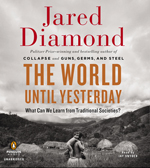
The World Until YesterdayThe World Until Yesterday: What Can We Learn from Traditional Societies?
By Jared Diamond; Read by Jay Snyder
Publisher: Penguin Audio
Published: 31 December 2012
ISBN: 9781611761474
[UNABRIDGED] 16 CDs – 19 hours

Themes: / humanity / community / society / history /

Publisher summary:

Most of us take for granted the features of our modern society, from air travel and telecommunications to literacy and obesity. Yet for nearly all of its six million years of existence, human society had none of these things. While the gulf that divides us from our primitive ancestors may seem unbridgeably wide, we can glimpse much of our former lifestyle in those largely traditional societies still or recently in existence. Societies like those of the New Guinea Highlanders remind us that it was only yesterday—in evolutionary time—when everything changed and that we moderns still possess bodies and social practices often better adapted to traditional than to modern conditions.

The World Until Yesterday provides a mesmerizing firsthand picture of the human past as it had been for millions of years—a past that has mostly vanished—and considers what the differences between that past and our present mean for our lives today.

This is Jared Diamond’s most personal book to date, as he draws extensively from his decades of field work in the Pacific islands, as well as evidence from Inuit, Amazonian Indians, Kalahari San people, and others. Diamond doesn’t romanticize traditional societies—after all, we are shocked by some of their practices—but he finds that their solutions to universal human problems such as child rearing, elder care, dispute resolution, risk, and physical fitness have much to teach us. A characteristically provocative, enlightening, and entertaining book, The World Until Yesterday will be essential and delightful reading.

The World Until Yesterday by Jared Diamond is at its heart a consciousness-raising book. It opens our eyes to the way we live, the ways we used to live, and what we now take for granted. The book covers many broad subjects, and although Jared Diamond had to condense each of them to fit them all into one book, there is enough detail to give readers a clearer perspective about what it means to be a human in a community, and there are plenty of great anecdotes too.

The audiobook narration is great. Jay Snyder comes across as personable and interested in what he’s talking about, so it’s easy to stay engaged all the way through. He helped to make the huge spectrum of ideas and information easy to absorb.

Each subject in the book is explored from the context of different societies, ranging from traditional small-scale societies to modern nation-state societies. The subjects covered include the sharing of territory and resources; managing disputes; the benefits and inherent harms of certain justice systems; how we maintain friendships; how we deal with strangers or enemies; how we treat our children and the elderly; what cultural blind-spots we have when it comes to dangers, diseases; varying ideas about nutrition; and how religion has evolved for different purposes in different cultures and eras.

The anecdotes from Jared Diamond’s many experiences living with traditional, small-scale societies range from scary to comical (although of course, we who live in the West are usually the comical ones). The story about the deranged, murdering “sorcerer” who roamed the New Guinea jungle at night gave me the chills. And I cracked up laughing at the story about the New Guinea tribe who could not believe the first white Europeans they ever saw were people and not spirits. The European explorers stayed with them and kept insisting they were just regular humans, but the tribe didn’t believe them until later, when they checked the explorers’ toilet. It had never occurred to me to wonder whether ghosts shit.

Jared Diamond does not romanticize traditional life: he explores what works and what doesn’t in all the different societies. While he is passionate about certain ideas (e.g. the hidden harms in certain child-rearing practices in the West, or the benefits of constructive paranoia), he also tries to remain objective and offers critics’ viewpoints too.

The World Until Yesterday is also a call to action because it not only shows what people in large modern cultures can learn from small traditional societies, it also explains how we might integrate the more beneficial practices into our personal lives (and simultaneously phase out some of the weirder ones).

Overall, this was a fascinating book with loads of insights into what it means to be human as viewed through the lens of other cultures. I think a lot of ideas from this book will stay with me for a long time, and I’m sure I’ll listen to this again at different times of my life when I want a clearer perspective on my community, culture, or even my own behavior as an individual.

Review by Marissa van Uden.

Commentary: Annotating Ward Shelley’s A History Of Science Fiction

SFFaudio Commentary

I love looking at Ward Shelley’s The History Of Science Fiction. It really inspires me.

I’ve, for my own amusement, done a little annotating, adding little thumbtacks noting every podcast READALONG we’ve done. But I’ve only put on the ones that are explicitly named on the chart. So, for example, even though we’ve talked about Tarzan Of The Apes I haven’t noted it because the chart only lists “Tarzan.” Similarly, we’ve done a podcast about A Princess Of Mars but as the chart only reads “John Carter” I haven’t made a notation.

But still and all, I find it fun to look at. And looking at it, it makes me want to add more!

You can click through to see more detail.

SFFaudio Podcast Episodes Noted

Posted by Jesse Willis

BBCR4 + RA.cc: The Viking Way

SFFaudio Online Audio

BBC Radio 4RadioArchives.ccFirst broadcast on BBC Radio 4, in November 2005, The Viking Way is David Aaronovitch‘s three part presentation exploring the world of the Vikings. The documentary is now available via RadioArchive.cc, the great public radio torrent site, HERE.

Part 1 – Ruling The Waves
This programme looks at who the Vikings were, where they came from, their social strata, their home life and why they were called Vikings.

It also examines their carpentry and boat-building skills: Norse craftsmen had a very sophisticated understanding of how to get the best out of wood, and used this knowledge in constructing their houses and ships.

In all nautical matters, Vikings were vastly superior to their contemporaries. Their navigational abilities alone are still being debated by historians and archaeologists: for how did they manage to navigate when out of sight of land?

Had they developed some kind of compass – and if not, what other methods did they use when travelling back and forth between places as far away as Iceland, Norway, and Greenland?

What were their fabled longships really like, and what was the effect of their appearance upon those the Vikings attacked?

…and did Viking warriors really wear those horned helmets?

Part 2 – A Danelaw Day
This programme explores what happened when the Vikings started attacking Anglo-Saxon communities in Britain .

Anglo-Saxon Britain was not a unified state – but it was a wealthy land, and much of that wealth was gathered in the monasteries. It had been gained largely by peaceful trade, but when the Vikings – or “north men” as they tended to be called – turned to raiding rather than trading, the various rival Anglo-Saxon kings found they had a common enemy.

Or did they? Our knowledge of the period is mostly due to the Anglo-Saxon Chronicles, written by the very people who were on the receiving end of that Viking approach to “free enterprise”. In addition, there are several different manuscript versions of the Anglo-Saxon Chronicles, written at different times and in different monasteries – and they don’t all tell the same story.
And what was life like under Norse domination? For those Anglo-Saxons who found themselves living in Danelaw – the area to the east of Britain ruled by the Danes – in what ways did their existence change? Would those at the bottom of the social scale have been better or worse off? Would they indeed have noticed much difference?

Part 3 – Inform, Educate And Entertain

After a hard day’s pillaging and plunder, what did a Viking do to relax?

Not surprisingly, alcohol featured a lot in their social activities – and picking a fight with a rival whilst emptying the goblets, was a commonplace occurrence. However, these were not just drunken brawls – for Norse society had a great love of poetry, and Viking warriors were practised at Insult-Poems: challenging eachother to aggressive poetic contests, each stanza followed by yet another drink…

The competitive element also emerged in a love of board-games, which have been described in such detail in Norse Sagas, that historians have a clear idea of the rules and stratagems used to play them.

However, Norse society’s chief creative contribution to the world, is the Saga. These secular narratives were filled with drama, action and adventure – and were as gripping for their audience as soaps are today. Not only did they provide massive entertainment, but they also demonstrated the Viking moral code: of bravery and loyalty, honour and vengeance, and the importance of kith and kin…

Posted by Jesse Willis