Review of Infected by Scott Sigler

SFFaudio Review

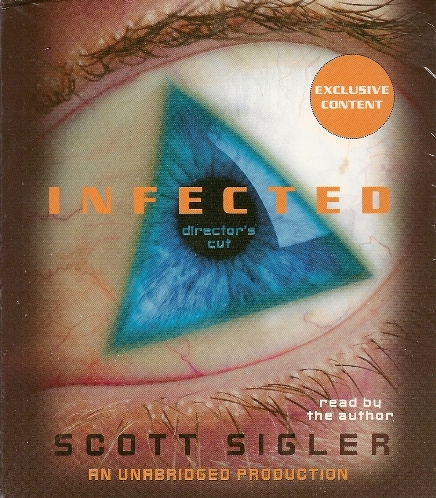
Infected by Scott SiglerInfected
By Scott Sigler; Read by Scott Sigler
9 CDs – 12 hours – [UNABRIDGED]
Publisher: Random House Audio
Published: 2008
ISBN: 9780739328859
Themes: / Horror / Science Fiction / Mystery / Bio Chemical / Self Mutilation / Scott Sigler / Podcast

Maybe you’ve been away on vacation. Maybe you’re new here. Maybe you fell asleep 100 years ago and you’re just waking up. Maybe you’ve been locked inside your house with a pair of chicken scissors. Who knows? But, if you are a fan of audiobooks and audio fiction and DON’T know about Scott Sigler, you’ve been missing out.

So, for those of you who don’t know who Scott Sigler is, he started out as a rogue novelist that decided to record his own novels and distribute them for free, over the internet, as podcasts, to build an audience for his writing. And my, oh my how it has worked! Who would have ever thought that you could make money, or at least get yourself a big time publishing deal with a major company just by giving your stuff away for free? For those of you who, like me, have been following his rise, you’ll be happy to hear that our little Scott Sigler is all grown up now. He’s out of diapers and he’s using his “big boy” voice.

The basic premise of Infected is this: Some strange virus, disease, or biological weapon is turning normal people in to stark raving lunatics. This mysterious disease, whatever it is, causes its victim to become paranoid, psychotic, and just a little more than grumpy. There’s suspense, gore, disturbing self mutilation and of course, lots and lots of violence. But, as you may well know, adult themes and disturbing images only work if they are used to serve as a backdrop to great writing. Infected is most certainly well written and that’s why it is a good listening experience from beginning to end.

CIA operative Dew Phillips is burdened with the task of figuring out what this thing is and why it causes such behavior from its victims. Even with the help of CDC Epidemiologist Margaret Montoya, he does not know much about the disease. Because of its nature, all infected victims have been found dead. The investigation takes them from city to city, hoping to catch a live host.

Then there’s our “host” Perry Dawsey. He’s a gigantic former college football player, with a slight twinge towards problems of an anger management nature. He doesn’t know it yet, but he’s about to take you on a wonderful ride of beautifully written “gross”. Perry is a man who has struggled for years to control his anger and you begin to feel for him as you witness his downward spiral in to violence. You may find yourself fighting for Perry the perfectly crafted underdog. Normally you wouldn’t consider such a hugely athletic man as an “underdog”. But, in Infected, his strength is literally his weakness.

I first heard Infected in its original form as a free audio podcast. When I sat down to listen to this professionally produced and released unabridged recording, I thought I was about to take a trip in to a wonderfully relaxing nostalgia. But, I was wrong. From the first page, the book has been completely re-worked, tightened, tweaked, improved upon, and added to. Infected is as fit as a boxer getting ready to fight for the title belt and every page, chapter, and verse has a polished feel that resonates with the listener. There is also new material, previously unreleased, including twenty-two pages that you won’t even find in hardcover book.

For fans of Sigler’s podcast, you will be happy to hear that he narrated the entire book himself. It comes complete with elements that you don’t normally find in a big budget release, such as voices and a mild amount of sound effects that help the recording spring to life. Yet the entire thing feels like his podcast. I kept expecting him to come in and say, “That’s all the story I’ve got for you this week…” but he never did. Not until the end, almost twelve gruesome hours later.

The sound quality is very good. There are no flubs, exterior sounds, or flaws. It not only sounds good, but Scott Sigler has actually never sounded better. That’s a lot to be said for someone who jokingly claims to have been doing this perfectly for over eighteen years now.

I realized when I first pressed “play” on this audiobook that I had never actually listened to anything written by Scott Sigler in one extended sitting. I had been consuming his fiction, just like every other person out there, one week at a time, for just a few minutes at a time. I am happy to report that he is not like one of those annoying friends that you enjoy only in small doses. I started listening to Infected, and even though I already had a good idea of what the story and characters were going to be, I just kept listening all the way through to the end. The writing is solid and the plot twists and character arcs are all perfectly juxtaposed. You can never relax or let your guard down because there is something even worse coming to get you from just around the corner.

So, if you’re in to a little romantic comedy where all is well at the end and everyone loves each other, Infected is not for you. But, if you are looking for something that is page burningly well written with great characters, violence gore, a dash of self mutilation and some chicken scissors thrown in for good measure, definitely give Infected a shot. I’m sure Scott Sigler would thank you personally, but he’s locked in his closet right now recording his next great hit, which he is still giving away for free, every week. Well, almost every week. It isn’t exactly clockwork.

Posted by Michael Bekemeyer of the Scatterpod podcast.
The Dial P For Pulp podcast dials up the goodness

SFFaudio Online Audio

Dial P For PulpWith a mere six podcasts completed Dial P For Pulp has already proven itself as a reliable source for great pulpy fiction. The host, David Drage, talks about pulp magazines, pulp authors, pulp books, the pulp era and games inspired by pulp. Older shows include stories by H. Rider Haggard and Robert E. Howard, but it is the most recent show, another Howard tale, that interests us the most. It’s a short story taken for the Second Annual SFFaudio Challlenge!

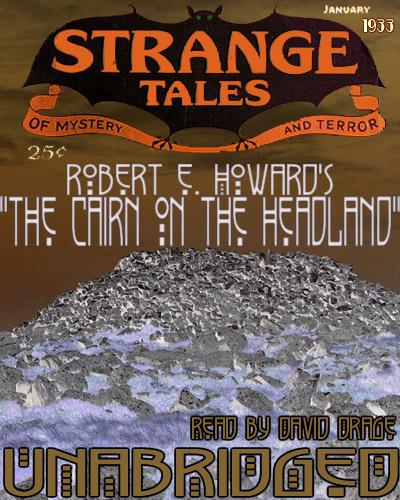
Fantasy / Horror Audiobook - The Cairn on the Headland by Robert E. HowardThe Cairn on the Headland
By Robert E. Howard; Read by David Drage
1 |MP3| – [UNABRIDGED]
Podcaster: Dial P For Pulp
Podcast: March 2008
What lies beneath the stone cairn on the headland of Clontarf, where the Christian Irish defeated the pagan Vikings in pitched battle a thousand years ago? An unscrupulous extortionist plans to uncover the secret. First published in the January 1933 issue of Strange Tales of Mystery And Terror magazine.

Set your podcatcher to pulp, and subscribe to the RSS feed:

http://dpfp.libsyn.com/rss/podcasts

Posted by Jesse Willis

BBC 7: Of Withered Apples by Philip K. Dick & Perelandra by C.S. Lewis

SFFaudio Online Audio

BBC Radio 7 - BBC7This weekend’s offerings on BBC Radio 7 include a Philip K. Dick short story that was first broadcast on BBC7 in September 2003. It was first printed in the July 1954 issue of Cosmos Science Fiction and Fantasy Magazine. And, in the middle of next week the 7th Dimension begins broadcasting the second novel in C.S. Lewis’ “Cosmic Trilogy.” Perelandra was first published in 1943. It makes an allegorical argument in the form of interplanetary adventure. Listeners familiar with the Narnia books will find a familiar morality play at work in Perelandra.

BBC Radio 7 - Of Withered Apples by Philip K. DickOf Withered Apples
By Philip K. Dick; Read by William Hootkins
1 Part – Approx. 30 Minutes [ABRIDGED?]
Broadcaster: BBC Radio 7 / The 7th Dimension
Broadcast: Sunday at 6.30pm and 12.30am
More horror than science-fiction – A young woman picks the last withered apple from an ancient tree. Although this ensures the tree’s survival, the cost is horrifically high.

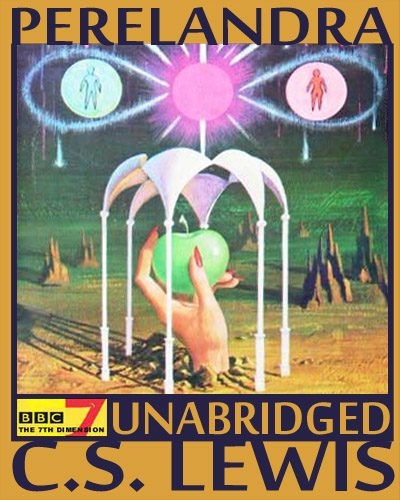
BBC 7 Perelandra by C.S. LewisPerelandra
By C.S. Lewis; Read by Alex Jennings
18 Parts – Approx. 9 Hours [UNABRIDGED]
Broadcaster: BBC Radio 7 / The 7th Dimension
Broadcast: Wednesday to Friday at 6.30pm and 12.30pm (continuing)
Perelandra continues the sometimes thrilling, sometimes mystical, but always sublimely evocative adventures of Dr.Ransom first explored in Out of the Silent Planet. In this second volume of C.S.Lewis’ acclaimed Cosmic Trilogy, Ransom is called to the beautiful paradise planet of Perelandra, or Venus, which is in grave peril from his old adversary Dr.Weston. Ransom encounters floating islands and bubble trees as well as an all-powerful female ruler, an Eve figure who undergoes temptation at the hands of a Satan figure in the form of Weston. Ransom must engage with Weston in a desperate struggle to save the purity of Perelandra.”

Each broadcast will be available via the “listen again” feature for a week after airing.

Posted by Jesse Willis

Frequency Of Fear podcast features CBC Radio Drama NIGHTFALL and more

SFFaudio Online Audio

Podcast - Zombie Astronaut's Frequency Of FearThe Zombie Astronaut‘s podcast Frequency Of Fear, tackles the doubly difficult problem of duplicates (doppelgängers or clones – if you will). Showcased on the show are stories about killers and killers, killing duplicates and trying to dupe the authorities about it. The second show is particularly cool as its an episode of CBC Radio’s 1980 series Nightfall. Entitled “The Repossession” it features Chris Wiggins (from Friday The Thirteenth – The Series) and other familiar CBC voices. It was first broadcast on September 26th, 1980.

Plug the podcast feed into your podcatcher, and listen twice:

http://frequencyoffear.com/podcasts-only/rss2.aspx

Posted by Jesse Willis

P.S. Free The Adventures Of Apocalypse Al

Commentary: Why History, Noir and pretty much anything else I like are really just Science Fiction

SFFaudio Commentary

Meta SFFaudioI live and breathe Science Fiction, but like many, I have some trouble defining what that term actually means. Sometimes I use Damon Knight’s definition for it… “Science Fiction is what I point to when I say it.” Sometimes I classify a story as a Fantasy even though it appears to be SF (think Star Wars), often this is because of its flagrant disregard for science. But Fantasy isn’t just the wastebasket under Science Fiction – far from it. I see Fantasy as a branch of SF (though I know other people see SF as a branch of Fantasy). If you visit the site often you also may notice I tend to capitalize the “S” and the “F” – it is even in our website logo – I insisted on that point. We had some debate, Scott and I, about whether the site should just be called SFaudio.com, I argued for the extra F, to represent Fantasy. Poor old Horror, always the ugly sister, was left out of the site name entirely. Sometimes therefore I use the “SF” abbreviation, the logic being, “SF,” other than it being shorter, can also stand for “Speculative Fiction” – which includes Horror (and Fantasy too).

Now, before you say, “Jesse, WTF are you capitalizing all these abstract nouns?” I’ll explain that too… I capitalize the Science Fiction the way many folks capitalize the “H” in “Him” when referring to God. And other than this one I don’t think you’ll find a single post in which I’ve personally abbreviated Science Fiction as “sci-fi.” On that issue, I’m with Harlan Ellison:

“…the hideous neologism ‘sci-fi’–which sounds like crickets fucking–is at the core of this seeming malaise. What is called ‘sci-fi’ is _not_, repeat NOT, science fiction. It is special effects movie/television produced by and for imbeciles. Giant lizards, moronic space battles with spaceships acting as if they were Spads and Fokkers dogfighting in atmosphere, recycled fairy tales, and illiterate appeals to paranoia. They bear as much relation to science fiction of quality (whether film or tv or books or magazines) as Dachau did to a health spa.”

Gotta love Harlan, he doesn’t mince words – he sautés them. But back to the matter at hand… the funny thing, despite my attempt at inclusivity I’ve got standards when it comes to what qualifies as what. SF is what I say it is, but I can’t just point to anything. So, for instance, we don’t talk about mainstream literature here. It isn’t that a lot of it isn’t good – as that’s also true about SF, Fantasy and Horror. The reason mainstream literature doesn’t get the mentioned here is that mostly, even when it is well written, a lot of it still really, really sucks. I mean that quite literally. It sucks. It sucks your time, it sucks your money and it doesn’t give you anything to show for it. Sure you’ve got a kind of satisfaction, some internal catharsis perhaps, but it doesn’t give you anything to challenge your beliefs. This month’s Oprah bestseller is little better than next month’s paperweight, except that a paperweight made of paper is already rather redundant. There’s a reason you’ll find some of these books in the supermarket check-out isle, it is because they are, like candy, something you pick up quite casually. And the fiction I read, and the fiction we tell you about, better not be that god-damned casual!

This all came to mind as I was listening to a non-SF podcast recently…

Philosophy Bites podcastPhilosophy Bites, is a podcast that interviews “top philosophers” in “bite-sized” segments. The hosts are: David Edmonds, a philosopher and writer whose day job is making radio documentaries for the BBC, and Nigel Warburton, another philosopher/writer who teaches and blogs about philosophy. They take their podcasts seriously. A recent guest, Alain de Botton, famous for his decidedly not SF, bestselling book The Consolations Of Philosophy brought up this very topic, turning the everyday experience (for our purposes, mainstream fiction) into matters of deep philosophy |MP3| subscribe to the podcast via this feed:

http://www.philosophybites.libsyn.com/rss

One alternative to mainstream literature about everyday experience is mainstream historical fiction. Sometimes I read or listen to a historical fiction novel (or should that be Historical Fiction) that I want to talk about on SFFaudio, but can’t because it doesn’t tie into SF, F or H. In cases of extreme delight though I can usually somehow stretch the boundaries of what I normally would consider proper SF to suit my purposes. A post about Crazy Dog Audio Theatre’s Infidel, which is based on true history, for instance, was saved by calling it Horror. The reasoning being that the Horror genre, includes the idea of “moral horror”, horror that comes not from fear for one’s bodily integrity, but fear for one’s beliefs, fear one’s values – the kind of fear you get when you watch true Film Noir, like Chinatown say.

I deem these kinds of tales eminently philosophical. Which ties back into Science Fiction, as SF is, when you get up close and personal to it quite actually Philosophical Fiction.

But then again, one really ought to just has to stick to one’s guns and exclude a lot of stuff too. Stuff like the Hardcore History podcast….

Dan Carlin’s Hardcore History podcastThe Hardcore History podcast, produced by Dan Carlin and his increasingly unlikely parter “Ben,” performs auditory miracles of storytelling using absolutely no fiction, or science at all. This is a pure History fan-boy show. There is no reasonable way that a blog about Science Fiction and Fantasy audio can mention this stunningly wonderful bi-monthly (or so) podcast with a straight face. At least not if it wants to pretend to be strictly topical blog. Subscribe via this feed:

http://www.dancarlin.com/dchh.xml

The only way one could post about Hardcore History and even pretend, with any honesty preserved, to be on-topic would be to compare it to an even less related program…

Entitled Opinions (about Life and Literature) podcastEntitled Opinions (which has just started it’s much anticipated fourth season) is a podcast radio program hosted by Professor Robert Harrison. Harrison teaches in the department of French and Italian and likely has never even read a Science Fiction novel in his life. Therefore I won’t ever mention his podcast here, except for one thing, EQ is a literary talk show that I like. Harrison interviews guests about issues that range from literature and philosophy to politics and sports. I have a feeling that one day, given infinite time, he might talk about SF.

To cap it all off, one feels absolutely flummoxed about a short story like….

To Build A Fire
By Jack London; Read by Betsie Bush
1 |MP3| – [UNABRIDGED]
A man and his husky, travel through the Klondike in seventy-five below zero weather (Fahrenheit).

This story came to mind after reading another website’s discussion of Tom Godwin’s The Cold Equations. The two tales are, essentially, the same ruthless story. That is, in terms of both tales’ focused intent to push naturalism upon the reader’s mind. Except that The Cold Equations is, by every conceivable imagining of the definition, at the very center of Science Fiction. The story has spaceships, planetary colonization, ballistic physics and is set in the future! That surely makes it SF. To Build A Fire has none of these things. It is set in the late 19th century Klondike, is contemporary to when it was written, and it doesn’t have any of the usual SF elements (tech, time travel, etc.). Without any fantastic elements at all can it be SF? Not SF then? Jack London isn’t often considered an SF writer. But, on the other hand it is fiction about science, and the consequences it truly has upon us. Fiction about science? Put another way, that must be SF!

Now, Naturalism as a literary movement, was just developing during the late nineteenth century (when London was writing). Its roots go back to ideas of scientific determinism and Darwin’s theory of evolution. Naturalism contended that human beings are determined by their heredity and the laws of nature and are thus controlled by their environment and their physical makeup rather than by than by appeals to spirituality or even to the power of human reason.

“Natural philosophy,” that’s what science used to be called back before it was called science.

It is my contention then, that “Science Fiction,” and all its relatives, Horror, Fantasy and Noir, (H, F, N) are quite literally philosophical fiction in disguise.

Of course, now it being as the case that I’ve shown in the above good reason as to why SF, and its related capitalized consonants, are all tied into philosophy we ought to forgive a little meta-post like this one, now and again eh?

Posted by Jesse Willis

UPDATE: Hey! Check out this audio interview with Thomas Hibbs (author of a new paperbook about Film Noir entitled Arts of Darkness: American Noir and the Quest for Redemption). In the interview Hibbs ties Noir and Horror together quite nicely.