News, Reviews, and Commentary on all forms of science fiction, fantasy, and horror audio. Audiobooks, audio drama, podcasts; we discuss all of it here. Mystery, crime, and noir audio are also fair game.
Earbud Theater is a new audio drama podcast (without a podcast feed that I can spot). Casey Wolfe, who pointed it out to me, calls them “podplays” – which is a new word but and one that fits fine.
The first episode to catch my attention is an adaptation of Neil Gaiman’s Shoggoth’s Old Peculiar!
Young American Ben Lassiter is touring the British coastline when he’s forced to take refuge from the rain at a pub in the town of… Innsmouth. Here he meets the peculiar Seth and Wilf who have something to teach Ben about life, Lovecraft, death and unspeakable horror. Adapted by Casey Wolfe and performed by Jake Borelli, Simon Verlaque, Rees Pugh and Joanne McCallin, please sit back and enjoy a pint of Shoggoth’s Old Peculiar.
I quite liked this 17 minute adaptation. It’s faithful to Gaiman’s original story and that’s always a good thing. But, I should point out the the MP3’s volume is too low – even wearing earbuds I had a hard time catching every bit of it.
I’ve created a PDF Page, that is a page full of printable PDFs. Most are short stories, most are in the public domain (in most places). There are more than fifty PDFs there. All ready for download and printing.
Now I’m afraid that most have no OCR. But on the other hand the files are unlocked and so you could OCR them yourself should you so desire.
It’s currently filed under out FEATURES page, but HERE‘s the direct link.
Please let me know if any of the files there don’t download.
Authors included:
Charles Beaumont, John Buchan, Ambrose Bierce, Ray Bradbury, Anthony Boucher, Emily Brontë, Lucy Clifford, John Collier, Philip K. Dick, Sir Arthur Conan Doyle, Laura Lee Hope, Robert E. Howard, W.W. Jacobs, Henry Kuttner, Jack London, H.P. Lovecraft, C.C MacApp, William Morrison, Fitz-James O’Brien, Edgar Pangborn, Edgar Allan Poe, Robert Sheckley, T.S. Stribling, Voltaire, H.G. Wells, and Manly Wade Welman.
Talked about on today’s show:
Not the Jonathan Davis of Korn, favourite audiobook narrators, Luke’s real job (juggling), how to become an audiobook narrator (or a professional juggler), acting, theatrical acting, voice over, New York, Testament by John Grisham, Brazil, Portuguese vs. Brazilian Portuguese, Gone For Soldiers by Jeff Shaara, long form narration, Snow Crash by Neal Stephenson, urban samurais and Aleutian assassins, binaural recording, The Shadow Of The Torturer by Gene Wolfe, The Windup Girl by Paolo Bacigalupi, London, Paris, Iowa City, Thailand, genetic engineering, Japan, accessory dogs, GMO food, graphic sex scenes in mid-juggle, Glamorama by Bret Easton Ellis, Zoolander, American Psycho, a 12 page sex scene, Star Wars, Genghis Khan And The Making Of The Modern World by Jack Weatherford, straight readings vs. impersonations, Yoda, Ewan McGregor, Liam Neeson, Luke re-edits Star Wars, alien languages, Calculating God by Robert J. Sawyer, When Gravity Fails by George Alec Effinger, Ian Mcdonald, North Africa, Egypt, Arab Spring, Bedouin, narration styles, straight narration vs. theatrical performance vs. cinematic narration, Michael Caine, scalpel vs. laser, Mike Resnick’s Starship series, voice based books, Star Trek, David Copperfield, Oliver Sacks, The Watchers by Jon Steele, Kirinyaga, The Scar by Sergey Dyachenko and Marina Dyachenko, Starship: Mutiny, Elinor Huntington, existential resonance, Harry Potter, conspiracy, dystopia, Ray Bradbury, Cool Air by H.P. Lovecraft, Starship: Rebel, no research, just fun, language, audiobooks as a collaboration between an author, a narrator and a listener, Walking Dead by Greg Rucka, espionage, comics, Neil Gaiman, Catch And Release by Lawrence Block, Hex Appeal, Jim Butcher, The Dresden Files, studio time, The Book Of The New Sun, “do your homework”, “suddenly revealed to be a Texan”, an Aleutian Rastafarian, Hiro Protagonist, Minding Tomorrow, revealing voices, American Gods, George Guidall, “the perfect audiobook experience”, Woden (aka Odin aka Mr. Wednesday), The Stand by Stephen King, reading with your ears, preferred narration styles, The Hundred Thousand Kingdoms by N.K. Jemisin, racism, Dune, Zoo City by Lauren Beukes, Johannesburg, South Africa, fantasy fiction shouldn’t have an American accent, Luke’s SFBRP review of The Scar, House Of Suns by Alastair Reynolds, an Arkansas accent, inner monologue vs. dialogue, the Sling Blade voice, Casaundra Freeman, audiobook narration is difficult, learning the characters over a series, George R.R. Martin, A.J. Hartley, Act Of Will, Will Power, working with authors, Cyteen by C.J. Cherryh, Book Of The Road, male and female narration, Gabra Zackman, Jonathan is the infodumper, Full Cast Audio, a one man show vs. theatrical collaboration, Scott Brick, Feyd-Rautha, a Jamaican brogue?, The Brief Wondrous Life of Oscar Wao, do you like computer games?, Max Payne 3, Tron, “that’s my neck fat”, Vladamir Lem, Armando Becker.
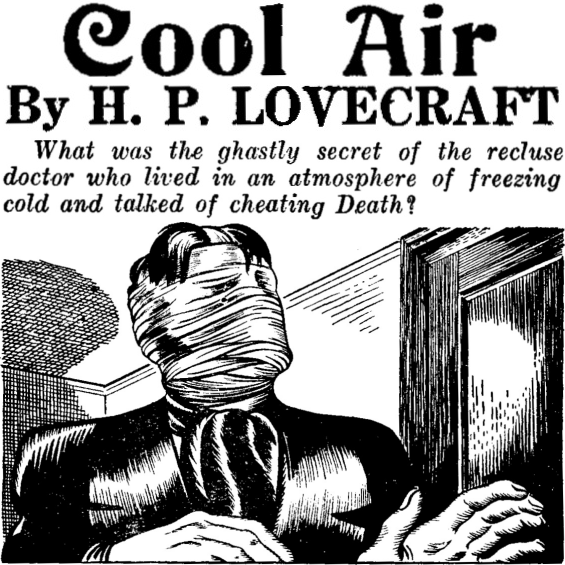
Here’s the subject of our next podcast recording, a specially commissioned reading of Cool Air by H.P. Lovecraft. The narrator is one of my very favourites, Jonathan Davis, who will be on the podcast discussing it with us!
The story itself runs 23 minutes. I think it’s the perfect balm for a hot summer day. Check it:
The unnamed protagonist, an underpaid writer of pulp magazines, lives in an oppressively hot New York city apartment. Luckily he makes friends with his convivial upstairs neighbor, who just so happens to own an air conditioner. What a cool guy!
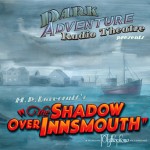
Dark Adventure Radio Theatre: H.P. Lovecraft’s The Shadow Over Innsmouth
Adapted from the novella by H.P. Lovecraft; Performed by a full cast
1 CD – Approx. 77 Minutes [AUDIO DRAMA]
Publisher: HPLHS
Published: October 27, 2009
Themes: / Horror / Cultists / Deep Ones / Cthulhu Mythos /
The final installment of a great series of faux Old Time Radio dramatisations of Lovecraft stories by the H.P. Lovecraft Historical Society’s very own Dark Adventure Radio Theatre is probably the easiest to convert in their point of view. By no means do I want to belittle their skill and effort but of all of Lovecrafts stories “Innsmouth”‘s dramaturgy comes easier to audio than, say, The Shadow out of Time [Review]. Bear in mind that Lovecraft was not exactly known for his use of action or suspense in the traditional sense, but this novella about a degenerated community on New England’s seaside features his attempt of a chase and narrow escape plus a final plot twist.
I assume that most readers will at least be vaguely familiar with the plot but for those who are not here’s a very brief overview.
A young man tours New England, more precisly the fictional area that became known as “Lovecraft Country”, in a search for antiques and his family’s history. He learns of the town of Innsmouth which used to be a prosperous fishing and trading port but which has long ago fallen into gloom and decay, shunned by outsiders and inhabited by secretive people on whom generations of inbreeding have not been kind.
Of course, he disregards all warning not to go there and buys a ticket for the bus to Innsmouth. Ahh, the carelessnes of youth!
Sure, he only wants to get a quick peek and then leave again with the evening bus. What he learns from his own observations and the only two people willing to talk to him – an outside shopkeeper and the town drunkard – is bad enough. All the churches of Innsmouth have either been abandoned or have been converted for use by the town’s sinister cult the Esoteric Order of Dagon. The cult that was brought to Innsmouth from the Pacific by one of its most prominent captains at a time when Innsmouth’s economy was failing. The new gods helped but at what terrible price our young protagonist is abuot to find out. Too bad that the bus that was supposed to bring him out of town in the evening has most inconveniently broken down leaves him stranded and cut-off in a town filled with people who are not entirely human anymore and even less keen on snooping outsiders than your usual run-of-the-mill hillbillies. Fortunately, there is a room available in the best (and only) hotel in town… and this is where the fun begins – our protagonist has to escape from Innsmouth.
But remember… you may take a man out of Innsmouth but can you take Innsmouth out of the man?
Find out more and watch <a title=” Shadow over Innsmouth Trailer” href=””>the trailer on Youtube.
There is not really much more to say about the last and thus far final installment of DART that is different from the previous ones. Although the crew does not produce audio dramas for a living they take this serious enough to be on par with most professional publishers, and indeed even better than some. Luckily they don’t take it so serious as to avoid the tongue-in-cheek humour which stands ol’ Lovecraft better than you might think.
The story has been dramatised well, music and sound design are great, the acting convincing and the feeling of an Old Time Radio show has been well preserved. The fact that DART have invented a visit from a government official to the protagonist (a fact actually mentioned in the original story) not only provides a convincing reason why the narrator keeps going on in the typical Lovecraftian monologues but also made it possible to tell the story’s ending a bit more dramatic than its literary predecessor.
Every DART show comes as both MP3 download and “enhanced” physical CD. The Shadow over Innsmouth is no different and the CD contains such props as a “real” match book (with one final match left) of the Gilman hotel, a handdrawn map of Insmouth, a fake newspaper clipping, and a postcard. A nice extra (and free for all) service is the downloadable script to read along.
To round off this the final audio drama the HPLHS offers a nicely designed box in the shape of a classic tube radio that holds all four currently available CDs.
The only thing that this leaves me wanting is more. I want more Dark Adventure Radio shows! Alas, the HPLHS has been awfully quiet on the audio front recently. One can only assume that their resources have been eaten up mainly by their film endeavours.
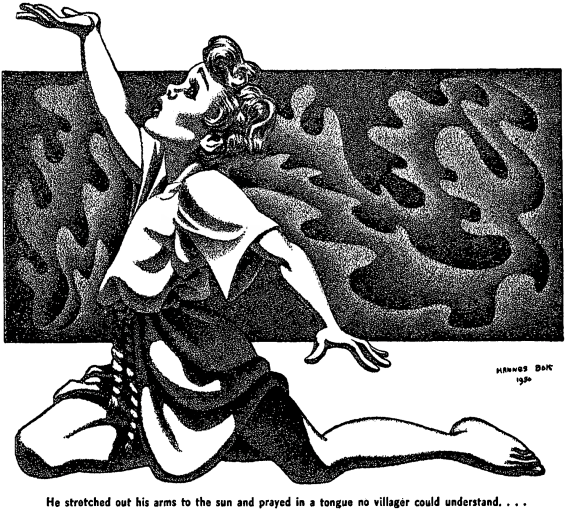
First published in Tryout, November 1920, The Cats Of Ulthar is an unusual tale by H.P. Lovecraft. It reads more like an old fashioned fairy tale than any other I’ve read. The story features a young boy named Menes who loves cats. Lovecraft probably took that name from the writings of a Greek historian named Diodorus Siculus who related a tale of a legendary Egyptian pharaoh named Menes that he heard from some crocodile-god priests. Menes it was said fled from his own dogs, who attacked him, while hinting. His escape was assisted by a crocodile. But no dogs or crocodiles are mentioned in The Cats Of Ulthar.
The Cats Of Ulthar
By H.P. Lovecraft; Read by James Pontolillo
1 |MP3| – Approx. 9 Minutes [UNABRIDGED]
Publisher: LibriVox.org
Published: October 19, 2008
|ETEXT|
First published in Tryout, November 1920.
And here’s a |PDF| made from the publication in Fantastic Novels, January 1951.


 Earbud Theater is a new audio drama podcast (without a podcast feed that I can spot). Casey Wolfe, who pointed it out to me, calls them “podplays” – which is a new word but and one that fits fine.
 I’ve created a


 The Cats Of Ulthar