News, Reviews, and Commentary on all forms of science fiction, fantasy, and horror audio. Audiobooks, audio drama, podcasts; we discuss all of it here. Mystery, crime, and noir audio are also fair game.
One of the finest Science Fiction audiobooks on LibriVox, the novel that was the subject of SFFaudio Podcast #056, here it is …. The Status Civilization by Robert Sheckley on YouTube.
A man awakes with amnesia. He is aboard a spaceship. He is a prisoner. He is gnorant of his crime and his name. His destination is the planet Omega. It is a prison planet from which there is no escape.
If you give it a five minutes, it’ll take you into the full five hours and you’ll know the truth of The Status Civilization!
Disappointed with the latest Conan movie? Yeah me too.
Here’s my response.
I’ve combined Gregg Margarite‘s narration of Robert E. Howard’s Red Nails with the original illustrations from its serialization in Weird Tales. It’s CONAN, it’s awesome storytelling, and it’s available in HD!
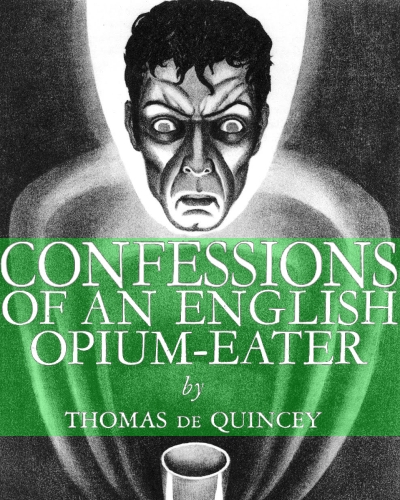
Mentioned in H.P. Lovecraft’s The Crawling Chaos, and discussed in SFFaudio Podcast #138, Confessions of an English Opium-Eater by Thomas de Quincey was first published in 1821.
Martin Geeson, the narrator, has written this intriguing mini essay about it for his LibriVox reading.
“Thou hast the keys of Paradise, O just, subtle, and mighty Opium!”
Though apparently presenting the reader with a collage of poignant memories, temporal digressions and random anecdotes, the Confessions is a work of immense sophistication and certainly one of the most impressive and influential of all autobiographies. The work is of great appeal to the contemporary reader, displaying a nervous (postmodern?) self-awareness, a spiralling obsession with the enigmas of its own composition and significance. De Quincey may be said to scrutinise his life, somewhat feverishly, in an effort to fix his own identity.
The title seems to promise a graphic exposure of horrors; these passages do not make up a large part of the whole. The circumstances of its hasty composition sets up the work as a lucrative piece of sensational journalism, albeit published in a more intellectually respectable organ – the London Magazine – than are today’s tawdry exercises in tabloid self-exposure. What makes the book technically remarkable is its use of a majestic neoclassical style applied to a very romantic species of confessional writing – self-reflexive but always reaching out to the Reader.
I’ve combined his narration with two different sets of illustrations and placed the resulting video on YouTube:
Confessions of an English Opium-Eater
By Thomas de Quincey; Read by Martin Geeson
1 |M4B|, 16 Zipped MP3s or Podcast – Approx. 5 Hours 22 Minutes [UNABRIDGED]
Publisher: LibriVox.org
Published: October 16, 2009
First published in September and October 1821 issues of London Magazine.
The Metamorphosis (in German, Die Verwandlung, “The Transformation”) is a novella by Franz Kafka, first published in 1915, and arguably the most famous of his works along with the longer works The Trial and The Castle. The story begins with a traveling salesman, Gregor Samsa, waking to find himself transformed into a giant “monstrous vermin”.
This narration by David Barnes is really terrific! One reviewer put it this way: “Slow, dignified, fitting for Kafka.” Another this way:
“A wonderful recording … Many thanks to Mr Barnes for his wonderful reading … [a] nightmarish and chilling tale of horror and abandonment. It is one of the most powerful texts written by Kafka and quite worth listening to.”
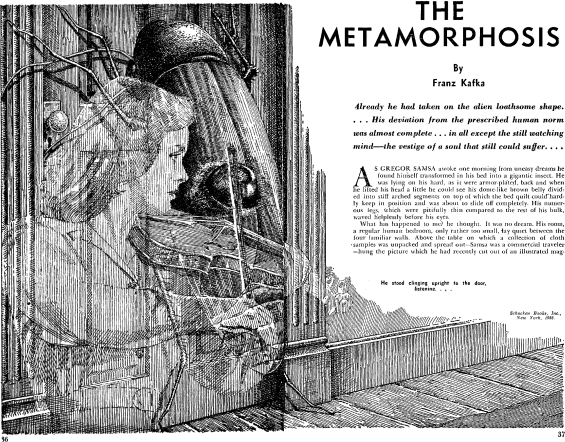
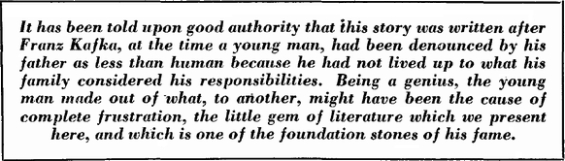
Here are the illustrations, and a brief editorial, from the June 1953 publication of Famous Fantastic Mysteries.
The Metamorphosis
By Franz Kafka; Translated by Ian Johnston; Read by David Barnes 3 Zipped MP3 Files or M4B – Approx. 2 Hours 34 Minutes [UNABRIDGED]
Publisher: LibriVox.org
Published: December 11, 2006
|ETEXT| “Already he had taken the alien loathesome shape … In all except the still watching mind – the vestige of a soul that still could suffer…”
Lo! ’tis a gala night
Within the lonesome latter years!
An angel throng, bewinged, bedight
In veils, and drowned in tears,
Sit in a theatre, to see
A play of hopes and fears,
While the orchestra breathes fitfully
The music of the spheres.
Mimes, in the form of God on high,
Mutter and mumble low,
And hither and thither fly-
Mere puppets they, who come and go
At bidding of vast formless things
That shift the scenery to and fro,
Flapping from out their Condor wings
Invisible Woe!
That motley drama- oh, be sure
It shall not be forgot!
With its Phantom chased for evermore,
By a crowd that seize it not,
Through a circle that ever returneth in
To the self-same spot,
And much of Madness, and more of Sin,
And Horror the soul of the plot.
But see, amid the mimic rout
A crawling shape intrude!
A blood-red thing that writhes from out
The scenic solitude!
It writhes!- it writhes!- with mortal pangs
The mimes become its food,
And seraphs sob at vermin fangs
In human gore imbued.
Out- out are the lights- out all!
And, over each quivering form,
The curtain, a funeral pall,
Comes down with the rush of a storm,
While the angels, all pallid and wan,
Uprising, unveiling, affirm
That the play is the tragedy, “Man,”
And its hero the Conqueror Worm.




 The Metamorphosis