News, Reviews, and Commentary on all forms of science fiction, fantasy, and horror audio. Audiobooks, audio drama, podcasts; we discuss all of it here. Mystery, crime, and noir audio are also fair game.
William H. Patterson, Jr., author of Robert A. Heinlein: In Dialogue With His Century a new biography of Robert A. Heinlein, is the speaker in this Cato Institute video from 2010. Here’s the official description:
Robert A. Heinlein is regarded by many as the greatest science fiction writer of the 20th century. He is the author of more than 30 novels, including Starship Troopers, Stranger in a Strange Land, and the libertarian classic The Moon Is a Harsh Mistress. According to biographer William H. Patterson Jr., Heinlein’s writings “galvanized not one, but four social movements of his century: science fiction and its stepchild, the policy think tank; the counterculture; the libertarian movement; and the commercial space movement.” This authorized biography, reviewed enthusiastically by Michael Dirda in the Washington Post, is the first of two volumes, covering Heinlein’s early ambition to become an admiral, his left-wing politics, and his first novels. Heinlein later became strongly libertarian.
The speech itself is short, and isn’t particularity exciting, but Patterson gives some very detailed and interesting answers to audience questions. Some are about the connections between Ayn Rand and Robert A. Heinlein, the philosophy of Heinlein, socialism in the U.S.A., and Heinlein’s mysticism.
But one question asked, about how to rebuff arguments that Heinlein’s ‘Starship Troopers is fascist’, has Patterson point to the compulsory military service in Switzerland. He equates it with being a part of Swiss citizenship. However, military service is only compulsory for Swiss men. In South Korea, where the threat of war is much more pressing, compulsory military service works the same way – only men are compelled. In fact compulsory military service works, and has worked, that way just about everywhere – including in Nazi Germany and Fascist Italy. A much better example of equating military service with citizenship would be Israel, where compulsory military service includes both men and women – and there aren’t very many exemptions. Problem is, this isn’t what the book, or the movie, has. Heinlein has voting rights for veterans – soldiers can’t vote and anybody who doesn’t join the military can’t vote. That’s not fascism. I don’t know what it’s called but it is not fascism.
Worthy of FIVE EXCLAMATION POINTS!!!!! Here’s the trailer for The Delivery (the only movie ever made about audiobooks):
And here’s the description:
“Reading is boring; and audiobooks are worse!”
That’s what Celia thinks. Celia loves to dance, hates to read. She has a book report due on Monday; if she does not deliver, she doesn’t get to be in the Spring Dance Recital. In an effort to secure a pre-written paper, she takes on a delivery to a local audiobook studio.
Simple, no? Not really.
Her delivery catapults her into a journey through a warren of studios which are inhabited by temperamental actors, ghostly apparitions and overtaxed producers. Upon reaching the final studio, her imagination tumbles her headlong into an full blown 1830 enactment of Lewis Carroll’s Mad Tea Party.
Through her wondrous adventure, Celia learns that listening to audiobooks will help her “deliver” her assignment, and open up a whole new part of her imagination!
A short film written and directed by Gabrielle de Cuir. Produced by Stefan Rudnicki
Stars:
Harlan Ellison
John Rubinstein
Orson Scott Card
Sir Michael York
Efrem Zimbalist, Jr.
Stephanie Zimbalist
Scott Brick
Emily Janice Card
One of the blogs I follow is FiveBooks, a segment of The Browser: Writing Worth Reading. The site features a daily interview of a renowned authority, invited to discuss his or her area of expertise and provide his or her choice of the best five books to read on that topic. It ranges from fiction to non-fiction, across all genres and subject matters. I like having it in my Google reader because I can just skip the topics that don’t interest me, while those that do have added to my to-read list exponentially.
Recently, Orson Scott Card was given this opportunity. He chose five books that will get readers hooked on science fiction, even if they are new to the genre. Card also briefly discusses the development of the genre itself. Check it out and tell me if these are the five you would have chosen. I thought it might be a slight cop-out to choose two anthologies as two of his five selections, except I keep hearing about one of them as a volume that drew science fiction fans into the genre as children.
Luke Burrage’s Science Fiction Book Review Podcast has another episode out (#135) titled Total Recall by Gordon Bell. But it’s not a Science Fiction book and he doesn’t really review it as much as discuss it and the topic of futurism with Tamahome and me.
Here’s what we talked about: Science Fantastic with Michio Kaku podcast, Jesse doesn’t like Michio Kaku, “anybody who does futurism is a bullshit artist”, the future will be different from the past, Total Recall by Gordon Bell, “get your ass to Mars”, Triangulation podcast #17, Leo Laporte, “internet famous”, pioneers of the internet, oral history, My Life Bits (a Microsoft research project), life journal, OCR (optical character recognition), body heat, respect level going up for Microsoft, Luke keeps everything, “is he weighing his shit as well?”, your life in 100 terabytes, “don’t bother reading the book”, maybe that’s why I hate futurism, it should have been a biography, “if you want good futurism that isn’t going to be proved wrong in ten years…”, Science Fiction is about the human condition, futurism is technology in isolation, Luke just wants to have a conversation with Gordon Bell, the European Juggling convention, your sister’s wedding, proposing on Skype, a successful marriage of convenience, Skype text chat logs go way back, Skype crash!, saving every email that you receive, presumable AIs, “That was fast”, “you better be careful what you say to Luke”, “in ten years time…”, Luke lives publicly and openly on the internet, how many people have an hour long discussion of every book they’ve read this year?, the benefits of living life on the internet openly, extracting entertainment value, “this is terrible”, Robert J. Sawyer‘s Hominids was a Hugo award winning novel, Startide Rising (Jesse hates it), Connie Willis just won the Hugo, “this is a horrible novel”, Connie Willis is good at getting Hugos, she needs an editor, A Good Story Is Hard To Find podcast, Luke was expecting more than crass futurism, “where the fuck did you pull that number from? was it from your ass”, Fu Manchu, Sunshine is a piece of shit (and not Science Fiction), Moore’s Law, “in ten years time”, William Gibson’s “the future is here it just isn’t evenly distributed yet”, bunk, it’s not falsifiable, SFsignal.com, Tam’s expurgated comment, Real Time with Bill Maher, the guy knows less about nuclear physics than I do (based on what he said on the show), burn that whole nuclear site, Chernobyl, Bikini Atoll (actually it was Enewetak Atoll – specifically Runit Island), Google Maps, the hydrogen bomb, Neil deGrasse Tyson is a lot better, the Hayden Planetarium, “when he talks I get more facts (and he doesn’t do futurism)”, string theory, Jesse doesn’t like Michio Kaku, Luke doesn’t like podcasts that run more than an hour, “that’s a whole separate podcast”, a nerdy internet guy, pocket protectors (are awesome) (see?), a condom for you pocket (they are handy), Revenge Of The Nerds, geek vs. nerd, the Functional Nerds podcast, Patrick Hester, Geek Nights podcast, nerding vs, geeking, “I don’t have nerdgasms”, hot rodding your computer, history geeks, enthusiasts, professionals vs. nerds, Star Trek nerds, they misunderstood Scotty’s origin, red matter is nothing, Star Trek movie made Luke cry, i09, “the top 10 suicide missions in SF”, ramming speed, WWII, “submarmine”, ram the “submarmine”, the Titanic, in 38 years everyone will be ramming other ships, health and safety, 1919, “I can’t believe the way this conference is going…”, futurism works in a story, the internet vs. cyberspace, Snow Crash, the blogsphere (discussion boards) were predicted (?) by Orson Scott Card in Ender’s Game, The Huffington Post, Luke really has to go now.
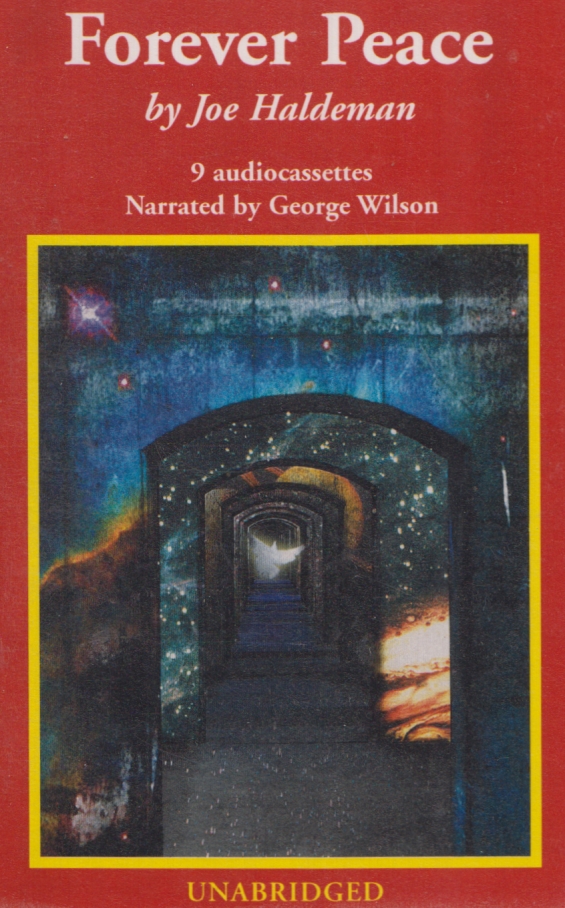
The SFFaudio Podcast #121 – Scott, Jesse, Tamahome and Gregg Margarite talk about Joe Haldeman’s novel Forever Peace.
Talked about on today’s show: The Forever War, Forever Peace, Forever Free, Haldeman’s experiences in South-East Asia (during the Vietnam War), William Mandella, Mandala, Julian Class, Philip Klass (William Tenn), racism, remotely controlled soldier robots, jacks, empathy, sharing menstruation, baldness as a fashion, the nanoforge (a molecular nanotechnology), caper, Stranger In A Stranger Land, heist, “two novellas smushed together”, John W. Campbell, Ben Bova, self help groups, one conceit that remains unexamined, magic machine (aka a sub-atomic replicator), Mack Reynolds, telepathy, asymmetric warfare, prescience, Libya, Pakistan, the two peaces of Forever Peace, what of the aftermath?, applying Isaac Asimov’s Three Laws of Robotics to people, Gregg is a creature capable of killing, not everyone wants to be the black sheep, is 98% of humanity humanizable?, the earth where everyone is gay, the earth where everyone is a clone, “a giant of SF”, The Memory Of Earth by Orson Scott Card, The Moon Is A Harsh Mistress, do you grok the group?, “The Hammer of God”, Jonestown, David Koresh, a religion that requires you believe in evolution, punctuated equilibrium, treating the bible like a science book (is problematic), we’re gonna drill into you brain and then you won’t have those feelings anymore, a utopian dystopia, Malthusian theory, the singularity, A Clockwork Orange, moral conviction vs. physical restriction, Gregg needs his murderer (and we do too), Starship Troopers, false consciousness, Women’s Studies, The Tea Party,
“False consciousness is the Marxist thesis that material and institutional processes in capitalist society are misleading to the proletariat, and to other classes. These processes betray the true relations of forces between those classes, and the real state of affairs regarding the development of pre-socialist society”,
following orders (as false consciousness), Stockholm syndrome, identifying with your oppressor, why do people do things that are against their own interests?, Costa Rica, withholding technology vs. holding resources hostage, Plato’s cave, “from each according to his ability, to each according to his need”, is Jesse making an argument for absolute truth?, what is truth?, “one person’s murder is another person’s dinner”, “God exists or he doesn’t exist”, “assuming we agree on the definition of God”, “we have a bedrock of truth”, Aristotle’s law of non-contradiction, “we’re here and we’re invading your software”, our perception of reality changes, “how can it not always be this way?”, “it’s The Matrix“, Gregg can find reasonable doubt in his own existence, Cogito Ergo Sum (I think therefore I am), René Descartes, “I doubt therefore I am”, Tama has no take, good and bad vs. right and wrong, a mass of conflicting impulses (ambivalence), Heinlein’s militaristic thinking vs. Haldeman’s militaristic thinking, Heinlein’s Future History series, religious conversion, telepathy vs. total immersion, Jonathan Swift, “you can’t reasons someone out of something they weren’t reasoned into”, there are two tenets in Greggism, what you believe doesn’t has to be true, Alan Moore’s personal made-up religion, Scott isn’t a Catholic because of feeling alone, Joseph Campbell “everything is true”, “he was born with a plowshare”, magical thinking, “that’s true for you and that’s fine”, a religious wacko who wants to end the world seems like a tired villain, Source Code, Moon is fantastic (but Source Code is not), the Norwegian whack job, can’t we find another kind of religion, Carl von Clausewitz, The Operative from Serenity (played by Chiwetel Ejiofor), effective villains, Robert E. Lee, Adolph Hitler vs. Joseph Stalin vs. Mao Zedong, the Tehran Conference, “Uncle Joe”, Stalin’s ending was noir, Pandora’s Star by Peter F. Hamilton has a great (and dirty) villain, Orson Scott Card’s Buggers, Speaker For The Dead, Ender’s Game, zombies are like a force of nature, Heinleinian villains are not diabolical, the ultimate orbital platform, the English Empire, “besides we’re better than you”, why do English actors always play villains? American accents = movie stars, Vancouver is a science fiction ghetto, iambk audio, the proper pronunciation of “about” in Canada, shock vs. shark, accents are lazy ways of speaking, George Wilson (the narrator of Forever Peace), P.G. Wodehouse, Bertie and Jeeves, the secret language of (drunken) Cockneys, no stupid voices please (in audiobooks), if you hire Nicholson for you movie your movie is a Jack Nicholson movie, Gregg’s signature voice may lose him work, why does the narrative switch between first and third person throughout Forever Peace, Yes, Minister, Goodreads.com, senior civil servant (3rd person) vs. elected official (1st person), The Long Habit Of Living by Joe Haldeman, The Forever War is told in first person (right?)
Tucked into the bottom of the latest batch of audiobooks to hit my PO Box there was a 16 page booklet featuring this month’s Blackstone Audio titles. So, with my expensive new scanner, I turned it into a PDF. Amongst other fascinating titles included in it (check page 12 for a biography of Lucrezia Borgia) you’ll find the much anticipated Brain Wave by Poul Anderson (read by Tom Weiner), an all-new Richard Matheson novel, and a collection of Orson Scott Card tales entitled Flux: Tales Of Human Futures. And, in addition to all the audiobooks, I am also reminded that Blackstone Audio has also been releasing NEW professional audio drama! In this month’s calatlogue there’s a new audio dramatization of The Mark Of Zorro (starring Val Kilmer) on the back page, and the third installment of The New Adventures Of Mickey Spillane’s Mike Hammer (Vol. 3) is in there too, and it of course stars Stacey Keach!