To Virgil Finlay… by H.P. Lovecraft (narrated by Wayne June)

SFFaudio Online Audio

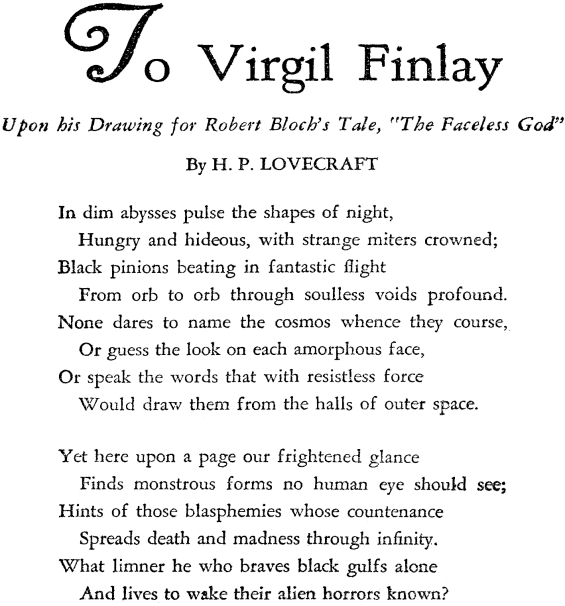
To Virgil Finlay by H.P. Lovecraft

I mentioned to Wayne June that I’d found the above poem in the July 1937 issue of Weird Tales. He hadn’t heard of it before. Then he went and narrated it for us!

|MP3|

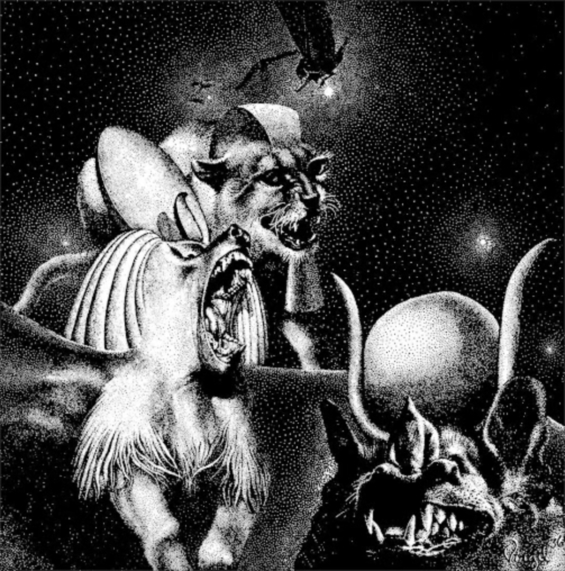
Written in a letter, dated November 30, 1937, it was sent from H.P. Lovecraft to Virgil Finlay. It was inspired by art drawn for a Robert Bloch story, published in the May 1936 issue of Weird Tales, and entitled The Faceless God. Here’s the illustration that inspired it:

The Faceless God - illustration by Virgil Finlay

Here’s at least part of the letter:

“I could easily scrawl a sonnet to one of your masterpieces if you weren’t too particular about quality. For example –

To Virgil Finlay Upon his Drawing Of Robert Bloch’s Tale “The Faceless God”
By H.P. LOVECRAFT

In dim abysses pulse the shapes of night,
Hungry and hideous, with strange miters crowned;
Black pinions beating in fantastic flight
From orb to orb through soulless voids profound.
None dares to name the cosmos whence they course,
Or guess the look on each amorphous face,
Or speak the words that with resistless force
Would draw them from the halls of outer space.

Yet here upon a page our frightened glance
Finds monstrous forms no human eye should see;
Hints of those blasphemies whose countenance
Spreads death and madness through infinity.
What limnner he who braves black gulfs alone
And lives to wake their alien horrors known?

Well well – quite in the Yuggoth tradition! I’ll have to keep a copy of this to try on one or another of the fan magazines!”

[Thanks Wayne!]

Posted by Jesse Willis

The Conqueror Worm by Edgar Allan Poe

SFFaudio Online Audio

The Conqueror Worm by Edgar Allan Poe

Here’s the LibriVox version |MP3| as ably read by Bob Gonzalez (from the Vintage Verse Rhapsody A Poetry Collection).

The Conqueror Worm
by Edgar Allan Poe

Lo! ’tis a gala night
Within the lonesome latter years!
An angel throng, bewinged, bedight
In veils, and drowned in tears,
Sit in a theatre, to see
A play of hopes and fears,
While the orchestra breathes fitfully
The music of the spheres.
Mimes, in the form of God on high,
Mutter and mumble low,
And hither and thither fly-
Mere puppets they, who come and go
At bidding of vast formless things
That shift the scenery to and fro,
Flapping from out their Condor wings
Invisible Woe!

That motley drama- oh, be sure
It shall not be forgot!
With its Phantom chased for evermore,
By a crowd that seize it not,
Through a circle that ever returneth in
To the self-same spot,
And much of Madness, and more of Sin,
And Horror the soul of the plot.

But see, amid the mimic rout
A crawling shape intrude!
A blood-red thing that writhes from out
The scenic solitude!
It writhes!- it writhes!- with mortal pangs
The mimes become its food,
And seraphs sob at vermin fangs
In human gore imbued.

Out- out are the lights- out all!
And, over each quivering form,
The curtain, a funeral pall,
Comes down with the rush of a storm,
While the angels, all pallid and wan,
Uprising, unveiling, affirm
That the play is the tragedy, “Man,”
And its hero the Conqueror Worm.

Posted by Jesse Willis

The SFFaudio Podcast #138 – AUDIOBOOK/READALONG: The Crawling Chaos by Winifred V. Jackson and H.P. Lovecraft

Podcast

The SFFaudio PodcastThe SFFaudio Podcast #138 – The Crawling Chaos by Winifred V. Jackson and H.P. Lovecraft, read by Wayne June. This is a complete and unabridged reading of the short story (21 Minutes) followed by a discussion of it (by Jesse, Tamahome, Jim Moon and Wayne June). Here’s the ETEXT.

“In The Crawling Chaos the narrator flees inland, taking his adjectives with him.” -L. Sprague de Camp (from Lovecraft: A Biography)

Talked about on today’s show:
Wayne June is still alive!, first impressions of The Crawling Chaos, Wikipedia’s plot summary of The Crawling Chaos, dream logic, an opium vision, the tripiness, the philosophy behind The Crawling Chaos, The Haunted Palace by Edgar Allan Poe, the self as a haunted palace, Poe is so 19th century, The Raven, The Fall Of The House Of Usher, entropy, there is no meaning in this uncaring universe, “and all the planets mourned”, you’d need a lot of Prozac (or opium) to go through a life like that, the catharsis of apocalypse, a cosmic apocalypse, the plot is a jumble of junk, the biblical echoes, “only the gods reside there” (in Teloe), a very old testament vibe, “lest you turn into a pillar of salt”, the protagonist is us (mankind), Lovecraft’s recurring themes, the ordinary man who swaps places with another, The Shadow Out Of Time, Polaris, Beyond The Wall Of Sleep, transcendental mind-swap stories, the story was a pseudonymous collaboration between Elizabeth Berkley (aka Winifred V. Jackson) and Louis Theobald, Jun. (aka H.P. Lovecraft), Nyarlathotep, “send me some money”, a lot of dross with a powerful effect, “the year of the plague”, the “oriel window” is an eyeball!, “calm down Howard”, “he’s in his own brain”, who or what is “the crawling chaos”?, the ocean pounding is his heart beating, “We’re all doomed!”, what is the crawling chaos?, S.T. Joshi, Rudyard Kipling, the peninsular beach house, Tiger Tiger (from The Jungle Book), The Tyger by William Blake, is the beautiful youth Mowgli?, who are “they”?, a fawn faced youth, Weena from H.G. Wells’ The Time Machine, did Winifred read The Time Machine before sleep?, what is the meaning of “Teloe”? is it teleology, reaching for meaning or purpose and losing it, Amber and Chalcedony, pleasure barges bound for blossomy Cytheron, Liquid Gold, Lord Dunsany, the heavenly host, the destruction of the physical (the corpse-like clay), black clouds like vultures, Supernatural Horror In Literature by H.P. Lovecraft, “the oldest and strongest emotion of mankind is fear”, City In The Sea by Edgar Allan Poe, opium addiction, why opium?, Confessions Of An English Opium-Eater by Thomas De Quincey, Charles Baudelaire, a waking dream, if the story was written in the 1960s…, LSD, morphine and Morpheus (dream), a waking dream, Aldous Huxley, Timothy Leary, The Doors Of Perception, out of Plato’s cave, Philip K. Dick, mindset and environment, mescaline, dreams vs. drug trips, journeys into the unconscious, Mouthpiece by Edward Wellen, decoding the death ravings of Dutch Schultz (HERE), William Burroughs, Robert Anton Wilson, “French Canadian Bean Soup”, stream of unconsciousness, Frances vs. French people, “swimming through New York”, The Librarian TV series, “perfectly ordinary strange adventures”, puns are big for the subconscious, Samuel R. Delany, Groucho Marx.

The Tyger by William Blake

The United Co-Operative, April 1921 - The Crawling Chaos

Posted by Jesse Willis

Lycidas by John Milton (poem read by Tom O’Bedlam)

SFFaudio News

Filled with a mournful o’er-brimming of incomprehensible beauty John Milton’s poem Lycidas likely inspired the titles of John Brunner’s The Sheep Look Up and Henry Kuttner and C.L. Moore’s Two-Handed Engine.

The complete text, with annotations, is available HERE.

[via Eighteenth Century Audio]

Posted by Jesse Willis

The SFFaudio Podcast #136 – READALONG: Neuromancer by William Gibson

Podcast

NEUROMANCER
The SFFaudio PodcastThe SFFaudio Podcast #136 – Jesse, Tamahome, Eric S. Rabkin, and Jenny talk about Neuromancer by William Gibson.

Talked about on today’s show:
What was really going on in 1984, the introduction to the audiobook, 3 MB of RAM, Commodore 64, Apple IIe, TI-99/4A, the 10 Year Anniversary Edition of Neuromancer, video arcade vs. arcade, Tank War Europa, Spy Hunter, Sinistar, BBC audio drama adaptation of Neuromancer, cyberpunk, Jenny couldn’t connect with Case the first time, Alfred Bester, the revolutionary effect of Neuromancer, “a very special book”, Mexico City, “an important novel”, Yevgeny Zamyatin’s We, The New Yorker’s parody of Neuromancer, the New Wave, “one great new idea per book”, Samuel “Chip” Delany, The Einstein Intersection, The Lovesong Of J. Alfred Prufrock by T.S. Eliot, “The sky above the port…”, Blade Runner, “time to murder and create”, Hesiod, “And he never saw Molly again.”, an untethered morality, the Rastafarian religion, WWI, virtual worlds, Second Life, Gibson’s intentions, Gravity’s Rainbow by Thomas Pynchon, conspiracy, The Crying Of Lot 49, William S. Burroughs, Naked Lunch, “the silent frequency of junk”, The Wonderful Wizard Of Oz, Dorothy’s shoes, L. Frank Baum, “the face of evil is the face of total need”, The Electric Kool-Aid Acid Test by Tom Wolfe, “slouching through the streets of Paris”, Case is a “man of decided inaction”, God was Adam’s employer, Dixie Flatline wants to die, Free Will, Eric felt for Case, 1980s, Watergate, a totemic fascination with color and material, branding, Pattern Recognition, the Sanyo spacesuit, Hosaka is a computer?, a dead channel would be blue (today), Ian Fleming, James Bond, Walther PPK, “elegance and cosmopolitanism”, John Brunner’s Stand On Zanzibar, Escape From New York, Johnny Mnemonic, the fear of what technology is going to bring, Case’s youth, detritus vs. kipple, Philip K. Dick, Martian Time-Slip, Galactic Pot-Healer, “you can’t prove that the United States exists” in Neuromancer, Case was a street-kid, Gibson has built something that has mythic power, the lame Braun robot, Molly -> Mother -> Mary, SSN vs. SIN, a Case study (pun), he has been assigned a SIN, Oedipus, they function as if they were physical, Case: “You know you repeat yourself man.” Dixie: “Yeah, it’s my nature.”, the Sprawl trilogy and “when it changed”, when is Neuromancer set?, “a rich kid’s hideout”, real kipple vs. fake kipple, “built by carpenters to look rustic”, 18th century fake ruins, Versailles (and the Hameau de la reine), the Tessier-Ashpool are fucked up, Mona Lisa Overdrive, cloning, Count Zero, “they dumped themselves into this matrix”, communication technologies begin with porn, A Chorus Line, SimStim gets short shrift in Neuromancer, Strange Days, Molly’s meat-puppet memories, 1-900 numbers, the lotus eaters, Circe, the Sirens song, The Lion of Comarre by Arthur C. Clarke, the heisters are motivated or moved by their A.I. puppet-master, Case’s motivation, Molly’s motivation, Corto/Armitage’s motivation, like Rabbit in Vernor Vinge’s Rainbow’s End, these characters want to believe in their own free will, Neuromancer‘s motivation, “who’s the bad guy in this book?”, “who isn’t?”, the shuriken is the only moral totem in the book, dystopia vs. dystopic, “the wavelength of amphetamine”, spit instead of cry, Jenny is kind of cheating (because she’s read the sequels), is Molly wrong for Case?, Eric questions the new pancreas, it’s Noir (because everyone smokes), Jo Walton’s review of Neuromancer (see the top and comment 59.), Jesse appreciates the world (and the great motivation of the plot), Eric likes Case (in part) because he’s the only one who doesn’t want to physically hurt anyone else, O’Neil colony, the fake French youths, Case is not Neo, The Matrix is a fairy tale with a prophecy whereas Neuromancer is Science Fiction, the Sprawl Trilogy vs. The Matrix Trilogy, Star Wars, “stuck in bullet time”, V: For Vendetta is a fantastic movie, Jenny thinks we should listen to the soundtrack to The Matrix, “the machine and the moment”, Tama thought the second half of Neuromancer dragged, Mary Shelley’s Frankenstein is also Necromancer‘s antecedent ,”what do we owe to what we create?”
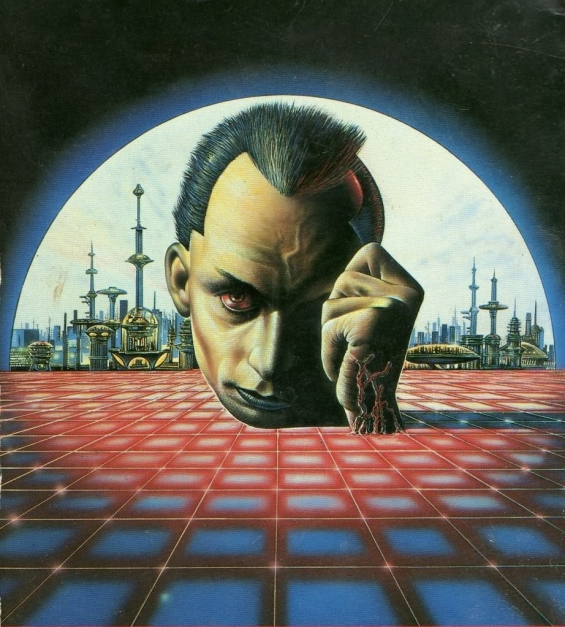

Neuromancer

Julian Assange has a copy of Neuromancer by William Gibson

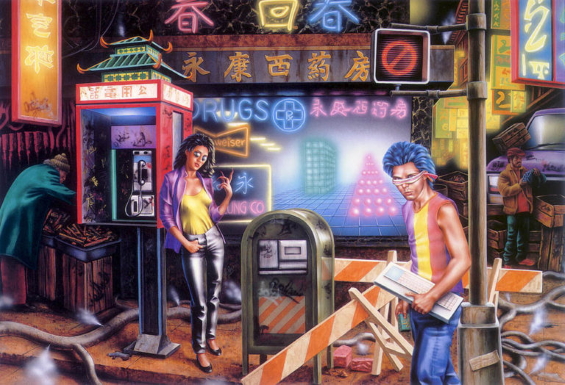
NEUROMANCER - illustration by Barclay Shaw

Posted by Jesse Willis