Review of On Basilisk Station by David Weber

SFFaudio Review

Ed. – Welcome to Paul [W] Campbell, prestidigitator with Cossmass Productions. This is his first review for SFFaudio.
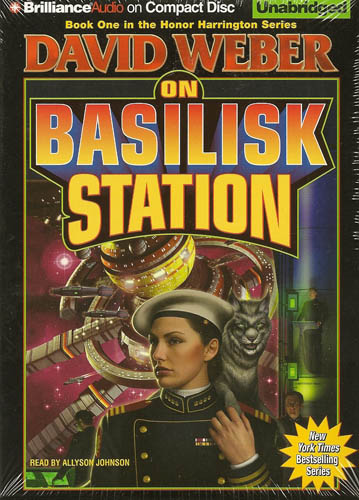
Science Fiction Audiobook - On Basilisk Station by David WeberOn Basilisk Station (Book One in the Honor Harrington Series)
By David Weber; Read by Allyson Johnson
15 Hours, 15 Minutes – [UNABRIDGED]
Publisher: Brilliance Audio
Published: 2009
ISBN: 9781423393382 (CD)
Themes: / Science Fiction / Military SF / War / Space Opera / Politics /

On Basilisk Station is the first of Weber’s Honor Harrington series. A great space opera that quickly builds up to a full out war between the Star Kingdom of Manticoran and her allies against the aggressive and expansionist Republic of Haven. So far there are eleven main novels in the series in print, plus over a half-dozen anthologies and spin-offs.

Mankind has spread out into the stars using a form of Hyperspace which offers the ability of sail along dangerous gravity waves at hundreds, even thousands, of times the speed of light. Some star systems are linked by wormhole termini that offer instantaneous travel between their end points. The benefit to interstellar trade and to fleet maneuvers that this offers is significant. Thus, Basilisk Station is the Royal Manticoran Navy’s picket at one such wormhole. In fact it is a collection of several wormholes that turn the star system of Basilisk into a major hub for commerce. Unfortunately the Republic of Haven’s economy is straining and they are looking at the worlds on the
far side of Basilisk as candidates to bolster their economy. Of course, having Basilisk Station under their control would make their annexation efforts and resultant ‘trade’ much simpler.

Commander Honor Harrington finds her aged and understrength ship being responsible for the entire picket On Basilisk Station. Her crew blame her for their posting to this punishment detail. Honor has been set up to fail. The Havenites are plotting to invade, the aboriginals on the planet below are taking homicide inducing drugs and her Executive Officer hates her.

As an opening volume in a series of this size, On Basilisk Station sets the initial pieces on the board for the following books and the war that develops. However, it doesn’t feel like that is what it is doing. The story is self contained and complete, as are all of the books in the series. Later books do benefit from reading the preceding ones, but it isn’t required. But, I’m not reviewing the series here. It can be a little heavy on the info-dumps at times, such as the history of the Founding of the Manticoran Nobility, Gravity Sails and a few others. Allyson Johnson gets through them well enough, but in audio they do interrupt the flow of the story. Otherwise she brings all the characters to life very well and covers quite a range, from Honor’s soprano all the way down to some gruff old sailors indeed.

Actually hearing Honor’s dialog in a soprano was quite jarring at first as I had read the books before and hadn’t properly assimilated that aspect of her character. Allyson stays truer to the characters and their voices than I had when reading myself. A good performance overall.

There was some slight confusion at times during the climactic battle as the point of view jumped from ship to ship. In print there would be a clear break in the text, but here the scenes flow together perhaps a little too quickly. They do resolves with a few seconds that there has been a scene change, but it still threw me a couple of times.

If you like your space opera with a well thought out political backdrop and with space battles that take into account the danger aboard ship and the scale of space, then On Basilisk Station should keep you happy.

Posted by Paul [W] Campbell
Review of Julian Comstock by Robert Charles Wilson

SFFaudio Review

Science Fiction Audiobook: Julian Comstock by Robert Charles WilsonJulian Comstock: A Story of the 22nd Century
By Robert Charles Wilson; Read by Scott Brick
21 Hours – [UNABRIDGED]
Publisher: Macmillan Audio
Published: 2009
Themes: / Science Fiction / Government / Aristocracy / History / Politics / Global Warming / Civilization / Theocracy /

The United States of America has changed. Global warming fears have come to pass, Christian groups have become a stronger part of the government (practically its own branch, called The Dominion), aristocracy has ascended because fewer and fewer have access to so much. The average citizen in this 22nd century view of the future have taken a step backward. The scientific past has retreated into myth, and superstition rules the day.

In short, Robert Charles Wilson has taken a particular view of what the United States is and has taken it to extremes in “if this should continue” science fiction tradition. The characters do not feel futuristic – instead they feel historical. Like Firefly in a way, the characters are straight from the 19th century. This creates a very interesting juxtaposition of time: A possible future that’s really a look at the present, but with characters that feel historical. Sci-Fi Wire quotes Wilson on this:

The past regarding the present from the future—that’s a literary effect only science fiction can achieve, and that’s what I was aiming for, a kind of simultaneous triple perspective. We think of the past as quaint and the present as mundane and the future as, well, futuristic—but so did our great-grandparents, and so will our great-grandchildren. ‘All times have been modern,’ as the French composer Nadia Boulanger said.

The novel is told by Adam Hazzard, a friend of Julian Comstock, who is aristocrat (the Comstock family has held the Presidency for years and years). Hazzard tells us right up front that he’s writing this biography of Comstock because Comstock has become a great man.

The first scenes have the two as young men looking through a pile of discarded books. They take what they can carry, but Comstock gives a specific book to Hazzard; a history of manned exploration of the Moon. Hazzard doesn’t believe such things actually happened, but accepts the book anyway, and wonders.

From there, Hazzard uses events like this one to show readers the life of Comstock, but everything is colored through Hazzard’s point of view. In a way, the book is like a Sherlock Holmes novel, but Wilson has created a much more interesting character in Hazzard than Doyle ever did with Watson.

Scott Brick takes full advantage of the Hazzard character, and does well with the 19th century sensibility of all the characters. This book has a whole lot of detail and a whole lot of lengthy conversation between the main characters about various subjects. Brick keeps it interesting, like he always does. We even get to hear him speak French when the characters spend time in Montreal.

This novel is rich and draws on a rich tradition. A Canticle for Leibowitz, The Postman, and Earth Abides all leap to mind, but this isn’t a homage or a retelling of those books. This is a story that looks at the present in a way that only science fiction can.

Posted by Scott D. Danielson

LibriVox: Short Science Fiction Collection Vol. 013

SFFaudio Online Audio

LibriVox Here’s another recent collection from the good people at LibriVox.org. I’ve made a few notes on just a few of these tales. Feel free to add your own as comments (we all should do more of that).

So here are those notes: My listening of Faithfully Yours was slightly distracted, but from what I heard it was a pretty good tale. I’m going to have to listen to it one more time to come to any final judgments about it. Unfortunately many mispronunciations mar Blair Buckland’s reading of The Invaders – but, the story still works – it would make a great tale to re-record. The Next Logical Step, by Ben Bova, is a very solid cold war piece that feels rather more modern than its 1962 vintage would normally suggest. It has an almost cyberpunk feel with its VR computer equipment – and the ending is absolutely rock solid. It has a great title too!

LibriVox - Short Science Fiction Collection Vol. 013Short Science Fiction Collection Vol. 013
By various; Read by various
10 Zipped MP3 Files or Podcast – Approx. 4 Hours 31 Minutes [UNABRIDGED]
Publisher: LibriVox.org
Published: April 24, 2009
Science fiction (abbreviated SF or sci-fi with varying punctuation and case) is a broad genre of fiction that often involves sociological and technical speculations based on current or future science or technology. This is a reader-selected collection of short stories, first published between 1951 – 1962, that entered the US public domain when their copyright was not renewed.

Podcast feed: http://librivox.org/bookfeeds/short-science-fiction-collection-vol-013.xml

iTunes 1-Click |SUBSCRIBE|

LibriVox - Faithfully Yours by Lou TabakowFaithfully Yours
By Lou Tabakow; Read Gregg Margarite
1 |MP3| – Approx. 40 Minutes [UNABRIDGED]
Publisher: LibriVox.org
Published: April 24, 2009
If it’s too impossibly difficult to track down and recapture an escaped criminal … there’s a worse thing one might do…
From “Astounding Science Fiction” December 1955.

LibriVox - The Golden Judge by Nathaniel GordonThe Golden Judge
By Nathaniel Gordon; Read by Hollis Hanover
1 |MP3| – Approx. 44 Minutes [UNABRIDGED]
Publisher: LibriVox.org
Published: April 24, 2009
A suggestion and a highly intriguing one–on how to settle the problems that involve face-saving among nations! From Astounding Science Fiction December 1955.

LibriVox - The Invaders by Benjamin FerrisThe Invaders
By Benjamin Ferris; Read by Blair Buckland
1 |MP3| – Approx. 34 Minutes [UNABRIDGED]
Publisher: LibriVox.org
Published: April 24, 2009
Magic—there’s no such thing. But the crops were beginning to grow backwards… From Weird Tales March 1951.


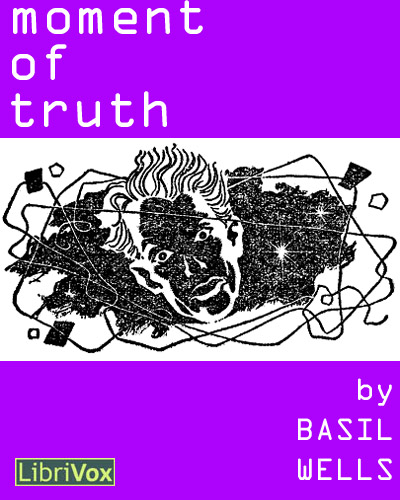
LibriVox - Moment Of Truth by Basil WellsMoment Of Truth
By Basil Wells; Read by Betsie Bush
1 |MP3| – Approx. 10 Minutes [UNABRIDGED]
Publisher: LibriVox.org
Published: April 24, 2009
“Basil Wells, who lives in Pennsylvania, has been doing research concerning life in the area during the period prior to and following the War of 1812. Here he turns to a different problem—the adjustment demanded of a pioneer woman, not in those days but Tomorrow—on Mars.” From Fantastic Universe December 1957.

LibriVox - The Next Logical Step by Ben BovaThe Next Logical Step
By Ben Bova; Read by Bill Ruhsam
1 |MP3| – Approx. 14 Minutes [UNABRIDGED]
Publisher: LibriVox.org
Published: April 24, 2009
Ordinarily the military least wants to have the others know the final details of their war plans. But, logically, there would be times— From Analog Science Fact & Fiction May 1962.

LibriVox - Pandemic by J.F. BonePandemic
By J.F. Bone; Read by Hollis Hanover
1 |MP3| – Approx. 45 Minutes [UNABRIDGED]
Publisher: LibriVox.org
Published: April 24, 2009
Generally, human beings don’t do totally useless things consistently and widely. So—maybe there is something to it—
From Analog Science Fact and Science Fiction February 1962.

LibriVox - The Perfectionists by Arnold CastleThe Perfectionists
By Arnold Castle; Read by Betsie Bush
1 |MP3| – Approx. 32 Minutes [UNABRIDGED]
Publisher: LibriVox.org
Published: April 24, 2009
Is there something wrong with you? Do you fail to fit in with your group? Nervous, anxious, ill-at-ease? Happy about it? Lucky you! From Amazing Science Fiction Stories January 1960.

LibriVox - Reluctant Genius by Henry SlesarReluctant Genius
By Henry Slesar; Read by Gregg Margarite
1 |MP3| – Approx. 6 Minutes [UNABRIDGED]
Publisher: LibriVox.org
Published: April 24, 2009
It is said that Life crawled up from the slime of the sea-bottoms and became Man because of inherent greatness bred into him before the dawn of time. But perhaps this urge was not as formless as we think. From Amazing Stories January 1957.

LibriVox - Tight Squeeze by Dean IngTight Squeeze
By Dean Ing; Read by Gregg Margarite
1 |MP3| – Approx. 35 Minutes [UNABRIDGED]
Publisher: LibriVox.org
Published: April 24, 2009
He knew the theory of repairing the gizmo all right. He had that nicely taped. But there was the little matter of threading a wire through a too-small hole while under zero-g, and working in a spacesuit! From Astounding Science Fiction February 1955.

LibriVox - We Didn't Do Anything Wrong, Hardly by Roger KuykendallWe Didn’t Do Anything Wrong, Hardly
By Roger Kuykendall; Read by Betsie Bush
1 |MP3| – Approx. 11 Minutes [UNABRIDGED]
Publisher: LibriVox.org
Published: April 24, 2009
After all—they only borrowed it a little while, just to fix it— From Astounding Science Fiction May 1959.


Posted by Jesse Willis

Review of Imager by L.E. Modesitt, Jr.

SFFaudio Review

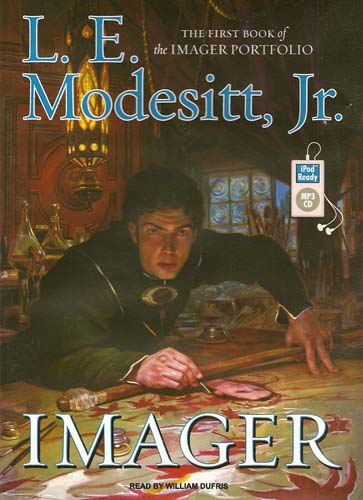
Fantasy Audiobook - Imager by L.E. Modesitt, Jr.Imager (The First Book of the Imager Portfolio)
By L.E. Modesitt, Jr.; Read by William Dufris
2 MP3-CDs – 18 hours – [UNABRIDGED]
Publisher: Tantor Media
Published: 2009
ISBN: 9781400161805
Themes: / Fantasy / Magic / Politics / Coming of Age / Economics /
| MP3 Audio Sample |

L.E. Modesitt, Jr. has published over 50 novels, both science fiction and fantasy. Imager, his latest novel, is the first time his work has appeared on audio.

Imager is the start of a new fantasy series called “The Imager Portfolio”. It’s the story of Rhenn, who at the beginning is an apprentice portrait painter. In a life-changing event, he realizes two things: First, he can no longer continue in his profession, and second, he is an “imager” – a person who can make things real by visualizing them in his mind. Imagers are not common, but common enough to be feared and respected in Modesitt’s world.

After this, the novel takes it’s time in following Rhenn grow into his new-found ability. He climbs the ladder as an imager taking various and interesting training that use his ability in unique ways. My first thought was not that an imager would make a good bodyguard, but imaging something into a person’s body makes for quick defense – or a potent offense.

William Dufris is wonderful as always. The novel is not quick paced, as if Modesitt is using this volume to firmly create the world for future volumes. Dufris is as engaged a narrator while relating the details as he is during the exciting bits. A pleasure to hear!

Tantor will be publishing the next two volumes of this trilogy, and I will be listening!

Posted by Scott D. Danielson

Review of Dune by Frank Herbert (Macmillan Audio)

SFFaudio Review

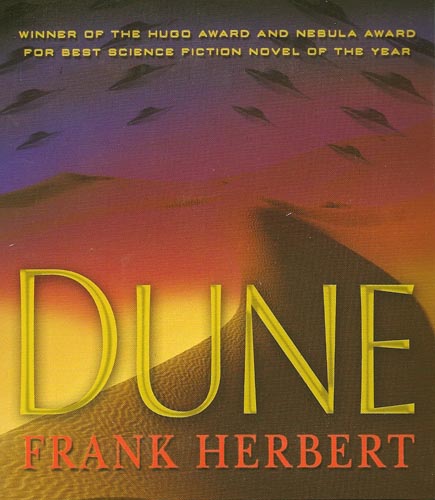
Science Fiction Audiobook - Dune by Frank HerbertSFFaudio EssentialDune
By Frank Herbert, Performed by Simon Vance
18 CDs – 22 hours – [UNABRIDGED]
Publisher: Macmillan Audio
Published: 2007
ISBN: 9781427201430
Themes: / Science Fiction / Politics / Space travel / Culture / Ecology /

Dune. Arrakis. Desert Planet.

I first read Dune when I was in college (late 1980’s), after a few false starts. I desperately wanted to read it, so I made it the only thing I took with me on a 30 hour bus ride from Tucson, Arizona to Idaho Falls, Idaho. It was a long trip. I smelled like cigarettes. But I got that book read, and loved it.

Years later, I reviewed an unabridged recording of Dune for SFFaudio that was read by George Guidall. Loved that one, too. Revisiting the book was a treat and Guidall is the Yoda of audiobook narration, so win-win.

Now, years after that, I’ve heard yet another unabridged version of Dune, this time a multi-voice presentation from Macmillan Audio. And again, I loved it. Frank Herbert’s novel remains one of the finest examples of world-building the genre has to offer. The political intrigue is delicious, the implied history deep and satisfying, and the characters smart.

Simon Vance is the main narrator. Each character’s dialogue is performed by actors, and skilled actors at that. I can’t find a list of the entire cast, but it includes Scott Brick, Katherine Kellgren, Orlagh Cassidy, and Euan Morton. I enjoyed it thoroughly. The actors were allowed to perform, and most of the time the attributives were dropped. Vance’s narration bridges the conversations, and the book is immersive and engaging.

I’m not certain why, but there are long passages that Simon Vance narrates himself. Vance is right up there with Guidall, so it’s an excellent reading. I’m just not certain why the audiobook wasn’t done with a full cast all they way through. I point this out as a curiosity rather than a flaw.

A few short years ago, if a person had asked me if I prefer a single narrator to a full cast recording, there wouldn’t have been any hesitation. Single narrator, definitely. But now, I’d have a difficult time choosing between a full cast narration and a single narrator, assuming the single narrator is good, the actors in the full cast narration are good, and – this is very important – the attributives in the full cast narration are dropped so I don’t have to hear the maddening “he said angrily” after an actor has made it quite clear that a character is angry. The problem is that most full cast narrations lean too far toward audio drama, adding too much sound and music. I love audio drama, but audio drama and audiobooks are very different experiences. Most productions that aim somewhere between the two fail in my opinion. Because of this leaning, there aren’t many full cast narrations I’ve enjoyed, but this production from Macmillan Audio and anything from Full Cast Audio are top-notch.

Despite my enjoyment of Dune, I have never read past it. I can’t explain why. I’ve owned a copies of Dune Messiah and Children of Dune for years, but have never read them. Brian Herbert and Kevin J. Anderson published a book called The Road to Dune (SFFaudio Review), which presented the history of the creation of the Dune books. In there it said that Frank Herbert intended Dune, Dune Messiah, and Children of Dune to be one story. It’s long past time I try more of these novels. Lucky for me, all six of Frank Herbert’s original books have been completed and released by Macmillan Audio, all as full cast productions.

 
On to Dune Messiah!

Posted by Scott D. Danielson

Review of Daemon by Daniel Suarez

SFFaudio Review

Daemon by Daniel SuarezDaemon
By Daniel Suarez; Read by  Jeff Gurner
Audible Download – approx. 16 hours [UNABRIDGED]
Publisher: Penguin Audiobooks
Published: 2009
Themes: / Science Fiction / Cyberpunk / Techno-Thriller / Virtual Reality / Online Gaming / Politics /

Daemon‘s success as a self-published novel that crossed over to attain mainstream success is a testament to its cultural relevance, especially among the technorati. Suarez, who moonlights (sunlights?) as a systems analyst, promoted the novel to the movers and shakers in the technology community, Its positive reception even among this tech-savvy elite suggests that Daemon has its finger on the pulse of technological developments and their implications for politics and culture.

Daemon opens with the death of game developer Matthew Sobol, acclaimed developer of multiplayer games such as first-person shooter Over the Rhine and RPG The Gate, which bears a strong resemblance to World Of Warcraft. Some successful entrepreneurs leave money to their kids when they die, others give it all away to charity. Not Sobol. His legacy is the book’s eponymous daemon, a background process which through distributed computing has spread itself across the net and continues to carry out the developer’s will through a series of intricate commands. The capabilities of this daemon, and Sobol’s talent as a developer of artificial intelligence, become apparent when the police raid Sobol’s mansion in Thousand Oaks, California, and find themselves outclassed by a network of elaborate automated booby-traps, including an almost-sentient Humvee.

The novel pans cinematically between several characters who, in one way or another, become embroiled in the daemon’s plot, which ultimately proves to be global in scale. Dramatis personae include police detectives, government agents, a gamer, a laid-off fashion reporter, a white-hat hacker, ad a convict. It’s not clear from the outset whether these characters will become heroes or villains as the story progresses, and even when battle lines are more firmly drawn most of them still defy simple caricature, exhibiting complex motives and emotions.

The real show-stopper, of course, is the daemon itself, who possesses a high degree of intelligence and resourcefulness despite residing in lines of code. The novel’s conceit still demands the willing suspension of disbelief, but the concept and the technical specifics are so finely conceived and executed that the reader is left with a small but nagging suspicion that somewhere, sometime in a future that may be all too near, Daemon could become a reality. Suarez achieves this feat by investigating the wider political, economic, and social implications of a self-aware autonomous computer system.

The living Matthew Sobol embedded many elements of his daemon into his multiplayer games, and several characters venture into these online worlds in search of clues. These scenes are among the strongest in the book, and they carry favorable resonances with both the Metaverse in Neal Stephenson’s Snow Crash and the simulator in Orson Scott Card’s Ender’s Game. Like the virtual reality elements in these novels, the online gaming sequences in Daemon succeed because they maintain a strong causal relationship to events in the “real” world.

The action battle sequences in Daemon are high-octane, and like all good action sequences they manage to incorporate the book’s themes rather than standing as mere set pieces. For the most part, the protagonists are fighting against computer-controlled contraptions. Nevertheless, I felt that these ultimately visceral and superficial scenes occupy too much space in the novel, and detract from the book’s otherwise deep and intellectually stimulating themes. Paramount Pictures has optioned the movie rights for Daemon, and I shudder to think that the cultural significance of this novel may be boiled away, leaving only two hours of car chases.

The pacing of Daemon also leaves something to be desired. Suarez has revealed that a sequel is in the works, and the book’s cliffhanger ending promises an exciting continuation to the story. Lots of loose ends also remain dangling free, mostly in the arc of character development. The novel’s ending was certainly climactic, but it somehow failed to provide satisfactory closure. As I’ve said in other reviews, even books in a multi-volume series need to retain a high level of internal cohesion.

Jef Gurner’s narration for Daemon is spot-on. His performance is varied enough that each character’s unique identity extends into the aural sphere. Through some tricks of distortion, Penguin Audio has turned the dialogue of the daemon itself into a performance worthy of classic cinematic computerized villains.

Fans of cyberpunk in particular should consider Daemon essential reading, but any science fiction fan looking for an intriguing and visionary techno-thriller should add this audiobook to their summer reading list. The novel’s fascinating themes make it worth slogging through some scenes of gratuitous violence and tugging in vein on a few loose plot threads. Daemon is an impressive debut novel by Daniel Suarez, hopefully presaging an illustrious writing career.

Posted by Seth Wilson